

Abstract
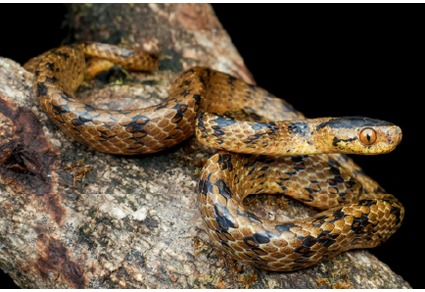
The Dulongjiang slug-eating snake Pareas dulongjiangensis was described based on a single preserved female specimen collected in Gongshan County, Nujiang Prefecture, Yunnan Province, China. Consequently, important aspects of its morphology, live coloration, sexual dimorphism, and geographic distribution have remained poorly understood. In this study, we report four additional specimens collected from Dulongjiang Township, Yunnan Province, China. Molecular phylogenetic analyses based on mitochondrial DNA confirm that these specimens cluster with P. dulongjiangensis, showing minimal genetic divergence from the type specimen (uncorrected p-distance of 0.0–0.9% in the Cyt b gene). The newly available material allow us to refine the diagnosis of the species, provide a broader redescription, and document intraspecific variation, including previously unknown male specimens and hemipenial morphology. We also present the first photographs of the species in life. Re-examination of a specimen from Hkakabo Razi National Park, Kachin State, northern Myanmar, previously referred to as Pareas sp. by Vogel et al. (2021), indicates that it represents P. dulongjiangensis, thereby extending the known distribution of the species to Myanmar. In addition, we clarify an important diagnostic character by demonstrating that the species possesses a single prefrontal scale, correcting earlier reports of paired prefrontals. Our results highlight the importance of adequate sampling in taxonomic studies, as reliance on a single specimen may lead to misinterpretation of intraspecific variation. Further integrative studies with broader sampling are required to better resolve morphological variation and species boundaries within the Pareas hamptoni species group.
References
- Akaike, H. (1973) Information theory and an extension of the maximum likelihood principle. In: Petrov, B.N. & Csáki, F. (Eds.), Second International Symposium on Information Theory, Tsahkadsor, Armenia, USSR. Akadémiai Kiadó, Budapest, pp. 267–281.
- Akaike, H. (1974) A new look at the statistical model identification. IEEE Transactions on Automatic Control, 19 (6), 716–723. https://doi.org/10.1109/TAC.1974.1100705
- Bhosale, H., Phansalkar, P., Sawant, M., Gowande, G., Patel, H. & Mirza, Z.A. (2020) A new species of snail-eating snakes of the genus Pareas Wagler, 1830 (Reptilia: Serpentes) from eastern Himalayas, India. European Journal of Taxonomy, 729 (1), 54–73. https://doi.org/10.5852/ejt.2020.729.1191
- Burbrink, F.T., Lawson, R. & Slowinski, J.B. (2000) Mitochondrial DNA phylogeography of the polytypic North American rat snake (Elaphe obsoleta): a critique of the subspecies concept. Evolution, 54 (6), 2107–2118. https://doi.org/10.1554/0014-3820(2000)054[2107:MDPOTP]2.0.CO;2
- Burland, T.G. (2000) DNASTAR’s Lasergene sequence analysis software. Methods in Molecular Biology, 132, 71–91. https://doi.org/10.1385/1-59259-192-2:71
- Darko, Y.A., Voss, O. & Uetz, P. (2022) A dictionary of abbreviations used in reptile descriptions. Zootaxa, 5219 (5), 421–432. https://doi.org/10.11646/zootaxa.5219.5.2
- Ding, L., Chen, Z.N., Suwannapoom, C., Nguyen, T.V., Poyarkov, N.A. & Vogel, G. (2020) A new species of the Pareas hamptoni complex (Squamata: Serpentes: Pareidae) from the Golden Triangle. Taprobanica, 9 (2), 174–193. https://doi.org/10.47605/tapro.v9i2.230
- Dowling, H.G. & Savage, J.M. (1960) A guide to the snake hemipenis: a survey of basic structure and systematic characteristics. Zoologica, 45 (2), 17–28. https://doi.org/10.5962/p.203350
- Dowling, H.G. (1951) A proposed method of expressing scale reductions in Snakes. Copeia, 2, 131–134. https://doi.org/10.2307/1437542
- Edgar, R.C. (2004) MUSCLE: Multiple sequence alignment with high accuracy and high throughput. Nucleic Acids Research, 32 (5), 1792–1797. https://doi.org/10.1093/nar/gkh340
- Figueroa, A., McKelvy, A.D., Grismer, L.L., Bell, C.D. & Lailvaux, S.P. (2016) A species-level phylogeny of extant snakes with description of a new colubrid subfamily and genus. PLoS ONE, 11 (9), e0161070. https://doi.org/10.1371/journal.pone.0161070
- Gong, Y.A., Wu, J.X., Huang, S., Xu, Y.H., Yang, D.C., Liu, Y.J., Liang, S.M. & Lee, P.X. (2023) A new species of Pareas (Squamata: Pareidae) from Guangxi Province, China. Animals, 13, 2233. https://doi.org/10.3390/ani13132233
- Guindon, S., Dufayard, J.F., Lefort, V., Anisimova, M., Hordijk, W. & Gascuel, O. (2010) New algorithms and methods to estimate maximum-likelihood phylogenies: assessing the performance of PhyML 3.0. Systematic Biology, 59 (3), 307–321. https://doi.org/10.1093/sysbio/syq010
- Guo, Y.H. (2023) Research progress on the systematics of the genus Pareas (Serpentes: Pareidae). Chinese Journal of Zoology, 58 (2), 307–317. [in Chinese]
- Guo, Y.H., Wu, Y.K., He, S.P., Shi, H.T. & Zhao, E.M. (2011) Systematics and molecular phylogenetics of Asian snail-eating snakes (Pareatidae). Zootaxa, 3001 (1), 57–64. https://doi.org/10.11646/zootaxa.3001.1.4
- Hoang, D.T., Chernomor, O., Haeseler, A.V., Minh, B.Q. & Vinh, L.S. (2018) UFBoot2: improving the ultrafast bootstrap approximation. Molecular Biology and Evolution, 35 (2), 518–522. https://doi.org/10.1093/molbev/msx281
- Huelsenbeck, J.P., Ronquist, F., Nielsen, R. & Bollback, J.P. (2001) Bayesian inference of phylogeny and its impact on evolutionary biology. Science, 294 (5550), 2310–2314. https://doi.org/10.1126/science.1065889
- Jiang, K. (2010) A method for evaginating the hemipenis of preserved snakes. Sichuan Journal of Zoology, 29, 122–123. [in Chinese]
- Kalyaanamoorthy, S., Minh, B.Q., Wong, T.K.F., Haeseler, A. von & Jermiin, L.S. (2017) ModelFinder: fast model selection for accurate phylogenetic estimates. Nature Methods, 14 (6), 587–589. https://doi.org/10.1038/nmeth.4285
- Kumar, S., Stecher, G., Li, M., Knyaz, C. & Tamura, K. (2018) MEGA X: molecular evolutionary genetics analysis across computing platforms. Molecular Biology and Evolution, 35 (6), 1547–1549. https://doi.org/10.1093/molbev/msy096
- Le, D.T.T., Tran, T.G., Hoang, H.D. & Stuart, B.L. (2021) A new species of Pareas (Squamata: Pareidae) from southern Vietnam. Vertebrate Zoology, 71, 439–451. https://doi.org/10.3897/vz.71.e70438
- Li, J.N., Liang, D., Wang, Y.Y., Guo, P., Huang, S. & Zhang, P. (2020) A large-scale systematic framework of Chinese snakes based on a unified multilocus marker system. Molecular Phylogenetics and Evolution, 148, 106807. https://doi.org/10.1016/j.ympev.2020.106807
- Liu, S. & Rao, D.Q. (2021) A new species of the genus Pareas (Squamata: Pareidae) from Yunnan, China. ZooKeys, 1011, 121–138. https://doi.org/10.3897/zookeys.1011.59029
- Liu, S., Li, Z.M., Yang, T. & Rao, D.Q. (2025) A new species of Pareas (Squamata: Pareidae) from southwestern Yunnan, China. Zoologia, 42, e24068. https://doi.org/10.1590/S1984-4689.v42.e24068
- Liu, S., Mo, M.Z., Li, M., Li, B., Luo, X., Rao, D.Q. & Li, S. (2024) Description of a new species of the Pareas hamptoni complex from Yunnan, China, with confirmation of P. hamptoni sensu stricto in China (Squamata: Pareidae). Animals, 14 (3), 421. https://doi.org/10.3390/ani14030421
- Liu, S., Yang, M.J., Rao, J.Q., Guo, Y.H. & Rao, D.Q. (2023a) A new species of Pareas Wagler, 1830 (Squamata: Pareidae) from northwestern Yunnan, China. Taxonomy, 3 (2), 169–182. https://doi.org/10.3390/taxonomy3020013
- Liu, S., Zhang, D.R., Poyarkov, N.A., Hou, M., Wu, L., Rao, D.Q., Nguyen, T.V. & Vogel, G. (2023b) Resurrection of Pareas yunnanensis (Vogt, 1922) with description of a new species of Pareas from Yunnan Province, China (Squamata: Pareidae). European Journal of Taxonomy, 860 (1), 1–26. https://doi.org/10.5852/ejt.2023.860.2045
- Loredo, A.I., Wood, P.L., Quah, E.S., Anuar, S., Greer, L., Norhayati, A. & Grismer, L.L. (2013) Cryptic speciation within Asthenodipsas vertebralis (Boulenger, 1900) (Squamata: Pareatidae), the description of a new species from Peninsular Malaysia, and the resurrection of A. tropidonotus (Lidth de Jude, 1923) from Sumatra: an integrative taxonomic analysis. Zootaxa, 3664 (4), 505–524. https://doi.org/10.11646/zootaxa.3664.4.5
- Myers, C.W. & Cadle, J.E. (2003) On the snake hemipenis, with notes on Psomophis and techniques of eversion: a response to Dowling. Herpetological Review, 34, 295–302.
- Nguyen, L.T., Schmidt, H.A., Haeseler, A. von & Minh, B.Q. (2015) IQ-TREE: a fast and effective stochastic algorithm for estimating maximum likelihood phylogenies. Molecular Biology and Evolution, 32 (1), 268–274. https://doi.org/10.1093/molbev/msu300
- Poyarkov, N.A., Nguyen, T.V., Pawangkhanant, P., Yushchenko, P.V., Brakels, P., Nguyen, L.H., Nguyen, H.N., Suwannapoom, C., Orlov, N. & Vogel, G. (2022) An integrative taxonomic revision of slug-eating snakes (Squamata: Pareidae: Pareineae) reveals unprecedented diversity in Indochina. PeerJ, 10, e12713. https://doi.org/10.7717/peerj.12713
- Rambaut, A. (2018) FigTree v1.4.4. Available from: http://tree.bio.ed.ac.uk/software/figtree/ (accessed 10 April 2025)
- Ren, J.L., Huang, J.J., Wu, W., Jiang, K. & Li, J.T. (2025) One mountain, two tigers: a new species of Gloydius (Serpentes: Viperidae) from the Upper Lancang Valley in Xizang, China, with comments on the diagnostic characters and evolution of the G. strauchi (Bedriaga, 1912) species complex. Asian Herpetological Research, 16 (1), 1–19. https://doi.org/10.3724/ahr.2095-0357.2024.0059
- Ren, J.L., Jiang, K., Huang, J.J., David, P. & Li, J.T. (2022) Taxonomic review of the genus Herpetoreas (Serpentes: Natricidae), with the description of a new species from Tibet, China. Diversity, 14 (2), 79. https://doi.org/10.3390/d14020079
- Ronquist, F., Teslenko, M., van der Mark, P., Ayres, D.L., Darling, A., Höhna, S., Larget, B., Liu, L., Suchard, M.A. & Huelsenbeck, J.P. (2012) MrBayes 3.2: efficient Bayesian phylogenetic inference and model choice across a large model space. Systematic Biology, 61 (3), 539–542. https://doi.org/10.1093/sysbio/sys029
- Stuart, B.L., Seateun, S., Sivongxay, N., Souvannavong, S. & Phimmachak, S. (2025) A new species in the Pareas hamptoni group (Squamata: Pareidae) from southeastern Laos. Zoological Research: Diversity and Conservation, 2, 1–16. https://doi.org/10.24272/j.issn.2097-3772.2024.028
- Uetz, P., Freed, P., Aguilar, R., Reyes, F., Kudera, J. & Hošek, J. (Eds.) (2026) The Reptile Database. Available from: http://www.reptile-database.org/ (accessed 2 March 2026)
- Vogel, G. (2015) A new montane species of the genus Pareas Wagler, 1830 (Squamata: Pareatidae) from northern Myanmar. Taprobanica, 7 (1), 1–7. https://doi.org/10.47605/tapro.v7i1.148
- Vogel, G., Nguyen, T.V., Lalremsanga, H.T., Biakzuala, L., Hrima, V. & Poyarkov, N.A. (2020) Taxonomic reassessment of the Pareas margaritophorus–macularius species complex (Squamata: Pareidae). Vertebrate Zoology, 70, 547–569. https://doi.org/10.26049/VZ70-4-2020-05
- Vogel, G., Nguyen, T.V., Zaw, T. & Poyarkov, N.A. (2021) A new species of the Pareas monticola complex (Squamata: Serpentes: Pareidae) from Chin Mountains with additions to the Pareas fauna of Myanmar. Journal of Natural History, 54, 2577–2612. https://doi.org/10.1080/00222933.2020.1856953
- Wang, P., Che, J., Liu, Q., Li, K., Jin, J.Q., Jiang, K., Shi, L. & Guo, P. (2020) A revised taxonomy of Asian snail-eating snakes Pareas (Squamata: Pareidae): evidence from morphological comparison and molecular phylogeny. ZooKeys, 939, 45–64. https://doi.org/10.3897/zookeys.939.49309
- You, C.W., Poyarkov, N.A. & Lin, S.M. (2015) Diversity of the snail-eating snakes Pareas (Serpentes: Pareatidae) from Taiwan. Zoologica Scripta, 44 (4), 349–361. https://doi.org/10.1111/zsc.12111
- Zhang, C.W., Xu, S.H., Luo, T., Liu, C., Yu, L., Zhou, J., Pan, T. & Zhang, B.W. (2025) Taxonomic and distributional revision of Pareas boulengeri (Reptilia: Squamata: Pareidae), including two new species from eastern and central China. Zoosystematics and Evolution, 101 (4), 1621–1638. https://doi.org/10.3897/zse.101.156697
- Zhang, D., Gao, F.L., Jakovlić, I., Zou, H., Zhang, J., Li, W.X. & Wang, G.T. (2020) PhyloSuite: an integrated and scalable desktop platform for streamlined molecular sequence data management and evolutionary phylogenetics studies. Molecular Ecology Resources, 20 (1), 348–355. https://doi.org/10.1111/1755-0998.13096
- Zhang, F.J., Hu, S.Q. & Zhao, E.M. (1984) Comparative studies and phylogenetic discussions on hemipenial morphology of the Chinese Colubrinae (Colubridae). Acta Herpetologica Sinica, 3, 23–44. [in Chinese]