

Abstract
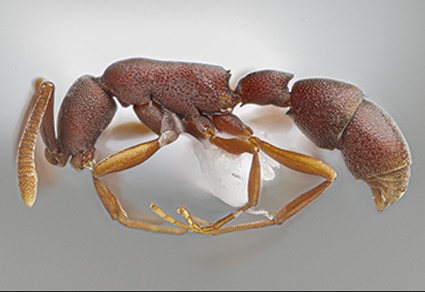
Based on morphological evidence, the ant genus Probolomyrmex Mayr, 1901 in China is revised, indicating the presence of at least five confirmed species, with an additional taxon (P. longinodus Terayama & Ogata, 1988) requiring further clarification. In addition to the previously recorded P. dammermani Wheeler, 1928, P. longiscapus Xu & Zeng, 2000, and P. vieti Eguchi, 2006, two new species are described herein: P. bispinatus sp. nov. from Tibet and P. similis sp. nov. from Guangxi. The new species P. bispinatus sp. nov. is morphologically most similar to P. procne, but can be distinguished by the following combination of characters: (1) propodeal posterodorsal denticles sharper and spine-like; (2) posterodorsal corner of petiole in lateral view sharper and points posterodorsally (in P. procne points posteroventrally); and (3) in dorsal view, lateral margins of petiole slightly convex (not straight). The new species P. similis sp. nov. is morphologically most similar to P. longiscapus, but can be distinguished by the following combination of characters: (1) larger body size; (2) posterior head margin nearly straight; (3) propodeal declivity with bordered, straight or slightly curved dark lines laterally; and (4) petiole bearing a pair of broad and distinct teeth. A global identification key to Probolomyrmex species based on queen and worker morphology is provided.
References
- Agosti, D. (1995) A revision of the South American species of the ant genus Probolomyrmex (Hymenoptera: Formicidae). Journal of the New York Entomological Society, 102, 429–434. https://doi.org/10.15468/ghvxjn
- AntWeb (2025) AntWeb. Available from: http://www.antweb.org (accessed 22 June 2025)
- AntWiki (2026) AntWiki. Available from: http://www.antwiki.org/wiki/Probolomyrmex (accessed 15 February 2026)
- Asfiya, W., Lach, L., Majer, J.D., Heterick, B. & Didham, R.K. (2015) Intensive agroforestry practices negatively affect ant (Hymenoptera: Formicidae) diversity and composition in southeast Sulawesi, Indonesia. Asian Myrmecology, 7, 87–104. https://doi.org/10.20362/am.007009
- Baroni Urbani, C. & de Andrade, M.L. (2003) The ant genus Proceratium in the extant and fossil record (Hymenoptera: Formicidae). Museo Regionale di Scienze Naturali Monografie (Turin), 36, 1–492. https://doi.org/10.1002/mmnz.20040800210
- Bolton, B. (1994) Identification guide to the ant genera of the world. Harvard University Press, Cambridge, Massachusetts, 222 pp.
- Bolton, B. (2003) Synopsis and classification of Formicidae. Memoirs of the American Entomological Institute, 71, 1–370.
- Bolton, B. (2026) An online Catalog of the Ants of the World by Barry Bolton. Available from: http://www.antcat.org (accessed 15 February 2026)
- Borowiec, M.L., Rabeling, C., Brady, S.G., Fisher, B.L., Schultz, T.R. & Ward, P.S. (2019) Compositional heterogeneity and outgroup choice influence the internal phylogeny of the ants. Molecular Phylogenetics and Evolution, 134, 111–121. https://doi.org/10.1016/j.ympev.2019.01.024
- Brady, S.G., Schultz, T.R., Fisher, B.L. & Ward, P.S. (2006) Evaluating alternative hypotheses for the early evolution and diversification of ants. Proceedings of the National Academy of Sciences of the United States of America, 103, 18172–18177. https://doi.org/10.1073/pnas.0605858103
- Chen, D. & Xu, Y. (2025) A newly record ant genus Probolomyrmex Mayr, 1901 in Guangdong Province, China (Hymenoptera: Formicidae). The Indochina Entomologist, 1 (59), 551–555. https://doi.org/10.70590/ice.2025.01.59
- de Andrade, M.L. & Baroni Urbani, C. (2003) The Baltic amber ant genus Bradoponera (Hymenoptera: Formicidae), with description of two new species and a reassessment of the Proceratiini genera. Revue Suisse de Zoologie, 110, 913–938. https://doi.org/10.5962/bhl.part.80219
- Eguchi, K., Yoshimura, M. & Yamane, S. (2006) The Oriental species of the ant genus Probolomyrmex (Insecta: Hymenoptera: Formicidae: Proceratiinae). Zootaxa, 1376 (1), 1–35. https://doi.org/10.11646/zootaxa.1376.1.1
- Eguchi, K., Viet, B.T. & Yamane, S. (2014) Generic synopsis of the Formicidae of Vietnam (Insecta: Hymenoptera), Part II—Cerapachyinae, Aenictinae, Dorylinae, Leptanillinae, Amblyoponinae, Ponerinae, Ectatomminae and Proceratiinae. Zootaxa, 3860 (1), 1–46. https://doi.org/10.11646/zootaxa.3860.1.1
- Emery, C. (1895) Die Gattung Dorylus Fab. und die systematische Eintheilung der Formiciden. Zoologische Jahrbücher. Abteilung für Systematik, Geographie und Biologie der Tiere, 8, 685–778. https://doi.org/10.5281/zenodo.25462
- Fisher, B.L. (2007) A new species of Probolomyrmex from Madagascar. In: Snelling, R.R., Fisher, B.L. & Ward, P.S. (Eds.), Advances in ant systematics (Hymenoptera: Formicidae): homage to E.O. Wilson – 50 years of contributions. Memoirs of the American Entomological Institute, 80, pp. 146–152. https://doi.org/10.15468/dwwn3l
- Hamer, M.T., Lee, R.H., Liu-Wei, W., Davies, K., Chan, M., Fellowes, J.R. & Guénard, B. (2025) A checklist of ants (Hymenoptera: Formicidae) of Hainan Province, China. Asian Myrmecology, 18, 018006. https://doi.org/10.20362/am.018006
- Harris, R.A. (1979) A glossary of surface sculpturing. Occasional Papers in Entomology, State of California Department of Food and Agriculture, 28, 1–31. https://doi.org/10.5281/zenodo.26215
- Hosoishi, S., Hashimoto, Y., Park, S., Yamane, S. & Ogata, K. (2017) A comparison of ground-dwelling and arboreal ant assemblages (Hymenoptera: Formicidae) in lowland forests of Cambodia. The Raffles Bulletin of Zoology, 65, 416–425. https://doi.org/10.5281/zenodo.5357318
- Ito, F. (1998) Colony composition and specialized predation on millipedes in the enigmatic ponerine ant genus Probolomyrmex (Hymenoptera, Formicidae). Insectes Sociaux, 45, 79–83. https://doi.org/10.1007/s000400050070
- Jaitrong, W. & Nabhitabhata, J. (2005) A list of known ant species of Thailand (Formicidae: Hymenoptera). The Thailand Natural History Museum Journal, 1 (1), 9–54.
- Jaitrong, W., Guénard, B., Economo, E.P., Buddhakala, N. & Yamane, S. (2016) A checklist of known ant species of Laos. Asian Myrmecology, 8, 17–48. https://doi.org/10.20362/am.008019
- Keller, R.A. (2011) A Phylogenetic Analysis of Ant Morphology (Hymenoptera: Formicidae) with Special Reference to the Poneromorph Subfamilies. Bulletin of the American Museum of Natural History, 355, 1–90. https://doi.org/10.1206/355.1
- Kikuchi, T. & Tsuji, K. (2005) Unique social structure of Probolomyrmex longinodus. Entomological Science, 8, 1–3. https://doi.org/10.1111/j.1479-8298.2005.00094.x
- Li, W., Chen, Z. & Zhou, S. (2020) Faunal analysis of the poneromorph subfamilies (formicidae) of China. Journal of Henan Agricultural University, 54 (3), 471–479, 498. https://doi.org/10.16445/j.cnki.1000-2340.20200520.001
- Liang, C. & Chen, Z. (2022) Taxonomic review of Chinese ant genus Probolomyrmex (Hymenoptera: Formicidae). Zoological Systematics, 47 (2), 146–154. https://doi.org/10.11865/zs.2022205
- Mayr, G. (1901) Südafrikanische Formiciden, gesammelt von Dr. Hans Brauns. Annalen des Kaiserlich-Königlichen Naturhistorischen Museums in Wien, 16, 1–30. https://doi.org/10.5281/zenodo.25873
- Moreau, C.S., Bell, C.D., Vila, R., Archibald, S.B. & Pierce, N.E. (2006) Phylogeny of the ants: diversification in the age of angiosperms. Science (Washington, D. C.), 312, 101–104. https://doi.org/10.1126/science.1124891
- O’Keefe, S.T. & Agosti, D. (1998) A new species of Probolomyrmex (Hymenoptera: Formicidae) from Guanacaste, Costa Rica. Journal of the New York Entomological Society, 105, 190–192. https://doi.org/10.15468/xas16k
- Oliveira, A.M. & Feitosa, R.M. (2019) Taxonomic revision of the genus Probolomyrmex Mayr, 1901 (Hymenoptera: Formicidae: Proceratiinae) for the Neotropical Region. Zootaxa, 4614 (1), 61–94. https://doi.org/10.11646/zootaxa.4614.1.3
- Ouellette, G.D., Fisher, B.L. & Girman, D.J. (2006) Molecular systematics of basal subfamilies of ants using 28S rRNA (Hymenoptera: Formicidae). Molecular Phylogenetics and Evolution, 40, 359–369. https://doi.org/10.1016/j.ympev.2006.03.017
- Perrault, G.H. (2000) Les Probolomyrmicinae, nouvelle sous-famille pour le genre Probolomyrmex (Hymenoptera, Formicidae). Bulletin de la Société Entomologique de France, 105, 253–272. https://doi.org/10.3406/bsef.2000.16669
- Rabeling, C., Brown, J.M. & Verhaagh, M. (2008) Newly discovered sister lineage sheds light on early ant evolution. Proceedings of the National Academy of Sciences of the United States of America, 105 (30), 14913–14917. https://doi.org/10.1073/pnas.0806187105
- Schmidt, C.A. (2013) Molecular phylogenetics of ponerine ants (Hymenoptera: Formicidae: Ponerinae). Zootaxa, 3647 (2), 201–250. https://doi.org/10.11646/zootaxa.3647.2.1
- Shattuck, S.O., Gunawardene, N.R. & Heterick, B. (2012) A revision of the ant genus Probolomyrmex (Hymenoptera: Formicidae: Proceratiinae) in Australia and Melanesia. Zootaxa, 3444 (1), 40–50. https://doi.org/10.11646/zootaxa.3444.1.2
- Tanaka, M. (1974) Description of a new species of the ant of the genus Probolomyrmex Mayr from Malaysia (Hymenoptera, Formicidae). Entomological Review of Japan, 26, 35–37. https://doi.org/10.5281/zenodo.24801
- Taylor, R.W. (1965) A monographic revision of the rare tropicopolitan ant genus Probolomyrmex Mayr (Hymenoptera: Formicidae). Transactions of the Royal Entomological Society of London, 117, 345–365. https://doi.org/10.1111/j.1365-2311.1965.tb00044.x
- Terayama, M. & Ogata, K. (1988) Two new species of the ant genus Probolomyrmex (Hymenoptera, Formicidae) from Japan. Kontyû, 56, 590–594. https://doi.org/10.5281/zenodo.24863
- Terayama, M. (1990) A list of Ponerinae of Taiwan (Hymenoptera; Formicidae). Bulletin of the Toho Gakuen, 4, 25–50.
- Varghese, T. (2024) Report of a rare ant species Probolomyrmex procne (Formicidae: Proceratiinae) from the Indian Institute of Science campus, with description of its dealate queen. Halteres, 14, 1–16. https://doi.org/10.5281/zenodo.12539264
- Wang, W.Y., Soh, E.J.Y., Yong, G.W.J., Wong, M.K.L., Guénard, B., Economo, E.P. & Yamane, S. (2022) Remarkable diversity in a little red dot: a comprehensive checklist of known ant species in Singapore (Hymenoptera: Formicidae) with notes on ecology and taxonomy. Asian Myrmecology, 15, 015006. https://doi.org/10.20362/am.015006
- Wheeler, W.M. (1928) A new species of Probolomyrmex from Java. Psyche (Cambridge), 35, 7–9. https://doi.org/10.1155/1928/45073
- Wu, J. & Wang, C. (1995) The ants of China. China Forestry Publishing House, Beijing, x + 214 pp.
- Xu, Z. & Zeng, G. (2000) Discovery of the worker caste of Platythyrea clypeata Forel and a new species of Probolomyrmex Mayr in Yunnan, China (Hymenoptera: Formicidae). Entomologia Sinica, 7, 213–217. https://doi.org/10.1111/j.1744-7917.2000.tb00410.x
- Yoshimura, M. & Fisher, B.L. (2009) A revision of male ants of the Malagasy region (Hymenoptera: Formicidae): key to genera of the subfamily Proceratiinae. Zootaxa, 2216 (1), 1–21. https://doi.org/10.11646/zootaxa.2216.1.1
- Zhou, S. & Ran, H. (2010) Checklist of Poneromorph Subfamilies (Hymenoptera:Formicidae) in China. Journal of Guangxi Normal University (Natural Science Edition), 28 (4), 101–113. https://doi.org/10.16088/j.issn.1001-6600.2010.04.006