
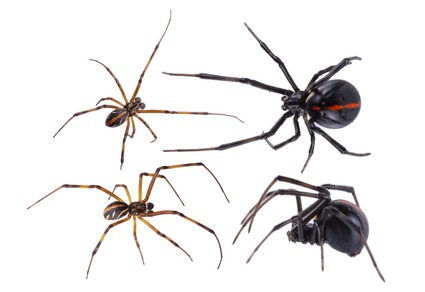

Abstract
The comb-footed spider genus Latrodectus Walckenaer, 1805 comprises some of the most medically important spider species due to the potent neurotoxic action of their venom. Despite this relevance, few studies have examined the distribution and presence of Latrodectus in Colombia. Recently, two new species were described from this country based on COI molecular data: Latrodectus hurtadoi Rueda & Realpe, 2021 and Latrodectus garbae Rueda & Realpe, 2021. However, these species lack consistent diagnostic morphological characters and exhibit genetic divergences of ~2%, a level commonly surpassed by intraspecific variation reported in other araneomorph spiders, raising doubts about their taxonomic validity. To assess their status, we reconstructed the phylogeny of Latrodectus using 329 COI sequences representing multiple species obtained from GenBank, including those used in the original descriptions. We applied tree-based (PTP and mPTP) and genetic-distance-based (ASAP) species delimitation methods. Our analyses suggest that L. hurtadoi is likely a valid species within the broader L. hesperus Chamberlin & Ivie, 1935 lineage, a widespread North American taxon that may itself represent a species complex. In contrast, L. garbae is genetically indistinguishable from the Argentine species L. corallinus Abalos, 1980. Therefore, we consider Latrodectus garbae a junior synonym of L. corallinus. These findings highlight the need for integrative taxonomic approaches to Colombian Latrodectus species, which will ultimately improve species identification and the clinical management of envenomation cases.
References
- Ábalos, J.W. (1980) Las arañas del género Latrodectus en la Argentina. Centenario del Museo de Ia Plata, VI, 29–51.
- Ábalos, J.W. & Baez, E.C. (1967) The spider genus Latrodectus in Santiago del Estero, Argentina. Toxicon, 4 (4), 293. https://doi.org/10.1016/0041-0101(67)90067-0
- Arnedo, M.A., Coddington, J., Agnarsson, I. & Gillespie, R.G. (2004) From a comb to a tree: Phylogenetic relationships of the comb-footed spiders (Araneae, Theridiidae) inferred from nuclear and mitochondrial genes. Molecular Phylogenetics and Evolution, 31 (1), 225–245. https://doi.org/10.1016/S1055-7903(03)00261-6
- Barrett, R.D.H. & Hebert, P.D.N. (2005) Identifying spiders through DNA barcodes. Canadian Journal of Zoology, 83 (1), 481–491. https://doi.org/10.1139/z05-024
- Bidegaray-Batista, L. & Arnedo, M.A. (2011) Gone with the plate: The opening of the Western Mediterranean basin drove the diversification of ground-dweller spiders. BMC Evolutionary Biology, 11 (1). https://doi.org/10.1186/1471-2148-11-317
- Brandley, N., Johnson, M. & Johnsen, S. (2016) Aposematic signals in North American black widows are more conspicuous to predators than to prey. Behavioral Ecology, 27 (4), 1104–1112. https://doi.org/10.1093/beheco/arw014
- Cabrera-Espinosa, L.A. & Valdez-Mondragón, A. (2021) Distribución y modelaje de nicho ecológico, comentarios biogeográficos y taxonómicos del género de arañas Latrodectus (Araneae: Theridiidae) de México. Revista Mexicana de Biodiversidad, 92, e923665. https://doi.org/10.22201/ib.20078706e.2021.92.3665
- Carcavallo, R.U. (1960) Una nueva Latrodectus y consideraciones sobre las especies del género en la República Argentina (Arach. Theridiidae). Neotropica, 5, 85–94.
- Caruso, M.B., Sales Lauria, P.S., de Souza, C.M.V., Casais-E-Silva, L.L. & Zingali, R.B. (2021) Widow spiders in the New World: a review on Latrodectus Walckenaer, 1805 (Theridiidae) and latrodectism in the Americas. Journal of Venomous Animals and Toxins Including Tropical Diseases, 27. https://doi.org/10.1590/1678-9199-jvatitd-2021-0011
- Choi, M.B., Lee, S.Y., Yoo, J.S., Jun, J. & Kwon, O. (2019) First record of the western black widow spider Latrodectus hesperus Chamberlin & Ivie, 1935 (Araneae: Theridiidae) in South Korea. Entomological Research, 49 (3), 141–146. https://doi.org/10.1111/1748-5967.12350
- Collins, R.A. & Cruickshank, R.H.† (2013) The seven deadly sins of DNA barcoding. Molecular Ecology Resources, 13 (6), 969–975. https://doi.org/10.1111/1755-0998.12046
- Desales-Lara, M.A., Jiménez, M.L. & Corcuera, P. (2018) Nuevos registros de arañas (Arachnida: Araneae) para México y listado actualizado de la araneofauna del estado de Coahuila. Acta Zoológica Mexicana (N.S.), 34, 1–14. https://doi.org/10.21829/azm.2018.3411183
- Domènech, M., Crespo, L.C., Enguídanos, A. & Arnedo, M.A. (2020) Mitochondrial discordance in closely related Theridion spiders (Araneae, Theridiidae), with description of a new species of the T. melanurum group. Zoosystematics and Evolution, 96 (1), 159–173. https://doi.org/10.3897/ZSE.96.49946
- Garb, J.E., González, A. & Gillespie, R.G. (2004) The black widow spider genus Latrodectus (Araneae: Theridiidae): Phylogeny, biogeography, and invasion history. Molecular Phylogenetics and Evolution, 31 (3), 1127–1142. https://doi.org/10.1016/j.ympev.2003.10.012
- Garb, J.E. & Hayashi, C.Y. (2013) Molecular evolution of α-latrotoxin, the exceptionally potent vertebrate neurotoxin in black widow spider venom. Molecular Biology and Evolution, 30 (5), 999–1014. https://doi.org/10.1093/molbev/mst011
- Hazzi, N.A. & Hormiga, G. (2021) Morphological and molecular evidence support the taxonomic separation of the medically important neotropical spiders Phoneutria depilata (Strand, 1909) and P. boliviensis (F.O. Pickard-Cambridge, 1897) (Araneae, Ctenidae). ZooKeys, 2021 (1022), 13–50. https://doi.org/10.3897/zookeys.1022.60571
- Hazzi, N.A. & Hormiga, G. (2023) Molecular phylogeny of the tropical wandering spiders (Araneae, Ctenidae) and the evolution of eye conformation in the RTA clade. Cladistics, 39 (1), 18–42. https://doi.org/10.1111/cla.12518
- Jiménez, M.L., Nieto-Castañeda, I.G., Correa-Ramírez, M.M. & Palacios-Cardiel, C. (2015) Las arañas de los oasis de la región meridional de la península de Baja California, México. Revista Mexicana de Biodiversidad, 86 (2), 319–331. https://doi.org/10.1016/j.rmb.2015.04.028
- Kalyaanamoorthy, S., Minh, B.Q., Wong, T.K.F., Von Haeseler, A. & Jermiin, L.S. (2017) ModelFinder: Fast model selection for accurate phylogenetic estimates. Nature Methods, 14 (6), 587–589. https://doi.org/10.1038/nmeth.4285
- Kapli, P., Lutteropp, S., Zhang, J., Kobert, K., Pavlidis, P., Stamatakis, A. & Flouri, T. (2017) Multi-rate Poisson tree processes for single-locus species delimitation under maximum likelihood and Markov chain Monte Carlo. Bioinformatics, 33 (11), 1630–1638. https://doi.org/10.1093/bioinformatics/btx025
- Levi, H.W. (1959) The Spider Genus Latrodectus (Araneae, Theridiidae). Transactions of the American Microscopical Society, 78 (1), 7–43. https://doi.org/10.2307/3223799
- Minh, B.Q., Schmidt, H.A., Chernomor, O., Schrempf, D., Woodhams, M.D., Von Haeseler, A., Lanfear, R. & Teeling, E. (2020) IQ-TREE 2: New Models and Efficient Methods for Phylogenetic Inference in the Genomic Era. Molecular Biology and Evolution, 37 (5), 1530–1534. https://doi.org/10.1093/molbev/msaa015
- Naseem, S. & Tahir, H.Muhammad. (2018) Use of mitochondrial COI gene for the identification of family Salticidae and Lycosidae of spiders. Mitochondrial DNA Part A: DNA Mapping, Sequencing, and Analysis, 29 (1), 96–101. https://doi.org/10.1080/24701394.2016.1248428
- Orton, M.G., May, J.A., Ly, W., Lee, D.J. & Adamowicz, S.J. (2019) Is molecular evolution faster in the tropics? Heredity, 122 (5), 513–524. https://doi.org/10.1038/s41437-018-0141-7
- Puillandre, N., Brouillet, S. & Achaz, G. (2021) ASAP: assemble species by automatic partitioning. Molecular Ecology Resources, 21, 609–620. https://doi.org/10.1111/1755-0998.13281
- Puillandre, N., Lambert, A., Brouillet, S. & Achaz, G. (2012) ABGD, Automatic Barcode Gap Discovery for primary species delimitation. Molecular Ecology, 21 (8), 1864–1877. https://doi.org/10.1111/j.1365-294X.2011.05239.x
- Purgat, P. & Švecová, L. (2025) First record of Latrodectus hesperus Chamberlin & Ivie, 1935, Western Black Widow (Araneae, Theridiidae), in Slovakia. Check List, 21 (1), 107–115. https://doi.org/10.15560/21.1.107
- Rueda, A., Lozano, D., Muñoz-Charry, V., Velásquez-Vélez, MI., Amézquita, A., Parra, D. & Realpe, E. (2021) Phylogeny of the genus Latrodectus (Araneae: Theridiidae) and two new species from the dry forests in the Magdalena Valley-Colombia. Species, 22 (70), 243–265.
- Santos, L.M., Borges, D.M., Gallão, J.E. & Chagas-Jr, A. (2025) Extending the distribution of Latrodectus corallinus Abalos, 1980 (Araneae: Theridiidae) in South America: first record for Brazil. Revista Chilena de Entomología, 51 (1), 139–143. https://doi.org/10.35249/rche.51.1.25.14
- Tamura, K., Stecher, G. & Kumar, S. (2021) MEGA11: Molecular Evolutionary Genetics Analysis Version 11. Molecular Biology and Evolution, 38 (7), 3022–3027. https://doi.org/10.1093/molbev/msab120
- Thi Hoang, D., Chernomor, O., von Haeseler, A., Quang Minh, B., Sy Vinh, L. & Rosenberg, M.S. (2017) UFBoot2: Improving the Ultrafast Bootstrap Approximation. Molecular Biology and Evolution, 35 (2), 518–522. https://doi.org/10.5281/zenodo.854445
- Trifinopoulos, J., Nguyen, L.T., von Haeseler, A. & Minh, B.Q. (2016) W-IQ-TREE: a fast online phylogenetic tool for maximum likelihood analysis. Nucleic Acids Research, 44 (W1), W232–W235. https://doi.org/10.1093/NAR/GKW256
- Ushkaryov, Y.A., Volynski, K.E. & Ashton, A.C. (2004) The multiple actions of black widow spider toxins and their selective use in neurosecretion studies. Toxicon, 43 (5), 527–542. https://doi.org/10.1016/j.toxicon.2004.02.008
- Valdez-Mondragón, A. & Nolasco-Garduño, S. (2025) Ixchela azteca (Araneae: Pholcidae), a widespread spider species from Central Mexico: Underestimated diversity or morphological and genetic variation? Revista Mexicana de Biodiversidad, 96, e965466. https://doi.org/10.22201/ib.20078706e.2025.96.5466
- Valdez-Mondragón, A. & Cabrera-Espinosa, L.A. (2023) Phylogenetic analyses and description of a new species of black widow spider of the genus Latrodectus Walckenaer (Araneae, Theridiidae) from Mexico; one or more species? European Journal of Taxonomy, 897, 1–56. https://doi.org/10.5852/ejt.2023.897.2293
- World Spider Catalog (2026) World Spider Catalog. Version 7. Natural History Museum Bern, Bern. Available from: https://wsc.nmbe.ch (accessed 13 May 2026)
- Wong, T.K., Ly-Trong, N., Ren, H., Baños, H., Roger, A.J., Susko, E., Bielow, C., De Maio, N., Goldman, N., Hahn, M.W., Huttley, G., Lanfear, R. & Quang Minh, B. (2025) IQ-TREE 3: Phylogenomic Inference Software using Complex Evolutionary Models. https://doi.org/10.32942/x2p62n
- Young, M.R. & Hebert, P.D.N. (2015) Patterns of protein evolution in cytochrome c oxidase 1 (COI) from the class Arachnida. PLoS ONE, 10 (8), e0135053. https://doi.org/10.1371/journal.pone.0135053
- Zhang, H. & Bu, W. (2022) Exploring Large-Scale Patterns of Genetic Variation in the COI Gene among Insecta: Implications for DNA Barcoding and Threshold-Based Species Delimitation Studies. Insects, 13 (5), 425. https://doi.org/10.3390/insects13050425
- Zhang, J., Kapli, P., Pavlidis, P. & Stamatakis, A. (2013) A general species delimitation method with applications to phylogenetic placements. Bioinformatics, 29 (22), 2869–2876. https://doi.org/10.1093/bioinformatics/btt499