
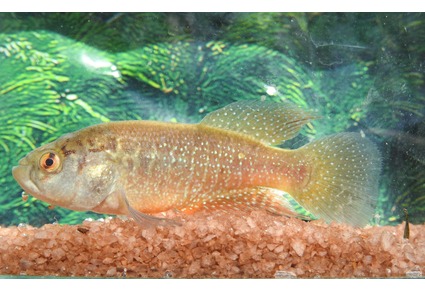

Abstract
In 2021, through the social media, a new record of Cynolebias was reported in the upper rio Jaguaribe basin in Ceará State (CE), northeastern Brazil. Previously, Cynolebias microphthalmus was the only species of the genus from the Northeastern Caatinga and Coastal Drainages hydrographic ecoregion, known from the seasonal pools of the rio Apodi-Mossoró basin in Rio Grande do Norte State and in the lower rio Jaguaribe basin (CE). Based on morphological and molecular data (mitochondrial DNA sequences), we concluded that the recent record represents a new species, described herein as Cynolebias penaforte sp. nov.. It differs from all congeners by absence of contact organs on inner surface pectoral fin-rays in males, and by presenting higher number of supraorbital scales, dorsal-fin origin through base of 8th anal-fin ray, and higher number of neuromasts in anterior rostral, otic, and post-otic series. The new species was only recorded in a temporary pool close to the rio São Francisco inter-basin water transfer channels, highlighting the possible impact of changes in the hydrologic cycles to the Brazilian semiarid seasonal killifishes. Finally, the description of this species was only possible due to the citizen science provided by two residents of the municipality in which the species was discovered.
References
- Abell, R., Thieme, M.L., Revenga, C., Bryer, M., Kottelat, M., Bogutskaya, N., Coad, B., Mandrak, N., Balderas, S.C., Bussing, W., Stiassny, M.L.J., Skelton, P., Allen, G.R., Unmack, P., Naseka, A., Rebecca, Ng, Sindorf, N., Robertson, J., Armijo, E., Higgins, J.V., Heibel, T.J., Wikramanayake, E., Olson, D., López, H.L., Reis, R.E., Lundberg, J.G., Sabaj Pérez, M.H. & Petry, P. (2008) Freshwater ecoregions of the world: a new map of biogeographic units for freshwater biodiversity conservation. Bioscience, 58 (5), 403–414. https://doi.org/10.1641/B580507
- Abrantes, Y.G., Medeiros, L.S., Bennemann, A.B.A., Bento, D.M., Teixeira, F.K., Rezende, C.F., Ramos, T.P.A. & Lima, S.M.Q. (2020) Geographic distribution and conservation of seasonal killifishes (Cyprinodontiformes, Rivulidae) from the Mid-Northeastern Caatinga ecoregion, northeastern Brazil. Neotropical Biology and Conservation, 15 (3), 301–315. https://doi.org/10.3897/neotropical.15.e51738
- Abrantes, Y.G., Berbel-Filho, W.M., Carvalho, R.A., Ramos, T.P.A. & Lima, S.M.Q. (2026). Description of two threatened and polymorphic seasonal killifish species of the genus Hypsolebias (Cyprinodontiformes: Rivulidae) from the Piranhas-Açu River basin, in the Brazilian semiarid. Neotropical Ichthyology, 24, e250044.
- Abrantes, Y.G., Ramos, T.P.A., Bento, D.M. & Lima, S.M.Q. (2023) Molecular delimitation of the seasonal killifishes of the Hypsolebias antenori species group (Cyprinodontiformes, Rivulidae), with description of two new species from the Caatinga coastal basins, northeastern Brazil. Zootaxa, 5389 (5), 545–62. https://doi.org/10.11646/zootaxa.5389.5.2
- Bouckaert, R., Vaughan, T.G., Barido-Sottani, J., Duchêne, S., Fourment, M., Gavryushkina, A. & Drummond, A.J. (2019) BEAST 2.5: An advanced software platform for Bayesian evolutionary analysis. PLoS computational biology, 15 (4), e1006650. https://doi.org/10.1371/journal.pcbi.1006650
- Bruford, M.W., Hanotte, O., Brookfield, J.F.Y. & Burke, T. (1991) Single-locus and multilocus DNA fingerprinting. In: Hoelzel, A.R. (Ed.), Molecular genetic analysis of populations: a practical approach. IRL Press, Oxford, New York, pp. 226–269.
- Costa, W.J.E.M. (1995) Pearl killifishes: The Cynolebiatinae. Systematics and biogeography of a Neotropical annual fish subfamily (Cyprinodontiformes: Rivulidae). T.F.H. Publications, Inc, Neptune City, 128 pp.
- Costa, W.J.E.M. (2001) The Neotropical annual fish genus Cynolebias (Cyprinodontiformes: Rivulidae): phylogenetic relationships, taxonomic revision and biogeography. Ichthyological Exploration of Freshwaters, 12, 333–383.
- Costa, W.J.E.M. (2006) Descriptive morphology and phylogenetic relationships among species of the Neotropical annual killifish genera Nematolebias and Simpsonichthys (Cyprinodontiformes: Aplocheiloidei: Rivulidae). Neotropical Ichthyology, 4 (1), 1–26. https://doi.org/10.1590/S1679-62252006000100001
- Costa, W.J.E.M. (2007) Taxonomic revision of the seasonal South American killifish genus Simpsonichthys (Teleostei: Cyprinodontiformes: Aplocheiloidei: Rivulidae). Zootaxa, 1669 (1), 1–134. https://doi.org/10.11646/zootaxa.1669.1.1
- Costa, W.J.E.M. (2010) Historical biogeography of cynolebiasine anual killifishes inferred from dispersal–vicariance analysis. Journal of Biogeography, 37 (10), 1995–2004. https://doi.org/10.1111/j.1365-2699.2010.02339.x
- Costa, W.J.E.M. (2014) Six new species of seasonal killifishes of the genus Cynolebias from the São Francisco river basin, Brazilian Caatinga, with notes on C. porosus. Ichthyological Exploration of Freshwaters, 25 (1), 79–96.
- Costa, W.J.E.M. (2017) Description of two endangered new seasonal killifish species of the genus Cynolebias from the São Francisco River basin, Brazilian Caatinga (Cyprinodontiformes, Aplocheilidae). Zoosystematics and Evolution, 93 (2), 333–341. https://doi.org/10.3897/zse.93.20906
- Costa, W.J.E.M., Amorim, P.F. & Bragança, P.H.N. (2014) Species limits and phylogenetic relationships of red-finned cryptic species of the seasonal killifish genus Hypsolebias from the Brazilian semi-arid Caatinga (Teleostei: Cyprinodontiformes: Rivulidae). Journal of Zoological Systematics and Evolutionary Research, 52, 52–58. https://doi.org/10.1111/jzs.12041
- Costa, W.J.E.M., Amorim, P.F. & Mattos, J.L.O. (2017) Molecular phylogeny and timing of diversification in South American Cynolebiini seasonal killifishes. Molecular Phylogenetics and Evolution, 116, 61–68. https://doi.org/10.1016/j.ympev.2017.07.020
- Costa, W.J.E.M., Amorim, P.F. & Mattos, J.L.O. (2018) Synchronic historical patterns of species diversification in seasonal aplocheiloid killifishes of the semi-arid Brazilian Caatinga. PLoS ONE, 13 (2), e0193021. https://doi.org/10.1371/journal.pone.0193021
- Costa, W.J.E.M., Ramos, T.P.A., Alexandre, L.C. & Ramos, R.T.C. (2010) Cynolebias parnaibensis, a new seasonal killifish from the Caatinga, Parnaíba River basin, northeastern Brazil, with notes on sound producing courtship behavior (Cyprinodontiformes: Rivulidae). Neotropical Ichthyology, 8, 283–288. https://doi.org/10.1590/S1679-62252010000200006
- Darriba, D., Taboada, G.L., Doallo, R. & Posada, D. (2012) jModelTest 2: more models, new heuristics and high-performance computing. Nature Methods, 9 (8), 772–772. https://doi.org/10.1038/nmeth.2109
- Hoedeman, J.J. (1958) The frontal scalation pattern in some groups of tooth carps (Pisces-Cyprinodontiformes). Bulletin of Aquatic Biology, 1 (3), 23–28.
- International Union for Conservation of Nature [IUCN] (2022) Standards and petitions subcommittee. Guidelines for using the IUCN Red List categories and criteria. Version 15 [Internet]. Available from: https://www.iucnredlist.org/resources/redlist-guidelines (accessed 4 December 2025)
- Nielsen, D.T.B., Martins, M., Araujo, L.M., Lira, F.O. & Faour, A. (2018) Cynolebias akroa, a new species of annual fish (Cyprinodontiformes: Rivulidae) from the rio Preto, São Francisco basin, northeastern Brazil. International Journal of Ichthyology, 23 (4), 113–121.
- Rambaut, A., Drummond, A.J., Xie, D., Baele, G. & Suchard, M.A. (2018) Posterior summarization in Bayesian phylogenetics using Tracer 1.7. Systematic Biology, 67 (5), 901–904. https://doi.org/10.1093/sysbio/syy032
- Ramos, T.P.A., Nielsen, D.T., Abrantes, Y.G., Lira, F.O.D. & Lustosa-Costa, S.Y. (2023) A new species of cloud fish of the genus Hypsolebias from Northeast Brazil (Cyprinodontiformes: Rivulidae). Neotropical Ichthyology, 21, e230068. https://doi.org/10.1590/1982-0224-2023-0068
- Sabaj, M.H. (2020) Codes for natural history collections in ichthyology and herpetology. Copeia, 108, 593–669. https://doi.org/10.1643/ASIHCODONS2020
- Simmons, M.P., Pickett, K.M. & Miya, M. (2004) How meaningful are Bayesian support values? Molecular Biology and Evolution, 21 (1), 188–199. https://doi.org/10.1093/molbev/msh014
- Steindachner, F. (1876) Ichthyologische Beiträge V. Teil 3: Über einige Meeresfische von den Küsten Brasiliens. Sitzungsberichte der Akademie der Wissenschaften in Wien, Abteilung 1, Mathematik-Naturwissenschaften, 74, 173–175.
- Tamura, K., Stecher, G. & Kumar, S. (2021) MEGA11: Molecular evolutionary genetics analysis version 11. Molecular Biology and Evolution, 38 (7), 3022–3027. https://doi.org/10.1093/molbev/msab120
- Taylor, W.R. & Van Dyke, G.C. (1985) Revised procedures for staining and clearing small fishes and other vertebrates for bone and cartilage study. Cybium, 9 (2), 107–119.
- Thompson, J.D., Higgins, D.G. & Gibson, T.J. (1994) CLUSTAL W: improving the sensitivity of progressive multiple sequence alignment through sequence weighting, position-specific gap penalties and weight matrix choice. Nucleic acids research, 22 (22), 4673–4680. https://doi.org/10.1093/nar/22.22.4673
- Ward, R.D., Zemlak, T.S., Innes, B.H., Last, P.R. & Hebert, P.D. (2005) DNA barcoding Australia's fish species. Philosophical Transactions of the Royal Society B: Biological Sciences, 360 (1462), 1847–1857. https://doi.org/10.1098/rstb.2005.1716