

Abstract
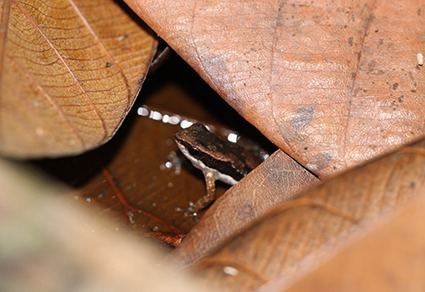
We describe a new species of Dryadobates known exclusively from a small (0.384 km²) and shrinking forest fragment between the neighborhoods of Costa Bela and Praia de Capuba, Serra, Espírito Santo, Brazil. In addition to genetic differences, the new species is diagnosed by its small size, white or pale ventral coloration on the thighs in life, white ventral coloration in males in life, posteriorly diffuse ventrolateral stripe in females in life, presence of webbing between toes II and III, and absence of isolated advertisement calls. Progressive habitat loss at the type locality has resulted in a 30% reduction in the forest fragment at the type locality from 0.543 km² in 2011 to 0.384 km² in 2025. We surveyed another forest fragment near the type locality but failed to detect additional individuals, leading us to classify the new species as Critically Endangered due to its extremely limited distribution (< 1 km²) and ongoing anthropogenic pressure at the type locality. We also reanalyzed the advertisement calls of D. alagoanus to enable comparisons, finding that it produces notes emitted both in isolation and groups.
References
- Andrade, F.S., Lyra, M.L., Baêta, D. & Toledo, L.F. (2026) Unveiling cryptic diversity in the genus Arcovomer (Anura: Microhylidae): description of two new species from the Brazilian Atlantic Forest. Salamandra, 62 (2), 77–96.
- Anganoy-Criollo, M., Viuche-Lozano, A., Enciso-Calle, M.P., Bernal, M.H. & Grant, T. (2022) The enigmatic Hyloxalus edwardsi species group (Anura: Dendrobatidae): Phylogenetic position, a new species, and new putative morphological synapomorphies. Herpetologica, 78 (4), 253–267. https://doi.org/10.1655/Herpetologica-D-21-00015
- Almeida, A.P. & Angulo, A. (2006) A new species of Leptodactylus (Anura: Leptodactylidae) from the state of Espirito Santo, Brazil, with remarks on the systematics of associated populations. Zootaxa, 1334 (1), 1–25. https://doi.org/10.11646/zootaxa.1334.1.1
- Almeida, A.P., Gasparini, J.L. & Peloso, P.L.V. (2011) Frogs of the state of Espírito Santo, southeastern Brazil — The need for looking at the ‘coldspots’. Check List, 7 (4), 542–560. https://doi.org/10.15560/7.4.542
- Alves, K.P., Valadares, R.T., Silva, L.T.D.P., Peralta, D.F. & Dutra, V.F. (2024) Bryophytes in the Área de Proteção Ambiental Mestre Álvaro (APAMA), Serra, Espírito Santo, Brazil. Rodriguésia, 75, e00792023. https://doi.org/10.1590/2175-7860202475092
- Bates, D., Mächler, M., Bolker, B. & Walker, S. (2015) Fitting linear mixed-mffects models using lme4. Journal of Statistical Software, 67 (1), 1–48. https://doi.org/10.18637/jss.v067.i01
- Bokermann, W.C.A. (1967) Novas espécies de “Phyllobates” do leste e sudeste brasileiro (Anura, Dendrobatidae). Revista Brasileira de Biologia, 27, 349–353.
- Cavalcanti, I.R.S., Luna, M.C., Faivovich, J. & Grant, T. (2022) Structure and evolution of the sexually dimorphic integumentary swelling on the hands of dendrobatid poison frogs and their relatives (Amphibia: Anura: Dendrobatoidea). Journal of Anatomy, 240 (3), 447–465. https://doi.org/10.1111/joa.13569
- Chang, M.L.Y. (1933) A preoccupied name in Rana. China Journal of Science & Arts, 18, 209.
- Conde, D.A., Staerk, J., Colchero, F., Da Silva, R., Schöley, J., Baden, H.M., Jouvet, L., Fa, J.E., Syed, H., Jongejans, E., Meiri, S., Gaillard, J.-M., Chamberlain, S., Wilcken, J., Jones, O.R., Dahlgren, J.P., Steiner, U.K., Bland, L.M., Gomez-Mestre, I., Lebreton, J.-D., González Vargas, J., Flesness, N., Canudas-Romo, V., Salguero-Gómez, R., Byers, O., Berg, T.B., Scheuerlein, A., Devillard, S., Schigel, D.S., Ryder, O.A., Possingham, H.P., Baudisch, A. & Vaupel, J.W. (2019) Data gaps and opportunities for comparative and conservation biology. Proceedings of the National Academy of Sciences, 116 (19), 9658–9664. https://doi.org/10.1073/pnas.1816367116
- Cossel, J.O., Twining, J.E., Reich, A.S. & Roberts, K. (2023) Temporal and spectral analysis of the advertisement call of Pristimantis pardalis (Leopard Robber Frog). South American Journal of Herpetology, 28 (1), 55–63. https://doi.org/10.2994/SAJH-D-21-00032.1
- Costa, S.M.D. & Dias, E.J.D.R. (2019) Comportamento territorial, vocalização e biologia reprodutiva de Allobates olfersioides (Anura: Aromobatidae). Iheringia, Série Zoologia, 109, e2019031. https://doi.org/10.1590/1678-4766e2019031
- CPRM – Serviço Geológico do Brasil (2004) Carta Geológica do Brasil ao Milionésimo: Vitória. Available from: https://rigeo.sgb.gov.br/handle/doc/4998 (accessed 4 August 2025)
- Diegues, A.C.S. (1988) Diversidade biológica e culturas tradicionais litorâneas: o caso das comunidades caiçaras. Série Documentos e Relatórios de Pesquisa, n. 5. NUPAUB-USP, São Paulo.
- Fabrezi, M. & Alberch, P. (1996) The carpal elements of anurans. Herpetologica, 52 (2), 188–204.
- Ferreira, R.B., Mônico, A.T., Cruz, C.A.G., Guidorizzi, C.E., Zocca, C., Canedo, C., Ornellas, I.S., Oliveira, J.C.F., Tonini, J.F.R., Lacerda, J.V.A., Toledo, L.F., Peloso, P.L.V., Taucce, P.P.G., Lourenço-de-Moraes, R., Silva-Soares, T., Verdade, V.K. & Pertel, W. (2019a) Anfíbios ameaçados de extinção no estado do Espírito Santo. In: Fraga, C.N., Formigoni, M.H. & Chaves, F.G. (Eds.), Fauna e flora ameaçadas de extinção no estado do Espírito Santo. Instituto Nacional da Mata Atlântica, Santa Teresa, pp. 256–269.
- Ferreira, R.B., Mônico, A.T., Da Silva, E.T., Lirio, F.C.F., Zocca, C., Mageski, M.M., Tonini, J.F.R., Beard, K.H., Duca, C. & Silva-Soares, T. (2019b) Amphibians of Santa Teresa, Brazil: the hotspot further evaluated. ZooKeys, 857, 139–162. https://doi.org/10.3897/zookeys.857.30302
- Figueiredo, M.D.S.L., Weber, M.M., Brasileiro, C.A., Cerqueira, R., Grelle, C.E.V., Jenkins, C.N., Solidade, C.V., Thomé, M.T.C., Vale, M.M. & Lorini, M.L. (2021) Tetrapod Diversity in the Atlantic Forest: Maps and Gaps. In: Marques, M.C.M. & Grelle, C.E.V. (Eds.), The Atlantic Forest. Springer International Publishing, Cham, pp. 185–204. https://doi.org/10.1007/978-3-030-55322-7_9
- Flechas, S.V., Ortega-Chinchilla, J.E., Arenas, L.M. & Amézquita, A. (2018) The function of supplementary notes in the communication system of Johnstone's Whistling Frog, Eleutherodactylus johnstonei. Herpetological Review, 49 (4), 626–632.
- Forti, L.R., Da Silva, T.R.Á. & Toledo, L.F. (2017) The acoustic repertoire of the Atlantic Forest Rocket Frog and its consequences for taxonomy and conservation (Allobates, Aromobatidae). ZooKeys, 692, 141–153. https://doi.org/10.3897/zookeys.692.12187
- Grant, T. & Pinheiro, P.D.P. (2025) A recently extinct new species of Dryadobates (Anura: Aromobatidae) from South Brazil: species description and implications for the historical distribution and recent extinction history of the clade. Zootaxa, 5693 (4), 583–595. https://doi.org/10.11646/zootaxa.5693.4.9
- Grant, T., Frost, D.R., Caldwell, J.P., Gagliardo, R., Haddad, C.F.B., Kok, P.J.R., Means, B.D., Noonan, B.P., Schargel, W.E. & Wheeler, W.C. (2006) Phylogenetic systematics of dart-poison frogs and their relatives (Anura: Athesphatanura: Dendrobatidae). Bulletin of the American Museum of Natural History, 299, 1–262. https://doi.org/10.1206/0003-0090(2006)299[1:PSODFA]2.0.CO;2
- Grant, T., Lyra, M.L., Hofreiter, M., Preick, M., Barlow, A., Verdade, V.K. & Rodrigues, M.T. (2025) Museomics and the systematics of the Atlantic Forest nurse frogs (Dendrobatoidea: Aromobatidae: Allobatinae). Bulletin of the American Museum of Natural History, 472, 1–76. https://doi.org/10.1206/0003-0090.472.1.1
- Grant, T., Rada, M., Anganoy-Criollo, M., Batista, A., Dias, P.H., Jeckel, A.M., Machado, D.J. & Rueda-Almonacid, J.V. (2017) Phylogenetic systematics of dart-poison frogs and their relatives revisited (Anura: Dendrobatoidea). South American Journal of Herpetology, 12 (s1), S1–S90. https://doi.org/10.2994/SAJH-D-17-00017.1
- Griffiths, I. (1959) The phylogeny of Smithillus limbatus and the status of the Brachycephalidae (Amphibia, Salientia). Proceedings of the Zoological Society of London, 132 (3), 457–487. https://doi.org/10.1111/j.1469-7998.1959.tb05531.x
- Heyer, W.R. & Wolf, A.J. (1989) Physalaemus crombiei (Amphibia: Leptodactylidae), a new frog species from Espírito Santo, Brazil, with comment on the P. signifer group. Proceedings of the Biological Society of Washington, 102 (2), 500–506.
- Incaper (2023) Programa de Assistência Técnica e Extensão Rural, Governo do Estado do Espírito Santo: Secretaria de Estado da Agricultura, Abastecimento, Aquicultura e Pesca, Serra. Available from: https://incaper.es.gov.br/media/incaper/proater/municipios/Serra.pdf (accessed 2 August 2025)
- IUCN (2001) IUCN Red List Categories and Criteria: Version 3.1. IUCN Species Survival Commission. IUCN, Gland, Switzerland and Cambridge, U.K.
- Izecksohn, E. & Peixoto, O.L. (1981) Nova espécie de Proceratophrys, da hiléia Bahiana, Brasil (Amphibia, Anura, Leptodactylidae). Revista Brasileira de Biologia, 41, 19–24.
- Jiang, Q., Sun, R., Wang, Z., Song, J., Fang, K., Zhang, B. & Fang, G. (2024) The first two functionally antagonistic call notes influence female choice in the Anhui tree frog. Behavioral Ecology and Sociobiology, 78 (5), 60. https://doi.org/10.1007/s00265-024-03476-1
- Kuznetsova, A., Brockhoff, P.B. & Christensen, R.H.B. (2017) lmerTest: tests in linear mixed effects models. 3.2–1. Available from: 10.32614/CRAN.package.lmerTest
- Lassandro, M., Bolitho, L. & Newell, D. (2025) A systematic review of Passive Acoustic Monitoring for anuran conservation. Bioacoustics, 34 (5), 579–628. https://doi.org/10.1080/09524622.2025.2518486
- Lenth, R. & Piaskowski, J. (2026) emmeans: Estimated Marginal Means, aka Least-Squares Means. R package version 2.0.2. Available from: https://CRAN.R-project.org/package=emmeans
- Littlejohn, M.J. (1977) Long-range acoustic communication in anurans: an integrated and evolutionary approach. In: Taylor, D.H. & Guttman, S.I. (Eds.), The reproductive biology of amphibians. Springer, Boston, pp. 263–294. https://doi.org/10.1007/978-1-4757-6781-0_8
- Littlejohn, M.J. & Harrison, P.A. (1985) The functional significance of the diphasic advertisement call of Geocrinia victoriana (Anura: Leptodactylidae). Behavioral Ecology and Sociobiology, 16 (4), 363–373. https://doi.org/10.1007/BF00295550
- Lutz, A. (1925) Batraciens du Brésil. Comptes Rendus et Mémoires Hebdomadaires des Séances de la Société de Biologie et des ses Filiales, 2, 137–139.
- Lutz, A. (1930) Segunda memoria sobre especies brasileiras do genero Leptodactylus, incluindo outras alliadas/Second paper on Brasilian and some closely related species of the genus Leptodactylus. Memórias do Instituto Oswaldo Cruz, 23 (1), 1–34. https://doi.org/10.1590/S0074-02761930000100001
- McDiarmid, R.W. (1994) Preparing amphibians as scientific specimens. In: Heyer, W.R. (Ed.), Measuring and Monitoring Biological Diversity: Standard Methods for Amphibians. Smithsonian Institution Press, Washington, D.C., pp. 289–297.
- Miranda-Ribeiro, A.de (1926) Notas para servirem ao estudo dos Gymnobatrachios (Anura) Brasileiros. Arquivos do Museu Nacional. Rio de Janeiro, 27, 1–227.
- Narins, P.M. & Capranica, R.R. (1976) Sexual differences in the auditory system of the tree frog Eleutherodactylus coqui. Science, 192 (4237), 378–380. https://doi.org/10.1126/science.1257772
- Narins, P.M. & Capranica, R.R. (1978) Communicative significance of the two-note call of the treefrog Eleutherodactylus coqui. Journal of Comparative Physiology, 127 (1), 1–9. https://doi.org/10.1007/BF00611921
- Narins, P.M. & Capranica, R.R. (1980) Neural adaptations for processing the two-note call of the Puerto Rican treefrog, Eleutherodactylus coqui. Brain, Behavior and Evolution, 17 (1), 48–66. https://doi.org/10.1159/000121790
- Narins, P.M., Lewis, E.R. & McClelland, B.E. (2000) Hyperextended call note repertoire of the endemic Madagascar treefrog Boophis madagascariensis (Rhacophoridae). Journal of Zoology, 250 (3), 283–298. https://doi.org/10.1111/j.1469-7998.2000.tb00772.x
- Nimer, E. (1989) Climatologia do Brasil. IBGE, Rio de Janeiro, 421 pp.
- Pangea Geologia e Estudos Ambientais (2016) Revisão/Elaboração do Plano Municipal de Redução de Riscos do Município da Serra - PMRR. Available from: https://www4.serra.es.gov.br/arquivo/1619794945846-1748-r12-16-relatorio-etapa-7-pmrr-serra-texto.pdf (accessed 4 August 2025) https://doi.org/10.5151/engpro-eneeamb2016-grrd-002-5054
- Prestwich, K.N. (1994) The energetics of acoustic signaling in anurans and insects. American Zoologist, 34 (6), 625–643. https://doi.org/10.1093/icb/34.6.625
- Palumbi, S.R., Martin, A., Romano, S., McMillan, W.O., Stice, L. & Grabawski, G. (1991) The Simple Fool’s Guide to PCR. University of Hawaii, Honolulu, 45 pp.
- Pringle, R.M. (2017) Upgrading protected areas to conserve wild biodiversity. Nature, 546 (7656), 91–99. https://doi.org/10.1038/nature22902
- R Core Team (2024) R: a language and environment for statistical computing. R Foundation for Statistical Computing, Vienna, Austria. Available from: https://www.R-project.org/ (accessed 4 August 2025)
- Réjaud, A., Rodrigues, M.T., Crawford, A.J., Castroviejo-Fisher, S., Jaramillo-Martinez, A.F., Chaparro, J.C., Glaw, F., Gagliardi-Urrutia, L.A.G., Moravec, J., De la Riva, I., Pérez-Peña, P.E., Lima, A.P., Werneck, F.P., Hrbek, T., Ron, S.R., Ernst, R., Kok, P.J.R., Driskell, A.M., Chave, J. & Fouquet, A. (2020) Historical biogeography identifies a possible role of Miocene wetlands in the diversification of the Amazonian rocket frogs (Aromobatidae: Allobates). Journal of Biogeography, 47 (11), 2472–2482. http://doi.org/10.1111/jbi.13937
- Sampaio, T. (1987) O Tupi na Geografia Nacional. Companhia Editora Nacional, São Paulo.
- Simões, P.I., Rojas, D. & Lima, A.P. (2019) A name for the nurse-frog (Allobates, Aromobatidae) of Floresta Nacional de Carajás, Eastern Brazilian Amazonia. Zootaxa, 4550 (1), 71–100. https://doi.org/10.11646/zootaxa.4550.1.3
- Spix, J.B.von (1824) Animalia nova sive Species novae Testudinum et Ranarum quas in itinere per Brasiliam annis MDCCCXVII–MDCCCXX jussu et auspiciis Maximiliani Josephi I. Bavariae Regis. F. S. Hübschmann, München. https://doi.org/10.5962/bhl.title.63182
- Taigen, T.L. & Wells, K.D. (1985) Energetics of vocalization by an anuran amphibian (Hyla versicolor). Journal of Comparative Physiology B, 155 (2), 163–170. https://doi.org/10.1007/BF00685209
- Tonini, J.R.F., Mendonça, I.S., Coutinho, A.B. & Gasparini, J.L. (2011) Anurans from Costa Bela, State of Espírito Santo, southeastern Brazil: inventory at an urban area and the re-discovery of Allobates in the state. Herpetology Notes, 4, 435–444.
- Verdade, V.K. & Rodrigues, M.T. (2007) Taxonomic review of Allobates (Anura, Aromobatidae) from the Atlantic Forest, Brazil. Journal of Herpetology, 41 (4), 566–580. http://dx.doi.org/10.1670/06-094.1
- Weather Underground (2025) WU: Weather Underground. Available from: https://www.wunderground.com (accessed 26 July 2025)
- Wells, K.D. (1977a) The courtship of frogs. In: Taylor, D.H. & Guttman, S.I. (Eds.), The Reproductive Biology of Amphibians. Springer, Boston, pp. 233–262. https://doi.org/10.1007/978-1-4757-6781-0_7
- Wells, K.D. (1977b) The social behaviour of anuran amphibians. Animal Behaviour, 25 (3), 666–693. https://doi.org/10.1016/0003-3472(77)90118-X
- Wickham, H., François, R., Müller, K. & Vaughan, D. (2023) dplyr: A grammar of data manipulation. R package version 1.1.4. Available from: https://CRAN.R-project.org/package=dplyr
- Wickham, H., Hester, J. & Bryan, J. (2024) readr: Read rectangular text data. R package version 2.1.5. Available from: https://CRAN.R-project.org/package=readr
- Yang, K.L. (2022) Raven Pro: Interactive Sound Analysis Software. Version 1.6.3. Computer Software. The Cornell Lab of Ornithology, Ithaca, New York. Available from: https://ravensoundsoftware.com/ (accessed 4 August 2025)
- Yue, X., Fan, Y., Xue, F., Brauth, S.E., Tang, Y. & Fang, G. (2017) The first call note plays a crucial role in frog vocal communication. Scientific Reports, 7 (1), 10128. https://doi.org/10.1038/s41598-017-09870-2
- Zimmermann, H. & Zimmermann, E. (1988) Etho-Taxonomie und zoogeographische Artengruppenbildung bei Pfeilgiftfroschen (Anura: Dendrobatidae). Salamandra, 24, 125–160.