

Abstract
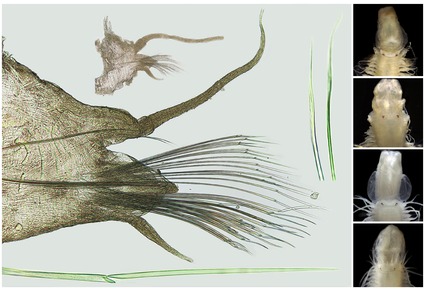
Oxydromus chinensis sp. nov., a new hesionid species collected from Fujian Province, China, was established based on both morphological and molecular phylogenetic analyses. The new species is characterized by having no pigmentation on the body dorsum, double aciculae in both notopodia and neuropodia, and unidentate neuropodial chaetae with partly curved distal ends. Multigene phylogenetic analysis based on five genes (COI, 16S rRNA, 18S rRNA, 28S rRNA and histone H3) supports the independent status of the new species. The partial gene sequences of COI diverged from those of the nearest relative species of Oxydromus in GenBank and BOLD Systems by 22.7%. An updated key to Oxydromus species is provided.
References
- Cai, L.Z. (2003) New methods studies on environmental quality assessment in bays and estuaries: using benthos. PhD dissertation, Xiamen University, China.
- Carr, C.M., Hardy, S.M., Brown, T.M., Macdonald, T.A. & Hebert, P.D. (2011) A tri-oceanic perspective: DNA barcoding reveals geographic structure and cryptic diversity in Canadian polychaetes. PLoS ONE, 6 (7), 22232. https://doi.org/10.1371/journal.pone.0022232
- Çinar, M.E., Dağli, E. & Erdoğan-Dereli, D. (2022) The diversity of polychaetes (Annelida: Polychaeta) in a long-term pollution monitoring study from the Levantine coast of Turkey (Eastern Mediterranean), with the descriptions of four species new to science and two species new to the Mediterranean fauna. Journal of Natural History, 56 (33–36), 1383–1426. https://doi.org/10.1080/00222933.2022.2140415
- Claparède, É. (1864) Glanures zootomiques parmi les annélides de Port-Vendres (Pyrénées Orientales). Mémoires de la Société de Physique et d’Histoire Naturelle de Genève, 17, 463–482. https://doi.org/10.5962/bhl.title.2173
- Colgan, D.J., McLauchlan, A., Wilson, G.D., Livingston, S., Edgecombe, G., Macaranas, J., Cassis, G. & Gray, M. (1998) Histone H3 and U2 snRNA DNA sequences and arthropod molecular evolution. Australian Journal of Zoology, 46 (5), 419–437. https://doi.org/10.1071/ZO98048
- Day, J.H. (1967) A monograph on the Polychaeta of Southern Africa. Part 1. Errantia. British Museum (Natural History), London, 836 pp.
- Delle Chiaje, S. (1828) Memorie sulla storia e notomia degli animali senza vertebre del regno di Napoli. Vol. 2. Societa Tipografica, Napoli, 114 pp. [in Italian]
- Ehlers, E. (1908) Die bodensässigen Anneliden aus den Sammlungen der deutschen Tiefsee-Expedition. Wissenschaftliche Ergebnisse der Deutschen Tiefsee-Expedition auf dem Dampfer “Valdivia”, 16 (1), 1–168.
- Ehlers, E. (1864) Die Borstenwürmer (Annelida Chaetopoda) nach systematischen und anatomischen Untersuchungen dargestellt. W. Engelmann, Leipzig, 748 pp. [in German] https://doi.org/10.5962/bhl.title.2081
- Fauchald, K. (1991) A morphometric study of eunicid polychaetes from Belize, western Caribbean Sea. Ophelia Supplement, 5, 47–54. https://doi.org/10.1163/9789004629745_007
- Giribet, G., Carranza, S., Baguñà, J., Riutort, M. & Ribera, C. (1996) First molecular evidence for the existence of a Tardigrada+ Arthropoda clade. Molecular Biology and Evolution, 13 (1), 76–84. https://doi.org/10.1093/oxfordjournals.molbev.a025573
- Giribet, G. (2015) Morphology should not be forgotten in the era of genomics – a phylogenetic perspective. Zoologischer Anzeiger, 256, 96–103. https://doi.org/10.1016/j.jcz.2015.01.003
- Grube, A.E. (1874) Über seine im verflossenen August und September ausgeführte Reise nach der Küste von Dalmatien. Jahresbericht der Schlesischen Gesellschaft für Vaterländische Kultur, 51, 174–176. [in German]
- Grube, A.E. (1878) Annulata Semperiana: Beiträge zur Kenntnis der Annelidenfauna der Philippinen nach den von Prof. Semper mitgebrachten Sammlungen. Mémoires de l’Académie Impériale des Sciences de St. Pétersbourg, Série 7, 25 (8), 1–300. [in German] https://doi.org/10.5962/bhl.title.85345
- Hartmann-Schröder, G. (1959) Zur Ökologie der Polychaeten des Mangrove‐Estero‐Gebietes von El Salvador. Beiträge zur Neotropischen Fauna, 1 (2), 69–183. https://doi.org/10.1080/01650525909380612
- Hartmann-Schröder, G. (1962) Zweiter Beitrag zur Polychaetenfauna von Peru. Kieler Meeresforschungen, 18 (1), 109–147. https://doi.org/10.2312/ifm.1962.18.109
- Hartmann-Schröder, G. (1974) Zur Kenntnis des Eulitorals der afrikanischen Westküste zwischen Angola und Kap der Guten Hoffnung und der afrikanischen Ostküste von Südafrika und Mocambique unter besonderer Berücksichtigung der Polychaeten und Ostracoden. Teil II. Die Polychaeten des Untersuchungsgebietes. Mitteilungen aus dem Hamburgischen Zoologischen Museum und Institut, 69, 95–228. https://doi.org/10.5962/bhl.part.24963
- Hartmann-Schröder, G. (1985) Teil 11. Die Polychaeten der antiborealen Südküste Australiens (zwischen Port Lincoln im Westen und Port Augusta im Osten). Mitteilungen aus dem Hamburgischen Zoologischen Museum und Institut, 82, 61–99. https://doi.org/10.5962/bhl.part.8239
- Hoagland, R.A. (1919) Polychaetous annelids from Porto Rico, the Florida Keys and Bermuda. Bulletin of the American Museum of Natural History, 41, 571–591. https://doi.org/10.5962/bhl.part.2584
- Hutchings, P.A. & Murray, A. (1984) Taxonomy of polychaetes from the Hawkesbury River and the southern estuaries of New South Wales, Australia. Records of the Australian Museum, 36 (3), 1–119. https://doi.org/10.3853/j.0812-7387.3.1984.101
- Johnson, H.P. (1901) The Polychaeta of the Puget Sound region. Proceedings of the United States National Museum, 23 (1228), 1–318. https://doi.org/10.5479/si.00963801.23-1228.1
- Knox, G.A. (1960) Biological Results of the Chatham Islands 1954 Expedition. Part 3. Polychaeta errantia. New Zealand Department of Scientific and Industrial Research Bulletin, 139 (1), 77–140. https://doi.org/10.5962/bhl.part.23602
- Lanfear, R., Frandsen, P.B., Wright, A.M., Senfeld, T. & Calcott, B. (2016) PartitionFinder 2: new methods for selecting partitioned models of evolution for molecular and morphological phylogenetic analyses. Molecular Biology and Evolution, 34 (3), 772–773. https://doi.org/10.1093/molbev/msw260
- Lenaers, G., Maroteaux, L., Michot, B. & Herzog, M. (1989) Dinoflagellates in evolution. A molecular phylogenetic analysis of large subunit ribosomal RNA. Journal of Molecular Evolution, 29 (1), 40–51. https://doi.org/10.1007/BF02106180
- Martin, D., Meca, M.A., Gil, J., Drake, P. & Nygren, A. (2017) Another brick in the wall: population dynamics of a symbiotic species of Oxydromus (Annelida, Hesionidae), described as new based on morphometry. Contributions to Zoology, 86 (3), 181–211. https://doi.org/10.1163/18759866-08603001
- Meng, F., Hong, X.G. & Wu, B.L. (1994) Studies on polychaeta of the Hainan island waters I. Oceanologia et Limnologia Sinica, 11 (4), 46–57. https://doi.org/10.1163/9789004629049_005
- Nguyen, L.T., Schmidt, H.A., von Haeseler, A. & Minh, B.Q. (2015) IQ-TREE: a fast and effective stochastic algorithm for estimating maximum-likelihood phylogenies. Molecular Biology and Evolution, 32 (1), 268–274. https://doi.org/10.1093/molbev/msu300
- Palumbi, S., Martin, A., Romano, S., McMillan, W., Stice, L. & Grabowski, G. (1991) The simple fool’s guide to PCR, version 2.0. Department of Zoology, University of Hawaii, Honolulu, 45 pp.
- Pettibone, M.H. (1961) New species of polychaete worms from the Atlantic Ocean, with a revision of the Dorvilleidae. Proceedings of the Biological Society of Washington, 74, 167–186. https://doi.org/10.5962/bhl.part.10707
- Rioja, E. (1923) Nota acerca del genero Ophiodromus Sars y descripcion del Ophiodromus pelagica n.sp. Boletín de la Real Sociedad Española de Historia Natural, 23, 198–205. [in Spanish]
- Rizzo, A.E. & Salazar-Vallejo, S.I. (2014) Hesionidae Grube, 1850 (Annelida: Polychaeta) from South-Southeastern Brazil, with descriptions of four new species. Zootaxa, 3856 (2), 267–291. https://doi.org/10.11646/zootaxa.3856.2.7
- Ronquist, F., Teslenko, M., van der Mark, P., Ayres, D.L., Darling, A., Höhna, S., Larget, B., Liu, L., Suchard, M.A. & Huelsenbeck, J.P. (2012) MrBayes 3.2: efficient Bayesian phylogenetic inference and model choice across a large model space. Systematic Biology, 61 (3), 539–542. https://doi.org/10.1093/sysbio/sys029
- Rosito, R.M. (1983) Polychaeta from shallow waters off Mactan, Cebu. Part 2. Philippine Scientist, 20, 11–38. https://doi.org/10.3860/psci.v20i0.1531
- Sars, M. (1862) Uddrag af en af detaillerede Afbildninger ledsaget udførlig Beskrivelse over følgende norske Annelider. Forhandlinger i Videnskabs-Selskabet i Christiania, 1861, 87–95. [in Norwegian]
- Schmarda, L.K. (1861) Neue wirbellose Thiere beobachtet und gesammelt auf einer Reise um die Erde 1853 bis 1857. Band 1, Part 2. W. Engelmann, Leipzig, 164 pp. [in German]
- Schüller, M. (2011) Evidence for a role of bathymetry and emergence in speciation in the genus Glycera (Glyceridae, Polychaeta) from the deep Eastern Weddell Sea. Polar Biology, 34 (4), 549–564. https://doi.org/10.1007/s00300-010-0904-y
- Shin, P.K. (1998) Biodiversity of subtidal benthic polychaetes in Hong Kong coastal waters. In: Morton, B. (Ed.), The marine biology of the South China Sea: proceedings of the third international conference on the marine biology of Hong Kong and the South China Sea, Hong Kong, 1996. Hong Kong University Press, Hong Kong, pp. 57–74. https://doi.org/10.1515/9789882202153-010
- Sun, R.P. & Yang, D.J. (2004) Fauna Sinica: Invertebrata Vol. 33, Annelida, Polyhaeta II. Nereidida. Science Press, Beijing, 514 pp.
- Tong, S., Yang, D., Qiu, J.-W., Ke, C. & Wang, Z. (2023) Podarkeopsis chinensis sp. nov. (Annelida, Hesionidae) from southeastern China. ZooKeys, 1173, 339–355. https://doi.org/10.3897/zookeys.1173.106112
- Uchida, H. (2004) Hesionidae (Annelida, Polychaeta) from Japan. I. Kuroshio Biosphere, 1, 27–92. https://doi.org/10.5044/kuroshio.1.0_27
- Uchida, H., Lopéz, E. & Sato, M. (2019) New Hesionidae (Annelida) from Japan: Unavailable names introduced by Uchida (2004) revisited, with reestablishment of their availability. Species Diversity, 24 (1), 69–95. https://doi.org/10.12782/specdiv.24.69
- Uschakov, P.V. & Wu, B.L. (1960) Preliminary report on the fauna of polychaete in China Sea. Oceanologia et Limnologia Sinica, 3 (2), 86–93. https://doi.org/10.1163/9789004629049_004
- Van der Auwera, G., Chapelle, S. & De Wächter, R. (1994) Structure of the large ribosomal subunit RNA of Phytophthora megasperma, and phylogeny of the oomycetes. FEBS Letters, 338 (2), 133–136. https://doi.org/10.1016/0014-5793(94)80350-1
- Verrill, A.E. & Smith, S.I. (1874) Report upon the invertebrate animals of Vineyard Sound and adjacent waters: with an account of the physical features of the region. In: Baird, S.F. (Ed.), Report on the condition of the sea fisheries of the south coast of New England. US Government Printing Office, Washington, pp. 295–778. https://doi.org/10.5962/bhl.title.57652
- Villalobos-Guerrero, T.F. & Harris, L. (2012) Oxydromus Grube, 1855 reinstated over Ophiodromus Sars, 1862 (Polychaeta, Hesionidae). ZooKeys, 241, 35–47. https://doi.org/10.3897/zookeys.241.3820
- Wang, B., Li, J., Wang, Y., Liang, C., Ji, Y., Sun, S., Guo, L., Zhu, H. & Wang, Z. (2025) A new species of the Marphysa sanguinea complex (Annelida: Eunicidae) from Fujian, China. Zootaxa, 5689 (1), 133–154. https://doi.org/10.11646/zootaxa.5689.1.5
- Wang, Z., Qiu, J.-W. & Salazar-Vallejo, S.I. (2018) Redescription of Leocrates chinensis Kinberg, 1866 (Annelida, Hesionidae). Zoological Studies, 57, 5. https://doi.org/10.6620/ZS.2018.57-05
- Wang, Z., Yang, D., Qiu, J.-W., Cai, M., Deng, Y. & Ke, C. (2023) Micropodarke fujianensis n. sp. (Annelida: Hesionidae) from Fujian, China. Zootaxa, 5256 (3), 279–288. https://doi.org/10.11646/zootaxa.5256.3.4
- Willey, A. (1902) Report on the collections of natural history made in the Antarctic regions during the voyage of the “Southern Cross”. Polychaeta. In: British Museum (Natural History) (Ed.), National Antarctic Expedition 1901-1904: Natural History, Vol. 4. British Museum, London, pp. 1–42. https://doi.org/10.5962/bhl.title.22496
- Willey, A. (1905) Report on the Polychaeta collected by Professor Herdman, at Ceylon, in 1902. In: Herdman, W.A. (Ed.), Report to the government of Ceylon on the pearl oyster fisheries of the Gulf of Manaar, Pt. 4. Royal Society, London, pp. 243–324.
- WoRMS Editorial Board (2026) World Register of Marine Species. VLIZ, Available from: https://www.marinespecies.org (accessed 1 April 2026)
- Xiang, C.Y., Gao, F.L., Jakovlić, I., Lei, H.P., Hu, Y., Zhang, H., Zou, H.P., Wang, G.T. & Zhang, D. (2023) Using PhyloSuite for molecular phylogeny and tree-based analyses. iMeta, 2, e87. https://doi.org/10.1002/imt2.87
- Zhang, D., Gao, F., Jakovlić, I., Zou, H., Zhang, J., Li, W.X. & Wang, G.T. (2020) PhyloSuite: An integrated and scalable desktop platform for streamlined molecular sequence data management and evolutionary phylogenetics studies. Molecular Ecology Resources, 20 (1), 348–355. https://doi.org/10.1111/1755-0998.13096