

Abstract
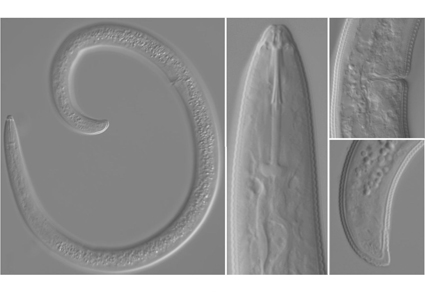
Originally, Helicotylenchus crassatus was described by Anderson in 1973 as most similar to Helicotylenchus digonicus. Reports generated over the years question the validity of the two species, as their morphometry and most of the morphological features overlap. Additionally, the molecular data revealed the representatives of H. crassatus cluster with one of the two main lineages of the polyphyletic H. digonicus. So far, H. crassatus has neither been reported from Poland nor from other parts of Europe, while H. digonicus has been recognized as a commonly occurring species in Poland and associated with many plants. The studies of three Helicotylenchus populations from Poland, initially identified as H. cf. digonicus revealed their high molecular and morphological resemblance to the recently characterized populations of H. crassatus from Canada. Therefore, this work extends the characteristics of H. crassatus, expands its occurrence to the European continent and discusses it in the context of the similarities with H. digonicus, with which it is often confused.
References
- Ali, N., Tavoillot, J., Besnard, G., Khadari, B., Dmowska, E., Winiszewska, G., Fossati-Gaschignard, O., Ater, M., Aït Hamza, M., El Mousadik, A., El Oualkadi, A., Moukhli, A., Essalouh, L., El Bakkali, A., Chapuis, E. & Mateille, T. (2017) How anthropogenic changes may affect soil-borne parasite diversity? Plant-parasitic nematode communities associated with olive trees in Morocco as a case study. BMC Ecology, 17, 4. https://doi.org/10.1186/s12898-016-0113-9
- Anderson, R.V. (1973) Morphology and description of Helicotylenchus crassatus n. sp. (Nematoda: Hoplolaimidae) from eastern Canada. Canadian Journal of Zoology, 51, 1195–1200. https://doi.org/10.1139/z73-173
- Anderson, R.V. (1974) Canadian species of the genus Helicotylenchus Steiner, 1945 (Nematoda: Hoplolaimidae), their identifying characteristics and descriptions of three new species. Canadian Journal of Zoology, 52, 1365–1381. https://doi.org/10.1139/z74-174
- Bahmani, J., Khozeini, F., Barooti, S., Rezaee, S. & Ghaderi, R. (2013) Plant-parasitic nematodes associated with walnut in the Asnandej region of west Iran. Journal of Plant Protection Research, 53 (4). https://doi.org/10.2478/jppr-2013-0060
- Berg, E. van den & Quénéhervé, P. (2012) Hoplolaimidae. In: Manzanilla-López, R.H. & Marbán-Mendoza, N. (Eds.), Practical Plant Nematology. Colegio de Postgraduados and Mundi-Prensa, Biblioteca Básica de Agricultura, Montecillo, Texcoco, pp. 251–296.
- Brzeski, M.W. (1998) Nematodes of Tylenchina in Poland and Temperate Europe. Muzeum i Instytut Zoologii Polska Akademia Nauk, Warszawa, 397 pp.
- Cao, A.X., Liu, X.Z., Zhu, S.F. & Lu, B.S. (2005) Detection of pinewood nematode, Bursaphelenchus xylophilus, using a real-time polymerase chain reaction assay. Phytopathology, 95, 566–571. https://doi.org/10.1094/PHYTO-95-0566
- Chau, N.N. & Anh, D.T. (2019) Three new species of the spiral nematode genus Helicotylenchus Steiner, 1945 (Nematoda: Hoplolaimidae) from Vietnam. Academia Journal of Biology, 41 (2), 404–408. https://doi.org/10.15625/0866-7160/v41n2.13597
- Deimi, A.M., Chitambar, J.J. & Maafi, Z.T. (2008) Nematodes associated with flowering ornamental plants in Mahallat, Iran. Nematologia Mediterranea, 36 (2), 115–123. [https://journals.flvc.org/nemamedi/article/view/86964]
- Dobosz, R., Winiszewska, G., Malewski, T., Rybarczyk-Mydłowska, K., Tereba, A., Kowalewska, K., Gawlak, M. & Bogdanowicz, W. (2013) Morphological and molecular features of Punctodera stonei Brzeski, 1998 (Nematoda: Heteroderidae) – species associated with roots of grasses. Annales Zoologici, 63 (2), 157–162. https://doi.org/10.3161/000345413X669487
- Filipjev, I.N. (1934) The classification of the free-living nematodes and their relation to the parasitic nematodes. Smithsonian Miscellaneous Collection, 89, 1–63.
- Hall, T.A. (1999) BioEdit: a user-friendly biological sequence alignment editor and analysis program for Windows 95/98/NT. Nucleic Acids Symposium Series, 41, 95–98.
- Hashim, Z. (1982) Description of the male and notes on the female of Helicotylenchus digonicus Perry in Perry, Darling & Thorne, 1959 (Nematoda: Tylenchida) from Jordan. Nematologica, 28, 206–209. https://doi.org/10.1163/187529282X00051
- Hodda, M. (2022) Phylum Nematoda: a classification, catalogue and index of valid genera, with a census of valid species. Zootaxa, 5114 (1), 001–289. https://doi.org/10.11646/zootaxa.5114.1.1
- Holterman, M., van der Wurff, A., van den Elsen, S., van Megen, H., Bongers, T., Holovachov, O., Bakker, J. & Helder, J. (2006) Phylum-wide analysis of SSU rDNA reveals deep phylogenetic relationships among nematodes and accelerated evolution toward crown clades. Molecular Biology and Evolution, 23, 1792–1800. https://doi.org/10.1093/molbev/msl044
- Holterman, M., Rybarczyk, K., van den Elsen, S., van Megen, H., Mooyman, P., Santiago, R.P., Bongers, T., Bakker, J. & Helder, J. (2008) A ribosomal DNA-based framework for the detection and quantification of stress-sensitive nematode families in terrestrial habitats. Molecular Ecology Resources, 8 (1), 23–34. https://doi.org/10.1111/j.1471-8286.2007.01963.x
- Kasapoğlu Uludamar, E.B., Yıldız, Ş., İmren, M., Öcal, A. & Elekçioğlu, İ.H. (2018) Occurrence of plant parasitic nematode species in important crops in the Southeast Anatolia Region of Turkey. Turkish Journal of Entomology, 42 (1), 63–74. https://doi.org/10.16970/entoted.359616
- Mahdikhani, E. & Alvani, S. (2013) Plant parasitic nematodes from rhizosphere of saffron (Crocus sativus L.) with two new records of Geocenamus squamatus and Filenchus pratensis from Iran. Pakistan Journal of Nematology, 31 (2), 99–103.
- Mateille, T., Tavoillot, J., Martiny, B., Dmowska, E., Winiszewska, G., Ferji, Z., Msanda, F. & El Mousadik, A. (2016) Aridity or low temperatures: What affects the diversity of plant-parasitic nematode communities in the Moroccan argan relic forest? Applied Soil Ecology, 101, 64–71. https://doi.org/10.1016/j.apsoil.2015.11.026
- Munawar, M., Konschuh, M., Castillo, P. & Yevtushenko, D.P. (2024) Morpho-Anatomy, In Vitro Culture, and Phylogenetic Studies of Two Helicotylenchus Species from Southern Alberta, Canada. Microorganisms, 12 (3), 497. https://doi.org/10.3390/microorganisms12030497
- Mokhtari, S., Bazeghi, F., Ruiz-Cuenca, A.N., Palomares-Rius, J.E., Eskandari, A. & Pedram, M. (2025) Morphological and molecular description of Helicotylenchus fortuneri n. sp. (Hoplolaimidae: Hoplolaiminae) a new mono-ovarian species from Iran. European Journal of Plant Pathology, 174, 517–537. https://doi.org/10.1007/s10658-025-03146-6
- Mwamula, A.O., Kwon, O.G., Kwon, C., Kim, Y.S., Kim, Y.H. & Lee, D.W. (2024) A Revision of the Phylogeny of Helicotylenchus Steiner, 1945 (Tylenchida: Hoplolaimidae) as Inferred from Ribosomal and Mitochondrial DNA. The Plant Pathology Journal, 40 (2), 171–191. https://doi.org/10.5423/PPJ.OA.01.2024.0013
- Nunn, G.B. (1992) Nematode molecular evolution: An investigation of evolutionary patterns among nematodes based upon DNA sequences. Ph.D. Thesis, University of Nottingham, Nottingham, UK.
- Perry, V.G., Darling, H.M. & Thorne, G. (1959) Anatomy, taxonomy and control of certain spiral nematodes attacking blue grass in Wisconsin. Research Bulletin, 207, University of Wisconsin, Madison.
- Rambaut, A., Suchard, M.A., Xie, D. & Drummond, A.J. (2014) Tracer v.1.6. Available from: http://beast.bio.ed.ac.uk/Tracer
- Ronquist, F. & Huelsenbeck, J.P. (2003) MrBayes 3: Bayesian phylogenetic inference under mixed models. Bioinformatics, 19, 1572–1574. https://doi.org/10.1093/bioinformatics/btg180
- Rybarczyk-Mydłowska, K., Dmowska, E. & Kowalewska, K. (2019) Phylogenetic studies on three Helicotylenchus species based on 28S rDNA and mtCOI sequence data. Journal of Nematology, 51 (1), 1–17. https://doi.org/10.21307/jofnem-2019-033
- Rybarczyk-Mydłowska, K., Sikora, G. & Kubicz, M. (2022) Morphological and molecular characteristics of Geocenamus longus and the first report of G. brevidens from a karst cave (Nematoda: Merliniidae Siddiqi, 1971). Zootaxa, 5134 (3), 383–398. https://doi.org/10.11646/zootaxa.5134.3.3
- Shokoohi, E., Marais, M., Fourie, H. & Panahi, H. (2018) Morphological and molecular characterization of three Helicotylenchus species from Iran. Zootaxa, 4388 (2), 207–220. https://doi.org/10.11646/zootaxa.4388.2.4
- Shokoohi, E., Marais, M., Mashela, P.W. & Divsalar, N. (2021) Morphological and molecular variations within Helicotylenchus vulgaris. Biologia, 76, 549–563. https://doi.org/10.2478/s11756-020-00551-6
- Steiner, G. (1945) Helicotylenchus, a new genus of plant-parasitic nematodes and its relationship to Rotylenchus Filipjev. Proceedings of the Helminthological Society of Washington, 12, 34–38.
- Subbotin, S.A., Inserra, R.N., Marais, M., Mullin, P., Powers, T.O., Roberts, P.A., van den Berg, E., Yeates, G.W. & Baldwin, J.G. (2011) Diversity and phylogenetic relationships within the spiral nematodes of Helicotylenchus Steiner, 1945 (Tylenchida: Hoplolaimidae) as inferred from analysis of the D2-D3 expansion segments of 28S rRNA gene sequences. Nematology, 13 (3), 333–345. https://doi.org/10.1163/138855410X520936
- Subbotin, S., Vovlas, N., Yeates, G., Hallmann, J., Kiewnick, S., Chizhov, V., Manzanilla-López, R., Inserra, R. & Castillo, P. (2015) Morphological and molecular characterisation of Helicotylenchus pseudorobustus (Steiner, 1914) Golden, 1956 and related species (Tylenchida: Hoplolaimidae) with a phylogeny of the genus. Nematology, 17 (1), 27–52. https://doi.org/10.1163/15685411-00002850
- van Bezooijen, J. (2006) Methods and Techniques for Nematology. The Nematology Department Manual, Wageningen University, The Netherlands.
- Yoder, M., De Ley, I.T., King, I., Mundo-Ocampo, M., Mann, J., Blaxter, M., Poiras, L. & De Ley, P. (2006) DESS: a versatile solution for preserving morphology and extractable DNA of nematodes. Nematology, 8, 367–376. https://doi.org/10.1163/156854106778493448