
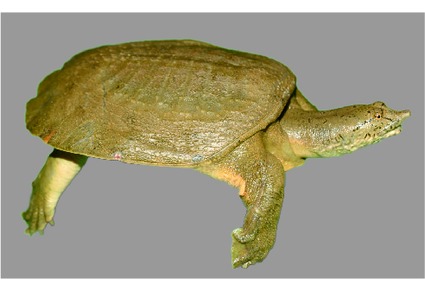

Abstract
Softshell turtle populations from the Yellow River Basin have traditionally been assigned to Pelodiscus sinensis, but their taxonomic identity remained uncertain. Integrating evidence from nuclear SNPs, complete mitochondrial genomes, and data from external morphology and osteology, we reassessed the taxonomic identity of the Yellow River softshell turtle. Phylogenomic analyses consistently place these populations sister to Pelodiscus maackii, and external morphology and osteology further demonstrate strong resemblance to P. maackii while clearly differentiating them from P. sinensis. These results support recognizing the Yellow River softshell turtle as a distinct geographic lineage of P. maackii, clarifying its taxonomic identity and refining our understanding of diversity within Pelodiscus.
References
- Brandt, J.F. (1857) Observationes quaedam ad generis Trionychum species duas novas spectantes auctore J.F. Brandt. Bulletin de la Classe Physico-Mathématique de l’Académie Impériale des Sciences de Saint Pétersbourg, 16, cols. 110–111.
- Castresana, J. (2000) Selection of conserved blocks from multiple alignments for their use in phylogenetic analysis. Molecular Biology and Evolution, 17 (4), 540–552. https://doi.org/10.1093/oxfordjournals.molbev.a026334
- Chan, K.O. & Grismer, L.L. (2026) GroupStruct2: A user-friendly graphical user interface for statistical and visual support in species diagnosis. Systematic Biology, 75 (4), 814–823. https://doi.org/10.1093/sysbio/syaf090
- Chen, J., Jiao, J., Yuan, X., Huang, X., Huang, L., Lin, L., Yin, W., Yao, J. & Zhang, H. (2023) Complete mitochondrial genomes of four Pelodiscus sinensis strains and comparison with other Trionychidae species. Biology, 12 (3), 406. https://doi.org/10.3390/biology12030406
- Chernov, S.A. (1930) O dal’nevostochnykh i kitayskikh cherepakhakh r. Amyda. Doklady Akademii nauk SSSR, 1930, 251–255. [in Russian]
- Chkhikvadze, V.M. (1987) O sistematicheskom polozhenii dal’nevostochnogo trioniksa. Bulletin of the Academy of Sciences of the Georgian SSR, 128, 609–611. [in Russian]
- Danecek, P., Auton, A., Abecasis, G., Albers, C.A., Banks, E., DePristo, M.A., Handsaker, R.E., Lunter, G., Marth, G.T., Sherry, S.T., McVean, G., Durbin, R. & 1000 Genomes Project Analysis Group (2011) The variant call format and VCFtools. Bioinformatics, 27 (15), 2156–2158. https://doi.org/10.1093/bioinformatics/btr330
- Danecek, P., Bonfield, J.K., Liddle, J., Marshall, J., Ohan, V., Pollard, M.O., Whitwham, A., Keane, T., McCarthy, S.A., Davies, R.M. & Li, H. (2021) Twelve years of SAMtools and BCFtools. GigaScience, 10 (2), giab008. https://doi.org/10.1093/gigascience/giab008
- Farkas, B., Ziegler, T., Pham, C.T., Ong, A.V. & Fritz, U. (2019) A new species of Pelodiscus from northeastern Indochina (Testudines, Trionychidae). ZooKeys, 824, 71–86. https://doi.org/10.3897/zookeys.824.31376
- Fritz, U., Gong, S., Auer, M., Kuchling, G., Schneeweiß, N. & Hundsdörfer, A.K. (2010) The world’s economically most important chelonians represent a diverse species complex (Testudines: Trionychidae: Pelodiscus). Organisms Diversity & Evolution, 10 (3), 227–242. https://doi.org/10.1007/s13127-010-0007-1
- Fritz, U., Herrmann, H.-W., Rosen, P.C., Auer, M., Vargas-Ramírez, M. & Kehlmaier, C. (2024) Trachemys in Mexico and beyond: Beautiful turtles, taxonomic nightmare, and a mitochondrial poltergeist (Testudines: Emydidae). Vertebrate Zoology, 74, 435–452. https://doi.org/10.3897/vz.74.e125958
- Gong, S.P., Fritz, U., Vamberger, M., Gao, Y. & Farkas, B. (2022) Disentangling the Pelodiscus axenaria complex, with the description of a new Chinese species and neotype designation for P. axenaria (Zhou, Zhang & Fang, 1991). Zootaxa, 5125 (2), 131–143. https://doi.org/10.11646/zootaxa.5125.2.2
- Gong, S.P., Li, J., Fritz, U. & Farkas, B. (2025) When light casts long shadows: The increasingly dark truth about Pelodiscus axenaria (Zhou, Zhang & Fang, 1991). Zootaxa, 5604 (1), 94–100. https://doi.org/10.11646/zootaxa.5604.1.11
- Gong, S.P., Vamberger, M., Auer, M., Praschag, P. & Fritz, U. (2018) Millennium-old farm breeding of Chinese softshell turtles (Pelodiscus spp.) results in massive erosion of biodiversity. Science of Nature, 105, 34. https://doi.org/10.1007/s00114-018-1558-9
- Gong, Y., Peng, L., Huang, S., Lin, Y., Huang, R., Xu, Y., Yang, D. & Nie, L. (2021) A new species of the genus Pelodiscus Fitzinger, 1835 (Testudines: Trionychidae) from Huangshan, Anhui, China. Zootaxa, 5060 (1), 137–145. https://doi.org/10.11646/zootaxa.5060.1.7
- Hu, W. (2021) Genetic diversity analysis of the Wuwangdu Yellow River softshell turtle population. Dissertation, Shanxi University, Taiyuan, 61 pp. [in Chinese, with English abstract] https://doi.org/10.27284/d.cnki.gsxiu.2021.001636
- Jin, J.J., Yu, W.B., Yang, J.B., Song, Y., DePamphilis, C.W., Yi, T.S. & Li, D.Z. (2020) GetOrganelle: A fast and versatile toolkit for accurate de novo assembly of organelle genomes. Genome Biology, 21 (1), 241. https://doi.org/10.1186/s13059-020-02154-5
- Katoh, K. & Standley, D.M. (2013) MAFFT multiple sequence alignment software version 7: Improvements in performance and usability. Molecular Biology and Evolution, 30 (4), 772–780. https://doi.org/10.1093/molbev/mst010
- Kehlmaier, C., Fritz, U. & Kuchling, G. (2025) The taxonomic quagmire of northern Australian snake-necked turtles (Testudines: Chelidae): Chelodina kuchlingi—Extinct or hiding in plain sight? Vertebrate Zoology, 75, 127–145. https://doi.org/10.3897/vz.75.e150370
- Kumar, S., Stecher, G. & Tamura, K. (2016) MEGA7: Molecular evolutionary genetics analysis version 7.0 for bigger datasets. Molecular Biology and Evolution, 33 (7), 1870–1874. https://doi.org/10.1093/molbev/msw054
- Li, H. & Durbin, R. (2009) Fast and accurate short read alignment with Burrows–Wheeler transform. Bioinformatics, 25 (14), 1754–1760. https://doi.org/10.1093/bioinformatics/btp324
- Li, J.X., Zeng, Z.C., Wang, Y.Y., Liang, D. & Zhang, P. (2019) Sequence capture using AFLP-generated baits: A cost‐effective method for high‐throughput phylogenetic and phylogeographic analysis. Ecology and Evolution, 9 (10), 5925–5937. https://doi.org/10.1002/ece3.5176
- Liang, H.W., Cao, L.H., Li, X., Tong, M.M., Jiang, Y.L., Li, Z., Luo, X.Z. & Zou, G.W. (2017) Morphological differences among three cultured strains of the Chinese softshell turtle, Pelodiscus sinensis. Freshwater Fisheries, 47 (4), 91–96. [in Chinese, with English abstract] https://doi.org/10.13721/j.cnki.dsyy.2017.04.014
- Liang, Y., Huang, C., Wang, P., Xiao, H., Wang, Z.A., Zeng, J., Wang, X., Xiong, S., Hu, Y. & Qin, Q. (2025) Research on SSR genetic molecular markers and morphological differences of different Pelodiscus sinensis populations. Genes, 16 (3), 318. https://doi.org/10.3390/genes16030318
- Liu, J.Y., Fu, W., Ma, Y.H., Zhou, T., Blanck, T., Zhou, G.J., Xiao, Y.M. & Mo, X.Y. (2024) Shedding light into the confusing history of Pelodiscus axenaria (Zhou, Zhang et Fang, 1991), clarifying and correcting its taxonomic position within the P. axenaria complex with the description of yet another Pelodiscus species. Russian Journal of Herpetology, 31 (6), 337–350. https://doi.org/10.30906/1026-2296-2024-31-6-337-350
- Luo, D. (2024) Quantitative analysis of fish morphology through landmark and outline-based geometric morphometrics with free software. bio-protocol, 14 (20), e5087. https://doi.org/10.21769/BioProtoc.5087
- Meng, G., Li, Y., Yang, C. & Liu, S. (2019) MitoZ: A toolkit for animal mitochondrial genome assembly, annotation and visualization. Nucleic Acids Research, 47 (11), e63. https://doi.org/10.1093/nar/gkz173
- Nguyen, L.T., Schmidt, H.A., von Haeseler, A. & Minh, B.Q. (2015) IQ-TREE: A fast and effective stochastic algorithm for estimating maximum-likelihood phylogenies. Molecular Biology and Evolution, 32 (1), 268–274. https://doi.org/10.1093/molbev/msu300
- Ni, X., Chen, Y., Deng, G. & Fu, C. (2023) Pleistocene landscape dynamics drives lineage divergence of a temperate freshwater fish Gobio rivuloides in coastal drainages of northern China. Genes, 14 (12), 2146. https://doi.org/10.3390/genes14122146
- Nikolsky, A.M. (1915) Faune de la Russie et des pays limitrophes. Reptiles (Reptilia), Volume 1. Chelonia et Sauria. Académie Impériale des Sciences de Petrograd, 532 pp. [in Russian with additional French title].
- Onwuama, K.T., Salami, S.O., Ali, M. & Nzalak, J.O. (2012) Effect of different methods of bone preparation on the skeleton of the African giant pouched rat (Cricetomys gambianus). International Journal of Morphology, 30 (2), 425–427. https://doi.org/10.4067/S0717-95022012000200011
- Purcell, S., Neale, B., Todd-Brown, K., Thomas, L., Ferreira, M.A., Bender, D., Maller, J., Sklar, P., de Bakker, P.I.W., Daly, M.J. & Sham, P.C. (2007) PLINK: A tool set for whole-genome association and population-based linkage analyses. American Journal of Human Genetics, 81 (3), 559–575. https://doi.org/10.1086/519795
- Rennick, S.L., Fenton, T.W. & Foran, D.R. (2005) The effects of skeletal preparation techniques on DNA from human and non-human bone. Journal of Forensic Sciences, 50 (5), JFS2004405-4. https://doi.org/10.1520/JFS2004405
- Strauch, A. (1876) Presmykayushchiyasya i zemnovodnyya. In: Przhevalsky, N.M. (Ed.), Mongoliya i strana tangutov. Trekhletnee puteshestvie v vostochnoi nagornoi Azii. Volume II. V.S. Balasheva, St. Petersburg, pp. 1–55 + pls. I–VIII. [in Russian]
- Stuckas, H. & Fritz, U. (2011) Identity of Pelodiscus sinensis revealed by DNA sequences of an approximately 180‐year‐old type specimen and a taxonomic reappraisal of Pelodiscus species (Testudines: Trionychidae). Journal of Zoological Systematics and Evolutionary Research, 49 (4), 335–339. https://doi.org/10.1111/j.1439-0469.2011.00632.x
- Suzuki, D. & Hikida, T. (2014) Taxonomic status of the soft-shell turtle populations in Japan: A molecular approach. Current Herpetology, 33 (2), 171–179. https://doi.org/10.5358/hsj.33.171
- Tang, Y.Z. (1997) Research on a new species of Pelodiscus (Trionychidae) in China. Zoological Research, 18 (1), 13–17. [in Chinese, with English abstract]
- Temminck, C.J. & Schlegel, H. (1834) Reptilia. I. Les chéloniens. In: von Siebold, P.F. (Ed.), Fauna Japonica, sive Descriptio animalium, quae in itinere per Japoniam, jussu et auspiciis superiorum, qui summum in India Batava Imperium tenent, suscepto, annis 1823–1830 collegit, notis observationibus et adumbrationibus illustravit, Vol. III. J.G. la Lau, Lugduni Batavorum, pp. 1–80 + pls. I–IX.
- Toews, D.P. & Brelsford, A. (2012) The biogeography of mitochondrial and nuclear discordance in animals. Molecular Ecology, 21 (16), 3907–3930. https://doi.org/10.1111/j.1365-294X.2012.05664.x
- TTWG [Turtle Taxonomy Working Group] (2025) Turtles of the world. Annotated checklist and atlas of taxonomy, synonymy, distribution, and conservation status (10th edition). Chelonian Research Monographs, 10, 1–575. https://doi.org/10.3854/crm.10.checklist.atlas.v10.2025
- Wang, F., Song, G.T., Chen, Z., Xu, B., Ji, S.F., Zhou, X., Xu, X.N., Hou, G.J., Zhang, Y., Li, D., Zhu, C.J., Su, Y.F., Dong, Z.X. & Jiang, Y.L. (2023) Morphological differences and path analysis among four cultured strains of the Chinese softshell turtle, Pelodiscus sinensis. Chinese Agricultural Science Bulletin, 39 (20), 147–154. [in Chinese, with English abstract] https://doi.org/10.11924/j.issn.1000-6850.casb2022-0560
- Wiegmann, A.F.A. (1834) Beiträge zur Zoologie gesammelt auf einer Reise um die Erde. Siebente Abhandlung. Amphibien. Nova Acta Physico-Medica Academia Caesarea Leopoldino-Carolina, 17, 185–268.
- Xie, M.M., Hong, X.Y., Li, W., Liu, X.L., Chen, C. & Zhu, X.P. (2022) The skeletal system of the Yangtze giant softshell turtle and comparisons with the Chinese softshell turtle, Pelodiscus sinensis. Journal of Hydrobiology, 46 (5), 654–663. [in Chinese, with English abstract] https://doi.org/10.7541/2021.2021.074
- Yang, P., Tang, Y.Z., Ding, L., Guo, X.G. & Wang, Y.Z. (2011) Validity of Pelodiscus parviformis (Testudines: Trionychidae) inferred from molecular and morphological analyses. Asian Herpetological Research, 2 (1), 21–29. https://doi.org/10.3724/SP.J.1245.2011.00021
- Zhang, C., Zhang, H.Q., Xu, X.J., He, Z.Y. & Wang, C.L. (2014) Comparative analysis of 16S rRNA gene polymorphism in two cultured strains of the Chinese softshell turtle, Pelodiscus sinensis. Journal of Fishery Sciences of China, 21 (2), 398–404. [in Chinese]
- Zhao, C.G. (2008) Biological characteristics and new techniques for breeding and culture of the Japanese softshell turtle (II). Scientific Fish Farming, (2), 12–13. [in Chinese]
- Zhou, G., Zhang, X. & Fang, Z. (1991) Bulletin of a new species Trionyx. Acta Scientiarum Naturalium Universitatis Normalis Hunanensis, 14, 379–382. [in Chinese, with English abstract]