

Abstract
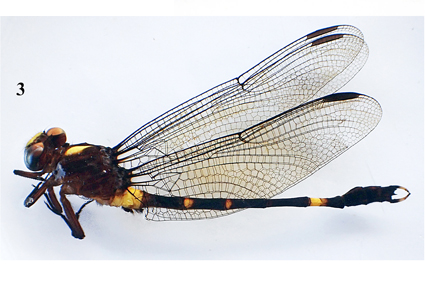
Phyllogomphoides biguttatus sp. nov., from western Ecuador, is described based on reared adults of both sexes and larvae collected in slow parts of small forest streams in hilly landscapes. This species belongs to the semicircularis-group of species and is closely related to P. semicircularis (Selys Longchamps) and P. insignatus Donnelly. Phyllogomphoides insignatus probably represents the adelphotaxon of the new species. A differential diagnosis is given to distinguish these closely related species. The new species can be separated from all known Phyllogomphoides Belle by its unique thoracic color pattern with pleural and tergal parts of pterothorax entirely brown to dark brown except for a pair of large yellow drop-shaped antehumeral markings.
References
- Bechly, G. (1996) Morphologische Untersuchungen am Flugelgeader der rezenten Libellen und deren Stammgruppenvertreter (Insecta; Pterygota; Odonata), unter besonderer Berucksichtigung der Phylogenetischen Systematik und des Grundplanes der Odonata. Petalura, Sonderband 2, 1–402.
- Belle, J. (1970) Studies on South American Gomphidae (Odonata) with special reference to the species from Surinam. Studies on the fauna of Suriname and other Guyanas, 11 (43), 1–158.
- Belle, J. (1982) Some new and interesting South American species of Phyllogomphoides in the Museum of Zoology, University of Michigan, Ann Arbor, Michigan (Insecta: Odonata: Gomphidae. Occasional Papers of the Museum of Zoology University of Michigan, 701, 1–14.
- BOLD (2018) Barcode of Life Data System (BOLD). Version 5. Available from: http://boldsystems.org/ (accessed 2 March 2026)
- Donnelly, T.W. (1979) The genus Phyllogomphoides in Middle America (Anisoptera: Gomphidae). Odonatologica, 8 (4), 245–265.
- Fleck, G., Nel, A., Bechly, G., Martínez-Delclòs, X., Jarzembowski, E.A. & Coram, R. (2003) Phylogeny and classification of the Stenophlebioptera (Insecta, Odonata, Epiproctophora). Annales de la Société Entomologique de France, 39 (1), 55–93. https://doi.org/10.1080/00379271.2003.10697363
- Garrison, R.W., von Ellenrieder, N. & Louton, J.A. (2006) Dragonfly genera of the New World. An illustrated and annotated key to the Anisoptera. The Johns Hopkins University Press, Baltimore, Maryland, xiv + 368 pp.
- Mauffray, W.F. & Tennessen, K.J. (2019) A Catalogue and Historical Study of the Odonata of Ecuador. Zootaxa, 4628 (1), 1–265. https://doi.org/10.11646/zootaxa.4628.1.1
- Novelo-Gutiérrez, R. & Gómez-Anaya, J.A. (2019) The larva of Phyllogomphoides pugnifer Donnelly, 1979 (Odonata: Gomphidae). Zootaxa, 4688 (4), 578–584. https://doi.org/10.11646/zootaxa.4688.4.9
- Ratnasingham, S. & Hebert, P.D.N. (2007) BOLD: The Barcode of Life Data System (www.barcodinglife.org). Molecular Ecology Notes, 7, 355–364. https://doi.org/10.1111/j.1471-8286.2007.01678.x
- Ratnasingham, S. & Hebert, P.D.N. (2013) A DNA-Based Registry for All Animal Species: The Barcode Index Number (BIN) System. PLOS ONE, 8, e66213. https://doi.org/10.1371/journal.pone.0066213
- Selys Longchamps, E. de (1854) Synopsis des Gomphines. Bulletin de l’Académie Royale des Sciences de Belgique, 21 (2), 23–112.
- Selys Longchamps, E. de (1858) Monographie des Gomphines. Mémoires de la Société Royale des Sciences de Liège, 11, 257–720. https://doi.org/10.5962/bhl.title.60465
- Theischinger, G. & Fleck, G. (2003) A new character useful for taxonomy and phylogeny of Anisoptera (Odonata). Bulletin de la Société Entomologique de France, 108 (4), 409–412. https://doi.org/10.3406/bsef.2003.16992
- Torres-Pachón, M. & Novelo-Gutiérrez, R. (2017) Phyllogomphoides enriquei (Odonata: Gomphidae) a new species from Mexico. Zootaxa, 4312 (3), 595–600. https://doi.org/10.11646/zootaxa.4312.3.12
- Torres-Pachón, M., Novelo-Gutiérrez, R. & Ruiz-Sanchez, E. (2019) A synopsis of Phyllogomphoides Belle, 1970 (Odonata: Gomphidae) of Mexico: taxonomy and distribution. Zootaxa, 4634 (1), 1–67. https://doi.org/10.11646/zootaxa.4634.1.1
- Watson, M.C. (1956) The utilization of mandibular armature in taxonomic studies of anisopterous nymphs. Transactions of the American Entomological Society, 81, 155–205.