
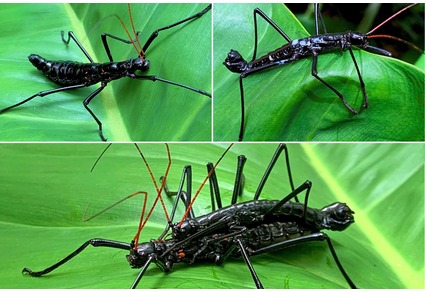

Abstract
The genus Autolyca Stål, 1875 (Pseudophasmatidae: Pseudophasmatinae: Anisomorphini) comprises several species endemic to Nuclear Central America. Here, we report the first record of Autolyca pallidicornis Stål, 1875 from Honduras, based on specimens from the Celaque Mountains and historical, previously unreported museum material from a nearby locality in Gracias housed in the Field Museum of Natural History (FMNH), Chicago. The species can be distinguished by its characteristic shiny black coloration, robust abdomen, orange-yellowish antennae, and distinctive genital structures. Previously, A. herculeana Conle & Hennemann, 2002 was the only species of the genus formally recorded from the country. With this new record, two species of Autolyca are now formally known from Honduras. Additionally, we provide notes on the natural history of the species and a taxonomic review of the genus Autolyca. This finding underscores the importance of studying the diversity of phasmids and other taxa in this region to better understand its distribution and biogeographic patterns.
References
- Atkinson, D. (1994) Temperature and organism size: a biological law for ectotherms? Advances in Ecological Research, 25, 1–58. https://doi.org/10.1016/s0065-2504(08)60212-3
- Bragg, P.E. (1993) Parasites of Phasmida. The Entomologist, 112 (1), 37–42.
- Brock, P.D. (1998) Catalogue of type specimens of Stick- and Leaf-insects in the Naturhistorisches Museum Wien (Insecta: Phasmida). Kataloge der wissenschaftlichen Sammlungen des Naturhistorischen Museums in Wien, 13 (5), 72 pp.
- Brock, P.D., Marshall, J.A., Beccaloni, G.W. & Harman, A.J.E. (2016) The types of Phasmida in the Natural History Museum, London, UK. Zootaxa, 4179 (2), 151–208. https://doi.org/10.11646/zootaxa.4179.2.1
- Brock, P.D. & Büscher, T.H. (2022) Stick and leaf-insects of the world. Phasmids. N.A.P. Editions, Verrières-le-Buisson, 611 pp.
- Brock, P.D., Büscher, T. & Baker, E. (2026) Phasmida Species File Online. Available from: https://phasmida.speciesfile.org/ (accessed 20 February 2026).
- Burack, J., Gorb, S.N. & Büscher, T.H. (2022) Attachment performance of stick insects (Phasmatodea) on plant leaves with different surface characteristics. Insects, 13 (10), 952. https://doi.org/10.3390/insects13100952
- Chown, S.L. & Gaston, K.J. (2010) Body size variation in insects: a macroecological perspective. Biological Reviews, 85, 139–169. https://doi.org/10.1111/j.1469-185x.2009.00097.x
- Camousseight, A. (2005) Redefinición del género Agathemera Stål, 1875 (Phasmatodea, Pseudophasmatidae). Revista Chilena de Entomología, 31, 13–20.
- Conle, O.V. & Hennemann, F.H. (2002) Revision neotropischer Phasmatodea: Die Tribus Anisomorphini sensu Bradley & Galil 1977 (Insecta, Phasmatodea, Pseudophasmatidae). Spixiana, Supplement No. 28, 1–141, plates 1–19.
- Conle, O.V. & Hennemann, F.H. (2005) Studies on neotropical Phasmatodea I: A remarkable new species of Peruphasma Conle & Hennemann, 2002 from northern Peru (Phasmatodea: Pseudophasmatidae: Pseudophasmatinae). Zootaxa, 1068, 1–59. https://doi.org/10.11646/zootaxa.1068.1.5
- Delfosse, E., Cliquennois, N., Depraetere, M. & Robillard, T. (2019) Catalogue des types de la collection de phasmes du Muséum national d’Histoire naturelle de Paris (Insecta, Phasmatodea). Zoosystema, 41 (11), 181–235. https://doi.org/10.5252/zoosystema2019v41a11
- de Luna, M. (2022) Checklist of stick insects (Insecta: Phasmatodea) of North America, with three new records for Nuevo León, México. Phasmid Studies, 21, 90–105.
- de Luna, M., García-Barrios, R., Cuéllar-Rodríguez, G. & López-Mora, U. (2023) A new record of a winged stick insect (Phasmatodea) from Mexico, with a checklist and key to the species of the family Pseudophasmatidae from continental North America. Journal of Orthoptera Research, 32 (2), 171–176. https://doi.org/10.3897/jor.32.98203
- GBIF (2026) In GBIF. Global Biodiversity Information Facility. Available from: https://www.gbif.org (accessed 20 February 2026).
- Google LLC (2025) Google Earth Pro (Version 7.3). Available from: https://www.google.com/earth/ (accessed 28 December 2025)
- Gorochov, A.V. & Berezin, M.V. (2008) A new species of the genus Autolyca Stål (Phasmatoptera) from Mexico. Russian Entomological Journal, 17 (2), 135–138.
- Holdridge, L.R. (1967) Life zone ecology. Tropical Science Center, San José, 206 pp.
- iNaturalist (2026) In iNaturalist. Available from: https://www.inaturalist.org (accessed 20 February 2026).
- Krantz, G.W. (1970) A Manual of Acarology. Cornell University Press, Highlands, New Jersey, 335 pp.
- López-Mora, U. & Llorente-Bousquets, J. (2018) Lista de especies y clave ilustrada de los géneros de Phasmatodea (Insecta) de México. Revista Mexicana de Biodiversidad, 89 (1), 46–78. https://doi.org/10.22201/ib.20078706e.2018.1.2175
- Mariño, P.E. & Márquez, M.C. (1983) Primer registro del género Autolyca Stål, 1875 para México (Insecta: Phasmatodea). Anales del Instituto de Biología, Universidad Nacional Autónoma de México, Serie Zoología, 54, 213–215.
- Otte, D. & Brock, P. (2005) Phasmid Species File. Catalog of Stick and Leaf Insects of the World, 2nd Edition. The Insect Diversity Association and the Academy of Natural Sciences, Philadelphia, 414 pp.
- Oviedo-Maas, A., Flores-Suazo, S.M., Hernandez-Osorio, J.C., Mérida, J.E. & Cruz, G.A. (2026) Contribution to the knowledge of Autolyca herculeana (Phasmatodea: Pseudophasmatidae): record from Honduras and first descriptions of the female and eggs. Zootaxa, 5748 (1), 135–143. https://doi.org/10.11646/zootaxa.5748.1.9
- QGIS Development Team (2025) QGIS Geographic Information System. Open Source Geospatial Foundation. Available from: http://qgis.osgeo.org (accessed 2 Nov. 2025)
- Redtenbacher, J. (1906) Die Insektenfamilie der Phasmiden. I. Phasmidae Areolatae (Clitumnini, Lonchodini, Bacunculini). Wilhelm Engelmann, Leipzig, 339 pp., pls. 1–6.
- Shelford, R. (1909) Family Phasmidae. In: Godman, F.D.C. & Salvin, O. (Eds.), Biologia Centrali-Americana. Insecta Orthoptera. Vol. 2. Porter, London, pp. 343–377, pls. 5–8.
- Shelomi, M. (2012) Where are we now? Bergmann’s rule sensu lato in insects. The American Naturalist, 180, 511–519. https://doi.org/10.1086/667595
- Southcott, R.V. (1961) Studies on the systematics and biology of the Erythraeoidea (Acarina) with a critical revision of the genera and subfamilies. Australian Journal of Zoology, 9, 367–610. https://doi.org/10.1071/zo9610367
- Stål, C. (1875) Recensio Orthopterorum. Revue critique des Orthoptères decrits par Linné, de Geer et Thunberg. P.A. Norstedt & Söner, Stockholm, 105 pp.
- Zeng, Y., O'Malley, C., Singhal, S., Rahim, F., Park, S., Chen, X. & Dudley, R. (2020) A tale of winglets: evolution of flight morphology in stick insects. Frontiers in Ecology and Evolution, 8, 121. https://doi.org/10.3389/fevo.2020.00121
- Zompro, O. & Hennemann, F.H. (2001) A new species of Autolyca Stål, 1875, from El Salvador (Insecta: Phasmatodea: Pseudophasmatidae, Anisomorphini). Nachrichten des entomologischen Vereins Apollo, (NF) 22 (3), 175–176.
- Zompro, O. (2004) Revision of the genera of the Areolatae, including the status of Timema and Agathemera (Insecta, Phasmatodea). Abhandlungen des Naturwissenschaftlichen Vereins in Hamburg, (NF) 37, 327 pp, 161 figs.