

Abstract
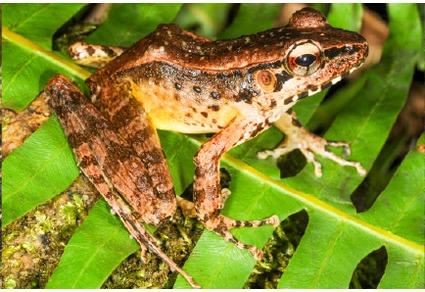
The frog family Ranidae includes many cryptic taxa due to their high morphological similarity and broad distributions. The majority of original descriptions and distributional records have been based primarily on morphological identification alone, often lacking genetic support. This has led to instability and controversy in their taxonomy. The taxonomic status of Odorrana gigatympana (Orlov, Ananjeva & Ho, 2006), which was described and distributed in central Vietnam, has remained problematic since its original description. This study reassesses this species using both morphological comparisons and newly generated mitochondrial 16S rRNA sequence data (newly generated in this study) from the paratype of O. absita (Stuart & Chan-ard, 2005), the topotypic material of O. gigatympana, and additional specimens collected extensively across the Kon Tum–Gia Lai Plateau of central Vietnam. Our results demonstrate that the diagnostic traits previously used to distinguish the two taxa, particularly the relatively large tympanum, fall within the range of intraspecific variation of O. absita, and largely reflect sexual dimorphism. Mitochondrial sequence data reveal no genetic differentiation between O. gigatympana and O. absita. We therefore treat O. gigatympana as a junior synonym of O. absita, which occurs on the Kon Tum–Gia Lai Plateau of central Vietnam and in adjacent areas of southern Laos. This study highlights the importance of combining morphological and molecular evidence, as well as broad geographic sampling, to clarify species boundaries and assess the conservation status of Asian ranid frogs.
References
- Arkhipov, D.V., Pawangkhanant, P., Sarker, G., Gorin, V.A., Bragin, A.M., Nguyen, T.V., Hamidy, A., Muin, M.A., Kurniawan, N., Brown, R.M., Suwannapoom, C., Smith, E. & Poyarkov, N.A. (2025) A taxonomic revision of the Ingerophrynus parvus species complex (Amphibia: Anura: Bufonidae) with the description of a new species from Thailand. Herpetozoa, 38, 271–297. https://doi.org/10.3897/herpetozoa.38.e165173
- Bain, R.H. & Nguyen, T.Q. (2005) Geographic distribution: Huia absita. Herpetological Review, 36, 332.
- Bain, R.H., Nguyen, T.Q. & Doan, K.V. (2007) New herpetofaunal records from Vietnam. Herpetological Review, 38, 107–117.
- Bain, R.H., Stuart, B.L., Nguyen, T.Q., Che, J. & Rao, D.Q. (2009) A new Odorrana (Amphibia: Ranidae) from Vietnam and China. Copeia, 2009, 348–362. https://doi.org/10.1643/CH-07-195
- Che, J., Pang, J.F., Zhao, H., Wu, G.F., Zhao, E.M. & Zhang, Y.P. (2007) Phylogeny of Raninae (Anura: Ranidae) inferred from mitochondrial and nuclear sequences. Molecular Phylogenetics and Evolution, 43, 1–13. https://doi.org/10.1016/j.ympev.2006.11.032
- Chen, L., Murphy, R.W., Lathrop, A., Ngo, A., Orlov, N.L., Ho, C.T. & Somorjai, I.L.M. (2005) Taxonomic chaos in Asian ranid frogs: an initial phylogenetic resolution. Herpetological Journal, 15, 231–243.
- Chen, W.C., Mo, Y.M., Lin, L. & Qin, K. (2024) A new species of Odorrana Fei, Ye & Huang, 1990 (Amphibia: Anura: Ranidae) from central Guangxi, China with a discussion of the taxonomy of Odorrana (Bamburana). ZooKeys, 1190, 131–152. https://doi.org/10.3897/zookeys.1190.109886
- Chen, X.H., Chen, Z., Jiang, J.P., Qiao, L., Lu, Y.Q., Zhou, K.Y., Zheng, G.M., Zhai, X.F. & Liu, J.X. (2013) Molecular phylogeny and diversification of the genus Odorrana (Amphibia, Anura, Ranidae) inferred from two mitochondrial genes. Molecular Phylogenetics and Evolution, 69, 1196–1202. https://doi.org/10.1016/j.ympev.2013.07.023
- Chen, Z., Li, H.Y., Zhai, X.F., Zhu, Y.J., He, Y.X., Wang, Q.Y., Li, Z., Jiang, J.P., Xiong, R.C. & Chen, X.H. (2019) Phylogeography, speciation and demographic history: contrasting evidence from mitochondrial and nuclear markers of the Odorrana graminea sensu lato (Anura, Ranidae) in China. Molecular Phylogenetics and Evolution, 144, 106701. https://doi.org/10.1016/j.ympev.2019.106701
- Dubois, A. (1992) Notes sur la classification des Ranidae (Amphibiens anoures). Bulletin Mensuel de la Société Linnéenne de Lyon, 61, 305–352. https://doi.org/10.3406/linly.1992.11011
- Frost, D.R. (2007) Amphibian Species of the World: An Online Reference. Version 5.1. American Museum of Natural History, New York. Available from: https://amphibiansoftheworld.amnh.org/ (accessed 1 March 2026)
- Frost, D.R. (2026) Amphibian Species of the World: An Online Reference. Version 6.4. American Museum of Natural History, New York. Available from: https://amphibiansoftheworld.amnh.org/ (accessed 1 March 2026)
- Frost, D.R., Grant, T., Faivovich, J., Bain, R.H., Haas, A., Haddad, C.F.B., de Sá, R.O., Channing, A., Wilkinson, M., Donnellan, S.C., Raxworthy, C.J., Campbell, J.A., Blotto, B.L., Moler, P.E., Drewes, R.C., Nussbaum, R.A., Lynch, J.D., Green, D.M. & Wheeler, W.C. (2006) The amphibian tree of life. Bulletin of the American Museum of Natural History, 297, 1–370. https://doi.org/10.1206/0003-0090(2006)297[0001:TATOL]2.0.CO;2
- Gorin, V.A., Orlov, N.L., Bragin, A.M., Pawangkhanant, P., Milto, K.D., Le, D.X., Nguyen, T.V., Suwannapoom, C. & Poyarkov, N.A. (2024) Phylogeographic pattern and taxonomic revision of the Kaloula baleata species complex (Amphibia: Anura: Microhylidae) with description of two new species from Indochina. Herpetozoa, 37, 391–420. https://doi.org/10.3897/herpetozoa.37.e137394
- Hall, T.A. (1999) BioEdit: a user–friendly biological sequence alignment editor and analysis program for Windows 95/98/NT. Nucleic Acids Symposium Series, 41, 95–98.
- Hedges, S.B. (1994) Molecular evidence for the origin of birds. Proceedings of the National Academy of Sciences of the United States of America, 91 (7), 2621–2624.
- Hillis, D.M., Moritz, C., Mable, B.K. & Graur, D. (1996) Molecular systematics. Sinauer Associates, Inc., Sunderland, Massachusetts, 655 pp.
- Huelsenbeck, J.P. & Hillis, D.M. (1993) Success of phylogenetic methods in the four-taxon case. Systematic Biology, 42 (3), 247–264. https://doi.org/10.1093/sysbio/42.3.247
- Kilunda, F.K., Yang, S.P., Nguyen, L.T., Le, M.V., Suwannapoom, C., Stuart, B.L., Nguyen, S.N., Zuo, A.R., Zhang, D.C., Duan, Z.P., Duan, P.W., Yu, Z.B., Wu, Y.H. & Che, J. (2025) Unveiling hidden diversity in Odorrana (Anura, Ranidae) with description of a new species from Yingjiang, China and the first national records of Odorrana heatwolei in Thailand and Vietnam. Zoosystematics and Evolution, 101 (4), 2337–2356. https://doi.org/10.3897/zse.101.162366
- Kumar, S., Stecher, G. & Tamura, K. (2016) MEGA7: Molecular Evolutionary Genetics Analysis version 7.0 for bigger datasets. Molecular Biology and Evolution, 33 (7), 1870–1874. https://doi.org/10.1093/molbev/msw054
- Kurabayashi, A., Yoshikawa, N., Sato, N., Hayashi, Y., Oumi, S., Fujii, T. & Sumida, M. (2010) Complete mitochondrial DNA sequence of the endangered frog Odorrana ishikawae (family Ranidae) and unexpected diversity of mt gene arrangements in ranids. Molecular Phylogenetics and Evolution, 56, 543–553. https://doi.org/10.1016/j.ympev.2010.01.022
- Lanfear, R., Calcott, B., Ho, S.Y. & Guindon, S. (2012) PartitionFinder: combined selection of partitioning schemes and substitution models for phylogenetic analyses. Molecular Biology and Evolution, 29 (6), 1695–1701. https://doi.org/10.1093/molbev/mss020
- Li, S., Xu, N., Lv, J., Jiang, J., Wei, G. & Wang, B. (2018) A new species of the odorous frog genus Odorrana (Amphibia, Anura, Ranidae) from southwestern China. PeerJ, 6, e5695. https://doi.org/10.7717/peerj.5695
- Li, S.Z., Chen, J.J., Su, H.J., Liu, J., Tang, X.J. & Wang, B. (2024) A new odorous frog species of Odorrana (Amphibia, Anura, Ranidae) from Guizhou Province, China. ZooKeys, 1192, 57–82. https://doi.org/10.3897/zookeys.1192.114315
- Li, S.Z., Mu, L., Jing, J.H., Liu, L., Cheng, Y.L. & Wang, B. (2025) A new species of the genus Odorrana (Amphibia, Anura, Ranidae) from Guizhou Province, China. Zoosystematics and Evolution, 101 (4), 1949–1964. https://doi.org/10.3897/zse.101.161151
- Lin, S.S., Li, Y.H., Su, H.L., Yi, H., Pan, Z., Sun, Y.J., Zeng, Z.C. & Wang, J. (2022) Discovery of a new limestone karst-restricted odorous frog from northern Guangdong, China (Anura, Ranidae, Odorrana). ZooKeys, 1120, 47–66. https://doi.org/10.3897/zookeys.1120.87067
- Liu, S., Hou, M., Wang, Q., Rao, D. & Li, S. (2023) Resurrection and distribution extension of Odorrana heatwolei (Stuart & Bain, 2005) (Anura, Ranidae). Herpetozoa, 36, 177–188. https://doi.org/10.3897/herpetozoa.36.e106373
- Liu, S., Rao, D., Zhang, D., Lwin, Y.H., Mo, M., Zuo, C., Yin, F., Quan, R. & Li, S. (2022) Phylogenetic position of Odorrana macrotympana (Yang, 2008) (Anura, Ranidae) and extension of its geographical distribution. Herpetozoa, 35, 9–19. https://doi.org/10.3897/herpetozoa.35.e77147
- Liu, X., He, Y., Wang, Y., Beukema, W., Hou, S., Li, Y., Che, J. & Yuan, Z. (2021) A new frog species of the genus Odorrana (Anura: Ranidae) from Yunnan, China. Zootaxa, 4908, 263–275. https://doi.org/10.11646/zootaxa.4908.2.7
- Luo, T., Wang, S.W., Xiao, N., Wang, Y.L. & Zhou, J. (2021) A new species of odorous frog genus Odorrana (Anura, Ranidae) from southern Guizhou Province, China. Asian Herpetological Research, 12 (4), 381–398. https://doi.org/10.16373/j.cnki.ahr.200122
- Matsui, M., Shimada, T., Ota, H. & Tanaka-Ueno, T. (2005) Multiple invasions of the Ryukyu Archipelago by Oriental frogs of the subgenus Odorrana with phylogenetic reassessment of the related subgenera of the genus Rana. Molecular Phylogenetics and Evolution, 37, 733–742. https://doi.org/10.1016/j.ympev.2005.04.030
- Minh, B.Q., Nguyen, M.A.T. & von Haeseler, A. (2013) Ultrafast approximation for phylogenetic bootstrap. Molecular Biology and Evolution, 30 (5), 1188–1195. https://doi.org/10.1093/molbev/mst024
- Mo, Y., Chen, W., Wu, H., Zhang, W. & Zhou, S. (2015) A new species of Odorrana inhabiting complete darkness in a karst cave in Guangxi, China. Asian Herpetological Research, 6, 11–17. https://doi.org/10.16373/j.cnki.ahr.140054
- Ngo, H.T., Le, M.D., Pham, C.T. & Nguyen, T.Q. (2016) Species diversity and phylogenetic relationships of the genus Odorrana (Amphibia: Anura: Ranidae) from northern Vietnam. In: Proceedings of the 2nd National Scientific Workshop on Amphibians and Reptiles in Vietnam. Publishing House for Science and Technology, Hanoi, pp. 67–76. [in Vietnamese]
- Nguyen, L.T., Schmidt, H.A., von Haeseler, A. & Minh, B.Q. (2015) IQ-TREE: a fast, effective stochastic algorithm for estimating maximum-likelihood phylogenies. Molecular Biology and Evolution, 32 (1), 268–274. https://doi.org/10.1093/molbev/msu300
- Nguyen, S.V., Ho, C.T. & Nguyen, T.Q. (2009) Herpetofauna of Vietnam. Edition Chimaira, Frankfurt am Main, 786 pp.
- Nguyen, T.V., Ohler, A. & Poyarkov, N.A. (2026a) Proposed transfer of Hylarana margariana Anderson, 1879 to the genus Odorrana Fei, Ye & Huang, 1990 (Anura: Ranidae). Zootaxa, 5760 (5), 590–596. https://doi.org/10.11646/zootaxa.5760.5.7
- Nguyen, T.V., Pham, C.T., Do, D.T., Ziegler, T. & Nguyen, T.Q. (2018) New records and first description of females of the large-eared frog, Odorrana gigatympana (Orlov, Ananjeva et Ho, 2006) (Anura: Ranidae), from Vietnam. Russian Journal of Herpetology, 25, 239–244. https://doi.org/10.30906/1026-2296-2019-25-3-239-244
- Nguyen, T.V., Ren, J.L., Duong, T.V., Orlov, N.L., Poyarkov, N.A. & Ohler, A. (2026b) Taxonomic reassessment of Rana (Hylorana) sinica Ahl, 1927 “1925” (Anura: Ranidae), with its synonymy with Amolops mantzorum (David, 1872). Zootaxa, 5796 (2), 381–392. https://doi.org/10.11646/zootaxa.5796.2.11
- Oliver, L.A., Prendini, E., Kraus, F. & Raxworthy, C.J. (2015) Systematics and biogeography of the Hylarana frog (Anura, Ranidae) radiation across tropical Australasia, Southeast Asia, and Africa. Molecular Phylogenetics and Evolution, 90, 176–192. https://doi.org/10.1016/j.ympev.2015.05.001
- Orlov, N.L., Ananjeva, N.B. & Ho, C.T. (2006) A new cascade frog (Amphibia: Ranidae) from central Vietnam. Russian Journal of Herpetology, 13, 155–163.
- Pham, C.T., Nguyen, T.Q., Le, M.D., Bonkowski, M. & Ziegler, T. (2016) A new species of Odorrana (Amphibia: Anura: Ranidae) from Vietnam. Zootaxa, 4084, 421–435. https://doi.org/10.11646/zootaxa.4084.3.7
- Poyarkov, N.A., Nguyen, T.V. & Arkhipov, D.V. (2021) A new species of the genus Tylototriton (Amphibia: Caudata: Salamandridae) from central Vietnam. Taprobanica, 10, 4–22. https://doi.org/10.47605/tapro.v10i1.244
- Poyarkov, N.A., Nguyen, T.V., Duong, T.V., Le, S.X. & Orlov, N.L. (2025) A new species of Leptobrachella (Anura: Megophryidae) from Chu Yang Sin National Park, Dak Lak Province, southern Vietnam. Russian Journal of Herpetology, 32 (4), 293–308. https://doi.org/10.30906/1026-2296-2025-32-4-293-308
- Poyarkov, N.A., Nguyen, T.V., Le, S.X., Le, D.X., Arkhipov, D.V., Gorin, V.A., Hernandez, A. & Dufresnes, C. (2024) Multiple lines of evidence for a new cryptic species of Tylototriton (Amphibia: Salamandridae) from northern Vietnam. Alytes, 41 (1–4), 56–98.
- Poyarkov, N.A., Nguyen, T.V., Popov, E.S., Geissler, P., Pawangkhanant, P., Neang, T., Suwannapoom, C. & Orlov, N.L. (2021) Recent progress in taxonomic studies, biogeographic analysis, and revised checklist of amphibians of Indochina. Russian Journal of Herpetology, 28 (3A), 1–110. https://doi.org/10.30906/1026-2296-2021-28-3A-1-110
- Poyarkov, N.A., Nguyen, T.V., Trofimets, A.V. & Gorin, V.A. (2020) A new cryptic species of the genus Microhyla (Amphibia: Microhylidae) from Langbian Plateau, Vietnam. Taprobanica, 9 (2), 136–163. https://doi.org/10.47605/tapro.v9i2.228
- Puillandre, N., Brouillet, S. & Achaz, G. (2021) ASAP: Assemble species by automatic partitioning. Molecular Ecology Resources, 21 (2), 609–620. https://doi.org/10.1111/1755-0998.13281
- R Core Team (2024) R: A language and environment for statistical computing. R Foundation for Statistical Computing, Vienna, Austria. Available from: https://www.R-project.org/ (accessed 19 May 2026)
- Ronquist, F. & Huelsenbeck, J.P. (2003) MrBayes 3: Bayesian phylogenetic inference under mixed models. Bioinformatics, 19 (12), 1572–1574. https://doi.org/10.1093/bioinformatics/btg180
- Savage, J.M. (1975) Systematics and distribution of the Mexican and Central American stream frogs related to Eleutherodactylus rugulosus. Copeia, 1975, 254–306. https://doi.org/10.2307/1442883
- Song, H., Zhang, S., Qi, S., Lyu, Z., Zeng, Z., Zhu, Y., Huang, M., Luan, F., Shu, Z., Gong, Y., Liu, Z. & Wang, Y. (2023) Redefinition of the Odorrana versabilis group, with a new species from China (Anura, Ranidae, Odorrana). Asian Herpetological Research, 14, 283–299. https://doi.org/10.3724/ahr.2095-0357.2023.0019
- Stuart, B.L. & Chan-ard, T. (2005) Two new Huia (Amphibia: Ranidae) from Laos and Thailand. Copeia, 2005 (2), 279–289. https://doi.org/10.1643/ch-04-137r3
- Stuart, B.L. (2008) The phylogenetic problem of Huia (Amphibia: Ranidae). Molecular Phylogenetics and Evolution, 46, 49–60. https://doi.org/10.1016/j.ympev.2007.09.016
- Stuart, B.L., Chuaynkern, Y., Chan-ard, T. & Inger, R.F. (2006) Three new species of frogs and a new tadpole from eastern Thailand. Fieldiana Zoology, 111, 1–19. https://doi.org/10.3158/0015-0754(2006)187[1:tnsofa]2.0.co;2
- Stuart, B.L., Seateun, S., Sivongxay, N. & Phimmachak, S. (2024) Amphibians (Class Amphibia). In: Wildlife in Lao PDR. 2024 Status Report. Wildlife Conservation Society Lao PDR Program, Vientiane, Laos, pp. 17–48.
- Tariang, A.D., Vabeiryureilai, M., Malsawmdawngliana, F. & Lalremsanga, H.T. (2025) Phylogenetic confirmation of generic allocation and specific distinction of Odorrana mawphlangensis (Pillai & Chanda, 1977) (Amphibia: Anura: Ranidae) and its updated distribution records. Journal of Threatened Taxa, 17 (11), 27863–27873. https://doi.org/10.11609/jott.9820.17.11.27863-27873
- Thompson, J.D., Gibson, T.J., Plewniak, F., Jeanmougin, F. & Higgins, D.G. (1997) The CLUSTAL X windows interface: flexible strategies for multiple sequence alignment aided by quality analysis tools. Nucleic Acids Research, 25 (24), 4876–4882. https://doi.org/10.1093/nar/25.24.4876
- Tran, T.A.D. (2013) Taxonomy and ecology of amphibian communities in southern Vietnam: linking morphology and bioacoustics. Unpublished PhD dissertation, Rheinische Friedrich-Wilhelms-Universität Bonn, Bonn, Germany, 257 pp.
- Trofimets, A.V., Dufresnes, C., Pawangkhanant, P., Bragin, A.M., Gorin, V.A., Hasan, M., Lalremsanga, H.T., Muin, M.A., Le, D.X., Nguyen, T.V., Suwannapoom, C. & Poyarkov, N.A. (2024) Four in one: an integrative taxonomic revision of the Microhyla berdmorei complex (Amphibia: Anura: Microhylidae) illustrates the tremendous amphibian diversity of Southeast Asia. Vertebrate Zoology, 74, 595–641. https://doi.org/10.3897/vz.74.e127937
- Wang, Y.Y., Lau, M.W.N., Yang, J.H., Chen, G.L., Liu, Z.Y., Pang, H. & Liu, Y. (2015) A new species of the genus Odorrana (Amphibia: Ranidae) and the first record of Odorrana bacboensis from China. Zootaxa, 3999, 235–254. https://doi.org/10.11646/zootaxa.3999.2.4
- Xue, R., Liu, J., Yu, J. & Yang, J. (2016) The complete mitogenome of Amolops loloensis and related phylogenetic relationship among Ranidae. Mitochondrial DNA. Part A. DNA Mapping, Sequencing, and Analysis, 27, 4629–4630. https://doi.org/10.3109/19401736.2015.1101589
- Yuan, Z.Y., Zhou, W.W., Chen, X., Poyarkov, N.A., Chen, H.M., Jang-Liaw, N.H., Chou, W.H., Matzke, N.J., Iizuka, K., Min, M.S., Kuzmin, S.L., Zhang, Y.P., Cannatella, D.C., Hillis, D.M. & Che, J. (2016) Spatiotemporal diversification of the true frogs (genus Rana): a historical framework for a widely studied group of model organisms. Systematic Biology, 65, 824–842. https://doi.org/10.1093/sysbio/syw055
- Zhang, B., Li, Y., Hu, K., Li, P., Gu, Z., Xiao, N. & Yang, D. (2021) A new species of Odorrana (Anura, Ranidae) from Hunan Province, China. ZooKeys, 1024, 91–115. https://doi.org/10.3897/zookeys.1024.56399
- Zhang, J., Kapli, P., Pavlidis, P. & Stamatakis, A. (2013) A general species delimitation method with applications to phylogenetic placements. Bioinformatics, 29, 2869–2876. https://doi.org/10.1093/bioinformatics/btt499