
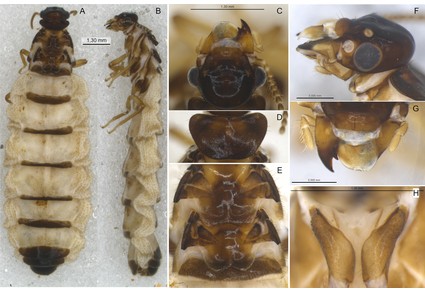

Abstract
Tiunatermes tapirape, sp. nov., is described and illustrated based on morphological characters of the reproductive, soldier, and worker castes. Specimens were collected from the Brazilian savannah (Cerrado sensu stricto) in Goiás and Distrito Federal, and the Brazilian ombrophilous forest in Pará and Mato Grosso, thus broadening the geographical distribution of the genus. The reproductive caste was previously unknown for Tiunatermes Carrijo, Cuezzo & Santos. Tiunatermes tapirape, sp. nov., differs from the formerly described species, Tiunatermes mariuzani Carrijo, Cuezzo & Santos, mostly in the broader head and nasus of its soldiers.
References
- Azevedo-Santos, V.M., Rodrigues-Filho, J.L., Fearnside, P.M., Lovejoy, T. & Brito, M.F.G. (2021) Conservation of Brazilian freshwater biodiversity: Thinking about the next 10 years and beyond. Biodiversity and Conservation, 30, 235–241. https://doi.org/10.1007/s10531-020-02076-5
- Carrijo, T.F., Cuezzo, C. & Santos, R.G. (2015) Tiunatermes mariuzani gen. nov. et sp. nov., a new nasute termite from the Brazilian savannah (Isoptera: Termitidae). Austral Entomology, 54 (4), 358–365. https://doi.org/10.1111/aen.12137
- Ferrante, L. & Fearnside, P.M. (2019) Brazil’s new president and ‘ruralists’ threaten Amazonia’s environment, traditional peoples and the global climate. Environmental Conservation, 46, 261–263. https://doi.org/10.1017/S0376892919000213
- Fontes, L.R. (1987) Morphology of the alate and worker mandibles of the soil-feeding nasute termites (Isoptera, Termitidae, Nasutitermitinae) from the Neotropical region. Revista brasileira de Zoologia, 3 (8), 503–531. https://doi.org/10.1590/S0101-81751986000400003
- Krishna, K., Grimaldi, D.A., Krishna, V. & Engel, M.S. (2013) Treatise on the Isoptera of the world. Bulletin of the American Museum of Natural History, 377, 1497–1987. [http://hdl.handle.net/2246/6430] https://doi.org/10.1206/377.1
- Noirot, C. (2001) The gut of termites (Isoptera). Comparative anatomy, systematics, phylogeny. II. Higher termites (Termitidae). Annales de la Société Entomologique de France, 37 (4), 431–471.
- Oliveira, D.E., Cunha, H.F. & Constantino, R. (2014) A taxonomic revision of the soil-feeding termite genus Anhangatermes (Isoptera: Termitidae: Nasutitermitinae). Zootaxa, 3869 (5), 523–536. https://doi.org/10.11646/zootaxa.3869.5.2
- Pocock, M.J.O., Chandler, M., Bonney, R., Thornhill, I., Albin, A., August, T., Bachman, S., Brown, P.M.J., Cunha, D.G.F., Grez, A., Jackson, C., Peters, M., Rabarijaon, N.R., Roy, H.E., Zaviezo, T. & Danielsen, F. (2018) A Vision for Global Biodiversity Monitoring With Citizen Science. In: Advances in Ecological Research, Vol. 59 Academic Press Inc., pp. 169–223. https://doi.org/10.1016/bs.aecr.2018.06.003
- Rocha, M.M., Cuezzo, C., Constantini, J.P., Oliveira, D.E., Santos, R.G., Carrijo, T.F. & Cancello, E.M. (2019) Overview of the Morphology of Neotropical Termite Workers: History and Practice. Sociobiology, 66 (1), 1–32. https://doi.org/10.13102/sociobiology.v66i1.2067
- Roonwal, M.L. (1970) Measurements of termites (Isoptera) for taxonomic purposes. Journal of Zoological Society of India, 21, 9–66.