

Abstract
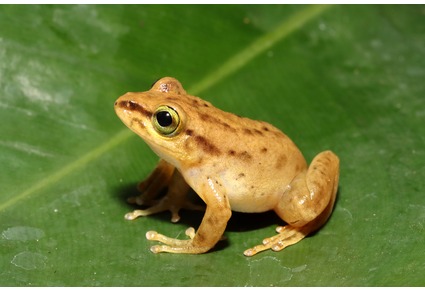
Central Africa is characterized by exceptionally high amphibian diversity, including members of the family Hyperoliidae, a group restricted to sub-Saharan Africa, Madagascar, and the Seychelles. The genus Cryptothylax is easily recognized from other hyperoliids by its brownish-orange (males) to orange-red (females) colouration and the typical large gular gland covering the entire throat of males. The genus presently contains two recognized species, the large-bodied and widespread C. greshoffii and the small-bodied C. minutus, a supposed endemic of the Lake Tumba region in the western Democratic Republic of the Congo. Cryptothylax greshoffii is a common inhabitant of open sites in the Congolian forest zone, typically riverbanks, while C. minutus has not been recorded since 1955, when its type series was collected from open habitats at two sites near Mabali, eastern Lake Tumba area. The latter taxon was described by its collector after >20 years (1976), but since the description its species status has been disputed as the only ‘clear’ diagnostic feature is its smaller size. During a recent field survey at the type locality, a series of small-bodied adult Cryptothylax individuals corresponding to C. minutus was collected. Here, we present molecular and morphological investigations of the newly collected material in comparison with C. greshoffii from across its range and morphological comparisons with the holotype of C. minutus. Molecular analyses uncovered low genetic variation across the genus’ range, including shared alleles in both mitochondrial and nuclear markers between the small and large Cryptothylax, confirming their conspecificity. Morphometric analyses also found no significant differences except for the body size. Therefore, we place C. minutus in the synonymy of C. greshoffii, making the genus Cryptothylax monotypic. We also document small adult individuals of C. greshoffii from other distant areas in the Congo Basin. Whether the small body size represents a young age cohort or an ecological morphotype remains a subject for further research.
References
- Arino, O., Ramos Perez, J.J., Kalogirou, V., Bontemps, S., Defourny, P. & Van Bogaert, E. (2012) Global Land Cover Map for 2009 (GlobCover 2009). European Space Agency (ESA) & Université catholique de Louvain (UCL), PANGAEA. https://doi.org/10.1594/PANGAEA.787668
- Badjedjea, G., Masudi, F.M., Dudu, B.A. & Gvoždík, V. (2022) Amphibians of Kokolopori: an introduction to the amphibian fauna of the Central Congolian Lowland Forests, Democratic Republic of the Congo. Amphibian and Reptile Conservation, 16, 35–70.
- Badjedjea, G., Masudi, F.M., Dudu, B.A. & Gvoždík, V. (2023) Predation by the Large Green-eyed Frog, Cryptothylax greshoffii (Schilthuis, 1889), on Osorioi’s Spiny Reed Frog, Afrixalus osorioi (Ferreira, 1906), in Sankuru Nature Reserve, Democratic Republic of the Congo. Herpetology Notes, 16, 439–441.
- Beadle, L.C. (1981) The Inland Waters of Tropical Africa. 2nd Edition. Longman, London, 365 pp.
- Bell, R.C., McLaughlin, P.J., Jongsma, G.F.M., Blackburn, D.C. & Stuart, L. (2019) Morphological and genetic variation of Leptopelis brevirostris encompasses the little-known treefrogs Leptopelis crystallinoron from Gabon and Leptopelis brevipes from Bioko Island, Equatorial Guinea. African Journal of Herpetology, 68, 91–117. https://doi.org/10.1080/21564574.2019.1681523
- Bossuyt, F. & Milinkovitch, M.C. (2000) Convergent adaptive radiations in Madagascan and Asian ranid frogs reveal covariation between larval and adult traits. Proceedings of the National Academy of Sciences of the United States of America, 97, 6585–6590. https://doi.org/10.1073/pnas.97.12.6585
- Burgess, N., D’Amico Hales, J., Underwood, E., Dinerstein, E., Olson, D., Itoua, I., Schipper, J., Ricketts, T. & Newman, K. (2004) Terrestrial Ecoregions of Africa and Madagascar. A Conservation Assessment. Island Press, Washington, Covelo, London, 497 pp.
- Chambers, J.M., Freeny, A. & Heiberger, R.M. (1992) Analysis of variance; designed experiments. In: Chambers, J.M. & Hastie, T.J. (Eds.), Statistical Models in S. Wadsworth & Brooks/Cole, Pacific Grove, 608 pp.
- Channing, A. & Rödel, M.-O. (2019) Filed Guide to the Frogs and Other Amphibians of Africa. Struik Nature, Cape Town, 408 pp.
- Clement, M., Snell, Q., Walker, P., Posada, D. & Crandall, K. (2002) TCS: Estimating gene genealogies. Parallel and Distributed Processing Symposium, International Proceedings, 2, 184. https://doi.org/10.1109/ipdps.2002.1016585
- Collete, M. & Trape, J.-F. (2020) Une nouvelle et remarquable espèce de naja semi-aquatique (Elapidae, sous-genre Boulengerina Dollo, 1886) dela République Démocratique du Congo. Bulletin de la Société Herpétologique de France, 173, 41–52.
- Delling, B., Zanga, N.L. & Norén, M. (2024) New data on the clupeoids of lakes Mai-Ndombe and Tumba, western Democratic Republic of the Congo, using an integrated approach combining morphology and barcoding. African Zoology, 59, 1–9. https://doi.org/10.1080/15627020.2023.2294749
- Deichmann, J.L., Mulcahy, D.G., Vanthomme, H., Tobi, E., Wynn, A.H., Zimkus, B.M. & McDiarmid, R.W. (2017) How many species and under what names? Using DNA barcoding and GenBank data for west Central African amphibian conservation. PLOS ONE, 12, e0187283. https://doi.org/10.1371/journal.pone.0187283
- Dinerstein, E., Olson, D., Joshi, A., Vynne, C., Burgess, N.D., Wikramanayake, E., Hahn, N., Palminteri, S., Hedao, P., Noss, R., Hansen, M., Locke, H., Ellis, E.C., Jones, B., Barber, C.V., Hayes, R., Kormos, C., Martin, V., Crist, E., Sechrest, W., Price, L., Baillie, J.E.M., Weeden, D., Suckling, K., Davis, C., Sizer, N., Moore, R., Thau, D., Birch, T., Potapov, P., Turubanova, S., Tyukavina, A., De Souza, N., Pintea, L., Brito, J.C., Llewellyn, O.A., Miller, A.G., Patzelt, A., Ghazanfar, S.A., Timberlake, J., Klöser, H., Shennan-Farpón, Y., Kindt, R., Barnekow Lillesø, J.-P., van Breugel, P., Graudal, L., Voge, M., Al-Shammari, K.F. & Saleem, M. (2017) An Ecoregion-Based Approach to Protecting Half the Terrestrial Realm. BioScience, 67, 534–545. https://doi.org/10.1093/biosci/bix014
- Dolinay, M., Nečas, T., Zimkus, B.M., Schmitz, A., Fokam, E.B., Moriarty Lemmon, E., Lemmon, A.R. & Gvoždík, V. (2021) Gene flow in phylogenomics: Sequence capture resolves species limits and biogeography of Afromontane forest endemic frogs from the Cameroon Highlands. Molecular Phylogenetics and Evolution, 163, 107258. https://doi.org/10.1016/j.ympev.2021.107258
- Drewes, R.C. (1984) A phylogenetic analysis of the Hyperoliidae (Anura): treefrogs of Africa, Madagascar, and Seychelles Islands. Occasional Papers of the California Academy of Sciences, 139, 1–70.
- Dubois, A., Ohler, A. & Pyron, R.A. (2021) New concepts and methods for phylogenetic taxonomy and nomenclature in zoology, exemplified by a new ranked cladonomy of recent amphibians (Lissamphibia). Megataxa, 5 (1), 1–738. https://doi.org/10.11646/megataxa.5.1.1
- Evans, B.J., Brown, R.M., McGuire, J.A., Supriatna, J., Andayani, N., Diesmos, A., Iskandar, D., Melnick, D.J. & Cannatella, D.C. (2003) Phylogenetics of Fanged Frogs: Testing Biogeographical Hypotheses at the Interface of the Asian and Australian Faunal Zones. Systematic Biology, 52, 794–819. https://doi.org/10.1093/sysbio/52.6.794
- Frost, D.R. (2026) Amphibian Species of the World: an Online Reference. Version 6.2. Electronic database. American Museum of Natural History, New York. Available from: https://amphibiansoftheworld.amnh.org/ (accessed 23 February 2026)
- Frost, D.R., Grant, T., Faivovich, J., Bain, R.H., Haas, A., Haddad, C.F.B., De Sá, R.O., Channing, A., Wilkinson, M., Donnellan, S.C., Raxworthy, C.J., Campbell, J.A., Blotto, B.L., Moler, P., Drewes, R.C., Nussbaum, R.A., Lynch, J.D., Green, D.M. & Wheeler, W.C. (2006) The amphibian tree of life. Bulletin of the American Museum of Natural History, 297, 1–291.
- Goudie, A.S. (2005) The drainage of Africa since the Cretaceous. Geomorphology, 67, 437–456. https://doi.org/10.1016/j.geomorph.2004.11.008
- Gvoždík, V., Moravec, J. & Kratochvíl, L. (2008) Geographical morphological variation in parapatric Western Palearctic tree frogs, Hyla arborea and Hyla savignyi: are related species similarly affected by climatic conditions? Biological Journal of the Linnean Society, 95, 539–556. https://doi.org/10.1111/j.1095-8312.2008.01056.x
- Hoang, D.T., Chernomor, O., von Haeseler, A., Minh, B.Q. & Vinh, L.S. (2018) UFBoot2: Improving the ultrafast bootstrap approximation. Molecular Biology and Evolution, 35, 518–522. https://doi.org/10.1093/molbev/msx281
- IUCN SSC Amphibian Specialist Group (2013) Cryptothylax greshoffii. The IUCN Red List of Threatened Species, 2013, e.T5609A18371419. https://doi.org/10.2305/IUCN.UK.2013-2.RLTS.T56094A18371419.en
- IUCN SSC Amphibian Specialist Group (2014) Cryptothylax minutus. The IUCN Red List of Threatened Species, 2014, e.T5609A18371550. https://doi.org/10.2305/IUCN.UK.2014-1.RLTS.T56095A18371550.en
- Jetz, W. & Pyron, R.A. (2018) The interplay of past diversification and evolutionary isolation with present imperilment across the amphibian tree of life. Nature Ecology & Evolution, 2, 850–858. https://doi.org/10.1038/s41559-018-0515-5
- Kalyaannamoorthy, S., Minh, B.Q., Wong, T.K.F., von Haeseler, A. & Jermiin, L.S. (2017) ModelFinder: Fast model selection for accurate phylogenetic estimates. Nature Methods, 14, 587–589. https://doi.org/10.1038/nmeth.4285
- Katoh, K. & Standley, D.M. (2013) MAFFT Multiple Sequence Alignment Software version 7: Improvements in performance and usability. Molecular Biology and Evolution, 30, 772–780. https://doi.org/10.1093/molbev/mst010
- Kumar, S., Stecher, G., Suleski, M., Sanderford, M., Sharma, S. & Tamura, K. (2024) MEGA12: Molecular Evolutionary Genetics Analysis version 12 for adaptive and green computing. Molecular Biology and Evolution, 41, 1–9. https://doi.org/10.1093/molbev/msae263
- Laurent, R.F. (1976) Les genres Cryptothylax, Phlyctimantis et Kassina au Zaïre. Annales de Musée Royal de l’Afrique Centrale. Série in Octavo, Science Zoologique, 213, 1–67.
- Laurent, R.F. (1981) Phenogrammes d’anoures basés sur la morphométrie. Monitore zoologico Italiano. Supplemento, 15, 1–22. https://doi.org/10.1080/03749444.1981.10736625
- Laurent, R.F. & Combaz, J. (1950) Sur l’attribution générique de certains batraciens appurtenant à la sous-famille de Hyperoliinae. Revue de Zoologie et de Botanique Africaines, 43, 269–280.
- Liem, S.S. (1970) The morphology, systematics, and evolution of the Old World Treefrogs (Rhacophoridae and Hyperoliidae). Fieldiana Zoology, 57, 1–145. https://doi.org/10.5962/bhl.title.2939
- Lötters, S., Rödel, M.-O. & Burger, M. (2005) A new large tree frog from north-western Gabon (Hyperoliidae: Leptopelis). Herpetological Journal, 15, 149–152.
- Maley, J. (1987) Fragmentation de la forêt dense humide africaine et extension des biotopes montagnards au Quaternaire récent: nouvelles données polliniques et chronologiques. Implications paléoclimatiques et biogéographiques. Palaeoecology of Africa, 18, 307–334. https://doi.org/10.1201/9781003763178-28
- Maley, J. (1996) The African rain forest – main characteristics of changes in vegetation and climate from the Upper Cretaceous to the Quaternary. Proceedings of the Royal Society of Edinburgh. Section B. Biological Sciences, 104, 31–73. https://doi.org/10.1017/S0269727000006114
- Measey, G.J., Vimercati, G., de Villers, F.A., Mokhatla, M.M., Davies, S.J., Edwards, S. & Altwegg, R. (2015) Frog eat frog: exploring variables influencing anurophagy. PeerJ, 3, e1204. https://doi.org/10.7717/peerj.1204
- Mosimann, J.E. (1970) Size allometry: size and shape variables with characterization of lognormal and generalized gamma distributions. Journal of the American Statistical Association, 65, 930–945. https://doi.org/10.2307/2284599
- Nečas, T., Badjedjea, G., Vopálenský, M. & Gvoždík, V. (2021) Congolius, a new genus of African reed frog endemic to the central Congo: A potential case of convergent evolution. Scientific Reports, 11, 8338. https://doi.org/10.1038/s41598-021-87495-2
- Nečas, T., Kielgast, J., Nagy, Z.T., Kusamba Chifundera, Z. & Gvoždík, V. (2022) Systematic position of the Clicking Frog (Kassinula Laurent, 1940), the problem of chimeric sequences and the revised classification of the family Hyperoliidae. Molecular Phylogenetics and Evolution, 174, 107514. https://doi.org/10.1016/j.ympev.2022.107514
- Nečas, T., Kielgast, J., Chinemerem, I.G., Rödel, M.-O., Dolinay, M. & Gvoždík, V. (2025) The phylogenetic position of Hyperolius sankuruensis (Anura: Hyperoliidae) reveals biogeographical affinity between the central Congo and West Africa, and illuminates the taxonomy of Hyperolius concolor. Zoological Journal of the Linnean Society, 203, zlae046. https://doi.org/10.1093/zoolinnean/zlae046
- Nussbaum, R.A. & Wu, S.H. (1995) Distribution, variation, and systematics of the Seychelles treefrog, Tachycnemis seychellensis (Amphibia: Anura: Hyperoliidae). Journal of Zoology, 236, 383–406. https://doi.org/10.1111/j.1469-7998.1995.tb02720.x
- Oksanen, J., Simpson, G.L., Blanchet, F.G., Kindt, R., Legendre, P., Minchin, P.R., O’Hara, R.B., Solymos, P., Stevens, M.H.H., Szoecs, E., Wagner, H., Barbour, M., Bedward, M., Bolker, B., Borcard, D., Borman, T., Carvalho, G., Chirico, M., De Caceres, M., Durand, S., Evangelista, H.B.A., FitzJohn, R., Friendly, M., Furneaux, B., Hannigan, G., Hill, M.O., Lahti, L., Martino, C., McGlinn, D., Ouellette, M.-H., Ribeiro Cunha, E., Smith, T., Stier, A., Ter Braak, C.J.F. & Weedon, J. (2025) vegan: Community Ecology Package. R package version 2.7-2. Available from: https://CRAN.R-project.org/package=vegan (accessed 17 October 2025) https://doi.org/10.32614/CRAN.package.vegan
- Palumbi, S.R., Martin, A., Romano, S., McMillan, W.O., Stice, L. & Grabowski, G. (1991) The Simple Fool’s Guide to PCR. University of Hawaii Press, Honolulu, 45 pp.
- Perret, J.-L. (1966) Les Amphibiens du Cameroun. Zoologische Jahrbücher - Abteilung für Systematik, Ökologie und Geographie der Tiere, 8, 289–464.
- Peters, C.R. & O’Brien, E.M. (2001) Palaeo-lake Congo: Implications for Africa’s Late Cenozoic climate – some unanswered questions. In: Heine, K. & Runge, J. (Eds.), Palaeoecology of Africa and the Surrounding Islands, vol. 27, Proceedings of the XVth INQUA Conference, Durban, South Africa, 3–11 August 1999. Swets & Zeitlinger, Lisse, pp. 11–18.
- Portik, D.M. & Blackburn, D.C. (2016) The evolution of reproductive diversity in Afrobatrachia: A phylogenetic comparative analysis of an extensive radiation of African frogs. Evolution, 70, 2017–2032. https://doi.org/10.1111/evo.12997
- Portik, D.M., Bell, R.C., Blackburn, D.C., Bauer, A.M., Barratt, C.D., Branch, W.R., Burger, M., Channing, A., Colston, T.J., Conradie, W., Dehling, J.M., Drewes, R.C., Ernst, R., Greenbaum, E., Gvoždík, V., Harvey, J., Hillers, A., Hirschfeld, M., Jongsma, G.F.M., Kielgast, J., Kouete, M.T., Lawson, L.P., Leaché, A.D., Loader, S.P., Lötters, S., van der Meijden, A., Menegon, M., Müller, S., Nagy, Z.T., Ofori-Boateng, C., Ohler, A., Papenfuss, T.J., Röβler, D., Sinsch, U., Rödel, M.-O., Veith, M., Vindum, J., Zassi-Boulou, A.-G. & McGuire, J.A. (2019) Sexual dichromatism drives diversification within a major radiation of African amphibians. Systematic Biology, 68, 859–875. https://doi.org/10.1093/sysbio/syz023
- Portik, D.M., Streicher, J.W. & Wiens, J.J. (2023) Frog phylogeny: A time-calibrated, species-level tree based on hundreds of loci and 5,242 species. Molecular Phylogenetics and Evolution, 188, 107907. https://doi.org/10.1016/j.ympev.2023.107907
- Pyron, R.A. (2014) Biogeographic analysis reveals ancient continental vicariance and recent oceanic dispersal in amphibians. Systematic Biology, 63, 779–797. https://doi.org/10.1093/sysbio/syu042
- QGIS.org (2025) QGIS Geographic Information System. QGIS Association. Available from: https://www.qgis.org (accessed 6 June 2025) https://doi.org/10.5281/zenodo.6139224
- R Core Team (2025) R: A Language and Environment for Statistical Computing. R Foundation for Statistical Computing, Vienna. Available from: https://R-project.org (accessed 11 April 2025)
- Sabaj, M.H. (2025) Codes for Natural History Collections in Ichthyology and Herpetology (online supplement). Version 9.8. Electronic database. Available from: https://www.asih.org/resources/standard-symbolic-codes (accessed 15 October 2025)
- Schilthuis, L. (1889) On a small collection of Amphibia from the Congo with description of a new species. Tijdschrift der Nederlandsche Dierkundige Vereeniging. Serie 2, 2, 285–286.
- Schiøtz, A. (1999) Treefrogs of Africa. Edition Chimaira, Frankfurt am Main, 350 pp.
- Schiøtz, A. (2007) Zoogeography of the treefrogs in Africa’s tropical forests. Alytes, 25, 1–37.
- Schliewen, U.K. & Stiassny, M.L.J. (2006) A new species of Nanochromis (Teleostei: Cichlidae) from Lake Mai Ndombe, central Congo Basin, Democratic Republic of Congo. Zootaxa, 1169 (1), 33–46. https://doi.org/10.11646/zootaxa.1169.1.2
- Toledo, L.F., Ribeiro, R.S. & Haddad, C.F.B. (2007) Anurans as prey: an exploratory analysis and size relationships between predators and their prey. Journal of Zoology, 271, 170–177. https://doi.org/10.1111/j.1469-7998.2006.00195.x
- Vences, M. (2000) Phylogenetic studies on ranoid frogs (Amphibia: Anura) with a discussion of the origin of the vertebrate clades of Madagascar. Unpublished PhD thesis, Rheinische Friedrich-Wilhelms-Universität, Bonn, 239 pp.
- Venables, W.N. & Ripley, B.D. (2002) Modern Applied Statistics with S, Fourth Edition. Springer, New York, 497 pp. https://doi.org/10.1007/978-0-387-21706-2
- Vieites, D.R., Wollenberg, K.C., Andreone, F., Köhler, J., Glaw, F. & Vences, M. (2009) Vast underestimation of Madagascar’s biodiversity evidenced by an integrative amphibian inventory. Proceedings of the National Academy of Sciences, 106, 8267–8272. https://doi.org/10.1073/pnas.0810821106
- Watters, J.L., Cummings, S.T., Flanagan, R.L. & Siler, C.D. (2016) Review of morphometric measurements used in anuran species descriptions and recommendations for a standardized approach. Zootaxa, 4072 (4), 477–495. https://doi.org/10.11646/zootaxa.4072.4.6
- Wells, K.D. (1977) The social behaviour of anuran amphibians. Animal Behaviour, 25, 666–693. https://doi.org/10.1016/0003-3472(77)90118-X
- Wells, K.D. (2007) The Ecology and Behavior of Amphibians. University of Chicago Press, Chicago, 1400 pp. https://doi.org/10.7208/chicago/9780226893334.001.0001
- Wong, T.K.F., Ly-Trong, N., Ren, H., Baños, H., Roger, A.J., Susko, E., Bielow, C., De Maio, N., Goldman, N., Hahn, M.W., Huttley, G., Lanfear, R. & Minh, B.Q. (2026) IQ-TREE 3: Phylogenomic inference software using complex evolutionary models. Molecular Biology and Evolution, 43, msag117. https://doi.org/10.1093/molbev/msag117
- Wright, J.W., Weber, C.A., Bezy, R.L. & Beaman, K.R. (2008) Type specimens of amphibians and reptiles in the Natural History Museum of Los Angeles County. Smithsonian Herpetological Information Service, 138, 1–52.