
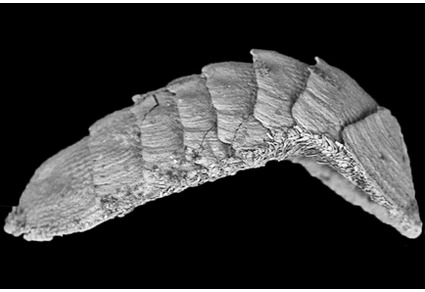

Abstract
The examination of chitons (Polyplacophora) associated with sandy bioclastic sediments collected in the southwestern Adriatic Sea (Mediterranean Basin) revealed the presence of three previously undescribed species: Leptochiton elisabettae sp. nov., L. gaiae sp. nov., and Ischnochiton falkori sp. nov. The latter two species preserve dried soft parts, allowing preliminary anatomical observations, particularly of the girdle. In addition, the studied sediments yielded valves of rare and recently described taxa (Leptochiton antondhorni, L. salicensis and Ischnochiton sigwartae), enabling refinement of their shell morphological characters. Notably, some species identified in these submerged deposits known only from disarticulated valves (L. salicensis and I. sigwartae) had been previously recorded exclusively from onshore Pleistocene deposits of Italy. Their presence in the Recent Mediterranean fauna remains unconfirmed and has so far been interpreted as representing palimpsest late Pleistocene fossils within this basin. The Polyplacophoran fauna of the Mediterranean basin presently comprises approximately 50 species, including a few taxa known only from putative last-glacial fossil records. It is foreseeable that this number will increase further, owing to more in-depth investigation of previously poorly explored habitats, not only in deep-sea environments, and to the increasingly widespread use of molecular techniques.
References
- Adams, H. & Adams, A. (1853–1858) The genera of recent Mollusca; arranged according to their organization. John van Voorst, London, 484 pp., 32 pls. & 660 pp., 106 pls. [pp. 1–256, pls. 1–32 (1853), 257–484 (1854), pp. 1–284, pls. 33–96 (1855), pp. 285–412, pls. 97–112 (1856), pp. 413–540, pls. 113–128 (1857), pp. 541–660, pls. 129–138 (1858)]. https://doi.org/10.5962/bhl.title.4772
- Arnaud, M. (1977) Revision des taxa malacologiques mediterraneens introduits par Antoine Risso. Annales du Muséum d’Histoire Naturelle de Nice, 5, 101–150, pls. 8–12.
- Bean, W. (1844) A supplement of new species. In: Thorpe, C. (Ed.), British Marine Conchology; Being a Descriptive Catalogue, Arranged According to The Lamarckian System, of The Salt water Shells in Great Britain. Edward Lumley, London, pp. 263–267.
- Bergenhayn, J.R.M. (1930) Kurze Bemerkungen zur Kenntnis der Schalenstruktur und Systematik der Loricaten. Kungliga Svenska vetenskapsakademiens handlingar, Series 3, 9 (3), 1–54.
- Bergenhayn, J.R.M. (1955) Die Fossilen Schwedischen Loricaten nebst einer vorläufigen Revision des Systems der ganzen Klasse Loricata. Skrifter fran Mineralogisk- och Paleontologisk-Geologiska Institutionerna, 22, 1–43, pls. 1–2.
- Bertolaso, L., Garilli, V., Parrinello, D., Sosso, M. & Dell’Angelo, B. (2015) A new Miocene deep-sea chiton and early evidence for Teredinidae-sustained wood-fall communities. Palaeontologia Electronica, 18.2.41A, 1–15. https://doi.org/10.26879/552
- Bonfitto, A., Dell’Angelo, B., Evangelisti, F. & Sabelli, B. (2011) The genus Acanthochitona (Mollusca: Polylacophora) in the Mediterranean Sea: morphological and molecular data. Scientia Marina, 75 (1), 171–180. https://doi.org/10.3989/scimar.2011.75n1171
- Capellini, J. (1859) Catalogue des oscabrions de la Méditerranée suivi de la description de quelques espèces nouvelles. Journal de Conchyliologie, 7, 321–328, pl. 12.
- Carmona Zalvide, P., Urgorri, V. & García, F.J. (2004) Two new species of Leptochiton Gray, 1847 (Polyplacophora) from the Iberian Peninsula (eastern Atlantic coast). The Nautilus, 118, 144–151.
- Chemnitz, J. (1785) Anmerkungen zum Geschlechte der vielschalichten Napfmuscheln, welche mit sichbaren Gelenken versehen sind und beym Linne’ Chitonen heissen. In: Martini & Chemnitz, J.H. (Eds.), Neues Systematisches Conchylien-cabinet. Vol. 8. G.N. Raspe, Nurnberg, pp. 252–293, pls. 94–96, figs. 788–810. https://doi.org/10.5962/bhl.title.120065
- Colomba, M., Sigwart, J.D., Renda, W., Gregorini, A., Sosso, M. & Dell’Angelo, B. (2022) Molecular analysis of Lepidopleurus cajetanus (Poli, 1791) (Polyplacophora, Leptochitonidae) from the Mediterranean and near Atlantic. Zookeys, 1099, 29–40. https://doi.org/10.3897/zookeys.1099.75837
- Costa, O.G. (“1829”) [1830] Catalogo sistematico e ragionato de’ testacei delle Due Sicilie. Tip. Minerva, Napoli, 8 + cxxxii pp., 2 tav. https://doi.org/10.5962/bhl.title.13093
- Dall, W.H. (1889) Reports on the results of dredging, under the supervision of Alexander Agassiz, in the Gulf of Mexico (1877–78) and in the Caribbean Sea (1879–80), by the U.S. Coast Survey Steamer “Blake”, Lieut.-Commander C.D. Sigsbee, U.S.N., and Commander J.R. Bartlett, U.S.N., commanding, 29: Report on the Mollusca, 2. Gastropoda and Scaphopoda. Bulletin of the Museum of Comparative Zoology, 18, 1–492.
- Dell’Angelo, B. & Bonfitto, A. (2005) Notes on fossil chitons. 1. A new species of Lepidopleurus (Mollusca: Polyplacophora) from the Pleistocene of Salice (Sicily, Italy). Zootaxa, 821 (1), 1–6. https://doi.org/10.11646/zootaxa.821.1.1
- Dell’Angelo, B., Giuntelli, Sosso, M. & Zunino, M. (2016) Polyplacophora from the Miocene of North Italy. Part 2: Callochitonidae, Chitonidae, Lepidochitonidae, Acanthochitonidae and Cryptoplacidae. Rivista Italiana di Paleontologia e Stratigrafia, 122, 71–102.
- Dell’Angelo, B., Giusti, F., Paolini, Sosso, M. & Bonfitto, A. (2009) New data on Polyplacophora from Tuscan Archipelago. I. Leptochiton sarsi Kaas, 1981 and Leptochiton pepezamorai Carmona Zalvide, Urgorri & Garcia, 2004, two species new to the Mediterranean Sea. Italian Journal of Zoology, 76, 76–82. https://doi.org/10.1080/11250000802137061
- Dell’Angelo, B., Landau, B., Van Dingenen, F. & Ceulemans, F. (2018) The upper Miocene chitons of northwest France (Mollusca: Polyplacophora). Zootaxa, 4447 (1), 1–62. https://doi.org/10.11646/zootaxa.4447.1.1
- Dell’Angelo, B. & Palazzi, S. (1986) Considerazioni sulla famiglia Leptochitonidae Dall, 1889 (Mollusca: Polyplacophora) con descrizione di due nuovi taxa. Bollettino Malacologico, 22, 1–36.
- Dell’Angelo, B. & Palazzi, S. (1989) Considerazioni sulla famiglia Leptochitonidae Dall, 1889 (Mollusca: Polyplacophora). III. Le specie terziarie e quaternarie europee, con note sistematiche e filogenetiche. Atti Prima Giornata di Studi Malacologici CISMA, 1989, 19–140.
- Dell’Angelo, B. & Palazzi, S. (1994) Callochiton calcatus n. sp. con note su Callochiton septemvalvis (Montagu, 1803). La Conchiglia, 26 (273), 15–23.
- Dell’Angelo, B., Piccioli Resta, B. & Bonfitto, A. (2007) Notes on fossil chitons. 3. A new species of Leptochiton (Mollusca: Polyplacophora) from the Pleistocene of South Italy. Bollettino Malacologico, 43, 139–142.
- Dell’Angelo, B., Renda, W., Sirenko, B.I., Sosso, M. & Giacobbe, S. (2021) The Mediterranean distribution of Hanleya hanleyi (Bean in Thorpe, 1844) and H. mediterranea Sirenko, 2014 (Polyplacophora). Bollettino Malacologico, 57, 124–135.
- Dell’Angelo, B., Sosso, M., Prudenza, M. & Bonfitto, A. (2013) Notes on fossil chitons. 5. Polyplacophora from the Pliocene of Western Liguria, Northwest Italy. Rivista Italiana di Paleontologia e Stratigrafia, 119, 65–107.
- Dell’Angelo, B., Sosso, M. & Taviani, M. (2024) A critical update of Mediterranean chitons (Mollusca: Polyplacophora) with the description of new taxa. Zootaxa, 5497 (2), 194–208. https://doi.org/10.11646/zootaxa.5497.2.2
- Dell’Angelo, B. & Smriglio, C. (1999) Chitoni Viventi del Mediterraneo. Edizioni Evolver, Rome, 256 pp. [English Edition, 2001: Living chitons of the Mediterranean].
- Dell’Angelo, B., Sosso, M. & Taviani, M. (2025) The Cenozoic European Polyplacophora (Mollusca). Zootaxa, 5704 (1), 1–377. https://doi.org/10.11646/zootaxa.5704.1.1
- Fernández, R., Lemer, S., McIntyre, E. & Giribet, G. (2014) Comparative phylogeography and population genetic structure of three widespread mollusc species in the Mediterranean and near Atlantic. Marine Ecology, 36, 701–715. https://doi.org/10.1111/maec.12178
- Gabrielczak, H., Filimon, A., Stoica, E. & Son, M.O. (2025) Hidden endemicity of Lepidochitona Molluscs in the Black Sea: First molecular insights and ecological characterization shows genetic isolation of species in littoral habitats and need for conservation efforts. Aquatic Conservation Marine and Freshwater Ecosystems, 35, e70144. https://doi.org/10.1002/aqc.70144
- Giribet, G. & Edgecombe, G.D. (2020) The Invertebrate Tree of Life. Princeton University Press, Princeton and Oxford, 608 pp. https://doi.org/10.1515/9780691197067
- Gmelin, J.F. (1791) Caroli a Linnei systema natura per regna tria naturae, secundum classes, ordines, genera, species, cum characteribus, differentis, synonymis, locis etc. Editio decima tertia, aucta, reformata, cura J.F. Gmelin. 1 (6). Vermes testacea. G.E. Beer, Lipsiae, 1100 pp. [pp. 3021–4120]
- Gray, J.E. (1821) A natural arrangement of Mollusca according to their internal structure. London medical Repository, 15, 229–239.
- Gray, J.E. (1828) Family Chitonidae. In: Spicilegia Zoologica; or Original Figures and Short Systematic Descriptions of New and Unfigured Animals. Treüttel, Würtz and Co, London, pp. 5–6, pls. 3 + 6.
- Gray, J.E. (1847a) Additional observations on the chitones. Proceedings of the Zoological Society of London, 15, 126–127.
- Gray, J.E. (1847b) A list of the genera of Recent Mollusca, their synonyms and types. Proceedings of the Zoological Society of London, 15, 129–206. https://doi.org/10.1111/j.1469-7998.1847.tb00164.x
- Gray, J.E. (1857) Suborder VII. Polyplacophora. In: Guide to the systematic distribution of Mollusca in the British Museum. Vol. I. Polyplacophora. British Museum (Nat. Hist.), London, pp. 176–188. https://doi.org/10.5962/bhl.title.59403
- I.C.Z.N. International Committee on Zoological Nomenclature (1971) Opinion 951. Rhyssoplax Thiele, 1893 (Amphineura): designation of a type-species under the Plenary Powers. Bulletin of Zoological Nomenclature, 28, 18–19. https://doi.org/10.5962/bhl.part.6100
- Irisarri, I., Uribe, J.E., Eernisse, D.J. & Zardoya, R. (2020) A mitogenomic phylogeny of chitons (Mollusca: Polyplacophora). BMC Evolutionary Biology, 20, 22. https://doi.org/10.1186/s12862-019-1573-2
- Kaas, P. (1977) Notes on Loricata, 9. On the rediscovery of Lepidopleurus africanus Nierstrasz, 1906 and the systematic position of the taxon Parachiton Thiele, 1909. Basteria, 41, 81–86.
- Kaas, P. (1981) Scandinavian species of Leptochiton Gray, 1847 (Mollusca: Polyplacophora). Sarsia, 66, 217–229. https://doi.org/10.1080/00364827.1981.10414541
- Kaas, P. (1985) The genus Acanthochitona Gray, 1821 (Mollusca, Polyplacophora) in the north-eastern Atlantic Ocean and in the Mediterranean Sea, with designation of neotypes of A. fascicularis (L., 1767) and of A. crinita (Pennant, 1777). Bulletin du Muséum national d’Histoire Naturelle, Series 4, 7, 579–609. https://doi.org/10.5962/p.285863
- Kaas, P. & Knudsen, J. (1992) Lorentz Spengler’s descriptions of chitons (Mollusca: Polyplacophora). Zoologische Mededelingen, 66, 49–90.
- Kaas, P. & Van Belle, R.A. (1985a) Monograph of Living Chitons (Mollusca: Polyplacophora). Volume 1. Order Neoloricata: Lepidopleurina. E.J. Brill/Dr. W. Backuys, Leiden, London, Köln and København, 240 pp. https://doi.org/10.1163/9789004431676
- Kaas, P. & Van Belle, R.A. (1985b) Monograph of Living Chitons (Mollusca: Polyplacophora). Volume 2. Suborder Ischnochitonina, Ischnochitonidae: Schizoplacinae, Callochitoninae & Lepidochitoninae. E.J. Brill/Dr. W. Backuys, Leiden, London, Köln and København, 198 pp. https://doi.org/10.1163/9789004431683
- Kaas, P. & Van Belle, R.A. (1990) Monograph of Living Chitons (Mollusca: Polyplacophora). Volume 4. Suborder Ischnochitonina: Ischnochitonidae: Ischnochitoninae (continued). Additions to Vols. 1, 2 and 3. E.J. Brill, Leiden-New York-København-Köln, 298 pp. https://doi.org/10.1163/9789004431706
- Laghi, G.F. (2005) Upper Triassic chitons from the Italian Dolomites. Lavori della Società Veneziana di Scienze Naturali, 30, 79–84.
- Linnaeus, C. (1767) Systema Naturae. Editio duodecima, reformata. “Vermes Testacea”. 1 (2). L. Salvii, Holmiae, pp. 533–1327.
- Liu, X., Sigwart, J.D. & Sun, J. (2023) Phylogenomic analyses shed light on the relationships of chiton superfamilies and shell‑eye evolution. Marine Life Science & Technology, 5, 525–537. https://doi.org/10.1007/s42995-023-00207-9
- Montagu, G. (1803) Testacea Britannica or Natural History of British Shells, Marine, Land and Freshwater, Including the Most Minute, Systematically Arranged and Embellished with Figures. Vols. 1 & 2. White, London, xxxvii + 606, 16 pls. [Vol. 1: pp. i–xxxvii + 1–291, Vol. 2: 292–606, pls. 1–16]. https://doi.org/10.5962/bhl.title.33927
- Nierstrasz, H.F. (1906) Remarks on the Chitonidae. 2. Lepidopleurus africanus, sp. nov. Tijdschrift der Nederlandsche Dierkundige Vereeniging, Series 2, 10, 155–158, pl. 3.
- Park, J., Lee, Y., Kim, Y. & Park, J-K. (2022) Description of microscopic morphology of Leptochiton hakodatensis (Mollusca: Polyplacophora). Animal Systematics, Evolution and Diversity, 38, 14–19. https://doi.org/10.5635/ASED.2022.38.1.040
- Pennant, T. (1777) British Zoology. Vol. 4. Crustacea, Mollusca, Testacea. 4th Edition. Printed for Benj. White, London, viii + 154 pp., 193 pls.
- Pilsbry, H.A. (1892–1894) Monograph of Polyplacophora. In: Tryon, G.W. (Ed.), Manual of Conchology. Vols. 14 & 15. Academy of Natural Sciences, Philadelphia, pp. 1–128, pls. 1–30 (1892) + pp. i–xxxiv + 129–350, pls. 31–68 (1893) & pp. 1–64, pls. 1–10 (1893) + pp. 65–133, pls. 11–17 (1894).
- Plate, L.H. (1898–1901) Die Anatomie und Phylogenie der Chitonen. In: Fauna Chilensis. Zoologische Jahrbücher, Supplement, 4 (1), 5 (1) & 5 (2), 1–243, pls. 1–12 (1898), 1–216, pls. 2–11 (1899) & 281–600, pls. 12–16 (1901).
- Rafinesque, C.S. (1815) Analyse de la nature ou tableau de l’univers et des corps organisés. Rafinesque, Palermo, 223 pp. https://doi.org/10.5962/bhl.title.106607
- Risso, J.A. (1826) Histoire Naturelle des Principales Productions de l’Europe Méridionale et Particulièrement de Celles des Environs de Nice et des Alpes Maritimes. Vol. 4. Libraire F.G. Levrault, Paris, vii + 439 pp., 12 pls. https://doi.org/10.5962/bhl.title.58984
- Sabelli, B. & Taviani, M. (2014) The Making of the Mediterranean Molluscan Biodiversity. In: Goffredo, S. & Dubinsky, Z. (Eds.), The Mediterranean Sea: Its history and present challenges, Chapter: 16. Springer Science+Business Media, Dordrecht, pp. 285–306. https://doi.org/10.1007/978-94-007-6704-1_16
- Schumacher, C.F. (1817) Essai d’un nouveau système des habitations des vers testacés. Schultz, Copenhagen, 287 pp. https://doi.org/10.5962/bhl.title.35863
- Schwabe, E. (2005) A catalogue of Recent and fossil chitons (Mollusca: Polyplacophora) Addenda. Novapex, 6, 89–105.
- Schwabe, E. (2008) A summary of reports of abyssal and hadal Monoplacophora and Polyplacophora (Mollusca). In: Martínez Arbizu & Brix, S. (Eds.), Bringing Light into Deep-sea Biodiversity. Zootaxa, 1866 (1), 1–574. https://doi.org/10.11646/zootaxa.1866.1.10
- Schwabe, E. & Sellanes, J. (2010) Revision of Chilean bathyal chitons (Mollusca: Polyplacophora) associated with cold‐seeps, including description of a sp. nov. of Leptochiton (Leptochitonidae). Organisms Diversity and Evolution, 10, 31–55. https://doi.org/10.1007/s13127-009-0002-6
- Sirenko, B.I. (2006) New Outlook on the System of Chitons (Mollusca: Polyplacophora). Venus, 65, 27–49.
- Sirenko, B.I. (2013) Four new species and one new genus of Jurassic chitons (Mollusca: Polyplacophora) from the Middle Russian Sea. Proceedings of the Zoological Institute RAS, 317, 30–44. https://doi.org/10.31610/trudyzin/2013.317.1.30
- Sirenko, B.I. (2015a) Shallow and deep-sea chitons of the genus Leptochiton Gray, 1847 (Mollusca: Polyplacophora: Lepidopleurida) from Peruvian and Chilean waters. Zootaxa, 4033 (2), 151–202. https://doi.org/10.11646/zootaxa.4033.2.1
- Sirenko, B.I. (2015b) Leptochiton antarcticus (Mollusca, Polyplacophora): a new species from the Southern Ocean. Ruthenica, 25, 139–146.
- Sirenko, B.I. (2017) Two new species of the genus Leptochiton (Mollusca, Polyplacophora) from northwestern Pacific. Russian Journal of Marine Biology, 43 (2), 111–117. https://doi.org/10.1134/s1063074017020109
- Sirenko, B.I. (2023) Lepidochitona bondarevi sp. nov. (Mollusca: Polyplacophora) from the Black Sea and its relatives. Ruthenica, 33, 149–165. https://doi.org/10.35885/ruthenica.2023.33(4).2
- Sirenko, B.I. & Sellanes, J. (2016) Update of the genus Leptochiton (Mollusca: Polyplacophora) in Chilean deep waters: three new reports and description of two new species. Zootaxa, 4173 (3), 259–279. https://doi.org/10.11646/zootaxa.4173.3.5
- Sirenko, B.I. & Sigwart, J.D. (2021) Leptochiton subrugatus sp. nov. (Mollusca: Polyplacophora) from low boreal waters of northern Pacific. Marine Biodiversity, 51, 1–10. https://doi.org/10.1007/s12526-021-01190-z
- Sirenko, B.I., Sigwart, J. & Dell’Angelo, B. (2016) Hanleya hanleyi (Bean in Thorpe, 1844) (Mollusca, Polyplacophora) and the influence of the Gulf Stream System on its distribution. Ruthenica, 26, 57–70.
- Spengler, L. (1797) Udförlig beskrivelse over det mangeskallede konkylie-slaegt, af Linnaeus kaldet Chiton; met endeel nye Arter og Varieteter. Skrivter af Naturhistorie Selskabet, 4, 62–103, pl. 6.
- Taviani, M. (1976) Studio di una tanatocenosi pleistocenica dragata nel basso Adriatico. Unpublished Thesis, University of Bologna, 145 pp.
- Taviani, M. (1978) Associazioni a Molluschi pleistoceniche-attuali dragate nell’Adriatico meridionale. Italian Journal of Zoology, 45 (3), 297–306. https://doi.org/10.1080/11250007809440136
- Taviani, M., Sosso, M. & Dell’Angelo, B. (2023) Chitons from deep-water mollusk-rich deposits in the Southwestern Adriatic Sea (Mollusca, Polyplacophora). Diversity, 15 (3), 359. https://doi.org/10.3390/d15030359
- Thiele, J. (1893) Das Gebiss der Schecken zur Begrundung einer naturlichen Classification. In: Troschel, F.H. (Ed.), Polyplacophora, Lepidoglossa, Schuppenzüngler. Nicolaische Verlagsbuchhandlung, Berlin, pp. 353–401.
- Thiele, J. (1909) Revision des Systems der Chitonen. Zoologica, 22, 1–132, pls. 1–10. https://doi.org/10.5962/bhl.title.11245
- Trincardi, F., Foglini, F., Verdicchi, G., Asioli, A., Correggiari, A., Minisini, D., Piva, A., Remia, A., Ridente, D. & Taviani, M. (2007) The impact of cascading currents on the Bari Canyon System, SW-Adriatic Margin (Central Mediterranean). Marine Geology, 246, 208–230. https://doi.org/10.1016/j.margeo.2007.01.013