

Abstract
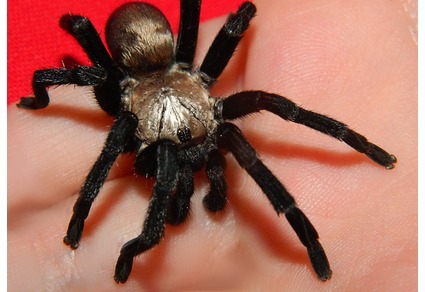
The barychelid genus Idiommata Ausserer, 1871 is reviewed: the type species Idiommata blackwalli O. Pickard-Cambridge, 1870 is diagnosed and variability of characters in males discussed. Idiommata is rediagnosed to include only I. blackwalli and I. scintillans (Rainbow & Pulleine, 1918), which lack intercheliceral peg setae. The female paralectotype of Idiommata scintillans is placed in Synothele Simon, 1908 and described as a new species, Synothele xintillans sp. nov., from South Australia. A new genus, Zidiommata gen. nov., is described for I. fusca L. Koch, 1874 (for which males are described), I. iridescens (Rainbow & Pulleine, 1918) and two new species, Z. simonmaraisi sp. nov. and Z. steveirwini sp. nov., all of which have intercheliceral pegs and are found in eastern Australia.
References
- Ausserer, A. (1871) Beiträge zur Kenntniss der Arachniden-Familie der Territelariae Thorell (Mygalidae Autor). Verhandlungen der Kaiserlich-Königlichen Zoologisch-Botanischen Gesellschaft in Wien, 21, 117–224, pl. 1. [incl. unpubl. manuscript by Doleschall]
- Ausserer, A. (1875) Zweiter Beitrag zur Kenntniss der Arachniden-Familie der Territelariae Thorell (Mygalidae Autor). Verhandlungen der Kaiserlich-Königlichen Zoologisch-Botanischen Gesellschaft in Wien, 25, 125–206, pl. 5–7.
- Bond, J.E., Hendrixson, B.E., Hamilton, C.A. & Hedin, M. (2012) A reconsideration of the classification of the spider infraorder Mygalomorphae (Arachnida: Araneae) based on three nuclear genes and morphology. PLoS One, 7 (6), e38753. https://doi.org/10.1371/journal.pone.0038753
- Hedin, M. & Bond, J.E. (2006) Molecular phylogenetics of the spider infraorder Mygalomorphae using nuclear rRNA genes (18S and 28S): conflict and agreement with the current system of classification. Molecular Phylogenetics and Evolution, 41 (2), 454–471. https://doi.org/10.1016/j.ympev.2006.05.017
- Hedin, M., Derkarabetian, S., Ramírez, M.J., Vink, C. & Bond, J.E. (2018) Phylogenomic reclassification of the world’s most venomous spiders (Mygalomorphae, Atracinae), with implications for venom evolution. Scientific Reports, 8, 1636. https://doi.org/10.1038/s41598-018-19946-2
- Hogg, H.R. (1901) On Australian and New Zealand spiders of the suborder Mygalomorphae. Proceedings of the Zoological Society of London, 71 (1), 218–279.
- Koch, L. (1874) Die Arachniden Australiens, nach der Natur beschrieben und abgebildet [Erster Theil, Lieferung 10-11]. Bauer & Raspe, Nürnberg, 473–576, pl. 36–44.
- Main, B.Y. (1964) Spiders of Australia: a guide to their identification with brief notes on the natural history of common forms. Jacaranda Press, Brisbane, 124 pp.
- Main, B.Y. (1985) Mygalomorphae. Zoological Catalogue of Australia, 3, 1–48.
- Montes de Oca, L., Indicatti, R.P., Opatova, V., Almeida, M., Pérez-Miles, F. & Bond, J.E. (2022) Phylogenomic analysis, reclassification, and evolution of South American nemesioid burrowing mygalomorph spiders. Molecular Phylogenetics and Evolution, 168, 107377. https://doi.org/10.1016/j.ympev.2021.107377
- Opatova, V., Hamilton, C.A., Hedin, M., Montes de Oca, L., Král, J. & Bond, J.E. (2020) Phylogenetic systematics and evolution of the spider infraorder Mygalomorphae using genomic scale data. Systematic Biology, 69 (4), 671–707. https://doi.org/10.1093/sysbio/syz064
- Petrunkevitch, A. (1928) Systema Aranearum. Transactions of the Connecticut Academy of Arts and Sciences, 29, 1–270.
- Pickard-Cambridge, O. (1870) Supplementary notice on the genus Idiops. Proceedings of the Zoological Society of London, 38, 152–157, pl. 8.
- Pocock, R.I. (1895) Notes on the identity of some of the types of Mygalomorphae in the collection of the British Museum. Annals and Magazine of Natural History, (6), 16 (93), 223–230. https://doi.org/10.1080/00222939508680262
- Rainbow, W.J. (1911) A census of Australian Araneidae. Records of the Australian Museum, 9 (2), 107–319.
- Rainbow, W.J. (1914) Studies in the Australian Araneidae. No. 6. The Terretelariae. Records of the Australian Museum, 10, 187–270. https://doi.org/10.3853/j.0067-1975.10.1914.901
- Rainbow, W.J. & Pulleine, R.H. (1918) Australian trap-door spiders. Records of the Australian Museum, 12, 81–169, pl. 12–24. https://doi.org/10.3853/j.0067-1975.12.1918.882
- Raven, R.J. (1984) A new diplurid genus from eastern Australia and a related Aname species (Diplurinae: Dipluridae: Araneae). Australian Journal of Zoology Supplementary Series, 96, 1–51. https://doi.org/10.1071/ajzs096
- Raven, R.J. (1994) Mygalomorph spiders of the Barychelidae in Australia and the western Pacific. Memoirs of the Queensland Museum, 35, 291–706.
- Roewer, C.F. (1942) Katalog der Araneae von 1758 bis 1940. 1. Band (Mesothelae, Orthognatha, Labidognatha: Dysderaeformia, Scytodiformia, Pholciformia, Zodariiformia, Hersiliaeformia, Argyopiformia). Natura, Buchhandlung für Naturkunde und exakte Wissenschaften Paul Budy Bremen, 1040 pp.
- Rix, M.G., Wilson, J.D. & Harvey, M.S. (2020) The open-holed trapdoor spiders (Mygalomorphae: Anamidae: Namea) of Australia’s D’Aguilar Range: revealing an unexpected subtropical hotspot of rainforest diversity. Zootaxa, 4861 (1), 71–91. https://doi.org/10.11646/zootaxa.4861.1.5
- Simon, E. (1892) Histoire naturelle des araignées. Deuxième édition, tome premier. Roret, Paris, 1–256.
- Wheeler, W.C., Coddington, J.A., Crowley, L.M., Dimitrov, D., Goloboff, A., Griswold, C.E., Hormiga, G., Prendini, L., Ramírez, M.J., Sierwald, P., Almeida-Silva, L.M., Álvarez-Padilla, F., Arnedo, M.A., Benavides, L.R., Benjamin, S.P., Bond, J.E., Grismado, C.J., Hasan, E., Hedin, M., Izquierdo, M.A., Labarque, F.M., Ledford, J., Lopardo, L., Maddison, W.P., Miller, J.A., Piacentini, L.N., Platnick, N.I., Polotow, D., Silva-Dávila, D., Scharff, N., Szűts, T., Ubick, D., Vink, C., Wood, H.M. & Zhang, J.X. (2017) The spider tree of life: phylogeny of Araneae based on target-gene analyses from an extensive taxon sampling. Cladistics, 33 (6), 576–616. https://doi.org/10.1111/cla.12182