

Abstract
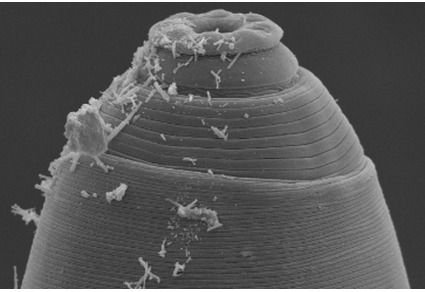
Isobinema luisdearmasi sp. nov. (Nematoda: Oxyuridomorpha: Travassosinematidae) is described from the mole cricket Gryllotalpa orientalis Burmeister, 1838 (Orthoptera: Gryllotalpidae) in Kasugai, Aichi Prefecture, Japan. The females of I. luisdearmasi sp. nov. are similar to I. flagellocercum Rao, 1958 (type species of the genus) by some morphometric variables overlapping in both species, namely the body length and the comparative length of the oesophagus and tail. The new species can be differentiated from I. flagellocercum by its comparatively slender body and larger eggs. Isobinema luisdearmasi sp. nov. lacks lateral alae, which are present in I. flagellocercum. The new species differs from I. indicum Singh & Singh, 1990 by its slightly longer body, comparatively shorter oesophagus and tail, and more posterior vulva. Isobinema jairajpurii Singh & Malti, 2003 is larger than I. luisdearmasi sp. nov.; its body is more robust, and its oesophagus and tail are comparatively shorter. Isobinema neoflagellocercum Padmaja & Lakshmi, 1994 differs from I. luisdearmasi sp. nov. by its more anterior vulva. The nomenclature of the species of Isobinema as well as Binema ornata Travassos, 1925, was corrected in order to match the gender of generic and specific epithets. Additionally, the genus Hindustanicola Morffe & García, 2023, is considered a junior synonym of Hexasinghiella Ceccolini & Cianferoni, 2021. Isobinema dimorphicaudum Parveen & Jairajpuri, 1982 is proposed as species inquirenda, since the identity of the species cannot be reliably determined. The phylogeny of I. luisdearmasi sp. nov. is inferred by the D2-D3 domains of the 28S rDNA, the 18S rDNA, and the mitochondrial COI. For all three markers, the new species was recovered in a clade with other taxa from mole crickets. In the case of the COI, the only marker with an available sequence of I. flagellocercum, both species form a monophyletic clade.
References
- Adamson, M.L. & Van Waerebeke, D. (1992) Revision of the Thelastomatoidea, Oxyurida of invertebrate hosts 2. Travassosinematidae, Protrelloididae and Pseudonymidae. Systematic Parasitology, 21, 169–188. https://doi.org/10.1007/BF00009698
- Blaxter, M.L., De Ley, P., Garey, J.R., Liu, L.X., Scheldeman, P., Vierstraete, A., Vanfleteren, J.R., Mackey, L.Y., Dorris, M., Frisse, L.M., Vida, J.T. & Thomas, W.K. (1998) A molecular evolutionary framework for the phylum Nematoda. Nature, 392, 71–75. https://doi.org/10.1038/32160
- Capella-Gutiérrez, S., Silla-Martínez, J.M. & Gabaldón, T. (2009) trimAl: a tool for automated alignment trimming in large-scale phylogenetic analyses. Bioinformatics, 25, 1972–1973. https://doi.org/10.1093/bioinformatics/btp348
- Ceccolini, F. & Cianferoni, F. (2021) Two nomenclature changes in Thelastomatoidea (Nematoda: Chromadorea: Rhabditida). Bonn Zoological Bulletin, 70 (2), 359–360. https://doi.org/10.20363/BZB-2021.70.2.359
- Edgar, R.C. (2004) MUSCLE: multiple sequence alignment with high accuracy and high throughput. Nucleic Acids Research, 32, 1792–1797. https://doi.org/10.1093/nar/gkh340
- Floyd, R.M., Rogers, A.D., Lambshead, P.J.D. & Smith, C.R. (2005) Nematode-specific PCR primers for the 18S small subunit rRNA gene. Molecular Ecology Notes, 5, 611–612. https://doi.org/10.1111/j.1471-8286.2005.01009.x
- Folmer, O., Black, M., Hoeh, W., Lutz, R. & Vrijenhoek, R. (1994) DNA primers for amplification of mitochondrial cytochrome c oxidase subunit I from diverse metazoan invertebrates. Molecular Marine Biology and Biotechnology, 3 (5), 294–299.
- Guindon, S., Dufayard, J.-F., Lefort, V., Anisimova, M., Hordijk, W. & Gascuel, O. (2010) New Algorithms and Methods to Estimate Maximum-Likelihood Phylogenies: Assessing the Performance of PhyML 3.0. Systematic Biology, 59 (3), 307–321. https://doi.org/10.1093/sysbio/syq010
- Guzeeva, E.A. & Spiridonov, S.E. (2013) Molecular-taxonomic study of two species of Pseudonymus Diesing, 1857 (Oxyuridomorpha: Thelastomatoidea: Pseudonymidae) from water beetles (Coleoptera: Hydrophilidae) of Volga estuary. Russian Journal of Nematology, 21 (2), 131–139.
- International Commission on Zoological Nomenclature (1999) International Code of Zoological Nomenclature. The International Trust for Zoological Nomenclature, London, xxix + 306 pp.
- Minh, B.Q., Nguyen, M.A.T. & von Haeseler, A. (2013) Ultrafast Approximation for Phylogenetic Bootstrap. Molecular Biology and Evolution, 30 (5), 1188–1195. https://doi.org/10.1093/molbev/mst024
- Morffe, J. & García, N. (2023) Correction of the homonymy of the nematode genus Singhiella Rao, 1958 (Oxyuridomorpha: Thelastomatoidea: Travasossinematidae) parasite from mole crickets (Insecta: Orthoptera: Gryllotalpidae). Zootaxa, 5244 (3), 299–300. https://doi.org/10.11646/zootaxa.5244.3.8
- Morffe, J. & Hasegawa, K. (2017) Morphological and molecular characterization of Travassosinema claudiae sp. nov. (Oxyuridomorpha: Travassosinematidae) from the Japanese millipede Parafontaria laminata (Attems, 1909) (Polydesmida: Xystodesmidae). Zootaxa, 4282 (1), 166–178. https://doi.org/10.11646/zootaxa.4282.1.10
- Nunn, G.B. (1992) Nematode Molecular Evolution: An Investigation of Evolutionary Patterns Among Nematodes Based Upon DNA Sequences. University of Nottingham, Nottingham, 187 pp.
- Padmaja, B. & Lakshmi, B.B. (1994) A new species of the genus Isobinema (Nematoda: Thelastomatidae) from the rectum of Gryllotalpa africana from Narsipatnam, South India. Indian Journal of Parasitology, 18 (2), 207–209.
- Parveen, R. & Jairajpuri, D.S. (1982) A new nematode, Isobinema dimorphicauda from the intestine of mole cricket, Gryllotalpa africana from Aligarth. Rivista di Parassitologia, 43 (1), 113–115.
- Rao, P.N. (1958) Studies on the nematode parasites of insects and other arthropods. Arquivos do Museo Nacional, Rio de Janeiro, 46, 33–84.
- Rusconi, J.M., Montes, M., Ferrari, W. & Achinelly, M.F. (2019) Identification of two species of Binema Travassos 1925 (Oxyurida: Travassosinematidae) and Cameronia arecoensis Marchissio and Miralles 1987 (Oxyurida: Thelastomatidae) based on morphological and 18S rRNA partial sequence. Anais da Academia Brasileira de Ciências, 91 (2), e20180408. https://doi.org/10.1590/0001-3765201920180408
- Seinhorst, J.W. (1959) A rapid method for the transfer of nematodes from fixative to anhydrous glycerin. Nematologica, 4, 67–69. https://doi.org/10.1163/187529259X00381
- Singh, N., Chaudhari, A. & Singh, H.S. (2015) Molecular Phylogeny of Nematodes (Oxyurida: Travassosinematidae) from Orthoptera (Gryllotalpidae) Inferred by Mitochondrial Cytochrome C Oxidase Subunit 1 Gene. Bioinformation, 11 (7), 343–347. https://doi.org/10.6026/97320630011343
- Sing, H.S. & Malti (2003) On a known and some unknown species of nematode parasites of Gryllotalpa africana. Journal of Experimental Zoology of India, 6 (2), 329–350.
- Singh, H.S. & Singh, K. (1990) On a rare nematode Isobinema indica n.sp., from Gryllotalpa africana, at Meerut. Proceedings of the Indian Academy of Parasitology, 10 (1 & 2), 11–12.
- Soubrier, J., Steel, M., Lee, M.S., Der Sarkissian, C., Guindon, S., Ho, S.Y. & Cooper, A. (2012) The influence of rate heterogeneity among sites on the time dependence of molecular rates. Molecular Biology and Evolution Society, 29, 3345–3358. https://doi.org/10.1093/molbev/mss140
- Spiridonov, S.E. & Guzeeva, E.A. (2009) Phylogeny of nematodes of the superfamily Thelastomatoidea (Oxyurida) inferred from LSU rDNA sequence. Russian Journal of Nematology, 17, 127–134.
- Tamura, K., Stecher, G., Peterson, D., Filipski, A. & Kumar, S. (2013) MEGA6: Molecular Evolutionary Genetics Analysis version 6.0. Molecular Biology and Evolution, 30, 2725–2729. https://doi.org/10.1093/molbev/mst197
- Travassos, L. (1925) Quelques nematodes du Gryllotalpa. Comptes Rendus des Séances de la Société de Biologie et de ses Filiales, 93, 140–141.
- Trifinopoulos, J., Nguyen, L.T., von Haeseler, A. & Minh, B.Q. (2016) W-IQ-TREE: a fast online phylogenetic tool for maximum likelihood analysis. Nucleic Acids Research, 44 (W1), W232–W235. https://doi.org/10.1093/nar/gkw256
- Yokohata, Y., Jiang, Y.P., Abe, H. & Ohbayashi, M. (1988) Pseudoparasitism by thelastomatid nematodes in moles, Mogera spp., in Japan. Japanese Journal of Veterinary Research, 36 (1), 53–67.