

Abstract
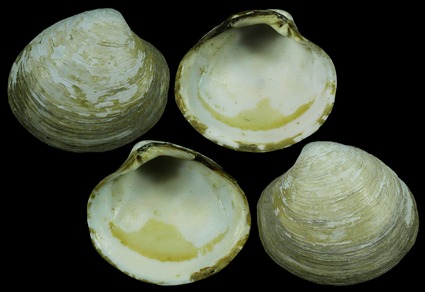
Chemosymbiotic vesicomyid clams in the subfamily Pliocardiinae are a major component of deep-sea chemosynthetic ecosystems, yet their diversity remains incompletely documented. Here, we report a new species of pliocardiine clam collected from two cold seeps, the 2,526 m deep Oomine Ridge site in the Nankai Trough, Japan and the 2,915 m deep Summit Site of South Chamorro Seamount, Mariana Forearc. This ovate species (maximum shell length 34.4 mm) is included in the genus Waisiuconcha Beets, 1943. It is most similar to Waisiuconcha helios Krylova & Janssen, 2006 but differs by having a larger shell, a subumbonal pit, a steeply inclined anterior cardinal tooth of the right valve (3a), a long and straight anterior cardinal tooth of the left valve (2a), as well as a thick and straight posterior cardinal tooth of the left valve (4b). Anatomical examination revealed a single prominent papilla-like projection on the inner vulva of the inhalant siphon previously only known from Calyptogena Dall, 1891. As such, we describe our species as Waisiuconcha takashii sp. nov. We also present a phylogenetic reconstruction using the mitochondrial cytochrome c oxidase subunit I (COI) gene, including the first molecular data available for Waisiuconcha. The finding of a single pliocardiine species at two seeps ~2,400 km apart adds evidence to members of the subfamily having high dispersal capabilities, expanding our knowledge of seep fauna in the northwestern Pacific Ocean.
References
- Amano, K. & Kiel, S. (2007) Fossil vesicomyid bivalves from the North Pacific Region. The Veliger, 49 (4), 270–293.
- Amano, K., Kiel, S., Hryniewickz, K. & Jenkins, R.G. (2022) Chapter 10. Bivalvia in Ancient Hydorcarbon Seeps. In: Kaim, A., Cochran, J.K. & Landman, N.H. (Eds.), Ancient Hydrocarbon Seeps. Springer, Cham, pp. 267–321. https://doi.org/10.1007/978-3-031-05623-9_10
- Audzijonyte, A., Krylova, E.M., Sahling, H. & Vrijenhoek, R.C. (2012) Molecular taxonomy reveals broad trans-oceanic distributions and high species diversity of deep-sea clams (Bivalvia: Vesicomyidae: Pliocardiinae) in chemosynthetic environments. Systematics and Biodiversity, 10 (4), 403–415. https://doi.org/10.1080/14772000.2012.744112
- Beets, C. (1943) Beiträge zur Kenntniss der Angeblich Oberoligocänen Mollusken-Fauna der Insel Buton, Niederländisch-Ostindlen. Leidsche Geologische Mededeelingen, 13 (255), 256–328.
- Belov, D., Kremenetskaia, A. & Krylova, E. (2025) The genetic diversity of the chemosymbiotic bivalve Calyptogena pacifica Dall, 1891 (Vesicomyidae: Pliocardiinae). Russian Journal of Marine Biology, 51 (5), 247–258. https://doi.org/10.1134/S1063074025700245
- Barry, J.P. & Kochevar, R.E. (1999) Calyptogena diagonalis, a new vesicomyid bivalve from subduction zone cold seeps in the Eastern North Pacific. The Veliger, 42 (2), 117–123.
- Bernard, F. (1974) The genus Calyptogena in British Columbia with a description of a new species (Bivalvia, Vesicomyidae). Venus (The Japanese Journal of Malacology), 33 (1), 11–22.
- Boss, K.J. & Turner, R.D. (1980) The giant white clam from the Galapagos Rift, Calyptogena magnifica, species novum. Malacologia, 20, 161–194.
- Brunner, O., Chen, C., Giguère, T., Kawagucci, S., Tunnicliffe, V., Watanabe, H.K. & Mitarai, S. (2022) Species assemblage networks identify regional connectivity pathways among hydrothermal vents in the Northwest Pacific. Ecology and Evolution, 12, e9612. https://doi.org/10.1002/ece3.9612
- Chen, C., Watanabe, H.K., Sawada, H., Iwamoto, H. & Takai, K. (2024) Serpentinite-hosted chemosynthetic community of South Chamorro Seamount, Mariana Forearc. Marine Ecology, 2024, e12808. https://doi.org/10.1111/maec.12808
- Chen, C., Watanabe, H.K., Hookabe, N., Shiraki, S., Nye, V., Fleming, J.F. & Jimi, N. (2025) Biological surveys reveal unexpectedly high faunal diversity at Nankai Trough methane seeps. Ecosphere, 16, e70451. https://doi.org/10.1002/ecs2.70451
- Cosel, R.v. & Olu, K. (2009) Large Vesicomyidae (Mollusca: Bivalvia) from cold seeps in the Gulf of Guinea off the coasts of Gabon, Congo and northern Angola. Deep Sea Research Part II: Topical Studies in Oceanography, 56, 2350–2379. https://doi.org/10.1016/j.dsr2.2009.04.016
- Cosel, R.v. & Salas, C. (2001) Vesicomyidae (Mollusca: Bivalvia) of the genera Vesicomya, Waisiuconcha, Isorropodon and Callogonia in the eastern Atlantic and the Mediterranean. Sarsia, 86, 333–366. https://doi.org/10.1080/00364827.2001.10425523
- Dall, W.H. (1891) On some new or interesting west American shells obtained from the dredgings of the U.S. Fish Commission steamer Albatross in 1888, and from other sources. Proceedings of the US National Museum, 14, 173–191, pls. 5–7. https://doi.org/10.5479/si.00963801.14-849.173
- Dall, W.H. (1889) Reports on the results of dredging, under the supervision of Alexander Agassiz, in the Gulf of Mexico (1877-78) and in the Caribbean Sea (1879-80), by the U.S. Coast Survey Steamer "Blake", Lieut.-Commander C.D. Sigsbee, U.S.N., and Commander J.R. Bartlett, U.S.N., commanding. XXIX. Report on the Mollusca. Part 2, Gastropoda and Scaphopoda. Bulletin of the Museum of Comparative Zoölogy at Harvard College, 18, 1–492, pls. 10–40.
- Dall, W.H. (1896) Diagnoses of new species of mollusks from the west coast of America. Proceedings of the United States National Museum, 18 (1034), 7–20. https://doi.org/10.5479/si.00963801.1034
- Dall, W.H. (1908) Reports on the dredging operations off the west coast of Central America to the Galapagos, to the west coast of Mexico, and in the Gulf of California, in charge of Alexander Agassiz, carried on by the U.S. Fish Commission steamer "Albatross," during 1891, Lieut.-Commander Z.L. Tanner, U.S.N., commanding. XXXVII. Reports on the scientific results of the expedition to the eastern tropical Pacific, in charge of Alexander Agassiz, by the U.S. Fish Commission steamer "Albatross", from October, 1904 to March, 1905, Lieut.-Commander L.M. Garrett, U.S.N., commanding. XIV. The Mollusca and Brachiopoda. Bulletin of the Museum of Comparative Zoology at Harvard College, 43, 205–487, pls. 1–22.
- Dall, W.H. & Simpson, C.T. (1901) The Mollusca of Porto Rico. Bulletin of the United States Fish Commission, 20, 351–524, pls. 54–58.
- Fujikura, K., Okutani, T. & Maruyama, T. (2012) Deep-Sea Life: Biological Observations Using Research Submersibles. Tokai University Press, Hatano, xxiii + 487 pp.
- Gao, K., He, X., Wang, H., Chen, C., Gu, X., Lai, Q., Perez, M., Kojima, S., Amano, K. & Sun, J. (2025) Phylogenomic analyses of Pliocardiinae (Bivalvia: Vesicomyidae) update genus-level taxonomy and shed light on trait evolution. Cladistics, 41, 372–387. https://doi.org/10.1111/cla.70001
- Johnson, S.B., Krylova, E.M., Audzijonyte, A., Sahling, H. & Vrijenhoek, R.C. (2017) Phylogeny and origins of chemosynthetic vesicomyid clams. Systematics and Biodiversity, 15 (4), 346–360. https://doi.org/10.1080/14772000.2016.1252438
- Habe, T. (1976) Eight new bivalves from Japan. Venus (The Japanese Journal of Malacology), 35 (2), 37–46.
- Kiel, S. (2010) Chapter 8. The Fossil Record of Vent and Seep Mollusks. In: Kiel, S. (Ed.), The Vent and Seep Biota. Aspects from Microbes to Ecosystems. Springer, Dordrecht, Heidelberg, London, New York, pp. 255–277. https://doi.org/10.1007/978-90-481-9572-5_8
- Kiel, S., Amano, K. & Goedert, J.L. (2023) New taxa, records, and data for vesicomyid bivalves from Cenozoic strata of the North Pacific region. Acta Palaeontologica Polonica, 68 (2), 297–320. https://doi.org/10.4202/app.01061.2023
- Krylova, E.M. & Janssen, R. (2006) Vesicomyidae from Edison Seamount (South West Pacific: Papua New Guinea: New Ireland fore-arc basin) (Bivalvia: Glossoidea). Archiv für Molluskenkunde, 135 (2), 231–261. https://doi.org/10.1127/arch.moll/0003-9284/135/231-261
- Krylova, E.M. & Sahling, H. (2006) Recent bivalve molluscs of the genus Calyptogena (Vesicomyidae). Journal of Molluscan Studies, 72, 359–395. https://doi.org/10.1093/mollus/eyl022
- Krylova, E.M. & Sahling, H. (2010) Vesicomyidae (Bivalvia): Current Taxonomy and Distribution. PLoS ONE, 5 (4), e9957. https://doi.org/10.1371/journal.pone.0009957
- Lanfear, R., Senfeld, T., Frandsen, P.B., Wright, A.M. & Calcott, B. (2016) Partition Finder 2: new methods for selecting partitioned models of evolution for molecular and morphological phylogenetic analyses. Molecular Biology and Evolution, 34 (3), 772–773. https://doi.org/10.1093/molbev/msw260
- Ohara, Y., Reagan, M.K., Fujikura, K., Watanabe, H., Michibayashi, K., Ishii, T., Stern, R.J., Pujana, I., Martinez, F., Girard, G., Ribeiro, J., Brounce, M., Komori, N. & Kino, M. (2012) A serpentinite-hosted ecosystem in the Southern Mariana Forearc. Proceedings of the National Academy of Sciences of the United States of America, 109 (8), 2831–2835. https://doi.org/10.1073/pnas.1112005109
- Okutani, T. (1957) Two new species of bivalves from the deep water in Sagami Bay collected by the R.V. “Soyo-Maru”. Bulletin of the Tokai Regional Fisheries Research Laboratory, 17, 27–30.
- Okutani, T., Fujikura, K. & Kojima, S. (2000) New taxa and review of vesicomyid bivalves collected from the Northwest Pacific by deep-sea research systems of Japan Marine Science and Technology Center. Venus (The Japanese Journal of Malacology), 59 (2), 83–101.
- Okutani, T. & Iwasaki, N. (2003) Noteworthy abyssal mollusks (excluding vesicomyid bivalves) collected from the Nankai Trough off Shikoku by the ROV Kaiko of the Japan Marine Science and Technology Center. Venus (Journal of the Malacological Society of Japan), 62 (1–2), 1–10. https://doi.org/10.18941/venus.62.1-2_1
- Okutani, T., Kojima, S. & Ashi, J. (1996) An unusual vesicomyid bivalve, Calyptogena nankaiensis n. sp. from bathyal depth off Honshu, Japan. Venus (The Japanese Journal of Malacology), 55 (4), 257–263.
- Okutani, T., Kojima, S. & Iwasaki, N. (2002) New and known vesicomyid bivalves recently collected from the western and central Nankai Trough off Shikoku and Honshu, by deep sea research systems of Japan Marine Science and Technology Center. Venus (Journal of the Malacological Society of Japan), 61 (3–4), 129–140. https://doi.org/10.18941/venus.61.3-4_129
- Okutani, T. & Métivier, B. (1986) Descriptions of three new species of vesicomyid bivalves collected by the submersible Nautile from abyssal depths off Honshu, Japan. Venus (The Japanese Journal of Malacology), 45 (2), 147–160.
- Rambaut, A., Drummond, A.J., Xie, D., Baele, G. & Suchard, M.A. (2018) Posterior summarization in Bayesian phylogenetics using Tracer 1.7. Systematic Biology, 67 (5), 901–904. https://doi.org/10.1093/sysbio/syy032
- Ronquist, F., Teslenko, M., van der Mark, P., Ayres, D.L., Darling, A., Höhna, S. & Huelsenbeck, J.P. (2012) MrBayes 3.2: efficient Bayesian phylogenetic inference and model choice across a large model space. Systematic Biology, 61 (3), 539–542. https://doi.org/10.1093/sysbio/sys029
- Sasaki, T., Okutani, T. & Fujikura, K. (2005) Molluscs from hydrothermal vents and cold seeps in Japan: A review of taxa recorded in twenty Recent years (1984–2004). Venus (Journal of the Malacological Society of Japan), 64, 87–133.
- Shimayama, T., Himeno, H., Sasuga, J., Yokobori, S., Ueda, T. & Watanabe, K. (1990) The genetic code of a squid mitochondrial gene. Nucleic Acids Symposium Series, 22, 77–78.
- Taylor, J.D. & Glover, E.A. (2010) Chapter 10. Chemosymbiotic Bivalves. In: Kiel, S. (Ed.), The Vent and Seep Biota. Aspects from Microbes to Ecosystems. Springer, Dordrecht, Heidelberg, London, New York, pp. 107–135. https://doi.org/10.1007/978-90-481-9572-5_5
- Tunnicliffe, V., Chen, C., Giguère, T., Rowden, A.A., Watanabe, H.K. & Brunner, O. (2023) Hydrothermal vent fauna of the western Pacific Ocean: Distribution patterns and biogeographic networks. Diversity and Distributions, 30, e13794. https://doi.org/10.1111/ddi.13794
- Woodring, W.P. (1925) Miocene mollusks from Bowden Jamaica. Pelecypods and scaphopods. Carnegie Institution of Washington Publication, 366, 1–222, pls. 1–28. https://doi.org/10.5962/t.165667