

Abstract
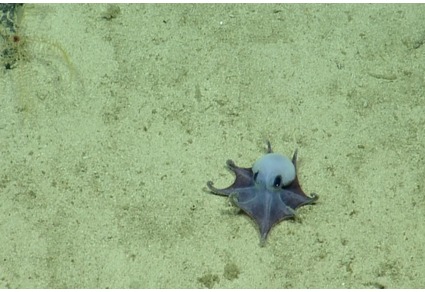
The octopod fauna of the deep tropical Pacific Ocean remains poorly known, as is the octopod family Megaleledonidae Taki. A single female megaleledonid specimen collected at 1773 m depth near the equatorial Galápagos island of Darwin is named Microeledone galapagensis sp. nov. This small, squat, short-armed octopod has few arm suckers and gill lamellae. Its lack of a crop diverticulum, ink sac, and anal flaps suggests that it pertains to Thaumeledone. However, its smooth skin, which dorsally is nearly free of pigment, large rachidian tooth, and large funnel organ ally it with the monotypic Microeledone. Its reverse countershading and dense pigmentation on the inner dorsal mantle musculature distinguish this species from Microeledone mangoldi Norman, Hochberg & Boucher-Rodoni, 2004a. This species belies the definition of the Megaleledonidae as large-bodied, Southern Ocean endemics, leading us to revise the family diagnosis. The short arms carrying few suckers in this genus and Thaumeledone are hypothesized to relate to heterochrony, potentially increasing energy available for reproduction and contributing to niche partitioning.
References
- Ablett, J., Brown, C., Gallichan, J., Gordon, D., Holmes, A.M., Hunter, T., Machin, R., Morgenroth, H., Oliver, P.G., Petts, R., Pye, S., Reilly, M., Rowson, B., Salvador, A., Sutcliffe, R., Turner, J.A. & Wood, H. (2019) Mollusca types in Great Britain. Amgueddfa Cymru-National Museum Wales, Cardiff and Natural History Museum, London, Available from: https://gbmolluscatypes.ac.uk/specimens/8143 (accessed 26 June 2024)
- Allcock, A.L., Hochberg, F.G. & Stranks, T.N. (2003a) Re-evaluation of Graneledone setebos (Cephalopoda: Octopodidae) and allocation to the genus Megaleledone. Journal of the Marine Biology Association, United Kingdom, 83, 319–328. https://doi.org/10.1017/S0025315403007148h
- Allcock, A.L., Collins, M.A. & Vecchione, M. (2003b) A redescription of Graneledone verrucosa (Verrill, 1881) (Octopoda: Octopodidae). Journal of Molluscan Studies, 69, 135–143. https://doi.org/10.1093/mollus/69.2.135
- Allcock, A.L., Hochberg, F.G., Rodhouse, P.G.K. & Thorpe, J.P. (2003c) Adelieledone, a new genus of octopodid from the Southern Ocean. Antarctic Science, 15, 415–424. https://doi.org/10.1017/S0954102003001512
- Allcock, A.L., Collins, M.A., Piatkowski, U. & Vecchione, M. (2004) Thaumeledone and other deep water octopodids from the Southern Ocean. Deep-Sea Research, Part II, 51, 1883–1901. https://doi.org/10.1016/j.dsr2.2004.07.019
- Allen, J.J., Bell, G.R.R., Kuzirian, A.M., Velankar, S.S. & Hanlon, R.T. (2014) Comparative morphology of changeable skin papillae in octopus and cuttlefish. Journal of Morphology, 275, 371–390. https://doi.org/10.1002/jmor.20221
- Amor, M., Roura, Á. & Rosa, R. (2024) Origin and diversification of octopuses. In: Rosa, R., Gleadall, I.G., Pierce, G.J. & Villanueva, R. (Eds.), Octopus biology and ecology. Elsevier, London, pp. 3–17. https://doi.org/10.1016/B978-0-12-820639-3.00018-2
- Atchley, W.R., Gaskins, C.T. & Anderson, D. (1976) Statistical properties of ratios. I. Empirical results. Systematic Zoology, 25 (2), 137–148. https://doi.org/10.2307/2412740
- Derby, C.D. (2014) Cephalopod ink: Production, chemistry, functions and applications. Marine Drugs, 12, 2700–2730. https://doi.org/10.3390/md12052700
- Gleadall, I., Guerrero-Kommritz, J., Hochberg, F.G. Jr. & Laptikhovsky, V.V. (2010) The inkless octopuses (Cephalopoda: Octopodidae) of the Southwest Atlantic. Zoological Science, 27, 528–553. https://doi.org/10.2108/zsj.27.528
- Guerra, Á., Roura, Á., Sieiro, M.P., Portela, J.M. & Del Río, J.L. (2012) New insights into the morphology, reproduction and distribution of the large-tuberculate octopus Graneledone macrotyla from the Patagonian slope. Scientia Marina, 76, 319–328. https://doi.org/10.3989/scimar.03473.07A
- Guerrero-Kommritz, J. (2006) Octopods (Cephalopoda: Octopoda) with uniserial suckers from the southwest Atlantic Ocean in the Zoological Museum Hamburg. Mitteilungen Hamburgisches Zoologisches Museum und Institut, 103, 11–32.
- Hartwell, A., Voight, J.R. & Wheat, C.G. (2018) Clusters of deep-sea egg-brooding octopods associated with warm fluid discharge: An ill-fated fragment of a larger, discrete population? Deep-Sea Research, 135, 1–8. https://doi.org/10.1016/j.dsr.2018.03.011
- Hoyle, W.E. (1885) Diagnoses of new species of Cephalopoda collected during the cruise of the H.M.S. ‘Challenger’ – Part I. The Octopoda. Annals and Magazine of Natural History, Series 5, 15 (87), 222–236. https://doi.org/10.1080/00222938509459320
- Huffard, C.L. & Hochberg, F.G. (2003) Description of a new species of the genus Amphioctopus (Mollusca: Octopodidae) from the Hawai’ian Islands. Molluscan Research, 25, 113–128. https://doi.org/10.11646/mr.25.3.1
- Ibáñez, C.M., Rezende, E.K., Sepúlveda, R.D., Avaria-Llautureo, J., Hernández, C.E., Sellanes, J., Poulin, E. & Pardo-Gandarillas, M.C. (2018) Thorson’s Rule, life history evolution, and diversification of benthic octopuses (Cephalopoda: Octopodoidea). Evolution, 72, 1829–1839. https://doi.org/10.1111/evo.13559
- leJeune, B., Bissey, L., Didaskalou, E.A., Sturaro, N., Lepoint, G. & Denoël, M. (2020) Progenesis as an intrinsic factor of ecological opportunity in a polyphenic amphibian. Functional Ecology, 35, 546–560. https://doi.org/10.1111/1365-2435.13708
- Metscher, B.D. (2009) MicroCT for comparative morphology: simple staining methods allow high-contrast 3D imaging of diverse non-mineralized animal tissues. BMC Physiology, 9, 11. https://doi.org/10.1186/1472-6793-9-11
- Muus, B. (2002) The Bathypolypus-Benthoctopus problem of the North Atlantic (Octopodidae, Cephalopoda). Malacologia, 44, 175–222.
- Nautiluslive. (2024) Gorgeous Octopus Models for Hercules’ Camera. Available from: https://nautiluslive.org/video/2022/07/13/gorgeous-octopus-models-hercules-camera (accessed 2 October 2024)
- Norman, M.D. (1992) Ameloctopus litoralis, gen. et sp. nov. (Cephalopoda: Octopodidae), a new shallow-water octopus from tropical Australian waters. Invertebrate taxonomy, 6, 567–582. https://doi.org/10.1071/IT9920567
- Norman, M.D. (2001) New octopus species from Queensland. Memoirs of the Queensland Museum, 46, 677–690.
- Norman, M.D., Hochberg, F.G. & Boucher-Rodoni, R. (2004a) Microeledone mangoldi n. gen. and n. sp., a deep-water pygmy octopus from the Norfolk Ridge, New Caledonia (Cephalopoda: Octopodidae). Molluscan Research, 24, 193–209.
- Norman, M.D., Boucher, R. & Hochberg, F.G. (2004b) The sharkclub octopus, Galeoctopus lateralis, a new genus and species of deep-water octopus from the western Pacific Ocean (Cephalopoda: Octopodidae). Journal of Molluscan Studies, 70, 247–256. https://doi.org/10.1093/mollus/70.3.247
- Norman, M.D., Hochberg, F.G. & Boucher-Rodoni, R. (2005) A revision of the deep-water octopus genus Scaeurgus (Cephalopoda: Octopodidae) with description of three new species from the southwest Pacific Ocean. Journal of Molluscan Studies, 71, 319–337. https://doi.org/10.1093/mollus/eyi033
- O’Leary, M.A. & Kaufman, S.G. (2012) MorphoBank 3.0: Web application for morphological phylogenetics and taxonomy. Available from: http://www.morphobank.org (accessed 10 April 2026)
- Palacio, F.J. (1978) Vosseledone charrua: a new Patagonian cephalopod (Octopodidae) with notes on related genera. Bulletin of Marine Science, 28, 282–296.
- Purser, A., Marcon, Y., Hoving, H.J., Vecchione, M., Piatkowski, U., Eason, D., Bluhm, H. & Boetius, A. (2016) Association of deep-sea incirrate octopods with manganese crusts and nodule fields in the Pacific Ocean. Current Biology, 26, R1268–R1269. https://doi.org/10.1016/j.cub.2016.10.052
- Robson, G.C. (1932) A monograph of the Recent Cephalopoda Part II Octopoda (excluding the Octopodinae). British Museum (Natural History), London, 359 pp.
- Roper, C.F.E. & Voss, G.L. (1983) Guidelines for taxonomic descriptions of cephalopod species. Memoirs of the National Museum, Victoria, 44, 49–63. https://doi.org/10.24199/j.mmv.1983.44.03
- Salinas-de-León, P., Martí-Puig, P., Buglass, S., Arnés-Urgellés, C., Rastoin-Laplane, E., Creemers, M., Cairns, S., Fisher, C., O’Hara, T., Ott, B., Raineault, N.A., Reiswig, H., Rouse, G., Rowley, S., Shank, T.M., Suarez, J., Watling, L. & Wicksten, M.K. & Marsh, L. (2020) Characterization of deep‑sea benthic invertebrate megafauna of the Galápagos Islands. Scientific Reports, 10, 13894. https://doi.org/10.1038/s41598-020-70744-1
- Schindelin, J., Arganda-Carreras, I., Frise, E., Kaynig, V., Longair, M., Pietzsch, T., Preibisch, S., Rueden, C., Saalfeld, S., Schmid, B., Tinevez, J.-Y., White, D.J., Hartenstein, V., Eliceiri, K., Tomancak, P. & Cardona, A. (2012) Fiji: an open-source platform for biological-image analysis. Nature Methods, 9, 676–682. https://doi.org/10.1038/nmeth.2019
- SOI (2024a) Schmidt Ocean Institute Site 7 | SOI Divestream 683 PART 2. Available from: https://www.youtube.com/watch?v=tSmv_GwQ9GI 16:53 UTC (accessed 2 October 2024)
- SOI (2024b) Schmidt Ocean Institute “UFO” Knoll | SOI Divestream 690. Available from: https://www.youtube.com/watch?v=-ky9jTcb2Xg&t=2407s 22:00:32 UTC (accessed 2 October 2024)
- Strugnell, J.M., Norman, M.D., Vecchione, M., Guzik, M. & Allcock, A.L. (2014) The ink sac clouds octopod evolutionary history. Hydrobiologia, 725, 215–235. https://doi.org/10.1007/s10750-013-1517-6
- Sykes, A.V., Almansa, E., Ponte, G., Cooke, G.M. & Andrews, P.L.R. (2020) Can cephalopods vomit? Hypothesis based on a review of circumstantial evidence and preliminary experimental observations. Frontiers in Physiology, 11, 765. https://doi.org/10.3389/fphys.2020.00765
- Taite, M., Fernández-Alvarez, F.A., Braid, H.E., Bush, S.L., Bolstad, K., Drewery, J., Mills, S., Strugnell, J.M., Vecchione, M., Villanueva, R., Voight, J.R. & Allcock, A.L. (2023) Genome skimming elucidates the evolutionary history of Octopoda. Molecular Phylogenetics and Evolution, 182, 107729. https://doi.org/10.1016/j.ympev.2023.107729
- Taki, Iw. (1961) On two new eledonid octopods from the Antarctic Sea. Journal of the Faculty of Fisheries and Animal Husbandry, Hiroshima University, 3, 297–316.
- Thomsen, E. (1931) Remarks on the distribution and systematic position of Graneledone verrucosa (Verrill). Videnskabelige Meddelelser fra Dansk naturhistorisk Forening I Kjobenhavn, 92, 293–299.
- Voight, J.R. (1991) Morphological variation in octopod specimens: reassessing the assumption of preservation-induced deformation. Malacologia, 33, 241–253.
- Voight, J.R. (1993a) The association between distribution and octopodid morphology: implications for classification. Zoological Journal of the Linnean Society, 108, 209–223. https://doi.org/10.1006/zjls.1993.1023
- Voight, J.R. (1993b) The arrangement of suckers on octopodid arms as a continuous character. Malacologia, 35, 351–359.
- Voight, J.R. (2013) Suctorial feeding in a deep-sea octopus as a means of niche partitioning (Cephalopoda: Octopodidae). Zoomorphology, 132, 157–162. https://doi.org/10.1007/s00435-012-0177-9
- Voight, J.R. (2000) A deep-sea octopus (Graneledone cf. boreopacifica) as a shell-crushing hydrothermal vent predator. Journal of Zoology, 252, 335–341. https://doi.org/10.1017/S0952836900000078
- Voight, J.R. (2021) Morphological deformation in preserved specimens of the deep-sea octopus Graneledone. Journal of Molluscan Studies, 67, 95–102. https://doi.org/10.1093/mollus/67.1.95
- Voight, J.R., Kurth, J., Strauss, R.E., Sturgnell, J.M. & Allcock, A.L. (2020) A depth cline in deep-sea octopuses (Mollusca, Octopoda). Bulletin of Marine Science, 96, 323–340. https://doi.org/10.5343/bms.2019.0039
- Voight, J.R., Morrison, A.C., Genovese, G.M. & Penney, B.K. (2025) Morphology of the warts of Graneledone pacifica and Pareledone charcoti. Journal of Molluscan Studies, 91, eyae055. https://doi.org/10.1093/mollus/eyae055
- Voss, G.L. (1950) Two new species of cephalopods from the Florida Keys. Revista de la Sociedad Malacológica Carlos de la Torre, 7, 73–79.
- Voss, G.L. (1976) Two new species of octopods of the genus Graneledone (Mollusca: Cephalopoda) from the Southern Ocean. Proceedings of the Biological Society of Washington, 88, 447–458.
- Voss, G.L. (1988) Evolution and phylogenetic relationships of deep-sea octopods. In: Clarke, M.R. & Trueman, E.R. (Eds.), Paleontology and Neontology of Cephalopods. Academic Press, San Diego, California, pp. 253–276. https://doi.org/10.1016/B978-0-12-751412-3.50022-X
- Voss, G.L. & Pearcy, W. (1990) Deep-water octopods (Mollusca: Cephalopoda) of the northeastern Pacific. Proceedings of the California Academy of Sciences, 47, 47–94.
- Ziegler, A. & Sagorny, C. (2021) Holistic description of new deep sea megafauna (Cephalopoda: Cirrata) using a minimally invasive approach. BMC Biology, 19, 81. https://doi.org/10.1186/s12915-021-01000-9
- Ziegler, A., Miller, A. & Nagelmann, N. (2021) Novel insights into early life stages of finned octopods (Octopoda: Cirrata). Swiss Journal of Palaeontology, 140, 24. https://doi.org/10.1186/s13358-021-00240-0