

Abstract
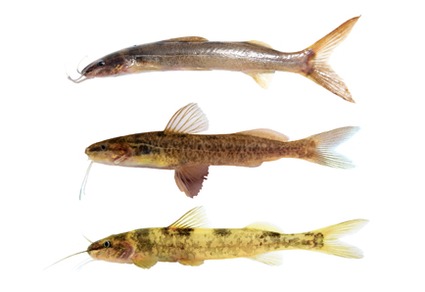
The integration of morphological and molecular data for Imparfinis species from Amazonian drainages of the Brazilian Shield revealed the presence of three previously undescribed species, which are formally described herein. These species are readily distinguished from their congeners by characters related to coloration: I. melanopterus, from the middle Araguaia River, has a distinctly darker lower caudal-fin lobe; I. nigropunctatus, from the upper Araguaia River, possesses conspicuous black spots on the body; and I. tessellatus, from the upper Tapajós River, is characterized by dark blocks of chromatophores on the body, forming a variegated color pattern. Additionally, our species-delimitation analysis recovered these three morphotypes as independent genetic lineages, exhibiting high levels of genetic divergence. A discussion of distributional patterns of Imparfinis within the Amazon River basin is provided.
References
- Aguilera, G., Terán, G.E., Mirande, J.M., Alonso, F., Chumacero, G.M., Cardoso, Y., Bogan, S. & Faustino-Fuster, D.R. (2022) An integrative approach method reveals the presence of a previously unreported species of Imparfinis Eigenman and Norris 1900 (Siluriformes: Heptapteridae) in Argentina. Journal of Fish Biology, 101 (5), 1248–1261. https://doi.org/10.1111/jfb.15197
- Bertaco, V.A. & Carvalho, F.R. (2005) A new species of Hemigrammus (Characiformes: Characidae) from the upper rio Tapajós basin, Central Brazil. Neotropical Ichthyology, 3 (3), 389–394. https://doi.org/10.1590/S1679-62252005000300006
- Bertaco, V.A. & Garutti, V. (2007) A new species of Astyanax (Ostariophysi: Characiformes: Characidae) from rio Tapajós basin, central Brazil, with a key to the species from the basin. Neotropical Ichthyology, 5 (1), 25–32. https://doi.org/10.1590/s1679-62252007000100003
- Bertaco, V.A. & Malabarba, L.R. (2007) A new species of Hasemania (Teleostei: Characiformes: Characidae) from the upper Rio Tapajós drainage, Brazil. Neotropical Ichthyology, 5 (4), 493–498. https://doi.org/10.1643/0045-8511(2007)7[350:ANSOHF]2.0.CO;2
- Bockmann, F.A. (1994) Description of Mastiglanis asopos, a new pimelodid catfish from northern Brasil, with comments on phylogenetic relationships inside the subfamily Rhamdiinae (Siluriformes: Pimelodidae). Proceedings of the Biological Society of Washington, 107 (4), 760–777.
- Bockmann, F.A. (1998) Análise filogenética da família Heptapteridae (Teleostei, Ostariophysi, Siluriformes) e redefenição de seus gêneros. Universidade de São Paulo, São Paulo, 599 pp. [unpublished doctoral dissertation]
- Bockmann, F.A. & Castro, M.C. (2010) The blind catfish from the caves of Chapada Diamantina, Bahia, Brasil (Siluriformes: Heptapteridae): description, anatomy, phylogenetic relationships, natural history, and biogeography. Neotropical Ichthyology, 8 (4), 673–706. https://doi.org/10.1590/s1679-62252010000400001
- Bockmann, F.A. & Slobodian, V. (2018) Family Heptapteridae – Three-barbeled catfishes. In: Sleen, P.V. & Albert, J.S. (Eds.), Field guide to the fishes of the Amazon, Orinoco and Guianas. Princeton University Press, New Jersey, pp. 233–252. https://doi.org/10.1515/9781400888801
- Calegari, B.B., Reis, R.E. & Vari, R.P. (2014) Miniature catfishes of the genus Gelanoglanis (Siluriformes: Auchenipteridae): monophyly and the description of a new species from the upper rio Tapajós basin, Brazil. Neotropical Ichthyology, 12 (4), 699–706. https://doi.org/10.1590/1982-0224-20130233
- Castro, I.S. & Wosiacki, W.B. (2019) A new species of Imparfinis Eigenmann & Norris, 1900 (Siluriformes: Heptapteridae) from the Tapajós basin, Brazil. Zootaxa, 4701 (5), 461–472. https://doi.org/10.11646/zootaxa.4701.5.6
- Castro, I.S. & Wosiacki, W.B. (2023) Redescription and expansion of the geographic distribution of Phenacorhamdia nigrolineata (Siluriformes: Heptapteridae). Neotropical Ichthyology, 21 (2), 1–19. https://doi.org/10.1590/1982-0224-2022-0107
- Cortés-Hernández, M.A., Lopez-Castano, J.A., Milani, N. & DoNascimiento, C. (2023) A new cryptic species of Imparfinis (Siluriformes: Heptapteridae) from the Orinoco River basin, revealed by an iterative approach. Journal of Fish Biology, 101 (5), 1248–1261. https://doi.org/10.1111/jfb.15495
- Carvalho, M. & Datovo, A. (2012) A new species of cascudinho of the genus Hisonotus (Siluriformes: Loricariidae: Hypoptopomatinae) from the upper Rio Tapajós basin, Brazil. Copeia, 2012 (2), 266–275. https://doi.org/10.1643/ci-11-016
- Dagosta, F.C.P. & de Pinna, M.C. (2019) The fishes of the Amazon: distribution and biogeographical patterns, with a comprehensive list of species. Bulletin of the American Museum of Natural History, 431 (1), 1–163. https://doi.org/10.1206/0003-0090.431.1.1
- Edgar, R.C. (2004) MUSCLE: Multiple sequence alignment with high accuracy and high throughput. Nucleic Acids Research, 32 (5), 1792–1797. https://doi.org/10.1093/nar/gkh340
- Espíndola, V.C., Spencer, M.R.S., Rocha, L.R. & Britto, M.R. (2014) A new species of Corydoras Lacépède (Siluriformes: Callichthyidae) from the Rio Tapajós basin and its phylogenetic implications. Papéis Avulsos de Zoologia, 54 (3), 25–32. https://doi.org/10.1590/0031-1049.2014.54.03
- Ferreira, M., Kavalco, K.F., Almeida-Toledo, L.F. & Garcia, C. (2014) Cryptic diversity between two Imparfinis species (Siluriformes, Heptapteridae) by cytogenetic analysis and DNA barcoding. Zebrafish, 11 (4), 306–317. https://doi.org/10.1089/zeb.2014.0981
- Fowler, H.W. (1940) Pimelodella cochabambae. Proceedings of the Academy of Natural Sciences of Philadelphia, 92, 80. (Figs. 35–37).
- Fricke, R., Eschmeyer, W. & Fong, J.D. (2025) Species by Family/Subfamily [internet]. California Academy of Science, San Francisco. Available from: http://researcharchive.calacademy.org/research/ichthyology/catalog/SpeciesByFamily.asp (accessed 20 September 2025)
- Hoorn, C., Wesselingh, F.P., ter Steege, H., Bermudez, M.A., Mora, A., Sevink, J., Sanmartín, I., Sanchez-Meseguer, A., Anderson, C.L., Figueiredo, J.P., Jaramillo, C., Riff, D., Negri, F.R., Hooghiemstra, H., Lundberg, J., Stadler, T., Särkinen, T. & Antonelli, A. (2010) Amazonia through time: Andean uplift, climate change, landscape evolution, and biodiversity. Science, 330 (6006), 927–931. https://doi.org/10.1126/science.1194585
- Ivanova, N.V., Dewaard, J.R. & Hebert, P.D. (2006) An inexpensive, automatic-friendly protocol for recovering high-quality DNA. Molecular Ecology Notes, 6, 998–1002. https://doi.org/10.1111/j.1471-8286.2006.01428.x
- Lima, F.C.T. & Moreira, C.R. (2003) Three new species of Hyphessobrycon (Characiformes: Characidae) from the upper Rio Araguaia basin, Brazil. Neotropical Ichthyology, 1 (1), 21–33. https://doi.org/10.1590/s1679-62252003000100003
- Lima, J.B., Oliveira, F.J.M., Borges, F.V., Corrêa, F. & Lima-Junior, D.P. (2021) Streams fish from Upper Araguaia and Middle Rio da Mortes basin, Brazil: generating subsides for preservation and conservation of this critical natural resource. Biota Neotropica, 21 (4), 1–15. https://doi.org/10.1590/1676-0611-bn-2021-1205
- Lima, C.L., Fernandez, I.M., Silva, H.P., Carvalho, F.R., Tencatt, L.F.C. & Venere, P.C. (2025) Ichtyofauna from headwater stream of the Araguaia and Das Mortes river basin, Mato Grosso, Central Brazil. Oecologia Australis, 29 (3), 225–243. https://doi.org/10.4257/oeco.2025.2903.04
- Lundberg, J.G. & McDade, L.A. (1986) On the South American catfish Brachyrhamdia imitator Myers (Siluriformes, Pimelodidae), with phylogenetic evidence for a large intrafamilial lineage. Proceedings of the Academy of Natural Sciences of Philadelphia, 463, 1–24.
- Lundberg, J.G. & Baskin, J.N. (1969) The caudal skeleton of the catfishes, order Siluriformes. American Museum.
- Melo, B.F., Albert, J.S., Dagosta, F.C.P. & Tagliacollo, V.A. (2021) Biogeography of curimatid fishes reveals multiple lowland-upland river transitions and differential diversification in the Neotropics (Teleostei: Curimatidae). Ecology and Evolution, 11 (22), 15815–15832. https://doi.org/10.1002/ece3.8251
- Kumar, S., Stecher, G. & Tamura, K. (2016) MEGA7: Molecular evolutionary genetics analysis version 7.0 for bigger datasets. Molecular Biology and Evolution, 33, 1870–1874. https://doi.org/10.1093/molbev/msw054
- Pattengale, N.D., Alipour, M., Bininda-Emonds, O.R.P., Moret, B.M.E. & Stamatakis, A. (2010) How many bootstrap replicates are necessary? Journal of Computational Biology, 17 (3), 337–354. https://doi.org/10.1089/cmb.2009.0179
- Pearson, N.E. (1924) Nannorhamdia guttatus, a new catfish from Bolivia, central South America. Proceedings of the Academy of Natural Sciences of Philadelphia, 76, 123–126.
- Puillandre, N., Brouillet, S. & Achaz, G. (2020) ASAP: assemble species by automatic partitioning. Molecular Ecology Resources, 21, 609–620. https://doi.org/10.1111/1755-0998.13281
- Oberdorff, T., Brosse, S., Lévêque, C., Hugueny, B., Thioulouse, J., Tedesco, P.A., Beauchard, O., Cornu, J.-F. & Dürr, H. (2019) Global biogeographical regions of freshwater fish species. Journal of Biogeography, 46 (1), 53–68. https://doi.org/10.1111/jbi.13674
- Ortega-Lara, A., Milani, N., DoNascimiento, C., Villa-Navarro, F. & Maldonado-Ocampo, J.A. (2011) Two new trans-Andean species of Imparfinis Eigenmann & Norris, 1900 (Siluriformes: Heptapteridae) from Colombia. Neotropical Ichthyology, 9 (4), 777–793. https://doi.org/10.1590/s1679-62252011000400009
- Reia, L., Oliveira, C. & Benine, R.C. (2021) Moenkhausia andrica (Characiformes: Characidae): a new species from the rio Tapajós basin, Brazil, with minute fin hooklets in females. Journal of Fish Biology, 1–13. https://doi.org/10.1111/jfb.14847
- Sabaj, M.H. (2025) Codes for Natural History Collections in Ichthyology and Herpetology (online supplement). Version 9.7 (3 Mar 2025). American Society of Ichthyologists and Herpetologists, Washington, DC. Available from: https://asih.org (accessed 6 Oct 2025)
- Sabaj, M.H. & Arce, M.H. (2021) Towards a complete classification of the Neotropical thorny catfishes (Siluriformes: Doradidae). Neotropical Ichthyology, 19 (4), e210064. https://doi.org/10.1590/1982-0224-2021-0064
- Sarmento-Soares, L.M. & Martins-Pinheiro, R.F. (2020) A reappraisal of phylogenetic relationships among auchenipterid catfishes of the subfamily Centromochlinae and diagnosis of its genera (Teleostei: Siluriformes). Proceedings of the Academy of Natural Sciences of Philadelphia, 167, 85–146. https://doi.org/10.1635/053.167.0108
- Silva, G.S.C., Roxo, F.F., Melo, B.F., Ochoa, L.E., Bockmann, F.A., Sabaj, M.H., Jerep, F.C., Foresti, F. & Oliveira, C. (2021) Evolutionary history of Heptapteridae catfishes using ultraconserved elements (Teleostei, Siluriformes). Zoologica Scripta, 50 (5), 543–554. https://doi.org/10.1111/zsc.12493
- Silva, G.S.C., Reia, L., Morimoto, C.K., Benine, R.C. & Oliveira, C. (2023) Integrative taxonomy of Imparfinis (Siluriformes, Heptapteridae) from the Upper Paraná River basin, Brazil, with description of a new species. Zootaxa, 5249 (3), 357–377. https://doi.org/10.11646/zootaxa.5249.3.3
- Silva, G.S.C., Sabaj, M.H., Carvalho, T.P. & Oliveira, C. (2025) Integrative taxonomy reveals a new species of Imparfinis (Siluriformes: Heptapteridae) from the upper rio Xingu basin, Brazil. Ichthyology & Herpetology, 113 (1), 143–153. https://doi.org/10.1643/i2023097
- Stamatakis, A. (2014) RaxML version*: A tool for phylogenetic analysis and post-analysis of large phylogenies. Bioinformatics, 30, 1312–1313. https://doi.org/10.1093/bioinformatics/btu033
- Steindachner, F. (1915) Imparfinis hasemani (Siluriformes: Heptapteridae). Proceedings of the Academy of Natural Sciences of Philadelphia, 67, 942–944.
- Taylor, W.R. & Van Dyke, G.C. (1985) Revised procedures for staining and clearing small fishes and other vertebrates for bone and cartilage study. Cybium, 9 (2), 107–119.
- Varella, H.R., Kullander, S.O. & Lima, F.C.T. (2012) Crenicichla chicha, a new species of pike cichlid (Teleostei: Cichlidae) from the rio Papagaio, upper rio Tapajós basin, Brazil. Neotropical Ichthyology, 10 (3), 233–244. https://doi.org/10.1590/s1679-62252012000200002
- Vari, R.P. & Calegari, B.B. (2014) New species of the catfish genus Tatia (Siluriformes: Auchenipteridae) from the rio Teles Pires, upper rio Tapajós basin, Brazil. Neotropical Ichthyology, 12 (4), 667–674. https://doi.org/10.1590/1982-0224-20130193
- Venere, P.C. & Garutti, V. (2011) Peixes do Cerrado: Parque Estadual da Serra Azul, rio Araguaia, MT. RiMa, São Carlos.
- Xia, X., Xie, Z., Salemi, M., Chen, L. & Wang, Y. (2003) An index of substitution saturation and its application. Molecular Phylogenetic and Evolution, 26 (1), 1–7. https://doi.org/10.1016/S1055-7903(02)00326-3
- Xia, X. & Lemey, P. (2009) Assessing substitution saturation with DAMBE. In: Lemey, P., Salemi, M. & Vandamme, A.M. (Eds.), The Phylogenetic Handbook. A practical approach to phylogenetic analysis and hypothesis testing. Cambridge University Press, pp. 615–630. https://doi.org/10.1017/cbo9780511819049.022
- Xia, X. (2018) DAMBE7: New and Improved Tools for Data Analysis in Molecular Biology and Evolution. Molecular and Biology Evolution, 35 (6), 1550–1552. https://doi.org/10.1093/molbev/msy073