

Abstract
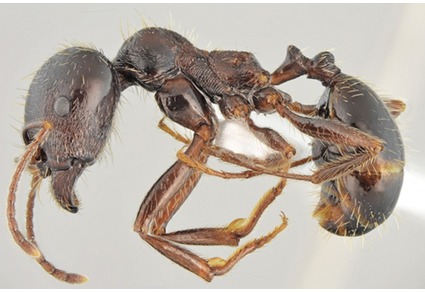
The genus Messor Forel, 1890 currently comprises 171 valid species and subspecies, with highest diversity in the Mediterranean and Central Asia. Greece hosts at least 16 species, although the taxonomic status of some needs to be further investigated. Amongst these, six species are island endemics, either restricted to a single Aegean island or distributed across several islands in the archipelago. Despite recent studies on the harvester ants of Greece, the case of Messor antennatus fodorii Röszler, 1942, remained unresolved amongst Greek representatives. This enigmatic harvester ant was first collected almost a century ago, in 1935, from Chios Island, situated in the northeastern part of the Aegean Sea. The lack of both a type and additional material has led to its exclusion from checklists and identification keys, leaving its status as uncertain. From April 24th to May 5th 2025, we conducted field surveys in Chios, Oinousses and Psara islands to investigate the presence and taxonomic status of M. antennatus fodorii. Upon investigation, the harvester ant is raised to the species level Messor fodorii Röszler, 1942 stat. nov., designating a neotype, providing a re-description, a morphometric comparison of species in the M. hellenius complex, ecological notes and an updated identification key to Greek representatives of the Messor hellenius species complex.
References
- Bolton, B. (2026) An online catalog of the ants of the world. Available from: https://antcat.org (accessed 27 January 2026)
- Boratyński, A., Browicz, K. & Zieliński, J. (1987) Woody flora of Chios. Arboretum Kornickie Rocznik, 32, 37–90.
- Borowiec, L., Demetriou, J., Georgiadis, C., Salata, S., Wetterer, J.K. & Zięcina, D. (2024) Notes on ants (Hymenoptera: Formicidae) of Lesvos island, Greece. Annals of the Upper Silesian Museum of Bytom Entomology, 33 (7), 1–26. https://doi.org/10.5281/zenodo.13949906
- Borowiec, L. & Salata, S. (2012) Ants of Greece – checklist, comments and new faunistic data (Hymenoptera: Formicidae). Genus, Wroclaw, 23 (4), 461–563.
- Borowiec, L. & Salata, S. (2013) Ants of Greece – additions and corrections (Hymenoptera: Formicidae). Genus, Wroclaw, 24 (3–4), 335–401.
- Borowiec, L. & Salata, S. (2018) Notes on ants (Hymenoptera: Formicidae) of Samos Island, Greece. Annals of the Upper Silesian Museum Bytom Entomology, 27 (3), 1–13. https://doi.org/10.5281/zenodo.1481802
- Borowiec, L., Wieczorek, K. & Salata, S. (2021) Review of ants (Hymenoptera: Formicidae) of the Dodecanese Archipelago, Greece. Annals of the Upper Silesian Museum in Bytom, Entomology, 30 (6), 1–33. https://doi.org/10.5281/zenodo.5571270
- Borowiec, L., Lebas, C. & Salata, S. (2022) Notes on ants (Hymenoptera: Formicidae) from three northern Aegean islands – Lemnos, Samothraki and Thasos. Annals of the Upper Silesian Museum in Bytom, Entomology, 31 (10), 1–14. https://doi.org/10.5281/zenodo.7346453
- Borowiec, L. & Salata, S. (2022) A monographic review of ants of Greece (Hymenoptera: Formicidae). Vol. 1. Introduction and review of all subfamilies except the subfamily Myrmicinae. Part 1. Text. Natural History Monographs of the Upper Silesian Museum. Upper Silesian Museum, Bytom, 297 pp.
- Borowiec, L. & Salata, S. (2025) A monographic review of ants of Greece (Hymenoptera: Formicidae) Vol. 2. Review of the subfamily Myrmicinae except the genera Temnothorax and Tetramorium. Part 1. Text. Natural History Monographs of the Upper Silesian Museum. Upper Silesian Museum, Bytom, 476 pp.
- Cagniant, H. (1964) Étude de quelques fourmis marocaines. Statistique provisoire des Formicidae du Maroc. Bulletin de la Société d’Histoire naturelle de l’Afrique du Nord, 53, 83–118.
- Cagniant, H. & Espalader, X. (1998) Le genre Messor au Maroc. Annales de la Société Entomologique de France, 33 (4), 419–434. https://doi.org/10.1080/21686351.1997.12279186
- Collingwood, C. (1993) A comparative study of the ant fauna of five Greek islands. Biologia Gallo-Hellenica, 20 (1), 191–197.
- Demetriou, J., Georgiadis, C., Salata, S., Koutsoukos, E., Borowiec, L. & Triantis, K.A. (2025) Notes on the ant biodiversity, ecology and biogeography (Hymenoptera: Formicidae) of Astypalaia Island (SE Aegean). Journal of Natural History, 59 (25–28), 1807–1823. https://doi.org/10.1080/00222933.2025.2502122
- Denye, G. & Bonaric, J.L. (1973) Fourmis de sud Morocain. Etude de certains milieux du Maroc et de leux evolution recentre. Travaux de la R.C.P. [Recherche Coopérative sur Programme] 249. Centre National de la Recherche Scientifique [CNRS], Paris, 249 pp.
- Emery, C. (1908) Beiträge zur Monographie der Formiciden des paläarktischen Faunengebietes. (Hym.) Teil III. Deutsche Entomologische Zeitschrift, 1908, 437–465. https://doi.org/10.1002/mmnd.48019080602
- Guénard, B., Weiser, M., Gomez, K., Narula, N. & Economo, E.P. (2017) The Global Ant Biodiversity Informatics (GABI) database: A synthesis of ant species geographic distributions. Myrmecological News, 24, 83–89.
- Harris, R.A. (1979) A glossary of surface sculpturing. Occasional Papers in Entomology, State of California Department of Food and Agriculture, 28, 1–31.
- IGME (1993) Geochemical Atlas of Chios Island 1:100.000, Map of Mercury distribution (Hg). Greek Institute of Geology and Mineral Exploration, Athens. [map]
- Janicki, J., Narula, N., Ziegler, M., Guénard, B. & Economo, E.P. (2016) Visualizing and interacting with large-volume biodiversity data using client-server web-mapping applications: The design and implementation of antmaps.org. Ecological Informatics, 32, 185–193. https://doi.org/10.1016/j.ecoinf.2016.02.006
- Kass, J.M., Guénard, B., Dudley, K.L., Jenkins, C.N., Azuma, F., Fisher, B.L., Parr, C.L., Gibb, H., Longino, J.T., Ward, P.S., Chao, A., Lubertazzi, D., Weiser, M., Jetz, W., Guralnick, R., Blatrix, R., Des Lauriers, J., Donoso, D.A., Georgiadis, C., Gomez, K., Hawkes, P.G., Johnson, R.A., Lattke, J.E., MacGown, J.A., Mackay, W., Robson, S., Sanders, N.J., Dunn, R.R. & Economo, E.P. (2022) The global distribution of known and undiscovered ant biodiversity. Science Advances, 8 (31), eabp9908. https://doi.org/10.1126/sciadv.abp9908
- Kassambara, A. & Mundt, F. (2020) factoextra: Extract and Visualize the Results of Multivariate Data Analyses. R Package. Version 1.0.7. Available from: https://CRAN.R-project.org/package=factoextra. https://doi.org/10.32614/CRAN.package.factoextra
- Kiran, K. & Karaman, C. (2012) First annotated checklist of the ant fauna of Turkey (Hymenoptera: Formicidae). Zootaxa, 3548 (1), 1–38. https://doi.org/10.11646/zootaxa.3548.1.1
- Kiran, K. & Karaman, C. (2020) Additions to the Ant Fauna of Turkey (Hymenoptera, Formicidae). Zoosystema, (18), 285–329. https://doi.org/10.5252/zoosystema2020v42a18
- Lapeva-Gjonova, A. & Borowiec, L. (2026) A new species of Messor from Bulgaria and redescription of the gyne of M. oertzeni Forel, 1910 (Hymenoptera, Formicidae). ZooKeys, 1275, 145–168. https://doi.org/10.3897/zookeys.1275.181745
- Lapeva-Gjonova, A., Pramatarova, M., Borowiec, L., Gjonov, I., Kostova, R., Bekchiev, R. & Borissov, S. (2025) DNA barcoding of Messor ants of Bulgaria with insights into their taxonomic diversity. Biodiversity Data Journal, 13, e168586. https://doi.org/10.3897/BDJ.13.e168586
- Markó, B. & Csősz, S. (2002) Die europäischen Ameisenarten (Hymenoptera: Formicidae) des Hermannstädter (Sibiu, Rumänien) Naturkundemuseums I.: Unterfamilien Ponerinae, Myrmicinae und Dolichoderinae. Annales Historico-Naturales Musei Nationalis Hungarici, 94, 109–121.
- Menozzi, C. (1936) Nuovi contributi alla conoscenza della fauna delle Isole italiane dell’Egeo. VI. Hymenoptera - Formicidae. Bollettino del Laboratorio di Zoologia Generale e Agraria della Reale Scuola Superiore d’Agricoltura Portici, 29, 262–311.
- MeteoBlue (2026) Weather Chios. Available from: https://www.meteoblue.com/en/weather/week/chios_greece_259973 (accessed 28 January 2026)
- Ogle, D.H., Doll, J.C., Wheeler, A.P. & Dinno, A. (2026) FSA: Simple Fisheries Stock Assessment Methods. R Package. Version 0.10.1. Available from: https://CRAN.R-project.org/package=FSA (accessed 13 April 2026) https://doi.org/10.32614/CRAN.package.FSA
- Orou, N., Csősz, S., Arnan, X., Pol, R.G., Arthofer, W., Schlick-Steiner, B.C. & Steiner, F.M. (2023) Messor erwini sp. n., a hitherto cryptic harvester ant in the Iberian Peninsula. Zoologischer Anzeiger, 307, 36–53. https://doi.org/10.1016/j.jcz.2023.09.001
- R Core Team (2025) R: A language and environment for statistical computing. R foundation for statistical computing, Vienna. Available from: https://www.R-project.org/ (accessed 13 April 2026)
- Röszler, P. (1942) Myrmecologisches 1938. Tijdschrift voor Entomologie, 85, 50–71.
- Röszler, P. (1951) Myrmecologisches aus dem Jahre 1938. Zoologischer Anzeiger, 146, 88–96.
- RStudio Team (2025) RStudio: Integrated development environment for R. Posit Software, PBC, Boston, Massachusetts. [software]
- Salata, S. & Borowiec, L. (2019) Preliminary contributions toward a revision of Greek Messor Forel, 1890 (Hymenoptera: Formicidae). Turkish Journal of Zoology, 43 (1), 52–67. https://doi.org/10.3906/zoo-1809-41
- Salata, S., Borowiec, L. & Trichas, A. (2020) Review of ants (Hymenoptera: Formicidae) of Crete, with keys to species determination and zoogeographical remarks. Monographs of the Upper Silesian Museum, 12, 5–296.
- Salata, S., Karaman, C., Kiran, K. & Borowiec, L. (2021) Review of the Aphaenogaster splendida species-group (Hymenoptera: Formicidae). Annales Zoologici, 71, 297–343. https://doi.org/10.3161/00034541ANZ2021.71.2.008
- Salata, S., Lapeva-Gjonova, A., Georgiadis, C. & Borowiec, L. (2023) Review of the Messor semirufus complex (Hymenoptera, Formicidae) in Greece. ZooKeys, 1185, 105–142. https://doi.org/10.3897/zookeys.1185.111484
- Santschi, F. (1927) Revision des Messor du groupe instabilis Sm. (Hymenopt.). Boletín de la Real Sociedad Española de Historia Natural, 27, 225–250.
- Santschi, F. (1929) Fourmis de Maroc, d’Algérie et de Tunisie. Bulletin et Annales de la Société Entomologique de Belgique, 69, 138–165.
- Scupola, A. & Borowiec, L. (2023) Ants (Hymenoptera Formicidae) of Greek islands: where we are. In: Masseti, M. (Ed.), Life on Islands 2. Zoological diversity of the Aegean Archipelago – studies dedicated to Norma Chapmann. Edizioni Danaus, Palermo, pp. 185–213.
- Sfenthourakis, S. & Triantis, K.A. (2017) The Aegean archipelago: a natural laboratory of evolution, ecology and civilisations. Journal of Biological Research - Thessaloniki, 24 (4), 1–13. https://doi.org/10.1186/s40709-017-0061-3
- Steiner, F.M., Csősz, S., Markó, B., Gamisch, A., Rinnhofer, L., Folterbauer, C., Hammerle, S., Stauffer, C., Arthofer, W. & Schlick-Steiner, B.C. (2018) Turning one into five: Integrative taxonomy uncovers complex evolution of cryptic species in the harvester ant Messor “structor”. Molecular Phylogenetics and Evolution, 127, 387–404. https://doi.org/10.1016/j.ympev.2018.04.005
- Triantis, K. & Mylonas, M. (2009) Greek islands, biology. In: Gillespie, R.G. & Clague, D.A. (Eds.), Encyclopedia of islands. University of California Press, Berkeley, California, pp. 388–392. https://doi.org/10.1525/9780520943728-091
- Wilson, E.O. (1955) A monographic revision of the ant genus Lasius. Bulletin of the Museum of Comparative Zoology, 113, 1–201.
- Wickham, H. (2016) Data Analysis. In: Wickham, H. (Ed.), Ggplot2. Springer International Publishing, Cham, pp. 189–201. https://doi.org/10.1007/978-3-319-24277-4_9
- Wickham, H., François, R., Henry, L., Müller, K. & Vaughan, D. (2023) dplyr: A Grammar of Data Manipulation. R Package. Version 1.1.4. Available from: https://CRAN.R-project.org/package=dplyr (accessed 13 April 2026) https://doi.org/10.32614/CRAN.package.dplyr