
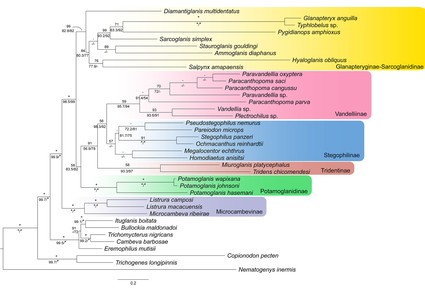

Abstract
Relationships of trichomycterid catfishes of the clade comprising Glanapteryginae and Sarcoglanidinae are still insufficiently known. We performed a multigene phylogeny, 3,252 bp, constituting the richest taxon sample of the Glanapteryginae-Sarcoglanidinae lineage in phylogenetic studies until now. It supported Ammoglanis multidentatus as sister to a clade comprising all other taxa of the Glanapteryginae-Sarcoglanidinae lineage, justifying the description of a new genus, diagnosed by the unique morphology of the sesamoid supraorbital, anteroventral process of the opercle, vomer and parurohyal, besides being distinguished from other glanapterygines by having 15 or 16 opercular odontodes and the anal-fin base posterior to the dorsal-fin base. Ammoglanis is supported as a monotypic genus, sister to Stauroglanis. Hyaloglanis and Salpynx were supported as sister taxa but do not form a monophyletic group with the Glanapteryginae as recently proposed, whereas Sarcoglanis is recovered as sister to the Glanapteryginae.
References
- Alonso, F., Teran, G.E., Alanis, W.S.S., Calvino, P., Montes, M.M., Garcia, I.D., Barneche, J.A., Almiron, A., Ciotek, L., Giorgis, P. & Casciotta, J. (2023) From the mud to the tree: phylogeny of Austrolebias killifishes, new generic structure and description of a new species (Cyprinodontiformes: Rivulidae). Zoological Journal of the Linnean Society, 199, 280–309. https://doi.org/10.1093/zoolinnean/zlad032
- Anisimova, M., Gil, M., Dufayard, J., Dessimoz, C. & Gascuel, O. (2011) Survey of branch support methods demonstrates accuracy, power, and robustness of fast likelihood-based approximation schemes. Systematic Biology, 60 (5), 685–699. https://doi.org/10.1093/sysbio/syr041
- Arratia, G. & Huaquin, L. (1995) Morphology of the lateral line system and of the skin of diplomystid and certain primitive loricarioid catfishes and systematic and ecological considerations. Bonner Zoologische Monographien, 36, 1–110.
- Barbosa, M.A. & Costa, W.J.E.M. (2010) Seven new species of the catfish genus Trichomycterus (Teleostei: Siluriformes: Trichomycteridae) from Southeastern Brazil and redescription of T. brasiliensis. Ichthyological Exploration of Freshwaters, 21, 97–122. https://doi.org/10.3897/vz.60.e31010
- Baskin, J.N. (1973) [2016] Structure and relationships of the Trichomycteridae; City University of New York: New York, NY, USA. Neotropical Ichthyology, 14, S1–S62.
- Bockmann, F.A., Ferrer, J., Rizzato, P.P., Esguícero, A.L.H., Duboc, L.F. & Ingenito, L.F.S. (2023) Anatomy, ecology, and behavior of a new species of Scleronema Eigenmann, 1917 (Siluriformes: Trichomycteridae) from coastal drainages in the southern Brazilian Atlantic Rainforest, with comments on the monophyly and phylogeny of the genus. Zootaxa, 5297 (1), 1–47. https://doi.org/10.11646/zootaxa.5297.1.1
- Bockmann, F.A. & Sazima, I. (2004) Trichomycterus maracaya, a new catfish from the upper rio Paraná, southeastern Brazil (Siluriformes: Trichomycteridae), with notes on the T. brasiliensis species-complex. Neotropical Ichthyology, 2, 61–74. https://doi.org/10.1590/s1679-62252004000200003
- Bragança, P.H.N., Amorim, P.F. & Costa, W.J.E.M. (2018) Pantanodontidae (Teleostei, Cyprinodontiformes), the sister group to all other cyprinodontoid killifishes as inferred by molecular data. Zoosystematics and Evolution, 94, 137–145. https://doi.org/10.3897/zse.94.22173
- Canto, A.L.C., Hercos, A.P. & Ribeiro, F.R.V. (2022) Description of a new species of miniature catfish of the genus Ammoglanis (Siluriformes: Trichomycteridae) from rio Tapajós basin, Brazil. Neotropical Ichthyology, 20 (2), e210122. https://doi.org/10.1590/1982-0224-2021-0122
- Costa, W.J.E.M. (1994) A new genus and species of Sarcoglanidinae (Siluriformes: Trichomycteridae) from the Araguaia basin, central Brazil, with notes on subfamilial phylogeny. Ichthyological Exploration of Freshwaters, 5, 207–216. https://doi.org/10.1080/00222939400770331
- Costa, W.J.E.M. (2021) Comparative osteology, phylogeny and classification of the eastern South American catfish genus Trichomycterus (Siluriformes: Trichomycteridae). Taxonomy, 1, 160–191. https://doi.org/10.3390/taxonomy1020013
- Costa, W.J.E.M. & Bockmann, F.A. (1994a) A new genus and species of Sarcoglanidinae (Siluriformes: Trichomycteridae) from southeastern Brazil, with a re-examination of subfamilial phylogeny. Journal of Natural History, 28, 715–730. https://doi.org/0.1080/00222939400770331
- Costa, W.J.E.M. & Bockmann, F.A. (1994b) Typhlobelus macromycterus, a new blind glanapterygine fish (Siluriformes Trichomycteridae) from the Rio Tocantins, Brazil. Tropical Zoology, 7, 67–72. https://doi.org/10.1080/03946975.1994.10539241
- Costa, W.J.E.M., Henschel, E. & Katz, A.M. (2020) Multigene phylogeny reveals convergent evolution in small interstitial catfishes from the Amazon and Atlantic forests (Siluriformes: Trichomycteridae). Zoologica Scripta, 49, 159–173. https://doi.org/10.1111/zsc.12403
- Costa, W.J.E.M. & Katz, A.M. (2021) Comparative morphology, phylogeny, classification and evolution of interstitial habits in microcambevine catfishes (Siluriformes: Trichomycteridae). Taxonomy, 1, 313–344. https://doi.org/10.3390/taxonomy1040025
- Costa, W.J.E.M., Mattos, J.L.O. & Santos, A.C.A. (2019) Ammoglanis multidentatus, a new miniature sand-dwelling sarcoglanidine catfish with unique osteological features from northeastern Brazil (Siluriformes: Trichomycteridae). Vertebrate Zoology, 70, 61–67. https://doi.org/10.26049/VZ70-1-2020-04
- Datovo, A. & Bockmann, F.A. (2010) Dorsolateral head muscles of the catfish families Nematogenyidae and Trichomycteridae (Siluriformes: Loricarioidei): comparative anatomy and phylogenetic analysis. Neotropical Ichthyology, 8 (2), 193–246. https://doi.org/10.1590/s1679-62252010000200001
- de Pinna, M.C.C. (1989a) A new sarcoglanidine catfish, phylogeny of its subfamily, and an appraisal of.the phyletic status of the Trichomycterinae (Teleostei, Trichomycteridae). American Museum Novitates, 2950, 1–39.
- de Pinna, M.C.C. (1989b) Redescription of Glanapteryx anguilla, with Notes on the Phylogeny of Glanapteryginae (Siluriformes, Trichomycteridae. Proceedings of the Academy of Natural Sciences of Philadelphia, 141, 361–374.
- de Pinna, M.C.C. (1992) A new subfamily of Trichomycteridae (Teleostei, Siluriformes), lower loricarioid relationships and a discussion on the impact of additional taxa for phylogenetic analysis. Zoological Journal of the Linnean Society, 106, 175–229. https://doi.org/10.1111/j.1096-3642.1992.tb01247.x
- de Pinna, M.C.C. (1998) Phylogenetic relationships of neotropical Siluriformes (Teleostei: Ostariophysi): Historical overview and synthesis of hypotheses. In: Malabarba, L.R., Reis, R.E., Vari, R.P., Lucena, Z.M.S. & Lucena, C.A.S. (Eds.), Phylogeny and Classification of Neotropical Fishes. Edipucrs, Porto Alegre, pp. 279–330.
- de Pinna, M.C.C. & Starnes, W.C. (1990) A new genus and species of Sarcoglanidinae from the Rio Mamoré, Amazon Basin, with comments on subfamilial phylogeny (Teleostei, Trichomycteridae). Journal of Zoology, 222, 75–88. https://doi.org/10.1111/j.1469-7998.1990.tb04030.x
- de Pinna, M., Reis, V.J.C. & DoNascimiento, C. (2025) On two new genera of Trichomycteridae (Teleostei, Siluriformes), with reallocation of some previously described taxa and discussion of phylogenetic relationships. Papéis Avulsos de Zoologia, 65, e202565027. https://doi.org/10.11606/1807-0205/2025.65.027
- de Pinna, M.C.C. & Winemiller, K.O. (2000) A new species of Ammoglanis (Siluriformes: Trichomycteridae) from Venezuela. Ichthyological Exploration of Freshwaters, 11, 255–264.
- de Pinna, M.C.C. & Zuanon, J. (2013) The genus Typhlobelus: monophyly and taxonomy, with description of a new species with a unique pseudotympanic structure (Teleostei: Trichomycteridae). Copeia, 2013 (3), 441–453. https://doi.org/10.1643/ci-13-007
- da Silva, R.S., Corrêa, F., de Oliveira, L.P., Guerra, V., Barros, B.S. & Vieira, L.J. (2020) Ichthyofauna of sandy beaches along the Acre river, Brazil. Biota Neotropica, 20, e20200988. https://doi.org/10.1590/1676-0611-BN-2020-0988
- Dias, A.C., Tencatt, L.F.C., Roxo, F.F., da Costa Silva, G.S., Santos, S.A., Britto, M.R., Taylor, M.I. & Oliveira, C. (2024) Phylogenomic analyses in the complex Neotropical subfamily Corydoradinae (Siluriformes: Callichthyidae) with a new classification based on morphological and molecular data. Zoololical Journal of the Linnean Society, 203, zlae053. https://doi.org/10.1093/zoolinnean/zlae053
- Gernhard, T. (2008) The conditioned reconstruction process. Journal of Theoretical Biology, 253 (4), 769–778. https://doi.org/10.1016/j.jtbi.2008.04.005
- Goulding, M., Carvalho, M.L. & Ferreira, E.J.G. (1988) Rich Life and Poor Water: Amazonian Diversity and Foodchain Ecology as Seen Through Fish Communities. SPB Academic Publishing, The Rague, 200 pp.
- Hanken, J. (1985) Morphological novelty on the limb skeleton accompanies miniaturization in salamanders. Science, 229, 871–874. https://doi.org/10.1126/science.4023715
- Hanken, J. & Wake, D.B. (1993) Miniaturization of body size: organismal consequences and evolutionary significance. Annual Review of Ecology and Systematics, 24, 501–519. https://doi.org/10.1146/annurev.ecolsys.24.1.501
- Henschel, E., Bragança, P.H.N., Rangel-Pereira, F. & Costa, W.J.E.M. (2020) A new psammophilic species of the catfish genus Ammoglanis (Siluriformes, Trichomycteridae) from the Amazon River basin, northern Brazil. Zoosystematics and Evolution, 96, 67–72. https://doi.org/10.3897/zse.96.48952
- Henschel, E., Lujan, N.K. & Baskin, J.N. (2020b) Ammoglanis natgeorum, a new miniature pencil catfish (Siluriformes: Trichomycteridae) from the lower Atabapo River, Amazonas, Venezuela. Journal of Fish Biology, 97, 1481–1490. https://doi.org/10.1111/jfb.14515
- Kubicek, K.M. (2022) Developmental osteology of Ictalurus punctatus and Noturus gyrinus (Siluriformes: Ictaluridae) with a discussion of siluriform bone homologies. Vertebrate Zoology, 72, 661–727. https://doi.org/10.3897/vz.72.e85144
- Kumar, S., Stecher, G., Suleski, M., Sanderford, M., Sharma, S. & Tamura, K. (2024) MEGA12: Molecular Evolutionary Genetic Analysis version 12 for adaptive and green computing. Molecular Biology and Evolution, 41 (12), msae263. https://doi.org/10.1093/molbev/msae263
- Lanfear, R., Frandsen, P.B., Wright, A.M., Senfeld, T. & Calcott, B. (2016) PartitionFinder 2: New methods for selecting partitioned models of evolution for molecular and morphological phylogenetic analyses. Molecular Biology and Evolution, 34 (3), 772–773. https://doi.org/10.1093/molbev/msw260
- Mattos, J.L.O., Costa, W.J.E.M. & Gama, C.S. (2008) A new miniature species of Ammoglanis (Siluriformes: Trichomycteridae) from the Brazilian Amazon. Ichthyological Exploration of Freshwaters, 19, 161–166.
- Melo, B.F., Ota, R.P., Benine, R.C., Carvalho, F.R., Lima, F.C.T., Mattox, G.M.T., Souza, C.S., Faria, T.C., Reia, L., Roxo, F.F., Valdez-Moreno, M., Near, T.J. & Oliveira, C. (2024) Phylogenomics of Characidae, a hyper-diverse Neotropical freshwater fish lineage, with a phylogenetic classification including four families (Teleostei: Characiformes). Zoological Journal of the Linnean Society, 202, zlae101. https://doi.org/10.1093/zoolinnean/zlae101
- Minh, B.Q., Schmidt, H.A., Chernomor, O., Schrempf, D., Woodhams, M.D., von Haeseler, A. & Lanfear, R. (2020) IQ-TREE 2: New models and efficient methods for phylogenetic inference in the genomic era. Molecular Biology and Evolution, 37 (5), 1530–1534. https://doi.org/10.1093/molbev/msaa015
- Myers, G.S. & Weitzman, S.H. (1966) Two remarkable new trichomycterid catfishes from the Amazon basin in Brazil and Colombia. Journal of Zoology, 149 (3), 277–287. https://doi.org/10.1111/j.1469-7998.1966.tb04049.x
- Near, T.J. & Thacker, C. (2024) Phylogenetic classification of living and fossil ray-finned fishes (Actinopterygii). Bulletin of the Peabody Museum of Natural History, 65, 3–302. https://doi.org/10.3374/014.065.0101
- Ochoa, L.E., Datovo, A., DoNascimiento, C., Roxo, F.F., Sabaj, M.H., Chang, J., Melo, F.B., Silva, G.C., Foresti, F., Alfaro, M. & Oliveira, C. (2020) Phylogenomic analysis of trichomycterid catfishes (Teleostei: Siluriformes) inferred from ultraconserved elements. Scientific Reports, 10, 1–15. https://doi.org/10.1038/s41598-020-59519-w
- Ochoa, L.E., Roxo, F.F., DoNascimiento, C., Sabaj, M.H., Datovo, A., Alfaro, M. & Oliveira, C. (2017) Multilocus analysis of the catfish family Trichomycteridae (Teleostei: Ostariophysi: Siluriformes) supporting a monophyletic Trichomycterinae. Molecular Phylogenetics and Evolution, 115, 71–81. https://doi.org/10.1016/j.ympev.2017.07.007
- Oliveira, C. (2025) Biodiversity, systematics, and taxonomy of Ostariophysi (Osteichthyes, Actinopterygii): what we know today after three decades of integration of morphological and molecular data. Taxonomy, 5, 33. https://doi.org/10.3390/taxonomy5020033
- Palumbi, S., Martin, A., Romano, W.O., Stice, L. & Grabowski, G. (1991) The simple fool’s guide to PCR, version 2.0. University of Hawaii, Honolulu, 47 pp.
- Rambaut, A., Drummond, A.J., Xie, D., Baele, G. & Suchard, M.A. (2018) Posterior summarization in Bayesian phylogenetics using Tracer 1.7. Systematic Biology, 67 (5), 901–904. https://doi.org/10.1093/sysbio/syy032
- Reis, V.J.C., Lecointre, G. & de Pinna, M.C.C. (2025) The Trichomycteridae: An overview of the systematics and classification of the family. In: Arratia, G. & Reis, R. (Eds.), Catfishes, a Highly Diversified Group. Vol. 2. Evolution and Phylogeny. CRC Press, Boca Raton, pp. 213–257. https://doi.org/10.1201/9781003374312-10
- Schaefer, S.A., Provenzano, F., de Pinna, M. & Baskin, J.N. (2005) New and noteworthy Venezuelan glanapterygine catfishes (Siluriformes, Trichomycteridae), with discussion of their biogeography and psammophily. American Museum Novitates, 3496, 1–27. https://doi.org/10.1206/0003-0082(2005)496[0001:NANVGC]2.0.CO;2
- Schwarz, G. (1978) Estimating the dimension of a model. Annals of Statistics, 6 (2), 461–464. https://doi.org/10.1214/aos/1176344136
- Stout, C.C., Tan, M., Lemmon, A.R., Lemmon, E.M. & Armbruster, J.W. (2016) Resolving Cypriniformes relationships using an anchored enrichment approach. BMC Evolutionary Biology, 16, 244. https://doi.org/10.1186/s12862-016-0819-5
- Suchard, M.A., Lemey, P., Baele, G., Ayres, D.L., Drummond, A.J. & Rambaut, A. (2018) Bayesian phylogenetic and phylodynamic data integration using BEAST 1.10. Virus Evolution, 4 (1), vey016. https://doi.org/10.1093/ve/vey016
- Sullivan, J.P., Lundberg, J.G. & Hardman, M. (2006) A phylogenetic analysis of the major groups of catfishes (Teleostei: Siluriformes) using rag1 and rag2 nuclear gene sequences. Molecular Phylogenetics and Evolution, 41, 636–662. https://doi.org/10.1016/j.ympev.2006.05.044
- Thacker, C.E. & Near, T.J. (2025) Phylogeny, biology, and evolution of acanthopterygian fish clades. Review in Fish Biology and Fisheries, 35, 805–845. https://doi.org/10.1007/s11160-025-09935-w
- Thompson, J.D., Higgins, D.G. & Gibson, T.J. (1994) CLUSTAL W: Improving the sensitivity of progressive multiple sequence alignment through sequence weighting, position-specific gap penalties and weight matrix choice. Nucleic Acids Research, 22 (22), 4673–4680. https://doi.org/10.1093/nar/22.22.4673
- Ward, R.D., Zemlak, T.S., Innes, B.H., Last, P.R. & Hebert, P.D.N. (2005) DNA barcoding Australia’s fish species. Philosophical Transactions of the Royal Society of London B: Biological Sciences, 360 (1462), 1847–1857. https://doi.org/10.1098/rstb.2005.1716
- Weitzman, S.H. & Vari, R.P. (1988) Miniaturization in South American freshwater fishes; an overview and discussion. Proceedings of the Biological Society of Washington, 101, 444–465.
- Wiens, J.J. (2004) The role of morphological data in phylogeny reconstruction. Systematic Biology, 53 (4), 653–661. https://doi.org/10.1080/10635150490472959
- Villa-Verde, L., Lazzarotto, H. & Lima, S.M.Q. (2012) A new glanapterygine catfish of the genus Listrura (Siluriformes: Trichomycteridae) from southeastern Brazil, corroborated by morphological and molecular data. Neotropical Ichthyology, 10 (3), 527–538. https://doi.org/10.1590/S1679-62252012000300005
- Xia, X. (2018) DAMBE7: New and improved tools for data analysis in molecular biology and evolution. Molecular Biology and Evolution, 35 (6), 1550–1552. https://doi.org/10.1093/molbev/msy073
- Xia, X. & Lemey, P. (2009) Assessing substitution saturation with DAMBE. In: Lemey, P., Salemi, M. & Vandamme, A.-M. (Eds.), The Phylogenetic Handbook: A Practical Approach to DNA and Protein Phylogeny. 2nd Edition. Cambridge University Press, Cambridge, pp. 615–630. https://doi.org/10.1017/cbo9780511819049.022
- Xia, X., Xie, Z., Salemi, M., Chen, L. & Wang, Y. (2003) An index of substitution saturation and its application. Molecular Phylogenetics and Evolution, 26 (1), 1–7. https://doi.org/10.1016/S1055-7903(02)00326-3
- Zuanon, J., Bockmann, F.A. & Sazima, I. (2006) A remarkable sand-dwelling fish assemblage from central Amazonia, with comments on the evolution of psammophily in South American freshwater fishes. Neotropical Ichthyology, 4, 107–118. https://doi.org/10.1590/S1679-62252006000100012
- Zuanon, J. & Sazima, I. (2004) Natural history of Stauroglanis gouldingi (Siluriformes: Trichomycteridae), a miniature sand-dwelling candiru from central Amazonia streamlets. Ichthyological Exploration of Freshwaters, 15, 201–208.