

Abstract
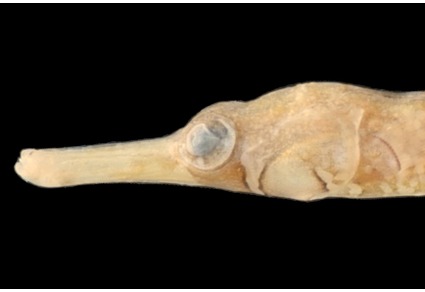
The new pipefish Festucalex bifasciatus sp. nov., described from eight specimens [89.8–152.8 mm standard length (SL)] collected from Western Australia and Queensland, Australia, and most closely resembling F. cinctus (Ramsay 1882) (11 specimens, 48.8–126.8 mm SL) and F. scalaris (Günther 1870) (10 specimens, 45.4–162.7 mm SL), differs from all members of Festucalex in having 19 or 20 trunk rings; 34–38 tail rings; 24–28 dorsal-fin rays; 12–15 pectoral-fin rays; snout length (SnL) 46.4–52.6% of head length (HL); snout depth 17.8–22.7% of SnL; postorbital length 60.0–74.6% of SnL; lateral trunk ridge ending at second or third tail ring; subadults and adults with or without indistinct ridges on pectoral-fin base; principal ridges of last 1 or 2 tail rings with 1–7 knobs or projections; and opercle with 2 white bars (2 pale bars in preserved specimens). The new species was mostly collected by dredge at depths of 9–81 m. Among all congeners, only F. cinctus shares with the new species the presence of knobbed principal tail ridges, and the two taxa have a broadly overlapping distribution in Australian waters, suggesting a close phylogenetic relationship.
References
- Allen, G.R. & Erdmann, M.V. (2015) Festucalex rufus, a new species of pipefish (Syngnathidae) from Milne Bay Province, Papua New Guinea. Aqua: Journal of Ichthyology and Aquatic Biology, 21 (1), 47–51.
- Dawson, C.E. (1977) Synopsis of syngnathine pipefishes usually referred to the genus Ichthyocampus Kaup, with description of new genera and species. Bulletin of Marine Science, 27 (4), 595–650.
- Dawson, C.E. (1985) Indo-Pacific Pipefishes (Red Sea to the Americas). The Gulf Coast Research Laboratory, Ocean Springs, Mississippi, vi + 230 pp.
- Fricke, R. (2004) Review of the pipefishes and seahorses (Teleostei: Syngnathidae) of New Caledonia, with descriptions of five new species. Stuttgarter Beiträge zur Naturkunde, Serie A (Biologie), 668, 1–66.
- Prokofiev, A.M. (2016) New species of pipefish (Syngnathidae) from the South China Sea. Voprosy Ikhtiologii, 56 (5), 787–789. [in Russian, English translation in Journal of Ichthyology, 56 (5), 787–789] https://doi.org/10.1134/S003294521605012X
- Sabaj, M.H. (2020) Codes for natural history collections in ichthyology and herpetology. Copeia, 108 (3), 593–669. https://doi.org/10.1643/ASIHCODONS2020
- Yuki, D. & Motomura, H. (2025) Festucalex rosa, a new species of pipefish (Teleostei: Syngnathidae) from the Seychelles, western Indian Ocean. Zootaxa, 5701 (5), 597–600. https://doi.org/10.11646/zootaxa.5701.5.8
- Yuki, D., Koreeda, R. & Motomura, H. (2025) Second Japanese record of Festucalex gibbsi (Syngnathidae) from Tanega-shima island, Osumi Islands. Ichthy: Natural History of Fishes of Japan, 58, 13–16. [in Japanese with English abstract] https://doi.org/10.34583/ichthy.58.0_13