

Abstract
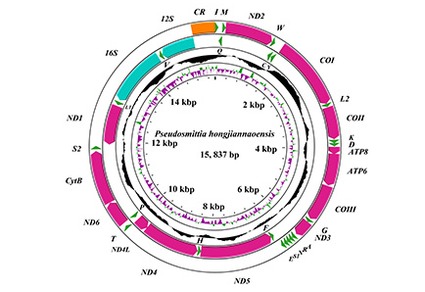
Pseudosmittia hongjiannaoensis Liu, sp. nov. is described and illustrated based on adult males collected from Hongjiannao National Nature Reserve, Shaanxi, China. Morphological identification, DNA barcoding comparison, and mitochondrial genome (mitogenome) assembly were employed to characterize the new species. The mitochondrial COI barcode sequences and mitogenomic data support its distinction from previously known Pseudosmittia species. The minimum interspecific K2P distance between P. hongjiannaoensis Liu, sp. nov., and its closest congener was 15.1%, with an average distance of 23.0%, substantially exceeding the commonly referenced threshold for insect species delimitation. The new species can be distinguished by the unique shape of the inferior volsella and the lack of an anal point. An updated key to the adult males of Pseudosmittia from China is provided. This discovery of the new species enriches the known diversity of the genus in East Asian inland freshwater ecosystems and highlights the ecological significance of the Hongjiannao Lake as a unique wetland habitat.
References
- Armitage, P.D., Cranston, P.S. & Pinder, L.C.V. (1995) The Chironomidae: Biology and ecology of non-biting midges. Chapman & Hall, London, 572 pp. https://doi.org/10.1007/978-94-011-0715-0
- Cheng, S.-Y., Lin, H.-X., Li, M.-Q. & Li, Y.-J. (2022) Study on the relationship between environmental changes and breeding sites of Larus relictus in Hongjiannao Lake. Quaternary Sciences, 42 (4), 1201–1212. https://doi.org/10.11928/j.issn.1001-7410.2022.04.23
- Cranston, P., Hardy, N. & Morse, G. (2011) A dated molecular phylogeny for the Chironomidae (Diptera). Systematic Entomology, 37 (1), 172–188. https://doi.org/10.1111/j.1365-3113.2011.00603.x
- Dierckxsens, N., Mardulyn, P. & Smits, G. (2017) NOVOPlasty: de novo assembly of organelle genomes from whole genome data. Nucleic Acids Research, 45, e18. https://doi.org/10.1093/nar/gkw955
- Evenhuis, N.L. & Pape, T. (Eds.) (2026) Systema Dipterorum. Version 7.0. Last Updated 1 February 2026. Available from: http://diptera.org/ (accessed 18 March 2026)
- Ferrington, L.C. Jr. (2008) Global diversity of non-biting midges (Chironomidae; Insecta-Diptera) in freshwater. Hydrobiologia, 595 (1), 447–455. https://doi.org/10.1007/s10750-007-9130-1
- Ferrington, L.C. Jr. & Sæther, O.A. (2011) A revision of the genera Pseudosmittia Edwards, 1932, Allocladius Kieffer, 1913, and Hydrosmittia gen. n. (Diptera: Chironomidae, Orthocladiinae). Zootaxa, 2849 (1), 1–314. https://doi.org/10.11646/zootaxa.2849.1.1
- Folmer, O., Black, M., Hoeh, W., Lutz, R. & Vrijenhoek, R. (1994) DNA primers for amplification of mitochondrial cytochrome c oxidase subunitⅠfrom diverse metazoan invertebrates. Molecular Marine Biology and Biotechnology, 3 (5), 294–299.
- Fang, X., Wang, X., Mao, B., Xiao, Y., Shen, M. & Fu, Y. (2023) Comparative mitogenome analyses of twelve non-biting flies and provide insights into the phylogeny of Chironomidae (Diptera: Culicomorpha). Scientific Reports, 13 (1), 9200. https://doi.org/10.1038/s41598-023-36227-9
- Giłka, W., Zakrzewska, M., Lukashevich, E., Vorontsov, D., Soszynska, A., Skibińska, K. & Cranston, S. (2022) Wanted, tracked down and identified: Mesozoic non-biting midges of the subfamily Chironominae (Chironomidae, Diptera). Zoological Journal of the Linnean Society, 194 (3), 874–892. https://doi.org/10.1093/zoolinnean/zlab020
- Hebert, P.D.N., Cywinska, A., Ball, S.L. & deWaard, J.R. (2003) Biological identifications through DNA barcodes. Proceedings of the Royal Society of London. Series B: Biological Sciences, 270 (1512), 313–321. https://doi.org/10.1098/rspb.2002.2218
- Kim, S., Kim, H. & Shin, S.C. (2016) Complete mitochondrial genome of the Antarctic midge Parochlus steinenii (Diptera: Chironomidae). Mitochondrial DNA, Part A, 27 (5), 3475–3476. https://doi.org/10.3109/19401736.2015.1066355
- Krosch, N.M. (2010) Evolutionary biology of Gondwanan non-biting midges (Diptera: Chironomidae). Ph.D. dissertation. Queensland University of Technology, Brisbane, 204 pp.
- Liang, K. & Yan, G. (2017) Application of Landsat Imagery to Investigate Lake Area Variations and Relict Gull Habitat in Hongjian Lake, Ordos Plateau, China. Remote Sensing, 9 (10), 1019. https://doi.org/10.3390/rs9101019
- Liu, W.Y., Gao, R.H., Zhang, Q.L. & Li, X.M. (2008) A study on the diversity of benthic macroinvertebrates and its correlation with foraging of relict gull during breeding season in salt marsh wetland of Ordos Plateau. Journal of Arid Land Resources and Environment, 22 (4), 185–192. https://doi.org/10.3969/j.issn.1003-7578.2008.04.035
- Li, S.-Y., Zhao, Y.-M., Guo, B.-X., Li, C.-H., Sun, B.-J. & Lin, X.-L. (2022) Comparative Analysis of Mitogenomes of Chironomus (Diptera: Chironomidae). Insects, 13 (12), 1164. https://doi.org/10.3390/insects13121164
- Li, X.-Y., Yan, L.-P., Thomas, P., Gao, Y.-Y. & Zhang, D. (2020) Evolutionary insights into bot flies (Insecta: Diptera: Oestridae) from comparative analysis of the mitochondrial genomes. International Journal of Biological Macromolecules, 149, 371–380. https://doi.org/10.1016/j.ijbiomac.2020.01.249
- Lin, X.-L., Liu, Z., Yan, L.-P., Duan, X., Bu, W.-J., Wang, X.-H. & Zheng, C.-G. (2022) Mitogenomes provide new insights of evolutionary history of Boreheptagyiini and Diamesini (Diptera: Chironomidae: Diamesinae). Ecology and Evolution, 12 (5), e8957. https://doi.org/10.1002/ece3.8957
- Martin, S. & Reiss, F. (1996) Catalog and bibliography of Neotropical and Mexican Chironomidae (Insecta, Diptera). Spixiana, 22, 61–119. [https://www.biodiversitylibrary.org/part/68102]
- Martin, J., Blinov, A., Alieva, E. & Hirabayashi, K. (2007) A molecular phylogenetic investigation of the genera closely related to Chironomus Meigen (Diptera: Chironomidae). In: Andersen, T. (Ed.), Contributions to the Systematics and Ecology of Aquatic Diptera. The Caddis Press, Columbus, Ohio, pp. 193–203. [https://api.semanticscholar.org/CorpusID:53997019]
- Papp, L. & Darvas, B. (1998) Contributions to a manual of Palaearctic Diptera (with special reference to flies of economic importance). Higher Brachycera, 3, 1–880.
- Sæther, O.A. (1969) Some Nearctic Pondonominae, Diamesinae and Orthocladiinae (Diptera: Chironomidae). Bulletin of the Fisheries Research Board of Canada, 170, 1–154.
- Sæther, O.A. (1980) Glossary of chironomid morphology terminology (Chironomidae: Diptera). Entomologica Scandinavica, 14 (Supplement), 1–51.
- Shen, J., Wang, Y., Yang, X.-D., Zhang, E.-L., Yang, B. & Ji, J.-F. (2005) Paleosandstorm characteristics and lake evolution history deduced from investigation on lacustrine sediments—The case of Hongjiannao Lake, Shaanxi Province. Chinese Science Bulletin, 50, 2355–2361. https://doi.org/10.1007/BF03183747
- Spies, M. & Sæther, O.A. (2004) Notes and recommendations on taxonomy and nomenclature of Chironomidae (Diptera). Zootaxa, 752 (1), 1–90. https://doi.org/10.11646/zootaxa.752.1.1
- Tamura, K., Stecher, G. & Kumar, S. (2021) MEGA11: Molecular Evolutionary Genetics Analysis Version 11. Molecular biology and evolution, 38 (7), 3022–3027. https://doi.org/10.1093/molbev/msab120
- Wang, S. (1990) Pseudosmittia aizaiensis, a new species of Orthocladiinae (Diptera, Chironomidae) from Hunan Province of China. Chinese Journal of Oceanology and Limnology, 8, 273–279. https://doi.org/10.1007/BF02849667
- Wang, Q.-X., Xiao, H., Shen, F. & Han, T.-K. (2020) Habitat restoration of lake islands and conservation of the relict gull population in Hongjiannao wetland, Shaanxi. Wetland Science & Management, 16 (2), 53–56. https://doi.org/10.3969/j.issn.1673-3290.2020.02.14
- Xu, Z.-W., Feng, N. & Wang, Z.-Q. (2005) Conservation management, existing problems and prospects of Larus relictus in Hongjiannao wetland. Chinese Journal of Wildlife, 6, 38–42. https://doi.org/10.19711/j.cnki.issn2310-1490.2005.06.015
- Yu, G., Xue, B., Wang, S.-M. & Liu, J. (2000) Lake records and LGM climate in China. Chinese Science Bulletin, 45, 1158–1164. https://doi.org/10.1007/BF02886069
- Zheng, C.-G., Ye, Z., Zhu, X.-X., Zhang, H.-G., Dong, X., Chen, P.-P. & Bu, W.-J. (2019) Integrative taxonomy uncovers hidden species diversity in the rheophilic genus Potamometra (Hemiptera: Gerridae). Zoologica Scripta, 49, 174–186. https://doi.org/10.1111/zsc.12401
- Zhang, H., Liu, Q., Lu, C. & Deng, J. (2022) Exploring Large-Scale Patterns of Genetic Variation in the COI Gene among Insecta: Implications for DNA Barcoding and Threshold-Based Species Delimitation Studies. Insects, 13 (5), 425. https://doi.org/10.3390/insects13050425