

Abstract
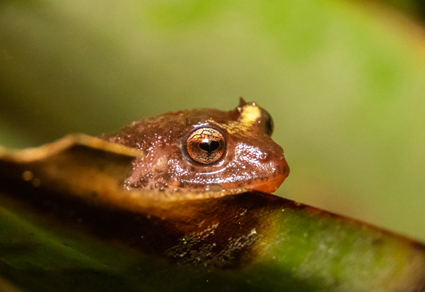
The Colombian Tropical Andes constitute an important area in terms of diversity and endemism of amphibian species. However, some studies have documented gaps in taxonomic information in these regions due to a lack of exploration, especially in the highest areas. The Parque Nacional Natural Farallones de Cali (PNN Farallones de Cali) is a protected area located in southwestern Colombia that brings together the Tropical Andes and Tumbes-Chocó-Magdalena biodiversity hotspots. This protected area holds a historical record of 112 named amphibian species, of which 36 are threatened according to the International Union for Conservation of Nature (IUCN) Red List and 44 are endemic to Colombia. However, the highest peaks of this national park have remained unexplored due to the political instability of the country, the presence of illegal productive activities, and operational and logistical difficulties of access. Fortunately, owing to the combination of human and institutional efforts, possibilities for exploration and the development of scientific activities have become available in the last decade. During recent explorations of the high Andean forest and páramo ecosystems of the PNN Farallones de Cali, we discovered two new threatened species herein in the Pristimantis leptolophus species group based on molecular, bioacoustic, and morphological evidence. The first species is distinguished by its polymorphic coloring patterns, the small size of the males, the presence of a small papilla at the tip of the snout, and its advertisement call, which is composed of a stereotyped group of 3–10 tonal notes that are widely separated by intervals of silence. The second new species is distinguished by the presence of a small papilla at the tip of the snout, and by lacking dorsolateral folds. These findings emphasize the importance of preserving the Andean and páramo ecosystems, which are home to several amphibian species and numerous others that remain undiscovered, highlighting the need to continue to explore uncharted areas in the Colombian Andes for a better understanding of Colombian amphibian diversity.
References
- Acosta-Galvis, A.R. (2023) Lista de los Anfibios de Colombia: Referencia en línea. Batrachia, Villa de Leyva, Boyacá. Available from: http://www.batrachia.com/ (accessed 3 April 2024)
- Bejarano-Muñoz, P., Ron, S.R., Navarrete, M.J. & Yánez-Muñoz, M.H. (2022) Dos nuevas especies del grupo Pristimantis boulengeri (Anura: Strabomantidae) de la cuenca alta del río Napo, Ecuador. Cuadernos de Herpetología, 36 (2), 125–154.
- Bernal, M.H. & Lynch, J.D. (2008) Review and analysis of altitudinal distribution of the Andean anurans in Colombia. Zootaxa, 1826 (1), 1–25. https://doi.org/10.11646/zootaxa.1826.1.1
- Bernal, M.H., Montealegre, D.P. & Páez, C.A. (2004) Estudio de la vocalización de trece especies de anuros del municipio de Ibagué, Colombia. Revista de la Academia Colombiana de Ciencias, 28 (108), 385–390. https://doi.org/10.18257/raccefyn.28(108).2004.2135
- Bioacoustics Research Program (2017) Raven Pro: Interactive Sound Analysis Software. The Cornell Lab of Ornithology, Ithaca, New York. [software]
- Bota-Sierra, C.A., Novelo-Gutiérrez, R. & Amaya-Vallejo, V. (2017) The rediscovery and redescription of Epigomphus pechumani Belle, 1970 (Odonata: Gomphidae), with a description of its female from the Western Colombian Andes. Zootaxa, 4306 (3), 419–427. https://doi.org/10.11646/zootaxa.4306.3.8
- Boulenger, G.A. (1882) Catalogue of the Batrachia Salientia s. Ecaudata in the collection of the British Museum. Printed by order of the Trustees, London, 503 pp.
- Boulenger, G.A. (1896) II.—Descriptions of new reptiles and batrachians from Colombia. Journal of Natural History, 17 (97), 16–21. https://doi.org/10.1080/00222939608680317
- Boulenger, G.A. (1912) Descriptions of new batrachians from the Andes of South America, preserved in the British Museum. Annals and Magazine of Natural History, Series 8, 10 (56), 185–191. https://doi.org/10.1080/00222931208693215
- Chaves-Acuña, W., Moreno, E.A. & Yánez-Muñoz, M.H. (2023) The advertisement call of Pristimantis unistrigatus (Anura: Strabomantidae) from the Ecuadorian Andes. Phyllomedusa, 22 (1), 49–55. https://doi.org/10.11606/issn.2316-9079.v22i1p49-55
- Cuellar-Valencia, O.M., Arriaga-Jaramillo, F.G., García-Gómez, I., Ceballos-Castro, I., Bolívar-García, W., Velásquez-Trujillo, D.A., Ortiz-Baez, A.S. & Ospina-Sarria, J.J. (2021) Two new species of Pristimantis (Anura: Strabomantidae) from the Serranía de los Paraguas: a priority site for conservation of amphibians in Colombia. Herpetologica, 77 (1), 72–84. https://doi.org/10.1655/Herpetologica-D-20-00003.1
- Cuellar-Valencia, O.M., Bolaños-Molina, B.E. & Bolívar-García, W. (2024) Exploring the acoustic diversity of Andean frogs in the Farallones de Cali National Natural Park, southwestern Colombia. Studies on Neotropical Fauna and Environment, 59 (3), 804–822. https://doi.org/10.1080/01650521.2023.2266187
- Cuellar-Valencia, O.M., Murillo-García, O.E., Rodriguez, G.A. & Bolívar-García, W. (2023) Bioaccumulation of mercury in direct-developing frogs: The aftermath of illegal gold mining in a National Park. Herpetological Journal, 33 (1), 6–13. https://doi.org/10.33256/33.1.613
- De Queiroz, K. (2007) Species concepts and species delimitation. Systematic Biology, 56 (6), 879–886. https://doi.org/10.1080/10635150701701083
- Duarte-Marín, S. (2024) The advertisement call of the robber frog Pristimantis peraticus in a population from the eastern slope of the Colombian central Andes. The Herpetological Bulletin, 170, 38–41. https://doi.org/10.33256/hb170.3841
- Duellman, W.E. & Lehr, E. (2009) Terrestrial-breeding frogs (Strabomantidae) in Peru. Natur und Tier-Verlag GmbH, Berlin, 382 pp.
- Flórez-V, C. & Evangelista, O. (2017) New species in the treehopper genus Bocydium Latreille, with description of nymphal stages and observations on their natural history. Zootaxa, 4281 (1), 22–57. https://doi.org/10.11646/zootaxa.4281.1.4
- García-R, J.C., Crawford, A.J., Mendoza, Á.M., Ospina, O., Cardenas, H. & Castro, F. (2012) Comparative phylogeography of direct-developing frogs (Anura: Craugastoridae: Pristimantis) in the southern Andes of Colombia. PLoS ONE, 7 (9), e46077. https://doi.org/10.1371/journal.pone.0046077
- Goin, C.J. & Cochran, D.M. (1963) Two new genera of leptodactylid frogs from Colombia. Proceedings of the California Academy of Sciences, XXXI (17), 499–505.
- González-Durán, G.A. (2016) A new small frog species of the genus Pristimantis (Anura: Craugastoridae) from the northern paramos of Colombia. Zootaxa, 4066 (4), 421. https://doi.org/10.11646/zootaxa.4066.4.4
- González-Durán, G.A., Targino, M., Rada, M. & Grant, T. (2017) Phylogenetic relationships and morphology of the Pristimantis leptolophus species group (Amphibia: Anura: Brachycephaloidea), with the recognition of a new species group in Pristimantis Jiménez de la Espada, 1870. Zootaxa, 4243 (1), 42–74. https://doi.org/10.11646/zootaxa.4243.1.2
- Günther, A.C.L.G. (1859) Second list of cold-blooded vertebrata collected by Mr. Fraser in the Andes of western Ecuador. Proceedings of the Zoological Society of London, 1859, 402–420.
- Heinicke, M.P., Duellman, W.E. & Hedges, S.B. (2007) Major Caribbean and Central American frog faunas originated by ancient oceanic dispersal. Proceedings of the National Academy of Sciences, 104 (24), 10092–10097. https://doi.org/10.1073/pnas.0611051104
- Hill, A.P., Prince, P., Piña Covarrubias, E., Doncaster, C.P., Snaddon, J.L. & Rogers, A. (2018) AudioMoth: Evaluation of a smart open acoustic device for monitoring biodiversity and the environment. In: Isaac, N. (Ed.). Methods in Ecology and Evolution, 9 (5), pp. 1199–1211. https://doi.org/10.1111/2041-210X.12955
- IUCN (2012) IUCN Red List Categories and Criteria: Version 3.1. 2nd Edition. IUCN, Gland and Cambridge, iv + 32 pp.
- IUCN (2024) The IUCN Red List of Threatened Species. Version 2023-1. IUCN, Gland and Cambridge. Available from: https://www.iucnredlist.org (accessed 7 April 2026)
- Kalyaanamoorthy, S., Minh, B.Q., Wong, T.K.F., von Haeseler, A. & Jermiin, L.S. (2017) ModelFinder: fast model selection for accurate phylogenetic estimates. Nature Methods, 14 (6), 587–589. https://doi.org/10.1038/nmeth.4285
- Katoh, K., Rozewicki, J. & Yamada, K.D. (2019) MAFFT online service: multiple sequence alignment, interactive sequence choice and visualization. Briefings in Bioinformatics, 20 (4), 1160–1166. https://doi.org/10.1093/bib/bbx108
- Kattan, G. (1986) Nueva especie de rana (Atelopus) de Los Farallones de Cali, Cordillera Occidental de Colombia. Caldasia, 14 (68–70), 651–657.
- Köhler, J., Jansen, M., Rodríguez, A., Kok, P.J.R., Toledo, L.F., Emmrich, M., Glaw, F., Haddad, C.F.B., Rödel, M.-O. & Vences, M. (2017) The use of bioacoustics in anuran taxonomy: theory, terminology, methods and recommendations for best practice. Zootaxa, 4251 (1), 1–124. https://doi.org/10.11646/zootaxa.4251.1.1
- Kumar, S., Stecher, G. & Tamura, K. (2016) MEGA7: Molecular Evolutionary Genetics Analysis Version 7.0 for Bigger Datasets. Molecular Biology and Evolution, 33 (7), 1870–1874. https://doi.org/10.1093/molbev/msw054
- Larsson, A. (2014) AliView: a fast and lightweight alignment viewer and editor for large datasets. Bioinformatics, 30 (22), 3276–3278. https://doi.org/10.1093/bioinformatics/btu531
- Laurance, W.F., Carolina Useche, D., Shoo, L.P., Herzog, S.K., Kessler, M., Escobar, F., Brehm, G., Axmacher, J.C., Chen, I.-C., Gámez, L.A., Hietz, P., Fiedler, K., Pyrcz, T., Wolf, J., Merkord, C.L., Cardelus, C., Marshall, A.R., Ah-Peng, C., Aplet, G.H., del Coro Arizmendi, M., Baker, W.J., Barone, J., Brühl, C.A., Bussmann, R.W., Cicuzza, D., Eilu, G., Favila, M.E., Hemp, A., Hemp, C., Homeier, J., Hurtado, J., Jankowski, J., Kattán, G., Kluge, J., Krömer, T., Lees, D.C., Lehnert, M., Longino, J.T., Lovett, J., Martin, P.H., Patterson, B.D., Pearson, R.G., Peh, K.S.-H., Richardson, B., Richardson, M., Samways, M.J., Senbeta, F., Smith, T.B., Utteridge, T.M.A., Watkins, J.E., Wilson, R., Williams, S.E. & Thomas, C.D. (2011) Global warming, elevational ranges and the vulnerability of tropical biota. Biological Conservation, 144 (1), 548–557. https://doi.org/10.1016/j.biocon.2010.10.010
- Lüddecke, H., Amézquita, A., Bernal, X. & Guzmán, F. (2000) Partitioning of vocal activity in a Neotropical highland-frog community. Studies on Neotropical Fauna and Environment, 35 (3), 185–194. https://doi.org/10.1076/snfe.35.3.185.8855
- Lynch, J.D. (1980) New species of Eleutherodactylus of Colombia (Amphibia: Leptodactylidae). I: five new species from the paramos of the Cordillera Central. Caldasia, XIII (61), 165–188.
- Lynch, J.D. (1981) Two new species of Eleutherodactylus from western Colombia (Amphibia: Anura: Leptodactylidae). Occasional papers of the museum of zoology University of Michigan, 697, 1–12.
- Lynch, J.D. (1986) Origins of the high Andean herpetological fauna. In: Vuilleumier, F. & Monasterio, M. (Eds.), High altitude tropical biogeography. Oxford University Press, Oxford, pp. 478–479.
- Lynch, J.D. (1991) New diminutive Eleutherodactylus from the Cordillera Central of Colombia (Amphibia: Leptodactylidae). Journal of Herpetology, 25 (3), 344–352. https://doi.org/10.2307/1564595
- Lynch, J.D. (1995) Three new species of Eleutherodactylus from paramos of the Cordillera Occidental of Colombia. Journal of Herpetology, 29 (4), 513–521. https://doi.org/10.2307/1564734
- Lynch, J.D. (1998) New species of Eleutherodactylus from the Cordillera Occidental of western Colombia with synopsis of the distributions of species in western Colombia. Revista de la Academia Colombiana de Ciencias, XXII (82), 117–148. https://doi.org/10.18257/raccefyn.22(82).1998.2880
- Lynch, J.D. (1999) Lista anotada y clave para las ranas (género Eleutherodactylus) chocoanas del Valle Del Cauca, y apuntes sobre las especies de la Cordillera Occidental adyacente. Caldasia, 21 (2), 182–202.
- Lynch, J.D. (2001) A small amphibian fauna from a previously unexplored paramo of the Cordillera Occidental in Western Colombia. Journal of Herpetology, 35 (2), 226–231. https://doi.org/10.2307/1566112
- Lynch, J.D. & Duellman, W.E. (1997) 1997 Frogs of the genus Eleutherodactylus (Leptodactylidae) in western Ecuador: systematics, ecology, and biogeography. Natural History Museum The University of Kansas, Lawrence, Kansas, IV + 236 pp.
- https://doi.org/10.5962/bhl.title.7951
- Lynch, J.D. & Rueda-Almonacid, J.V. (1998) New frogs of the genus Eleutherodactylus from the eastern flank of the northern Cordillera Central of Colombia. Revista de la Academia Colombiana de Ciencias, XXII (85), 561–570. https://doi.org/10.18257/raccefyn.22(85).1998.2946
- Lynch, J.D. & Ruiz-Carranza, P.M. (1983) New frogs of the genus Eleutherodactylus from the Andes of southern Colombia. Transactions of the Kansas Academy of Science, 86 (4), 99–112. https://doi.org/10.2307/3628163
- Lynch, J.D. & Suárez-Mayorga, Á.M. (2002) Análisis biogeográfico de los anfibios paramunos. Caldasia, 24 (2), 471–480.
- Maddison, W.P. & Maddison, D.R. (2021) Mesquite: a modular system for evolutionary analysis. Available from: http://www.mesquiteproject.org/ (accessed 7 April 2026)
- Marin, C.M., Molina-Zuluaga, C., Restrepo, A., Cano, E. & Daza, J.M. (2018) A new species of Leucostethus (Anura: Dendrobatidae) from the eastern versant of the Central Cordillera of Colombia and the phylogenetic status of Colostethus fraterdanieli. Zootaxa, 4461 (3), 359–380. https://doi.org/10.11646/zootaxa.4464.3.3
- Minh, B.Q., Nguyen, M.A.T. & Von Haeseler, A. (2013) Ultrafast approximation for phylogenetic bootstrap. Molecular Biology and Evolution, 30 (5), 1188–1195. https://doi.org/10.1093/molbev/mst024
- Moreno, J.S., Galindo-tarazona, R., Alegria-Valencia, M., Sierra-Ariza, M.A., Mora-A., D.L. & Tróchez, A.Z. (2023) Blossoming legacies: eight new Lepanthes (Orchidaceae: Pleurothallidinae) species from Los Farallones de Cali National Park named in honor of Colombian women. Harvard Papers in Botany, 28 (2). 663–693. https://doi.org/10.3100/hpib.v28iss2.2023.n4
- Myers, C.W. & Daly, J.W. (1976) Preliminary evaluation of skin toxins and vocalizations in taxonomic and evolutionary studies of poison-dart frogs (Dendrobatidae). Bulletin of the American Museum of Natural History, 157, 173–262.
- Navas, C.A. (1996) The effect of temperature on the vocal activity of tropical anurans: a comparison of high and low-elevation species. Journal of Herpetology, 30 (4), 488–497. https://doi.org/10.2307/1565691
- Navas, C.A. (2006) Patterns of distribution of anurans in high Andean tropical elevations: insights from integrating biogeography and evolutionary physiology. Integrative and Comparative Biology, 46 (1), 82–91. https://doi.org/10.1093/icb/icj001
- Nguyen, L.-T., Schmidt, H.A., Von Haeseler, A. & Minh, B.Q. (2015) IQ-TREE: A fast and effective stochastic algorithm for estimating maximum-likelihood phylogenies. Molecular Biology and Evolution, 32 (1), 268–274. https://doi.org/10.1093/molbev/msu300
- Ospina-Sarria, J.J. & Duellman, W.E. (2019) Two new species of Pristimantis (Amphibia: Anura: Strabomantidae) from southwestern Colombia. Herpetologica, 75 (1), 85. https://doi.org/10.1655/D-18-00019
- Palumbi, S.R., Martin, A.P., Romano, S.L., McMillan, W.O., Stice, L. & Grabowski, R. (1991) The simple fool’s guide to PCR. Department of Zoology, University of Hawaii, Honolulu, 43 pp.
- Pardo Locarno, L.C. & Villalobos Moreno, A. (2020) Two new species of Golofa Hope, 1837 (Coleoptera: Melolonthidae: Dynastinae) from the Colombian Andes, south America. Boletín Científico Centro de Museos Museo de Historia Natural, 24 (1), 231–241. https://doi.org/10.17151/bccm.2020.24.1.12
- Patiño-Ocampo, E., Duarte-Marín, S. & Rivera-Correa, M. (2022) Genética, bioacústica y morfología revelan una nueva especie oculta en Pristimantis dorsopictus (Anura: Strabomantidae). Revista Latinoamericana de Herpetología, 5 (1), 60–90. https://doi.org/10.22201/fc.25942158e.2022.1.305
- Pinto-Sánchez, N.R., Ibáñez, R., Madriñán, S., Sanjur, O.I., Bermingham, E. & Crawford, A.J. (2012) The great American biotic interchange in frogs: multiple and early colonization of Central America by the South American genus Pristimantis (Anura: Craugastoridae). Molecular Phylogenetics and Evolution, 62 (3), 954–972. https://doi.org/10.1016/j.ympev.2011.11.022
- Ridout, M.S. & Linkie, M. (2009) Estimating overlap of daily activity patterns from camera trap data. Journal of Agricultural, Biological, and Environmental Statistics, 14 (3), 322–337. https://doi.org/10.1198/jabes.2009.08038
- Rivera-Correa, M., Jiménez-Rivillas, C. & Daza, J.M. (2017) Phylogenetic analysis of the Neotropical Pristimantis leptolophus species group (Anura: Craugastoridae): molecular approach and description of a new polymorphic species. Zootaxa, 4242 (2), 313–343. https://doi.org/10.11646/zootaxa.4242.2.6
- Rivera-Correa, M., Ospina-L, A.M., Rojas-Montoya, M., Venegas-Valencia, K., Rueda-Solano, L.A., Gutiérrez-Cárdenas, P.D.A. & Vargas-Salinas, F. (2021) Cantos de las ranas y los sapos de Colombia: estado actual del conocimiento y perspectivas de investigación en ecoacústica. Neotropical Biodiversity, 7 (1), 350–363. https://doi.org/10.1080/23766808.2021.1957651
- Rodríguez-Salazar, G.A., Fierro-Perdomo, A.J., Cuellar-Valencia, O.M., Orozco-Chamorro, S., González-Durán, G.A., Suárez-Mayorga, Á.M. & Galindo-Tarazona, R. (2023) Guía ilustrada: anfibios y reptiles del Parque Nacional Natural Farallones de Cali. Proceditor Ltda, Bogotá D.C., 264 pp.
- Romero Ruíz, M.H., Cabrera Montenegro, E. & Ortiz Pérez, N. (2008) Informe sobre el estado de la biodiversidad en Colombia: 2006–2007. Instituto de Investigación de Recursos Biológicos Alexander von Humboldt, Bogotá D.C., 181 pp.
- Romero-Garcia, J., Clavijo-Garzon, S. & Bernal, M.H. (2015) The advertisement call of three highland endemic species (Anura: Craugastoridae) from the Andean mountains of Colombia. Zootaxa, 4007 (2), 298–300. https://doi.org/10.11646/zootaxa.4007.2.14
- RStudio Team (2023) RStudio: Integrated Development for R. Posit Software, PBC, Boston, Massachusetts. Avaialble from: https://posit.co/downloads (accessed 7 April 2026)
- Ruiz-Carranza, P.M., Ardila-Robayo, M.C. & Lynch, J.D. (1996) Lista actualizada de la fauna de Amphibia de Colombia. Revista de la Academia Colombiana de Ciencias, XX (77), 365–415. https://doi.org/10.18257/raccefyn.20(77).1996.3042
- Saboyá Acosta, L.P. & Urbina-Cardona, J.N. (2023) Current state of knowledge of Páramo amphibians in Colombia: spatio temporal trends and information gaps to be strengthened for effective conservation. Tropical Conservation Science, 16, 194008292311699. https://doi.org/10.1177/19400829231169984
- Santos, J.C., Coloma, L.A. & Cannatella, D.C. (2003) Multiple, recurring origins of aposematism and diet specialization in poison frogs. PNAS, 100 (22), 12792–12797. https://doi.org/10.1073/pnas.2133521100
- Sueur, J., Aubin, T. & Simonis, C. (2008) Seewave, a free modular tool for sound analysis and synthesis. Bioacoustics, 18 (2), 213–226. https://doi.org/10.1080/09524622.2008.9753600
- Urbina-Cardona, J.N. (2011) Gradientes andinos en la diversidad y patrones de endemismo en anfibios y reptiles de Colombia: posibles respuestas al cambio climático. Revista Facultad de Ciencias Básicas, 7 (1), 74–91.