

Abstract
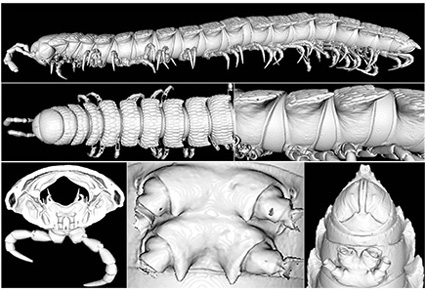
Madagascar’s microendemism is not restricted to large rainforests, but also still exists in small, isolated fragments of natural vegetation. One such fragment is the Lavasoa-Ambatotsirongorongo protected area in southeastern Madagascar, where less than 92 ha of humid forest continue to face deforestation, but to which several species are endemic and critically endangered, including three species of millipedes. Here, we describe Alafanahydesmus lavasoa gen. nov., sp. nov. (Polydesmida: Dalodesmidae), a locally endemic Polydesmida only found in the Lavasoa-Ambatotsirongorongo area. With our here described addition, Polydesmida remain rare on Madagascar, with only four genera and nine known species, all belonging to the family Dalodesmidae. Alafanahydesmus lavasoa gen. nov., sp. nov. shares its small size (10–25 mm) and light/brown colouration with Dalodesmus Cook, 1896, Eutubercularium Brölemann, 1916, and Phymatodesmus de Saussure & Zehntner, 1897, but differs conspicuously in somatic (paraterga projecting weakly before tergite 6, elongated shape of metatergal tubercles, paraprocts (pa) with dorsal setose knobs) and sexual characters (stoutly fused femorites and a unique five-branched gonopod with a retrorse branch). Here, we describe Alafanahydesmus lavasoa gen. nov., sp. nov. integratively, providing the first molecular data for Malagasy Dalodesmidae—via partial cytochrome c oxidase I (COI) sequences (GenBank PX922879–PX922581) and pioneer the first microcomputed tomography (μCT) images for a member of the family, alongside with multilayer photographs and scanning electron microscopy images.
References
- Antonelli, A., Smith, R.J., Perrigo, A.L., Crottini, A., Hackel, J., Testo, W., Farooq, H., Torres Jiménez, M.F., Andela, N., Andermann, T., Andriamanohera, A.M., Andriambololonera, S., Bachman, S.P., Bacon, C.D., Baker, W.J., Belluardo, F., Birkinshaw, C., Borrell, J.S., Cable, S., Canales, N.A., Carrillo, J.D., Clegg, R., Clubbe, C., Cooke, R.S.C., Damasco, G., Dhanda, S., Edler, D., Faurby, S., de Lima Ferreira, P., Fisher, B.L., Forest, F., Gardiner, L.M., Goodman, S.M., Grace, O.M., Guedes, T.B., Henniges, M.C., Hill, R., Lehmann, C.E.R., Lowry, P.P., Marline, L., Matos-Maraví, P., Moat, J., Neves, B., Nogueira, M.G.C., Onstein, R.E., Papadopulos, A.S.T., Perez-Escobar, O.A., Phelps, L.N., Phillipson, P.B., Pironon, S., Przelomska, N.A.S., Rabarimanarivo, M., Rabehevitra, D., Raharimampionona, J., Rajaonah, M.T., Rajaonary, F., Rajaovelona, L.R., Rakotoarinivo, M., Rakotoarisoa, A.A., Rakotoarisoa, S.E., Rakotomalala, H.N., Rakotonasolo, F., Ralaiveloarisoa, B.A., Ramirez-Herranz, M., Randriamamonjy, J.E.N., Randriamboavonjy, T., Randrianasolo, V., Rasolohery, A., Ratsifandrihamanana, A.N., Ravololomanana, N., Razafiniary, V., Razanajatovo, H., Razanatsoa, E., Rivers, M., Sayol, F., Silvestro, D., Vorontsova, M.S., Walker, K., Walker, B.E., Wilkin, P., Williams, J. & Ziegler, T., Zizka, A. & Ralimanana, H. (2022) Madagascar’s extraordinary biodiversity: Evolution, distribution, and use. Science, 378 (6623), 1–9. https://doi.org/10.1126/science.abf0869
- Astrin, J.J. & Stüben, P.E. (2008) Phylogeny in cryptic weevils: molecules morphology and new genera of western Palaearctic Cryptorhynchinae (Coleoptera: Curculionidae). Invertebrate Systematics, 22, 503–522. https://doi.org/10.1071/IS07057
- Brandt, J.F. (1833) Tentaminum quorundam monographicorum Insecta Myriapoda Chilognathi Latreillii spectantium prodromus. Bulletin de la Societé Impériale des Naturalistes de Moscou, 6, 194–209.
- Brölemann, H.W. (1916) Essai de classification des Polydesmiens. Annales de la Societe Entomologique de France, 84, 523–608. https://doi.org/10.1080/21686351.1915.12279415
- Bruker micro-CT. (2024) Nrecon. Version 2.2.0.6. Bruker Belgium, Kontich. [computer software]
- Cook, O.F. (1896) Cryptodesmus and its allies. Brandtia, 5, 19–28.
- Dawson, N., Fischer, J., Kuhn, M., Pasotti, A., Hugentobler, M., Rouzaud, D., Bruy, A., Sutton, T., Dobias, M., Pellerin, M., Rouault, E., Olaya, V., Blottiere, P., Macho, W., Blazek, R., Sherman, G., Sant-anna, H., Cabieces, J., Bartoletti, L., Woodrow, N., Signer, D., D’Hont, R.-L., Natsis, S., Shaffer, L., Belgacem, N., Santilli, S., Larosa, S., Mani, S., Felder, J. & Cloarec, V. (2026) ‘qgis/QGIS: 3.44.7’. Zenodo. https://doi.org/10.5281/zenodo.18268584
- de Saussure, H. & Zehntner, L. (1897) Atlas de l’histoire naturelle des Myriapodes. In: Grandidier, A. (Ed.), Histoire physique, naturelle et politique de Madagascar. 27 (53). Alfred Grandidier, Paris, pls. 1–12.
- de Saussure, H. & Zehntner, L. (1902) Myriapodes de Madagascar. In: Grandidier, A. (Ed.), Histoire physique, naturelle et politique de Madagascar. 27 (53). Alfred Grandidier, Paris, pp. i–viii + 1–356, pls. 13–15.
- Einhaus, M. (2025) Inventur und Habitatpräferenzen der Diplopoda im Lavasoa-Ambatotsirongorongo Gebirge, Madagaskar. Bachelor Thesis, Bachelor of Science Biologie, Universität zu Köln, Mathematisch-Naturwissenschaftliche Fakultät, Köln, 75 pp.
- Eppley, T.M., Refaly, E., Tsagnangara, C., Ramanamanjato, J.-B. & Donati, G. (2020) Urgent action needed: the forgotten forests of the Lavasoa–Ambatotsirongorongo Mountains, southeast Madagascar. Lemur News, 22, 15–19.
- Enghoff, H. (2003) Millipedes (Diplopoda) of Madagascar: diversity, distribution and endemism. In: Goodman, S.M. & Benstead, J.P. (Eds.), The Natural History of Madagascar. University of Chicago Press, Chicago, Illinois, pp. 617–627.
- ESRI, Garmin, GEBCO, NOAA NGDC and other contributors (2021) World Imagery [basemap]. Available from: https://www.arcgis.com/home/item.html?id=10df2279f9684e4a9f6a7f08febac2a9 (accessed 8 April 2026)
- Fedorov, A., Beichel, R., KalpathyCramer, J., Finet, J., FillionRobin, J.C., Pujol, S., Bauer, C., Jennings, D., Fennessy, F.M., Sonka, M., Buatti, J., Aylward, S.R., Miller, J.V., Pieper, S. & Kikinis, R. (2012) 3D Slicer as an image computing platform for the Quantitative Imaging Network. Magnetic Resonance Imaging, 30 (9), 1323–1341. https://doi.org/10.1016/j.mri.2012.05.001
- Gervais, P. (1844) Études sur les Myriapodes. Annales des Sciences naturelles, Série 3, 2, 51–80.
- Gould, L. & Sauther, M.L. (Eds.) (2007) Lemurs: Ecology and Adaptation. Springer, New York, New York, 395 pp. https://doi.org/10.1007/978-0-387-34586-4
- Hall, T.A. (1999) BioEdit: a user-friendly biological sequence alignment editor and analysis program for Windows 95/98/NT. Nucleic Acids Symposium Series, 41, 95–98.
- Hilgert, M., Akkari, N., Rahmadi, C. & Wesener, T. (2019) The Myriapoda of Halimun-Salak National Park (Java, Indonesia): overview and faunal composition. Biodiversity Data Journal, 7, e32218. https://doi.org/10.3897/BDJ.7.e32218
- Hotaling, S., Foley, M.E., Lawrence, N.M., Bocanegra, J., Blanco, M.B., Rasoloarison, R., Kappeler, P.M., Barrett, M.A., Yoder, A.D. & Weisrock, D.W. (2016) Species discovery and validation in a cryptic radiation of endangered primates: coalescent-based species delimitation in Madagascar’s mouse lemurs. Molecular Ecology, 25 (9), 2029–2045. https://doi.org/10.1111/mec.13604
- Irwin, M.T., Johnson, S.E. & Wright, P.C. (2010) The lemurs of Madagascar: ecology and adaptive radiation. Springer, New York, New York, 544 pp.
- Kelso, N.V. & Patterson, T. (2010) Introducing Natural Earth Data – NaturalEarthData.com. Geographia Technica, Special Issue, 82–89.
- Myers, N., Mittermeier, R.A., Mittermeier, C.G., da Fonseca, G.A.B. & Kent, J. (2000) Biodiversity hotspots for conservation priorities. Nature, 403, 853–858. https://doi.org/10.1038/35002501
- Murphy, A.T. (2015) The biodiversity mirage: responses to habitat degradation in Madagascar. PhD Thesis, Virginia Polytechnic Institute and State University, Blacksburg, Virgina, 177 pp.
- Omollo, W.O., Rabarijaona, R.N., Ranaivoson, R.M., Rakotoarinivo, M., Barrett, R.L., Zhang, Q., Lai, Y.-J., Ye, J.-F., Le, C.T., Antonelli, A., Chen, Z.-D., Liu, B. & Lu, L.-M. (2024) Spatial heterogeneity of neo- and paleo-endemism for plants in Madagascar. Current Biology, 34 (6), 1271–1283. https://doi.org/10.1016/j.cub.2024.02.023
- Pocock, R.I. (1887) XXXV.—On the classification of the Diplopoda. Annals and Magazine of Natural History, Series 5, 20 (118), 283–295. https://doi.org/10.1080/00222938709460057
- Roberts, S.H., Segami, J., Harinala, V.J., Greene, L.K., Blanco, M.B. & Yoder, A.D. (2023) New genetic evidence from the Ambatotsirongorongo/Petriky complex in southeast Madagascar calls for an immediate re-evaluation of conservation strategies focusing on the Bemanasy mouse lemur (Microcebus manitatra). Lemur News, 24, 14–19.
- Sagorny, C. & Wesener, T. (2017) Two new giant pill-millipede species of the genus Zoosphaerium endemic to the Bemanevika area in northern Madagascar (Diplopoda, Sphaerotheriida, Arthrosphaeridae). Zootaxa, 4263 (2), 273–294. https://doi.org/10.11646/zootaxa.4263.2.4
- Schwitzer, C., Mittermeier, R.A., Johnson, S.E., Donati, G., Irwin, M.T., Peacock, H., Ratsimbazafy, J., Razafindramanana, J., Louis, E.E. & Chikhi, L. (2014) Averting lemur extinctions amid Madagascar’s political crisis. Science, 343, 842–843. https://doi.org/10.1126/science.1245783
- Spelzhausen, L., Wesener, T. & Schütte, K. (2020) Vegetation thresholds for the occurrence of millipedes (Diplopoda) in different tropical forest types in Andasibe, Madagascar. Madagascar Conservation and Development, 15 (1), 1–8.
- http://dx.doi.org/10.4314/mcd.v15i1.3
- Thiele, D., Razafimahatratra, E. & Hapke, A. (2013) Discrepant partitioning of genetic diversity in mouse lemurs and dwarf lemurs–Biological reality or taxonomic bias? Molecular Phylogenetics and Evolution, 69 (3), 593–609. https://doi.org/10.1016/j.ympev.2013.07.019
- Tsiavahananahary, T.J. (2025) Madagascar Protected Area Outlook 2024: A conservation assessment of terrestrial protected areas in Madagascar. Madagascar Protected Area Consortium Partners, Antananarivo, Madagascar, April 2025, 1–74. [ISBN 978-0-982761-4]
- Vehof, J., Wesener, T., Golles, T. & Yoo, J. (2026) Micro-CT scan of the male paratype of Alafanahydesmus lavasoa (Polydesmida, Dalodesmidae) (Alpha). Zenodo. [published online] https://doi.org/10.5281/zenodo.18373993
- Vences, M., Wollenberg, Vieites, D.R. & Lees, D.C. (2009) Madagascar as a model region of species diversification. Trends in Ecology & Evolution, 24 (8), 456–465. https://doi.org/10.1016/j.tree.2009.03.011
- Vieilledent, G., Grinand, C., Rakotomalala, F.A., Ranaivosoa, R., Rakotoarijaona, J.-R., Allnutt, T.F. & Achard, F. (2018) Combining global tree cover loss data with historical national forest-cover maps to look at six decades of deforestation and forest fragmentation in Madagascar. Biological Conservation, 222, 189–197. https://doi.org/10.1016/j.biocon.2018.04.008
- Wesener, T. (2009) Unexplored richness: discovery of 31 new species of Giant Pill-Millipedes endemic to Madagascar, with a special emphasis on microendemism (Diplopoda, Sphaerotheriida). Zootaxa, 2097 (1), 1–134. https://doi.org/10.11646/zootaxa.2097.1.1
- Wesener, T. (2015) Integrative redescription of a forgotten Italian pill millipede endemic to the Apuan Alps—Glomeris apuana Verhoeff, 1911 (Diplopoda, Glomerida, Glomeridae). Zootaxa, 4039 (2), 391–400. https://doi.org/10.11646/zootaxa.4039.2.11
- Wesener, T. (2019) First records of giant pill-millipedes from Laos (Diplopoda, Sphaerotheriida, Zephroniidae). Zootaxa, 4563 (2), 201–248. https://doi.org/10.11646/zootaxa.4563.2.1
- Wesener, T. & Anilkumar, P.A. (2020) The millipedes collected by the Museum “La Specola” on Madagascar 1989/1991, with the description of three new species of giant pill-millipedes (Diplopoda, Sphaerotheriida, Arthrosphaeridae). In: Korsós, Z. & Dányi, L. (Eds.), Proceedings of the 18th International Congress of Myriapodology. ZooKeys, 930, pp. 3–35. https://doi.org/10.3897/zookeys.930.47620
- Wesener, T. & Enghoff, H. (2022) Diplopoda, Millipedes, Menavetraka, Ankodavitra, Ankodiavitry, Marotanana, Sakolavitsy. In: Goodman, S.M. (Ed.), The New Natural History of Madagascar, 1 (9), pp. 918–933. https://doi.org/10.2307/j.ctv2ks6tbb.118
- Wesener, T., Le, D.M-T. & Loria, S.F. (2014) Integrative revision of the giant pill-millipede genus Sphaeromimus from Madagascar, with the description of seven new species (Diplopoda, Sphaerotheriida, Arthrosphaeridae). ZooKeys, 414, 67–107. https://doi.org/10.3897/zookeys.414.7730
- Wesener, T., Enghoff, H. & Sierwald, P. (2009) Review of the Spirobolida on Madagascar, with descriptions of twelve new genera, including three genera of ‘Fire Millipedes’ (Diplopoda). ZooKeys, 19, 1–128. https://doi.org/10.3897/zookeys.19.221
- Wesener, T., Akkari, N. & Golovatch, S.I. (2025) Revision of the millipede family Dalodesmidae in Madagascar, with descriptions of two new Malagasy species of Dalodesmus Cook, 1896 (Diplopoda, Polydesmida). ZooKeys, 1223, 185–220. https://doi.org/10.3897/zookeys.1223.139346
- Wesener, T. & Rudolf, E. (2017) Granitobolus endemicus. The IUCN Red List of Threatened Species, 2017, e.T80580633A80580638. https://doi.org/10.2305/IUCN.UK.2017-1.RLTS.T80580633A80580638.en
- Wesener, T. & Rudolf, E. (2020A) Sphaeromimus lavasoa (amended version of 2017 assessment). The IUCN Red List of Threatened Species, 2020, e.T65527148A177161055. https://doi.org/10.2305/IUCN.UK.2020-3.RLTS.T65527148A177161055.en
- Wesener, T. & Rudolf, E. (2020) Zoosphaerium alluaudi (amended version of 2017 assessment). The IUCN Red List of Threatened Species, 2020, e.T65524313A177348529. https://doi.org/10.2305/IUCN.UK.2020-3.RLTS.T65524313A177348529.en
- Wilbrandt, J., Lee, P., Read, H. & Wesener, T. (2015) A first integrative study of the identity and origins of the British Dwarf Pill Millipede populations, Trachysphaera cf. lobata (Diplopoda, Glomerida, Glomeridae). Biodiversity Data Journal, 3, e5176. https://doi.org/10.3897/BDJ.3.e5176
- Wilmé, L., Goodman, S.M. & Ganzhorn, J.U. (2006) Biogeographic evolution of Madagascar’s microendemic biota. Science, 312, 1063–1065. https://doi.org/10.1126/science.1122806