

Abstract
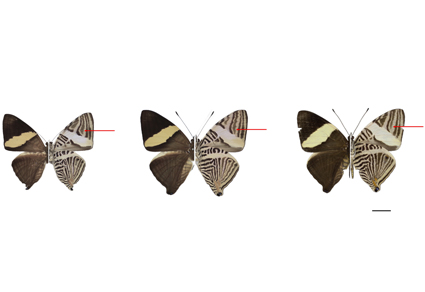
The Neotropical butterfly genus Colobura Billberg, 1820 (Nymphalidae) includes widespread, common and conspicuous species whose taxonomy one might expect to be well understood. Using integrative taxonomy—combining morphology (genitalia, larval traits, adult wing patterns, and UV reflectance), genome sequencing (mitochondrial barcodes, complete mitogenomes, and nuclear genomes), and life history data—we describe Colobura cryptica Sapkota, Orellana & Willmott sp. nov., a new species previously conflated with Colobura annulata. Key diagnostic morphological traits include: (1) a shorter third submarginal line on the ventral forewing that does not reach the pale cream transverse band, and (2) velvet-black larvae that lack yellow rings between segments or yellow spots at anterior edge of segments. Phylogenomic analyses resolved four distinct clades, with C. cryptica forming a genetically divergent lineage that is broadly sympatric with its sister species C. annulata. We further demonstrate a biogeographical split in C. dirce populations across the Andes and redefine the ranges of C. dirce wolcotti and C. dirce dirce. Genome sequencing showed that C. d. wolcotti, previously thought to be restricted to the Caribbean Islands, is also present in Central America and coastal Ecuador/northern Colombia west of the Andes, whereas C. d. dirce occurs only east of the Andes. This division corresponds with differences in ventral UV reflectance, which is strongly expressed in C. d. wolcotti but reduced in C. d. dirce. We conducted a preliminary investigation of UV-reflectance on the ventral wings and found evidence for differences across the four taxa, and we discuss the possibility of UV-mediated reproductive isolation that might have contributed to speciation in Colobura.
References
- Allyn, A.C. & Downey, J.C. (1977) Observations on male UV reflectance and scale ultrastructure in Phoebis (Pieridae). The Allyn Museum of Entomology, Sarasota, Florida, 20 pp.
- BOLDSystems. (2025) Barcode of Life Data System. Version 4. Available from: https://www.boldsystems.org (accessed 3 November 2025)
- Briscoe, A.D., Bybee, S.M., Bernard, G.D., Yuan, F., Sison-Mangus, M.P., Reed, R.D., Warren, A.D., Llorente-Bousquets, J. & Chiao, C. (2010) Positive selection of a duplicated UV-sensitive visual pigment coincides with wing pigment evolution in Heliconius butterflies. Proceedings of the National Academy of Sciences of the United States of America, 107 (8), 3628–3633. https://doi.org/10.1073/pnas.0910085107
- Chazot, N., Wahlberg, N., Freitas, A.V.L., Mitter, C., Labandeira, C., Sohn, J.C., Sahoo, R.K., Seraphim, N., de Jong, R. & Heikkilä, M. (2019) Priors and Posteriors in Bayesian Timing of Divergence Analyses: The Age of Butterflies Revisited. Systematic biology, 68 (5), 797–813. https://doi.org/10.1093/sysbio/syz002
- Chen, D.M. (1987) Ultraviolet sensitivity in compound eye of the butterfly Vanessa cardui. Acta Entomologica Sinica, 30 (4), 353–358.
- Cong, Q., Zhang, J. & Grishin, N.V. (2019) Genomic determinants of speciation. bioRxiv. https://doi.org/10.1101/837666
- Cong, Q., Shen, J., Zhang, J., Li, W., Kinch, L.N., Calhoun, J.V., Warren, A.D. & Grishin, N.V. (2021) Genomics reveals the origins of historical specimens. Molecular Biology and Evolution, 38 (5), 2166–2176. https://doi.org/10.1093/molbev/msab013
- Dayrat, B. (2005) Towards integrative taxonomy. Biological journal of the Linnean society, 85 (3), 407–417. https://doi.org/10.1111/j.1095-8312.2005.00503.x
- Davey, J.W., Chouteau, M., Barker, S.L., Maroja, L., Baxter, S.W., Simpson, F., Merrill, R.M., Joron, M., Mallet, J., Dasmahapatra, K.K. & Jiggins, C.D. (2016) Major improvements to the Heliconius melpomene genome assembly used to confirm 10 chromosome fusion events in 6 million years of butterfly evolution. G3: Genes, Genomes, Genetics, 6 (3), 695–708. https://doi.org/10.1534/g3.115.023655
- Dell’Aglio, D.D., Troscianko, J., McMillan, W.O., Stevens, M. & Jiggins, C.D. (2018) The appearance of mimetic Heliconius butterflies to predators and conspecifics. Evolution; international journal of organic evolution, 72 (10), 2156–2166. https://doi.org/10.1111/evo.13583
- DeVries, P.J., Walla, T.R. & Greene, H.F. (1999) Species diversity in spatial and temporal dimensions of fruit-feeding butterflies from two Ecuadorian rainforests. Biological Journal of the Linnean Society, 68 (3), 333–353. https://doi.org/10.1111/j.1095-8312.1999.tb01175.x
- Fenner, J., Rodriguez-Caro, L. & Counterman, B. (2019) Plasticity and divergence in ultraviolet reflecting structures on Dogface butterfly wings. Arthropod Structure & Development, 51, 14–22. https://doi.org/10.1016/j.asd.2019.06.001
- Finkbeiner, S.D., Fishman, D.A., Osorio, D. & Briscoe, A.D. (2017) Ultraviolet and yellow reflectance but not fluorescence is important for visual discrimination of conspecifics by Heliconius erato. Journal of Experimental Biology, 220 (7), 1267–1276. https://doi.org/10.1242/jeb.153593
- Hosken, D.J. & Stockley, P. (2004) Sexual selection and genital evolution. Trends in ecology & evolution, 19 (2), 87–93. https://doi.org/10.1016/j.tree.2003.11.012
- Imafuku, M. (2008) Variation in UV light reflected from the wings of Favonius and Quercusia butterflies. Entomological Science, 11 (1), 75–80. https://doi.org/10.1111/j.1479-8298.2007.00247.x
- iNaturalist. (2025) Observations of Colobura from the Americas. Available from: https://www.inaturalist.org (accessed 3 November 2025)
- Kemp, D.J. (2006) Heightened phenotypic variation and age-based fading of ultraviolet butterfly wing coloration. Evolutionary Ecology Research, 8 (3), 515–527.
- Lukhtanov, V.A., Kandul, N.P., Plotkin, J.B., Dantchenko, A.V., Haig, D. & Pierce, N.E. (2005) Reinforcement of pre-zygotic isolation and karyotype evolution in Agrodiaetus butterflies. Nature, 436 (7049), 385–389. https://doi.org/10.1038/nature03704
- Masly, J.P. (2012) 170 years of “lock-and-key”: Genital morphology and reproductive isolation. International Journal of Evolutionary Biology, 2012, 247352. https://doi.org/10.1155/2012/247352
- McCulloch, K.J., Osorio, D. & Briscoe, A.D. (2016) Sexual dimorphism in the compound eye of Heliconius erato: A nymphalid butterfly with at least five spectral classes of photoreceptor. Journal of Experimental Biology, 219 (15), 2377–2387. https://doi.org/10.1242/jeb.136523
- Mena, S., Kozak, K.M., Cárdenas, R.E. & Checa, M.F. (2020) Forest stratification shapes allometry and flight morphology of tropical butterflies. Proceedings of the Royal Society B, 287 (1937), 20201071. https://doi.org/10.1098/rspb.2020.1071
- Meyer-Rochow, V.B. (1991) Differences in ultraviolet wing patterns in the New Zealand lycaenid butterflies Lycaena salustius, L. rauparaha and L. feredayi as a likely isolating mechanism. Journal of the Royal Society of New Zealand, 21 (2), 169–177. https://doi.org/10.1080/03036758.1991.10431405
- Nguyen, L.T., Schmidt, H.A., Von Haeseler, A. & Minh, B.Q. (2015) IQ-TREE: a fast and effective stochastic algorithm for estimating maximum-likelihood phylogenies. Molecular biology and evolution, 32 (1), 268–274. https://doi.org/10.1093/molbev/msu300
- Obara, Y., Ozawa, G., Fukano, Y., Watanabe, K. & Satoh, T. (2008) Mate preference in males of the cabbage butterfly, Pieris rapae crucivora, changes seasonally with the change in female UV color. Zoological Science, 25 (1), 1–5. https://doi.org/10.2108/zsj.25.1
- Piszter, G., Kertész, K., Sramkó, G., Krízsik, V., Bálint, Z. & Biró, L.P. (2021) Concordance of the spectral properties of dorsal wing scales with the phylogeographic structure of European male Polyommatus icarus butterflies. Scientific Reports, 11 (1), 16498. https://doi.org/10.1038/s41598-021-95881-z
- Ratnasingham, S. & Hebert, P.D.N. (2013) A DNA-based registry for all animal species: The Barcode Index Number (BIN) system. PLoS ONE, 8 (8), e66213. https://doi.org/10.1371/journal.pone.0066213
- Schlick-Steiner, B.C., Steiner, F.M., Seifert, B., Stauffer, C., Christian, E. & Crozier, R.H. (2010) Integrative taxonomy: a multisource approach to exploring biodiversity. Annual review of entomology, 55 (1), 421–438. https://doi.org/10.1146/annurev-ento-112408-085432
- Shorthouse, D.P. (2010) SimpleMappr, an online tool to produce publication-quality point maps. Available from: https://www.simplemappr.net (accessed 6 October 2025)
- Silberglied, R.E. & Taylor, O.R. (1973) Ultraviolet differences between the sulphur butterflies, Colias eurytheme and C. philodice, and a possible isolating mechanism. Nature, 241 (5389), 406–408. https://doi.org/10.1038/241406a0
- Silberglied, R.E. & Taylor, O.R. (1978) Ultraviolet reflection and its behavioral role in the courtship of the sulfur butterflies Colias eurytheme and C. philodice (Lepidoptera, Pieridae). Behavioral Ecology and Sociobiology, 3, 203–243. https://doi.org/10.1007/BF00296311
- Song, H. & Bucheli, S.R. (2010) Comparison of phylogenetic signal between male genitalia and non-genital characters in insect systematics. Cladistics, 26 (1), 23–35. https://doi.org/10.1111/j.1096-0031.2009.00273.x
- Stalleicken, J., Labhart, T. & Mouritsen, H. (2006) Physiological characterization of the compound eye in monarch butterflies with focus on the dorsal rim area. Journal of Comparative Physiology A, 192 (3), 321–331. https://doi.org/10.1007/s00359-005-0073-6
- Stella, D., Pecháček, P., Meyer-Rochow, V.B. & Kleisner, K. (2018) UV reflectance is associated with environmental conditions in Palaearctic Pieris napi (Lepidoptera: Pieridae). Insect Science, 25 (3), 508–518. https://doi.org/10.1111/1744-7917.12429
- Tuxen, S.L. (1970) Taxonomist’s glossary of genitalia in insects (2nd ed.). Scandinavian University Press. https://doi.org/10.1163/9789004631663
- Van Der Kooi, C.J., Stavenga, D.G., Arikawa, K., Belušič, G. & Kelber, A. (2021) Evolution of insect color vision: From spectral sensitivity to visual ecology. Annual Review of Entomology, 66 (1), 435–461. https://doi.org/10.1146/annurev-ento-061720-071644
- Vanhoutte, K.J. & Stavenga, D.G. (2005) Visual pigment spectra of the comma butterfly, Polygonia c-album, derived from in vivo epi-illumination microspectrophotometry. Journal of Comparative Physiology A, 191 (5), 461–473. https://doi.org/10.1007/s00359-005-0608-x
- Willmott, K.R., Simon, M., Ortiz-Acevedo, E. & Hall, J.P. (2017) First record of the enigmatic tribe Anaeomorphini (Lepidoptera, Nymphalidae, Charaxinae) outside of the Amazon basin: a new species of Anaeomorpha Rothschild, 1894, from the Chocó region of western Ecuador. Insecta mundi, 0548, 1–10.
- Willmott, K.R., Constantino, L.M. & Hall, J.P.W. (2001) A review of Colobura (Lepidoptera: Nymphalidae) with comments on larval and adult ecology and description of a sibling species. Annals of the Entomological Society of America, 94 (2), 185–196. https://doi.org/10.1603/0013-8746(2001)094[0185:AROCLN]2.0.CO;2
- Zhang, J., Cong, Q., Shen, J., Song, L. & Grishin, N.V. (2025) Advancing butterfly systematics through genomic analysis. The Taxonomic Report of the International Lepidoptera Survey, 12 (5), 1–201. https://doi.org/10.64338/im.1131.4aypc