

Abstract
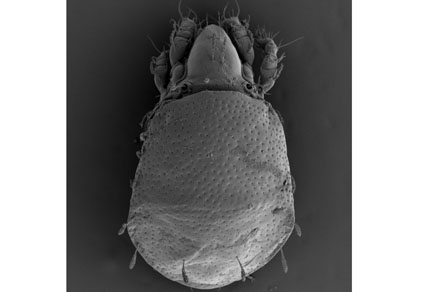
The oribatid mite species Trichogalumna ohkuboi Hagino, Bayartogtokh & Shimano, 2017 (Oribatida, Galumnidae) is recorded for the first time in Russia. Duration of development from larva to adult is 17–24 days at ≈25ºC while feeding on fungi (Alternaria sp.) and algae (Pleurococcus sp.), in laboratory conditions. The active juvenile instars are characterized by the unusual (among known juvenile Galumnidae) morphology, e.g., foveolate ornamentation of the dorsal side and posteroventral part (except LA) of the gastronotum, and the morphology of the lamellar, interlamellar, and some gastronotic setae (well developed, dilated distally). The provided data on the morphology of the juvenile instars of T. ohkuboi are the first comprehensive ones for any member of this genus.
References
- Afifi, A.M. & Abdel-Halim, S.M. (1989) Description of developmental stages of the new subspecies Pergalumna flagellata aegypticus, with notes on its biology (Acari: Oribatida: Galumnidae). Bulletin de la Société Entomologique d’Égypte, 68, 123–130.
- Akrami, M.A., Haddad Irani-Nejad, K. & Mirzaie, M. (2011) A new species of the genus Psammogalumna Balogh (Oribatida: Galumnidae) from Iran. Systematic and Applied Acarology, 16, 27–34. https://doi.org/10.11158/saa.16.1.4
- Aoki, J. (1965) Oribatiden (Acarina) Thailands. I. Nature and Life in Southeast Asia, Kyoto, 4, 129–193.
- Aoki, J. (1966) The large-winged mites of Japan (Acari: Cryptostigmata). Bulletin of the National Science Museum, Tokyo, 9, 257–275.
- Balogh, J. (1943) Magyarország Páncélosatkái (Conspectus Oribateorum Hungariae). Matematikai és természettudományi közlemenyek, 39, 1–202.
- Balogh, J. (1960a) Oribates (Acari) nouveaux d’Angola et du Congo Belge (2ème série). Companhia de Diamantes de Angola, 51, 15–40.
- Balogh, J. (1960b) Oribatides (Acari) nouveaux de Madagascar (1re série). Mémoires de l’Institut Scientifique de Madagascar, Série A, 14, 7–37.
- Banks, N. (1895) On the Oribatoidea of the United States. Transactions of the American Entomological Society, 22, 1–16.
- Bayartogtokh, B. & Bae, Y.S. (2024) New findings of poronotic oribatid mites (Acari: Oribatida) from Korea. Zootaxa, 5405 (2), 151–184. https://doi.org/10.11646/zootaxa.5405.2.1
- Bayartogtokh, B. & Ermilov, S.G. (2017) Nymphal instars of two Pergalumna species, with remarks on morphological ontogeny of Galumnidae (Acari, Oribatida). Systematic and Applied Acarology, 22, 518–540. https://doi.org/10.11158/saa.22.4.8
- Berlese, A. (1904) Acari nuovi. Vol. II. Redia, 2, 10–32. https://doi.org/10.1175/1520-0493(1904)3210%3Cc2:CITOCO%3E2.0.CO;2
- Berlese, A. (1908) Elenco di generi e specie nuovi di Acari. Redia, 5, 1–15.
- Berlese, A. (1914) Acari nuovi. Manipulus IX. Redia, 10, 113–150.
- Bernini, F. (1984) Notulae oribatologicae XXXII. Some new galumnid mites (Acarida, Oribatida) from North Africa exhibiting sexual dimorphism with some observations on racemiform organs. Animalia, 11, 103–126.
- Chistyakov, M.P. & Orlova, N.V. (1981) To the biology of Pergalumna nervosa Berlese, 1915 (Acariformes, Oribatei). In: Shaldybin, L.S. (Ed.), Fauna, Systematics, Biology and Ecology of Parasitic Worms and their Intermediate Host. Gorky State Pedagogical Institute, Gorky, pp. 95–98. [in Russian]
- Engelbrecht, C.M. (1973) South African Galumnoidea (Oribatei: Acari): new taxa and records. Navorsinge van die Nasionale Museum, Bloemfontein, 2, 394–415.
- Ermilov, S.G. (2025a) Juvenile instars of Pergalumna emarginata (Banks, 1895) (Acari, Oribatida, Galumnidae). Zoologichesky Zhurnal, 104, 3–12. https://doi.org/10.31857/S0044513425100015
- Ermilov, S.G. (2025b) Taxonomic contribution to knowledge of the oribatid mite genera Corynoppia, Ramusella and Wallworkella (Acari, Oribatida, Oppiidae). Zootaxa, 5621 (3), 353–370. https://doi.org/10.11646/zootaxa.5621.3.4
- Ermilov, S.G. (2025c) Taxonomic contribution to knowledge of the oribatid mite genus Trichogalumna (Acari, Oribatida, Galumnidae). Persian Journal of Acarology, 14, 140411. https://doi.org/10.22073/pja.v14i4.87545
- Ermilov, S.G. & Klimov, P.B. (2017) Generic revision of the large-winged mite superfamily Galumnoidea (Acari, Oribatida) of the world. Zootaxa, 4357 (1), 1–72. https://doi.org/10.11646/zootaxa.4357.1.1
- Ermilov, S.G. & Mzeek, H. (2026) Culturing and descriptions of the juvenile and adult instars of Scheloribates (Scheloribates) milleri Jacot, 1936 (Acari, Oribatida, Scheloribatidae). Zoologichesky Zhurnal. [in press]
- Ermilov, S.G. & Tolstikov, A.V. (2015) Additions to the galumnid oribatid mite fauna of Brazil, with description of two new species of Trichogalumna (Acari, Oribatida, Galumnidae). International Journal of Acarology, 41, 170–180. https://doi.org/10.1080/01647954.2014.999824
- Ermilov, S.G. & Sharapov, D.V. (2025) Nymphal instars of Pergalumna cienfuegosensis (Acari, Oribatida, Galumnidae). Persian Journal of Acarology, 14, 437–446. https://doi.org/10.22073/pja.v14i3.87135
- Ermilov, S.G., Alvarado-Rodríguez, O. & Retana-Salazar, A.P. (2014) Two new species of Pergalumna (Acari, Oribatida, Galumnidae) from Costa Rica, including a key to all species of the genus from the Neotropical region. ZooKeys, 435, 7–23. https://doi.org/10.3897/zookeys.435.8213
- Ermilov, S.G., Weigmann, G. & Tolstikov, A.V. (2013) Morphology of adult and juvenile instars of Galumna obvia (Acari, Oribatida, Galumnidae), with discussion of its taxonomic status. ZooKeys, 357, 11–28. https://doi.org/10.3897/zookeys.357.6404
- Ermilov, S.G., Hugo-Coetzee, E.A., Khaustov, A.A. & Theron, P.D. (2017) Juvenile instars of Galumna curvifamulus (Acari, Oribatida, Galumnidae). Acarina, 25, 87–95. https://doi.org/10.21684/0132-8077-2017-25-2-87-95
- Ermilov, S.G., Kolesnikov, V.B., Kontschán, J. & Klimov, P.B. (2023) Taxonomic contribution to the knowledge of Galumnidae (Acari, Oribatida, Galumnidae) from Cuba. Zootaxa, 5258 (4), 465–474. https://doi.org/10.11646/zootaxa.5258.4.7
- Grandjean, F. (1928) Deux nouveaux Oribatei d’Espagne. Bulletin de la Société zoologique de France, 53, 424–441.
- Grandjean, F. (1936) Les Oribates de Jean Frédéric Hermann et de son père. Annales de la Société Entomologique de France, 105, 27–110.
- Grandjean, F. (1953) Essai de classification des Oribates (Acariens). Bulletin de la Société zoologique de France, 78 (5–6), 421–446.
- Grandjean, F. (1956a) Galumnidae sans carènes lamellaires (Acariens, Oribates). 1e série. Bulletin de la Société Zoologique de France, 81, 134–150.
- Grandjean, F. (1956b) Observations sur les Galumnidae (2e série) (Acariens, Oribates). Revue Française D’Entomologie, 23, 265–275.
- Grishina, L.G. (1977) On morphological features of juvenile instars of Pergalumna nervosa (Berl.) (Acariformes, Oribatei) from Siberia. In: Cherepanov, A. (Ed.), Taxa of the Siberian Fauna. Nauka Press, Siberian Branch, Novosibirsk, pp. 109–116. [in Russian]
- Grishina, L.G. (1982) A new species of the genus Galumna (Acariformes, Oribatei). Zoologichesky Zhurnal, 61, 146–149. [in Russian]
- Grishina, L.G. (1991) The duration of oribatids (Sarcoptiformes, Oribatei) life cycle. Sibirsky Biologichesky Zhurnal, 38–47. [in Russian]
- Hagino, W., Bayartogtokh, B., Shimano, S. & Hiruta, S.F. (2017) Three species of the genus Trichogalumna (Acari: Oribatida: Galumnidae) from Japan. Systematic and Applied Acarology, 22, 858–873. https://doi.org/10.11158/saa.22.6.10
- Hammer, M. (1958) Investigations on the oribatid fauna of the Andes Mountains. I. The Argentine and Bolivia. Det Kongelige Danske Videnskabernes Selskab Biologiske Skrifter, 10, 1–129.
- Haq, M.A. & Adolph, C. (1981) A comparative study of the duration of the life cycles of four species of oribatid mites (Acari: Oribatei) from the soils of Kerala. Indian Journal of Acarology, 5, 56–61.
- Haq, M.A. & Shereef, A.M. (1992) Postembryonic development of a species of Galumna von Heyden (Acari: Oribatei). In: Haq, M.A. (Ed.), Man, Mites and Environment. Anjengo Publications, Calicut University, Kerala, pp. 155–160.
- Hermann, J.F. (1804) Memoire apterologique. F.G. Levrault, Strassbourg, 144 pp. https://doi.org/10.5962/bhl.title.137910
- Heyden, C. (1826) Versuch einer systematischen Eintheilung der Acariden. Isis, Oken, 1, 607–613.
- Jacot, A.P. (1929) American Oribatid mites of the subfamily Galumninae. Bulletin of the Museum of Comparative Zoology at Harvard College, 69, 1–37.
- Jacot, A.P. (1935) Galumna alatus Willmann (Acari, Oribatidae). The Annals and Magazine of Natural History, Series 10, 15 (88), 489–492. https://doi.org/10.1080/00222933508654990
- Koch, C.L. (1841) Deutschlands Crustaceen, Myriapoden und Arachniden. Heft 31–32. F. Pustet, Regensburg. [unknown pagination]
- Luxton, M. (1981) Studies on the oribatid mites of a Danish beech wood soil IV. Developmental biology. Pedobiologia, 21, 312–340. https://doi.org/10.1016/S0031-4056(23)03595-3
- Norton, R.A. (1977) A review of F. Grandjean’s system of leg chaetotaxy in the Oribatei (Acari) and its application to the family Damaeidae. In: Dindal, D.L. (Ed.), Biology of oribatid mites. SUNY College of Environmental Science and Forestry, Syracuse, New York, pp. 33–61.
- Norton, R.A. & Behan-Pelletier, V.M. (2009) Suborder Oribatida. Chapter 15. In: Krantz, G.W. & Walter, D.E. (Eds.), A Manual of Acarology. Texas Tech University Press, Lubbock, Texas, pp. 430–564.
- Norton, R.A. & Ermilov, S.G. (2014) Catalogue and historical overview of juvenile instars of oribatid mites (Acari: Oribatida). Zootaxa, 3833 (1), 1–132. https://doi.org/10.11646/zootaxa.3833.1.1
- Norton, R.А. & Ermilov, S.G. (2017) Identity of the oribatid mite Oribata curva and transfer to Trichogalumna (Acari, Oribatida, Galumnidae), with discussion of nomenclatural and biogeographical issues in the ‘curva’ species-group. Zootaxa, 4272 (4), 551–564. https://doi.org/10.11646/zootaxa.4272.4.4
- Norton, R.A. & Ermilov, S.G. (2024) Catalogue of juvenile instars of oribatid mites (Acari: Oribatida)—the next decade (2014–2023). Zootaxa, 5419 (4), 451–494. https://doi.org/10.11646/zootaxa.5419.4.1
- Ohkubo, N. (1984) Several species of Trichogalumna (Acarina, Oribatida) from Japan. Acarologia, 25, 293–306.
- Oudemans, A.C. (1914) Acarologisches aus Maulwurfsnestern [second continuation and conclusion]. Archiv für Naturgeschichte, Abteilung A, 79, 1–69.
- Oudemans, A.C. (1919) Notizen über Acari, 26. Reihe (Oribatoidea) Gruppe der Galumnae. Archiv für Naturgeschichte, Abteilung A, 83, 1–84.
- Páez, J., Villagomez, F. & Palacios-Vargas, J.G. (2019) Description of a new Pergalumna (Acari: Oribatida: Galumnidae) species from Mexico and its postembryonic development. Zootaxa, 4647 (1), 385–406. https://doi.org/10.11646/zootaxa.4647.1.25
- Páez, J., Villagomez, F., Iglesias, R. & Palacios-Vargas, J.G. (2018) Ontogenetic development of Pergalumna sp. nov. (Acari: Oribatida) under breeding and comparison with other Galumnidae. Entomología Mexicana, 5, 46–52.
- Reddy, A.S., Kumar, R. & Mathur, S.N. (1978) Studies on the biology of Galumna flabellifera Hammer, 1958 and its role as fungal spore carrier. In: Edwards, C.A. & Veeresh, G.K. (Eds.), Soil Biology and Ecology in India. UAS Technical Series. No. 22. University of Agricultural Sciences, Hebbal, Bangalore, pp. 134–143.
- Revelo-Tobar, H., Estrada-Venegas, E.G., Equihua-Martínez, A. & Valdez-Carrasco, J. (2023) Biology and morphology of the ontogenetic development of Allogalumna (Acrogalumna) longipluma (Berlese, 1904) (Oribatida: Galumnidae). New record for Mexico. Acta Zoológica Mexicana, 39, 1–15. https://doi.org/10.21829/azm.2023.3912438
- Rockett, C.L. & Woodring, J.P. (1966) Biological investigations on a new species of Ceratozetes and of Pergalumna (Acarina: Cryptostigmata). Acarologia, 8, 511–520.
- Sengbusch, H.G. (1954) Studies on the life history of three oribatoid mites with observations on other species. Annals of the Entomological Society of America, 47, 646–667. https://doi.org/10.1093/aesa/47.4.646
- Sengbusch, H.G. (1958) Zuchtversuche mit Oribatiden (Acarina). Naturwissenschaften, 45, 498–499. https://doi.org/10.1007/bf00635575
- Sengbusch, H.G. & Sengbusch, C.H. (1970) Post-embryonic development of Oppia nitens (Acarina: Oribatei). New York Entomological Society, 78, 207–214.
- Seniczak, A. (2007) Preliminary studies on the toxicity of copper and lead in Pergalumna nervosa (Berlese, 1914) (Acari, Oribatida) in laboratory tests. In: Tajovský, K., Schlaghamerský, K. & Pizl, V. (Eds.), Contributions to Soil Zoology in Central Europe II. ISB AS CR, Ceské Budejovice, pp. 131–134.
- Seniczak, A. & Seniczak, S. (2007) Morphology of juvenile stages of Pilogalumna crassiclava (Berlese, 1914) and P. ornatula Grandjean, 1956 (Acari: Oribatida: Galumnidae). Annales Zoologici, 57, 841–850. https://doi.org/10.3161/000345407783742051
- Seniczak, A. & Seniczak, S. (2022) Morphological ontogeny of Pilogalumna tenuiclava (Acari, Oribatida, Galumnidae) and comments on Pilogalumna Grandjean. Zootaxa, 5187 (1), 95–120. https://doi.org/10.11646/zootaxa.5187.1.8
- Seniczak, A., Seniczak, S., Rodríguez-Fernández, S. & Ondoño, E.F. (2021) Morphological ontogeny of Galumna flagellata Willmann (Acari: Oribatida: Galumnidae). International Journal of Acarology, 47, 199–217. https://doi.org/10.1080/01647954.2021.1880478
- Seniczak, S. (1972) Morphology of developmental stages of Pilogalumna tenuiclava (Berl.) and Pergalumna nervosa (Berl.). Bulletin de la Société des amis des Sciences et des letters de Poznań, Serié D, 12/13, 199–211.
- Seniczak, S. & Seniczak, A. (2023a) Morphological ontogeny of Carinogalumna erciyesi sp. nov. (Acari, Oribatida, Galumnidae) from Turkey, with comments on Carinogalumna Engelbrecht. Zootaxa, 5324 (1), 133–156. https://doi.org/10.11646/zootaxa.5324.1.11
- Seniczak, S. & Seniczak, A. (2023b) Morphological ontogeny of Pilogalumna ayildizi sp. nov. (Acari, Oribatida, Galumnidae), a new cryptic species from Turkey. Systematic and Applied Acarology, 28, 715–731. https://doi.org/10.11158/saa.28.4.8
- Seniczak, S., Iturrondobeitia, J.C. & Seniczak, A. (2012) The ontogeny of morphological traits in three species of Galumnidae (Acari: Oribatida). International Journal of Acarology, 38, 612–638. https://doi.org/10.1080/01647954.2012.709276
- Seniczak, S., Kaczmarek, S., Marquardt, T., Faleńczyk-Koziróg, K. & Seniczak, A. (2022) Morphological ontogeny of Psammogalumna iranica (Acari, Oribatida, Galumnidae). Systematic and Applied Acarology, 27, 600–618. https://doi.org/10.11158/saa.27.3.15
- Seniczak, S., Seniczak, A., Kaczmarek, S., Marquardt, T. & Kozhagaliyeva, R. (2023) Morphological ontogeny of Pilogalumna kazakhstanica sp. nov. (Acari, Oribatida, Galumnidae) from Kazakhstan. Systematic and Applied Acarology, 28, 105–122. https://doi.org/10.11158/saa.28.1.10
- Shereef, E.A.M. & Haq, M.A. (1992) Biologia of Galumna triquetra Aoki, 1965, a vector mite of cestode parasites. In: Ramachandran Nair, C.G. (Ed.), Proceedings of the 4th Kerala Science Congress, Thrissur, 1992, pp. 238–240.
- Shereef, G.M., Afifi, A.M. & Abdel-Halim, S.M. (1989) Life history of three oribatid mites in Egypt. Bulletin of the Entomological Society of Egypt, 68, 115–122.
- Soldatova, A.P. (1945) On the study of the biology of Oribatei – intermediate hosts of tapeworms of the family Anoplocephalidae. Reports of Academy of Sciences of USSR, 46, 379–380. [in Russian]
- Soldatova, A.P. (1948) On the biology of Oribatei – intermediate hosts of anoplocephalid cestodes parasitizing sheep, cattle and horses. Anniversary Collection of Papers on the 40th anniversary of the scientific activity of K.I. Scriabin and the 25th anniversary of the All-Union Institute of Helminthology, 209–213. [in Russian]
- Soldatova, A.P. (1950) Bio-ecology of oribatid mites and their importance in the epizootology of anoplocephalatosis in farm animals. Proceedings of the Helminthological Laboratory, 3, 285–289. [in Russian]
- Stunkard, H.W. (1944) Studies on the life history of the oribatid mite Galumna sp., intermediate host of Moniezia expansa. The Anatomical Record, American Society of Zoologists, 89, 550.
- Subías, L.S. (2022) Listado sistemático, sinonímico y biogeográfico de los ácaros oribátidos (Acariformes: Oribatida) del mundo (excepto fósiles). Monografías Electrónicas Sociedad Entomológica Aragonesa, 12, 1–538.
- Suzuki, K. (1979) Comparison of oribatid fauna between a vineyard without insecticides and fertilizers and its adjacent secondary forest. Memories of the Education Institute for Private Schools in Japan, 64, 125–138.
- Tanimoto, Y. (1980) The life history of Pergalumna sp. (Oribatei, Galumnidae). Nankiseibutu: The Nanki Biological Society, 22, 26–28.
- Travé, J. (1955) Galumna carinata (Acarien Oribate), espèce nouvelle des Pyrénées, pourvue de caractères sexuels secondaries. Vie et Milieu, 6, 537–550.
- Travé, J. (1970) Les stases immatures du genre Neoribates (Parakalumnidae, Oribates). Parakalumnidae et Galumnidae. Acarologia, 12, 208–215.
- Travé, J. & Vachon, M. (1975) François Grandjean. 1882–1975 (Notice biographique et bibliographique). Acarologia, 17, 1–19.
- Wallwork, J.A. (1965) A leaf-boring Galumnoid mite (Acari: Cryptostigmata) from Uruguay. Acarologia, 7, 758–764.
- Willmann, C. (1925) Neue und seltene Oribatiden. Jahresberichte des Entomologischen Vereins Bremen, 13, 7–11.
- Woodring, J.P. (1965) The biology of five new species of oribatids from Louisiana. Acarologia, 7, 564–576.