

Abstract
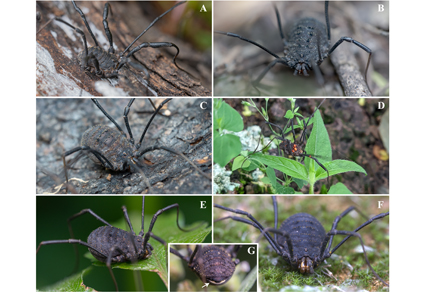
We describe three new species of Diguetinus from the Southern Mexican Plateau and the Sierra Madre Occidental biogeographic provinces. Diguetinus densiseriatus sp. nov. is described based on alpha and beta males and the female. It is distinguished from its congeners by possessing more than two transversal rows of small spines per opisthosomal tergites and at least tergites I–III with more than 40 spines per tergite. Diguetinus tastoanus sp. nov. is described based on a beta male and a female. This species is characterized by a single transversal row of spines per tergite, at least tergites I–III with less than 25 spines per tergite and the anterior propeltidium hump (APH) with a pattern with “III” form. Diguetinus susticacan sp. nov. is described from females only. It differs from remining species by a one row of spines configuration per opisthosomal tergite, at least tergites I–III with less than 30 spines each, APH pattern with “I” form, and by the presence of a light-yellowish band on posterior edge of sternite V. The description of male dimorphism in D. densiseriatus suggests the presence of Alternative Reproductive Tactics (ARTs) within Diguetinus. Additionally, female-predominant sex ratios are discussed, and an identification key is provided for Diguetinus.
References
- Acosta, L.E., González, A.P. & LúciaTourinho, A. (2007) Methods for taxonomic study. In: Pinto-da-Rocha, R., Machado, G. & Giribet, G. (Eds.), Harvestmen: The Biology of Opiliones. Harvard University Press, Cambridge, Massachusetts and London, pp. 493–510.
- Arriaga, L., Aguilar, C., Espinosa, D. & Jiménez, R. (1997) Regionalización ecológica y biogeográfica de México. Comisión Nacional para el Conocimiento y Uso de la Biodiversidad, México, D.F., 98 pp.
- Beron, P. (2018) Zoogeography of arachnida. Springer, Sofia, 987 pp. https://doi.org/10.1007/978-3-319-74418-6
- Bronn, H.G. (1932) Dr. H.G. Bronn’s Klassen und Ordnungen des Thier-Reichs: Wissenschaftlich dargestellt in Wort und Bild. Allgemeine Ubersicht der Klasse Arachnoidea (Spinnentiere). C. F. Winter, Leipzig und Heidelberg, 723 pp.
- Brown, T.A., Tsurusaki, N. & Burns, M. (2021) Genomic Determination of Reproductive Mode in Facultatively Parthenogenetic Opiliones. Journal of Heredity, 112 (1), 34–44. https://doi.org/10.1093/jhered/esaa045
- Burns, M., Hedin, M. & Tsurusaki, N. (2018) Population genomics and geographical parthenogenesis in Japanese harvestmen (Opiliones, Sclerosomatidae, Leiobunum). Ecology and Evolution, 8 (1), 36–52. https://doi.org/10.1002/ece3.3605
- Burns, M. & Tsurusaki, N. (2016) Male reproductive morphology across latitudinal clines and under long-term female sex-ratio bias. Integrative and Comparative Biology, 56 (4), 715–727. https://doi.org/10.1093/icb/icw017
- Buzatto, B.A. & Machado, G. (2014) Male dimorphism and alternative reproductive tactics in harvestmen (Arachnida: Opiliones). Behavioural Processes, 109 (Part A), 2–13. https://doi.org/10.1016/j.beproc.2014.06.008
- Cheung, D.K., Brunke, A.J., Akkari, N., Souza, C.M. & Pape, T. (2013) Rotational Scanning Electron Micrographs (rSEM): A novel and accessible tool to visualize and communicate complex morphology. Zookeys, 328, 47. https://doi.org/10.3897/zookeys.328.5768
- Cokendolpher, J.C. (1984a) A new genus of North American harvestmen (Arachnida: Opiliones: Palpatores). In: Horner, N.V. (Ed.), Festschrift for Walter W. Dalquest in Honor of His Sixty-sixth Birthday. Midwestern State University, Wichita Falls, Texas, pp. 27–43.
- Cokendolpher, J.C. (1984b) Revision of the harvestman genus Leptobunus and dismantlement of the Leptobunidae (Arachnida: Opiliones: Palpatores). Journal of the New York Entomological Society, 92 (4), 371–402.
- Cokendolpher, J.C. & Cokendolpher, J.E. (1984) A new genus of harvestmen from Costa Rica with comments on the status of the Neotropical Phalangiinae (Opiliones, Phalangiidae). Bulletin of the British Arachnological Society, 6 (4), 167–172.
- Cokendolpher, J.C. & Lee, V. (1993) Catalogue of the Cyphopalpatores and Bibliography of the Harvestmen (Arachnida, Opiliones) of Greenland, Canada, U.S.A., and Mexico. James C. Cokendolpher, Lubbock, Texas, 87 pp.
- Cokendolpher, J.C., Lucio-Palacio, C.R. & Starega, W. (2021) Redescription and Natural History of the Mexican harvestman Diguetinus raptator Roewer, 1912 (Opiliones: Globipedidae), type species of the genus. Zootaxa, 4984 (1), 119–133. https://doi.org/10.11646/zootaxa.4984.1.12
- Cokendolpher, J.C. & Sissom, W.D. (2000) Further contributions to the study of Dalquestia (Opiliones: Sclerosomatidae). Entomological News, 111 (4), 243–249.
- Cokendolpher, J.C. & Stockwell, S.A. (1986) A new species of harvestman from Arizona (Arachnida: Opiliones: Palpatores: Dalquestia). The Southwestern Naturalist, 31 (1), 49–53. https://doi.org/10.2307/3670959
- Crawford, R.L. (1992) Catalogue of the Genera and type species of the harvestman superfamily Phalangioidea (Arachnida). Burke Mueseum Contributions in Antrhopology and Natural History, 8, 1–59.
- Cushing, P.E. & Brookhart, J.O. (2016) Nine new species of the Eremobates scaber species group of the North American camel spider genus Eremobates (Solifugae, Eremobatidae). Zootaxa, 4178 (4), 503–520. https://doi.org/10.11646/zootaxa.4178.4.3
- Di Caporiacco, L. (1938) Aracnidi del Messico, di Guatemala e Honduras britannico. Istituto di Zoologia della R. Università di Firenze, 77 (3), 251–282.
- Garcia, E.L. & Cushing, P.E. (2024) Historical biogeography and the evolution of habitat preference in the North American camel spider family, Eremobatidae (Arachnida: Solifugae). Molecular Phylogenetics and Evolution, 201, 108193. https://doi.org/10.1016/j.ympev.2024.108193
- Giribet, G., Edgecombe, G.D., Wheeler, W.C. & Babbitt, C. (2002) Phylogeny and systematic position of Opiliones: a combined analysis of chelicerate relationships using morphological and molecular data. Cladistics, 18 (1), 5–70. https://doi.org/10.1006/clad.2001.0185
- Giribet, G., Vogt, L., González, A.P., Sharma, P. & Kury, A.B. (2010) A multilocus approach to harvestman (Arachnida: Opiliones) phylogeny with emphasis on biogeography and the systematics of Laniatores. Cladistics, 26 (4), 408–437. https://doi.org/10.1111/j.1096-0031.2009.00296.x
- González-Santillán, E. & Prendini, L. (2013) Redefinition and generic revision of the North American vaejovid scorpion subfamily Syntropinae Kraepelin, 1905, with descriptions of six new genera. Bulletin of the American Museum of Natural History, 2013 (382), 1–71. https://doi.org/10.1206/830.1
- González‐Santillán, E. & Prendini, L. (2015) Phylogeny of the N orth A merican vaejovid scorpion subfamily S yntropinae Kraepelin, 1905, based on morphology, mitochondrial and nuclear DNA. Cladistics, 31 (4), 341–405. https://doi.org/10.1111/cla.12091
- Goodnight, C.J. & Goodnight, M.L. (1942) New and little known Phalangida from Mexico. American Museum novitates, 1163, 1–16.
- Gruber, J. (1969) Bemerkungen zur Genitalmorphologie und systematischen Stellung von Metopilio australis (Banks) (Phalangiidae: Opiliones, Arachnida). Annalen des Naturhistorischen Museums in Wien, 73, 271–274.
- Hedin, M., Tsurusaki, N., Macías-Ordóñez, R. & Shultz, J.W. (2012) Molecular systematics of sclerosomatid harvestmen (Opiliones, Phalangioidea, Sclerosomatidae): geography is better than taxonomy in predicting phylogeny. Molecular Phylogenetics and Evolution, 62 (1), 224–236. https://doi.org/10.1016/j.ympev.2011.09.017
- Kury, A.B. & Cokendolpher, J.C. (2000) Opiliones. In: Llorente-Bousquets, J., González-Soriano, E. & Papavero, N. (Eds.), Biodiversidad, taxonomía y biogeografía de artrópodos de México: hacia una síntesis de su conocimiento. Comisión Nacional para el Conocimiento y Uso de la Biodiversidad (CONABIO), México, D.F., pp. 137–157.
- Kury, A.B. & Cokendolpher, J.C. (2020) A new family from the New World (Eupnoi: Phalangioidea). In: Kury, A.B., Mendes, A.C., Cardoso, L., Kury, M.S. & Granado, A. de A. (Eds.), WCO-Lite: online world catalogue of harvestmen (Arachnida, Opiliones): Version 1.0—Checklist of all valid nomina in Opiliones with authors and dates of publication up to 2018. do autor, Rio de Janeiro, pp. 52–53.
- Magalhaes, I.L. (2019) Spreadsheets to expedite taxonomic publications by automatic generation of morphological descriptions and specimen lists. Zootaxa, 4624 (1), 147–150. https://doi.org/10.11646/zootaxa.4624.1.12
- Maya-Morales, J., Jiménez, M.L. & Morrone, J.J. (2018) Track analysis of the funnel-web spiders (Araneae: Agelenidae) of Mexico. Revista Mexicana de Biodiversidad, 89 (2), 530–540. https://doi.org/10.22201/ib.20078706e.2018.2.2367
- Morrone, J.J. (2020) The Mexican Transition Zone: a natural biogeographic laboratory to study biotic assembly. Springer, Cham, 192 pp. https://doi.org/10.1007/978-3-030-47917-6
- Ochoa-Vázquez, D., Cruz-López, J.A., Rosas-Valdez, R. & Martínez-Salazar, E.A. (2025) Redefining the Mexican genus Diguetinus Roewer, 1912 (Opiliones, Phalangioidea, Globipedidae) based on morphology and molecular phylogenetic data, with the redescription of Diguetinus spinulatus (Banks, 1898) stat. restit. Zoosystema, 47 (30), 731–749. https://doi.org/10.5252/zoosystema2025v47a30
- Rodriguez, A.L., Townsend, V.R., Jr. & Proud, D.N. (2014) Comparative Study of the Microanatomy of Four Species of Harvestmen (Opiliones, Eupnoi). Annals of the Entomological Society of America, 107 (2), 496–509. https://doi.org/10.1603/AN13109
- Roewer, C.-F. (1912) Revision der Opiliones Palpatores (= Opiliones Plagiostethi). II. Teil: Familie der Phalangiidae. (Subfamilien: Sclerosomini, Oligolophini, Phalangiini). Abhandlungen aus dem Gebiete der Naturwissenschaften, herausgegeben vom Naturwissenschaftlichen Verein in Hamburg, 20 (1), 1–295.
- Roewer, C.-F. (1923) Die Weberknechte der Erde. Systematische Bearbeitung der bisher bekannten Opiliones. Gustav Fischer, Jena, pp.
- Roewer, C.-F. (1956) Uber Phalangiinae (Phalangiidae, Opiliones Palpatores). (Weitere Weberknechte XIX). Senckenbergiana biol., 37, 247–318.
- Tsurusaki, N. (1986) Parthenogenesis and geographic variation of sex ratio in two species of Leiobunum (Arachnida, Opiliones). Zoological Science, 3 (3), 517–532.
- Weidner, H. von (1959) Die entomologischen Sammlungen des Zoologischen Staatsinstituts und Zoologischen Museums Hamburg, I. Pararthropoda und Chelicerata, I. Mitteilungen Hamburger Zoologischen Museums und Instituts, 57, 89–142.
- Wijnhoven, H. (2013) Sensory structures and sexual dimorphism in the harvestman Dicranopalpus ramosus (Arachnida: Opiliones). Arachnologische Mitteilungen, 46, 27–46. https://doi.org/10.5431/aramit4605