

Abstract
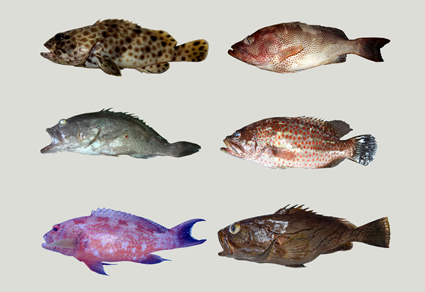
This study documents the first recorded occurrence of six commercially important grouper fish species (Teleostei: Perciformes: Epinephelidae) from the Lakshadweep Islands, India. The species documented in this study are the Snubnose grouper Epinephelus macrospilos (Bleeker, 1855), Brownspotted grouper Epinephelus chlorostigma (Valenciennes, 1828), Dotted grouper Epinephelus epistictus (Temminck and Schlegel, 1842), Slender grouper Anyperodon leucogrammicus (Valenciennes, 1828), White-edged lyretail Variola albimarginata Baissac, 1953 and Oblique-banded grouper Epinephelus radiatus (Day, 1868). Both morphological examination and molecular analysis were carried out to characterize and confirm the identity of these species. This investigation represents the first documentation of these six grouper species from the Lakshadweep Islands. The results enhance current understanding of the marine biodiversity of the region and provide valuable information for the management and sustainability of its commercially important fisheries.
References
- Ajith Kumar, T.T., Vinoth, R., Prakash, S. & Balasubramanian, T. (2012) Reef fishes of the Lakshadweep archipelago. Publications Division of the Annamalai University, Tamil Nadu, 180 pp.
- Aneeshkumar, K.V., Pravin, P., Meenakumari, B., Khanolkar, P.S. & Biju, M.V. (2015) Shark bycatch in the experimental tuna longline fishery in Lakshadweep Sea, India. Journal of Applied Ichthyology, 31, 301–307. https://doi.org/10.1111/jai.12682
- Arthur, R. (2004) Patterns and processes of reef recovery and human resource use in the Lakshadweep Islands, Indian Ocean. Ph.D. Thesis, James Cook University, Townsville, Queensland, 135 pp.
- Bellwood, D.R., Hughes, T.P., Folke, C. & Nystrom, M. (2004) Confronting the coral reef crisis. Nature, 429 (6994), 827–833. https://doi.org/10.1038/nature02691
- Craig, M.T. & Hastings, P.A. (2007) A molecular phylogeny of the groupers of the subfamily Epinephelinae (Serranidae) with a revised classification of the Epinephelini. Ichthyological Research, 54, 1–17. https://doi.org/10.1007/s10228-006-0367-x
- Fricke, R., Eschmeyer, W.N. & van der Laan, R. (2023) Eschmeyer’s Catalog of Fishes: Genera, Species, References. Available from: http://researcharchive.calacademy.org/research/ichthyology/catalog/fishcatmain.asp (accessed 24 January 2023)
- Froese, R. & Pauly, D. (2024) FishBase. World Wide Web electronic publication. Available from: http://www.fishbase.org (accessed 30 March 2026)
- Gilles, A., Miquelis, A., Quignard, J.P. & Faure, É. (2000) Molecular phylogeography of western Mediterranean dusky grouper Epinephelus marginatus. Comptes Rendus de l’Academie des Sciences, Serie III, Sciences de la Vie, 323, 195–205. https://doi.org/10.1016/S0764-4469(00)00114-1
- Han, J., Lv, F. & Cai, H. (2011) Detection of species-specific long VNTRs in mitochondrial control region and their application to identifying sympatric Hong Kong grouper (Epinephelus akaara) and yellow grouper (Epinephelus awoara). Molecular Ecology Resources, 11, 215–218. https://doi.org/10.1111/j.1755-0998.2010.02911.x
- Jones, S. & Kumaran, M. (1964) New records of fishes from the seas around India—part I. Journal of the Marine Biological Association of India, 6, 285–306.
- Jones, S. & Kumaran, M. (1966) New records of fishes from the seas around India—part IV. Journal of the Marine Biological Association of India, 8, 163–180.
- Jones, S. & Kumaran, M. (1968) New records of fishes from the seas around India—part VI. Journal of the Marine Biological Association of India, 10, 321–331.
- Jones, S. & Kumaran, M. (1959) The fishing industry of Minicoy Island with special reference to the tuna fishery. Indian Journal of Fisheries, 6, 30–57.
- Jones, S. (1969) Catalog of fishes in the Lacadive archipelago in the reference collections of the CMFR institute. Bulletin of the Central Marine Fisheries Research Institute, 8, 1–32.
- Jones, S. & Kumaran, M. (1980) The Fishes of the Lakshadweep Archipelago. Indian Journal of Fisheries, 27 (1), 85–96.
- Klein, C.J., Watkinson, A.R. & Ricketts, T.H. (2008) Incorporating ecosystem-based management into marine conservation planning. Ecological Applications, 18 (3), 754–765.
- Miller, S.A., Dykes, D.D. & Polesky, H.F. (1988) A simple salting out procedure for extracting DNA from human nucleated cells. Nucleic Acids Research, 16 (3), 1215. https://doi.org/10.1093/nar/16.3.1215
- Murty, V.S. (2001) Ornamental fish resources of Lakshadweep. In: Geological Survey of India Special Publication. No. 56. Geological Survey of India, Kolkata, pp. 103–111.
- Myers, R.A., Bowen, K.G. & Barrow, R.M. (2010) Population declines of groupers and snappers: The role of fishing practices and marine reserves. Fisheries Research, 106 (1–3), 159–165.
- Noushad, M.K., Sirajudheen, T.K. & Idrees Babu, K.K. (2014) Intertidal ichthyofaunal diversity of Androth Island, Lakshadweep, India – a call for developing culture based fishery. Journal of Aquatic Biology & Fisheries, 2 (1), 304–306.
- Prabhakaran, M.P., Bijoy, N.S., Jayachandran, P.R. & Pillai, N.G.K. (2013) Species diversity and community structure of ichthyofauna in the seagrass ecosystem of Minicoy Atoll, Lakshadweep, India. Indian Journal of Geo-Marine Sciences, 42 (3), 349–359. https://doi.org/10.1007/978-3-642-38200-0_3
- Rajan, P.T. (2001) A field guide to Grouper and Snapper fishes of Andaman and Nicobar Islands. Zoological Survey of India, Port Blair, 103 pp.
- Rajan, P.T. (2015) New record of two Species of Epinephelus (Perciformes: Serranidae: Epinephelinae) from Andaman Islands, India. Records of the Zoological Survey of India, 115 (4), 321–323. https://doi.org/10.26515/rzsi/v115/i4/2015/120693
- Rajan, P.T., Mishra, S.S. & Bineesh, K.K. (2017) First records of two species of groupers, Cephalopholis nigripinnis and Epinephelus retouti (Perciformes, Epinephelidae) from India, with a note on Epinephelids from Andaman and Nicobar Islands. Records of the Zoological Survey of India, 117 (3), 289–294. https://doi.org/10.26515/rzsi/v117/i3/2017/120972
- Rajan, R., Rajan, P.T., Mishra, S.S., Abdul Raheem, C.N., Shrinivaasu, S., Surendar, C. & Damodhar, A.T. (2021) Fishes of Lakshadweep archipelago: new records, review and a revised checklist. Marine Biodiversity Records, 14, 14. https://doi.org/10.1186/s41200-021-00208-6
- Rao. (2003) Guide to Reef Fishes of Andaman and Nicobar Islands. Zoological Survey of India, Kolkata, 555 pp.
- Rao, D.V., Devi, K. & Rajan, P.T. (2000) An account of Ichthyofauna of Andaman & Nicobar Islands, Bay of Bengal. Records of the Zoological Survey of India, Occasional Papers, 178, 1–434.
- Rao, G.C. (1991) Lakshadweep, General features. In: Ghosh, A.K. & Kumar, A. (Eds.), State Fauna Series 2, Fauna of Lakshadweep. Zoological Survey of India, Kolkata, pp. 5–40.
- Russell, B.C. & Houston, W. (1989) Offshore fishes of the Arafura Sea. Beagle, 6 (1), 69–84. https://doi.org/10.5962/p.271273
- Sadovy, Y.J., Craig, M.T., Bertoncini, A.A., Carpenter, K.E., Cheung, W.W.L., Choat, J.H., Cornish, A.S., Fennessy, S.T., Ferreira, B.P., Heemstra, P.C., Liu, M., Myers, R.F., Pollard, D.A., Rhodes, K.L., Rocha, L.A., Russell, B.C., Samoilys, M.A. & Sanciangco, J. (2012) Fishing groupers towards extinction: a global assessment of threats and extinction risks in a billion dollar fishery. Fish & Fisheries, 14 (2), 119–136. https://doi.org/10.1111/j.1467-2979.2011.00455.x
- Sluka, R.D. & Lazarus, S. (2006) Groupers and wrasses of Minicoy Island, Lakshadweep, India. In: Fennessy, S. (Ed.), Newsletter of the Groupers & Wrasses Specialist Group Issue 9. International Union for the Conservation of Nature, Lisbon, pp. 4–5.
- Smith, M.M. & Heemstra, P.C. (1986) Hexatrygonidae. In: Smith, M.M. & Heemstra, P.C. (Eds.), Smiths’ sea fishes. Springer-Verlag, Berlin, pp. 142–143. https://doi.org/10.1007/978-3-642-82858-4
- Talwar, P.K. (1990) Fishes of the Andaman and Nicobar Islands: A Synoptic analysis. Journal of the Andaman Science Association, 6 (2), 71–102.