
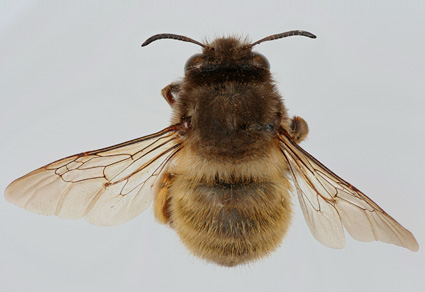

Abstract
The Japanese fauna of the bee genus Anthophora Latreille is revised. Three species are recognized from Japan: A. (A.) villosula Smith, 1854, A. (Clisodon) terminalis Cresson, 1869, and A. (C.) japonica Murao sp. nov. Anthophora terminalis is formally recorded from Japan. Two taxa of unclear origin, Anthophora hilgendorfi Cockerell, 1911 (= A. clessini Fedchenko, 1875) and A. venerabilis Cockerell, 1911 (= A. subterranea (Germar, 1826)), were originally described from Japan but may have been mislabeled with incorrect type localities and probably do not actually occur in Japan. A key to the Japanese species is provided, along with bionomical data such as flight periods and floral associations in Japan are given.
References
- Adhikari, R.D. & Miyanaga, R. (2016) Utilization of hairy footed flower bee Anthophora plumipes (Hymenoptera: Apidae) for pollination of greenhouse strawberry. Advances in Entomology, 4, 25–31. https://doi.org/10.4236/ae.2016.41004
- Adhikari, R.D., Maeta, Y., Izumi, Y. & Miyanaga, R. (2016) Nesting activity of Anthophora plumipes under the closed circumstance (Hymenoptera, Apidae). Kontyû, New Series, 19 (3), 86–93. [in Japanese]
- Ascher, J.S. & Pickering, J. (2025) Discover Life bee species guide and world checklist (Hymenoptera: Apoidea: Anthophila). Available from: http://www.discoverlife.org./mp/20q?guide=Apoidea_species (accessed 13 April 2025)
- Batra, S.W.T. (1994) Anthophora pilipes villosula Sm. (Hymenoptera: Anthophoridae), a manageable Japanese bee that visit blueberries and apples during cool, rainy, spring weather. Proceedings of the Entomological Society of Washington, 96, 98–119.
- Brooks, R.W. (1988) Systematics and phylogeny of the Anthophorine bees (Hymenoptera: Anthophoridae; Anthophorini). The University of Kansas Science Bulletin, 53 (9), 436–575.
- Černá, K., Munclinger, P., Vereecken, N.J. & Straks, J. (2017) Mediterranean lineage endemism, cold-adapted palaeodemographic dynamics and recent changes in population size in two solitary bees of the genus Anthophora. Conservation Genetics, 18, 521–538. https://doi.org/10.1007/s10592-017-0952-8
- Cockerell, T.D.A. (1898) New and little known bees from Washington State. Proceedings of the Academy of Natural Sciences of Philadelphia, 50, 50–56. https://doi.org/10.4039/Ent3050-3
- Cockerell, T.D.A. (1911) Bees in the collection of the United States National Museum. 2. Proceedings of the United States Natinal Museum, 40 (1818), 241–264. https://doi.org/10.5479/si.00963801.40-1818.241
- Cockerell, T.D.A. (1937) Bees collected by Mr. and Mrs. J. L. Sperry and Mr. R.H. Andrews in Arizona. Bulletin of the Southern California Academy of Sciences, 36, 107–110.
- Cresson, E.T. (1869) A list of the North American species of the genus Anthophora, with descriptions of new species. Transactions of the American Entomological Society, 2, 289–293. https://doi.org/10.2307/25076210
- Cresson, E.T. (1879) Descriptions of new North American Hymenoptera in the collection of the American Entomological Society. Transactions of the American Entomological Society, 7, 201–214. https://doi.org/10.2307/25076373
- Danforth, B.N., Minckley, R.L. & Neff, J.L. (2019) The Solitary Bees: Biology, Evolution, Conservation. Princeton University Press, Princeton, New Jersey and Oxford, 472 pp. https://doi.org/10.1515/9780691189321
- Davydova, N.G. & Pesenko, Yu.A. (2002) Bees of the subgenus Clisodon (Anthophora, Hymenoptera, Apidae) in the fauna of Russia. Entomological Review, 82 (5), 621–624.
- Editorial Committee of Catalogue of the Insects of Japan (2020) Catalogue of the Insects of Japan. Volume 9 (Part 3 Apocrita, Aculeata). Entomological Society of Japan, Kyoto, xxv + 434 pp.
- Fabricius, J.C. (1804) Systema Piezatorum. Carolum Reichard, Brunsvigae, 439 pp.
- GBIF Secretariat (2023) Anthophora villosula Smith, 1854 & Anthophora terminalis Cresson, 1869. GBIF Backbone Taxonomy. Available from: https://doi.org/10.15468/39omei (accessed 29 April 2025)
- Ghisbain, G., Rosa, P., Bogusch, P., Brau, T., Carion, F., Manincor, N.D., Devalez, J., Dorchin, A., Flaminio, S., Greil, H., Hölzler, G., Hopfenmüller, S., Kasparek, M., Kuhlmann, M., Divelec, R.L., Litman, J., Maugendre, A., Michez, D., Müller, A., Ortiz-Sánchez, F.J., Praz, C., Radchenko, V.G., Rasmont, P., Risch, S., Roberts, S.P.M., Santerre, R., Schmid-Egger, C., Sentil, A., Straka, J., Williams, P.H., Wood, T.J. & Reverté, S. (2025) The new annotated checklist of the wild bees of Europe (Hymenoptera: Anthophila)-version 2025. Zootaxa, 5736 (1), 1–126. https://doi.org/10.11646/zootaxa.5736.1.1
- Gussakovskij, V. (1932) Verzeichnis der von Herrn Dir. R. Malaise im Ussuri und Kamtschatka gesammelten aculeaten Hymenopteren. Arkiv Fur Zoologi, A24 (10), 1–66.
- Haneda, Y. (1992) On the Apoidea (Hymenoptera) of Fukui Prefecture, Japan (VIII). Entomological Journal of Fukui, 11, 3–8. [in Japanese]
- Haneda, Y. & Tano, T. (2002) The aculeate Hymenoptera collected at Tsushima, Nagasaki Prefecture in May of 2003. Tsunekibachi, 1, 8–22. [in Japanese]
- Haneda, Y., Nosaka, C., Tano, T., Kurokawa, H. & Murota, T. (2004) Aculeate Hymenoptera collected from Gifu Prefecture in 2002 and 2003. Tsunekibachi, 2, 19–55. [in Japanese]
- Hanson, T. & Ascher, J.S. (2018) An unusually large nesting aggregation of the digger bee Anthophora bomboides Kirby, 1838 (Hymenoptera: Apidae) in the San Juan Islands, Washington State. The Pan-Pacific Entomologist, 94 (1), 4–16. https://doi.org/10.3956/2018-94.1.4
- Ichihashi, T., Kurahashi, T. & Ikudome, S. (2011) Flower-visiting bees collected in Kagawa Prefecture, Japan and the possibility of unusual pollination by the large carpenter bee (Hymenoptera: Apoidea). Technical Bulletin of Faculty of Agriculture, Kagawa University, 63 (116), 43–59. [in Japanese]
- Ikudome, S. (1978) A wild bee survey in Kôchi Plain (Kôchi Pref.), Shikoku, Japan (Hymenoptera, Apoidea). Kontyû, 46 (3), 512–536. [in Japanese]
- Ikudome, S. (1982) Floral records of fourteen species of colletid, anthophorid and bombine bees in Kochi Plain, Shikoku, Japan. Bulletin of Kagoshima Women’s Junior College, 17, 131–136.
- Ikudome, S. (1992) The environment and the wild bee fauna of natural park in a city, with the result taken at Shiroyama park in Kagoshima city, Japan, and with the appendix of a revised bee list recorded from the mainland of Kagoshima Prefecture (Hymenoptera, Apoidea). Bulletin of Kagoshima Women’s Junior College, 27, 99–135. [in Japanese]
- Ikudome, S. & Hirashima, Y. (1995) Bee fauna of Miyazaki Prefecture, Kyushu, with special reference to Higashimorokata district (Hymenoptera, Apoidea). In: Hirashima, Y. (Ed.), Contribution to the fauna and flora of Miyazaki Higashimorokata district-new records and observations of noteworthy insects, spiders and plants based on systematic and biological studies-. Miyazaki Municipal University, Miyazaki, pp. 59–72. [in Japanese]
- Ikudome, S. & Nakamura, S. (1995) Bees of Hiroshima Prefecture, Honshu, Japan. Part 2. With special reference to the Gônokawa basin (Hymenoptera, Apoidea). Miscellaneous Reports of the Hiwa Museum for Natural History, 32, 1–18. [in Japanese]
- Ikudome, S. & Nakamura, S. (1997) Summary of bee survey in Hiroshima Prefecture, Japan (Hymenoptera, Apoidea). Miscellaneous Reports of the Hiwa Museum for Natural History, 32, 17–29. [in Japanese]
- Inoue, T., Kato, M., Kakutani, T., Suka, T. & Itino, T. (1990) Insect-flower relationship in the temperate deciduous forest of Kibune, Kyoto: an overview of the flowering phenology and the seasonal pattern of insect visits. Contribution from the Biological Laboratory, Kyoto University, 27, 377–463.
- Kakutani, T., Inoue, T., Kato, M. & Ichihashi, H. (1990) Insect-flower relationship in the campus of Kyoto University, Kyoto: an overview of the flowering phenology and the seasonal pattern of insect visits. Contribution from the Biological Laboratory, Kyoto University, 27, 465–521.
- Latreille, P.A. (1802) Histoire Naturelle des Fourmis: et Recueil de Mémoires et d'Observations sur les Abeilles, les Araignées, les Faucheurs, et Autres Insects. Barrois, Paris, 445 pp., 12 pls. https://doi.org/10.5962/bhl.title.11138
- Latreille, P.A. (1803) Nouveau Dictionnaire d’Histoire Naturelle, Appliquée aux Arts, a l’Agriculture, à la Médecine, etc. Vol. 18. Deterville, Paris, 552 pp.
- Lhomme, P., Michez, D., Christmann, S., Scheuchl, E., Abdouni, I.E., Hamroud, L., Ihsane, O., Sentil, A., Smaili, M.C., Schwarz, M., Dathe, H., Straka, J., Pauly, A., Schmid-Egger, C., Patiny, S., Terzo, M., Müller, A., Praz, C., Risch, S., Kasparek, M., Kuhlmann, M., Wood, T.J., Bogusch, P., Ascher, J.S. & Rasmont, P. (2020) The wild bees (Hymenoptera: Apoidea) of Morocco. Zootaxa, 4892 (1), 1–159. https://doi.org/10.11646/zootaxa.4892.1.1
- Maeta, Y. & Miyanaga, R. (2018) Some bionomical notes on Anthophora plumipes (Pallas) (Hymenoptera, Apidae). Chugoku Kontyu, 31, 7–12. [in Japanese]
- Maeta, Y., Miyanaga, R. & Kitamura, K. (2003) Studies on the wild bee fauna at Mt. Sanbe in Shimane Prefecture, Japan (Hymenoptera, Apoidea). New Entomologist, 52 (1), 19–47. [in Japanese]
- Maeta, Y., Otsui, K. & Miyanaga, R. (2017) Studies on the wild bee fauna at Mt. Ryuozan in Hiroshima Prefecture (Hymenoptera, Apoidea). Chugoku Kontyu, 30, 5–38. [in Japanese]
- Matsumura, M., Sakagami, S.F. & Fukuda, H. (1974) A wild bee survey in Kibi (Wakayama Pref.), southern Japan. Journal of the Faculty of Science Hokkaido University, Series VI, Zoology, 19 (2), 422–437.
- Meade-Waldo, G. (1914) Notes on the Apidae (Hymenoptera) in the collection of the British Museum, with descriptions of new species. Annals and Magazine of Natural History, Series 8, 13, 45–58 + 399–405. https://doi.org/10.1080/00222931408693501
- Michener, C.D. (1997) Genus-group names of bees and supplemental family group names. Scientific Papers, Natural History Museum, University of Kansas, 1, 1–81. https://doi.org/10.5962/bhl.title.4052
- Michener, C.D. (2007) The Bees of the World. The John Hopkins University Press, Baltimore, Maryland, and London, xiv + 913 pp.
- Mitchell, T.B. (1962) Bees of the eastern United States. Vol. II. North Carolina Agricultural Experiment Station Technical Bulletin, 152, 1–557.
- Miyamoto, S. (1960) Flower-visiting habits of two species of bees belonging to the genus Anthophora (Biological studies on Japanese bees XVII). Akitsu, 9, 53–58. [in Japanese]
- Murao, R. (2015) Records of Aculeate wasps and bees in the coast of northwestern part of Fukuoka Prefecture, Kyushu, Japan. Tsunekibachi, 27, 33–50. [in Japanese]
- Murao, R. (2022) A checklist of bees in Mt. Hiko, Kyushu, Japan. Esakia, 55, 70–87. https://doi.org/10.5109/6613528
- Nagase, H. (2004) Hymenoptera (excl. Formicidae). In: Insect Fauna of Kanagawa III. Kanagawa Konchû Danwakai, Odawara, pp. 1241–1326. [in Japanese]
- Nagase, H. (2022) Supplementary information on Hymenoptera in the catalogue of the insect of Japan. Vol. 9. Part 3. Sugareoi, 2, 13–16. [in Japanese]
- Negoro, H. (2014) The bees of Toyama Prefecture, central Honshu, Japan. Special Publications from the Toyama Science Museum, 27, 1–129. [in Japanese]
- Niu, Z.Q., Yuan, F., Luo, A., Zhou, Q.S., Orr, M., Rasmont, P. & Zhu, C.D. (2025) The types of Anthophorinae (Hymenoptera: Apidae) described by Yan-Ru Wu and held in the main museum of the Chinese National Animal Collection Resource Center. Zootaxa, 5629 (1), 1–84. https://doi.org/10.11646/zootaxa.5629.1.1
- Ortiz-Sánchez, F.J. & Jiménez-Rodríquez, A. (1992) Nuevos datos sobre las abejas del género Anthophora Latreille, 1803 en España (Hymenoptera, Anthophoridae). Boletin de la Asociatión Española de Entomologia, 16, 213–225. [in Spanish]
- Orr, M.C. (2020) A preliminary report on the bees of Joshua Tree National Park, with special focus on Anthophora, Digger Bees. National Park Service (NPS), Washington, D.C. [digital-only article]
- Orr, M.C., Griswold, T., Pitts, J.P. & Parker, F.D. (2016) A new bee species that excavates sandstone nests. Current Biology, 26 (17), R792–R793. https://doi.org/10.1016/j.cub.2016.08.001
- Packer, L. (2023) Bees of the world. A guide to every family. Princeton University Press, Princeton, New Jersey, 240 pp. https://doi.org/10.2307/j.ctv2v6pd2p
- Panzer, G.W.F. (1804) Faunae Insectorum Germaniae. Heft 86. Felseckersche Buchhandlung, Nürnberg, 48 pp.
- Patton, W.H. (1879) Generic arrangement of the bees allied to Melissodes and Anthophora. Bulletin of the United States Geological and Geographycal Survey of the Territories, 5, 471–479.
- Proshchalykin, M.Yu. & Lelej, A.S. (2004) New and little known bees (Hymenoptera: Colletidae, Apidae) from the Russian Far East. Far Eastern Entomologist, 136, 1–10.
- Provancher, L. (1882) Faune Canadienne. Les Insectes Hyménoptères. Naturaliste canadien, 13, 225–242.
- Provancher, L. (1888) Additions et Corrections au Volume II de la Faune Entomologique du Canada Traitant des Hyménoptères. Quebec, Darveau, 475 pp. https://doi.org/10.5962/bhl.title.46411
- QGIS Development Team (2025) QGIS Geographic Information System. Open Source Geospatial Foundation Project. Available from: http://qgis.osgeo.org (accessed 29 April 2025)
- Rasmont, P. (2014) Atlas of the European Bees: genus Anthophora. 1st Edition. STEP Project, Atlas Hymenoptera, Mons, Gembloux. Available from: http://www.atlashymenoptera.net/page.aspx?ID=260 (accessed 6 May 2025)
- Rasmont, R., Astafurova, Y., Antropov, A.V., Lambaere, K.L. & Wood, T.J. (2026) The Anthophorinae (Amegilla Friese, Anthophora Latreille) described by Alexei Pavlovich Fedchenko (Hymenoptera: Apidae). Annales de la Société entomologique de France, Nouvelle Série, 62 (1), 1–108. https://doi.org/10.1080/00379271.2025.2602489
- Sakagami, S.F. & Fukuda, H. (1973) Wild bee survey at the campus of Hokkaido University. Journal of the Faculty of Science Hokkaido University Series VI. Zoology, 19 (1), 190–250.
- Sandohouse, G.A. (1943) The type species of the genera and subgenera of bees. Proceedings of the United States National Museum, 92, 519–619. https://doi.org/10.5479/si.00963801.3156.519
- Satyshur, C.D. & Orr, M.C. (2020) Record of Anthophora (Clisodon) terminalis in a wooden trap-nesting block and comparison to available nesting information (Hymenoptera: Apidae). Journal of Melittology, 99, 1–6. https://doi.org/10.17161/jom.vi99.13315
- Schwarz, M. & Gusenleitner, F. (2001) Beitrag zur Kenntnis paläarktischer Anthophorini und Habropodini (Hymenoptera: Apidae). Entomofauna, 22 (6), 53–92. [in Germany]
- Sheffield, C.S. & Perron, J.-M. (2014) Annotated catalogue of the bees described by Léon Provancher (Hymenoptera: Apoidea). The Canadian Entomologist, 146, 117–169. https://doi.org/10.4039/tce.2013.64
- Sladen, F.W.L. (1919) Notes on the Canadian representatives of British species of bees. The Canadian Entomologist, 51 (6), 124–130. https://doi.org/10.4039/Ent51124-6
- Smith, F. (1854) Catalogue of Hymenopterous Insects in the Collection of the British Museum. Part 2. British Museum, London, 267 pp. [pp. 199–465]
- Strand, E. (1913) Apidae aus Pingshiang (Süd= China) gesammelt von Herrn Dr. Kreyenberg. Archiv für Naturgeschichte, 79 (A), 103–108. https://doi.org/10.5962/bhl.part.11220
- Stubbs, C.S. & Drummond, F.A. (1999) Pollination of lowbush blueberry by Anthophora plilipes villosula and Bombus impatiens (Hymenoptera: Anthophoridae and Apidae). Journal of the Kansas Entomological Society, 72, 306–309.
- Tadauchi, O. & Murao, R. (Eds.) (2014) An Illustrated Guide to Japanese Bees. Bunichi, Tokyo, 479 pp. [in Japanese]
- Torikata, T. (1931) Ueber Anthophora villosula Smith. MUSHI, 4, 92–96. [in Japanese]
- Usui, M., Nishijima, Y., Fukuda, H. & Sakagami, S.F. (1976) A wild bee survey in Obihiro eastern Hokkaido. Research bulletin of Obihiro University, Natural Science, Series I, 10, 225–251.
- Viereck, H.L. (1903) Hymenoptera of Beulah, New Mexico. Transactions of the American Entomological Society, 29, 43–100.
- Watanabe, K. & Nagase, H. (2022) Identification guide to Japanese bees (Hymenoptera, Apiformes) (excluding a part of Lasioglossum, Megachilidae and Apidae (Nomada)). Special Publication of the Kanagawa Prefectural Museum of Natural History, 1, 1–120. [in Japanese]
- Wu, Y.-R. (2000) Melittidae-Apidae. Fauna Sinica, Insecta. Vol. 20. Science Press, Beijing, xiv + 442 pp., ix pls. [in Chinese]
- Yajima, M. (1998) Reviews of the Hilgendorf Exhibition-A trial of the travelling exhibition-. Journal of Geography, 107 (6), 872–878. [in Japanese] https://doi.org/10.5026/jgeography.107.6_872
- Yamamoto, N. (2017) “Aculeate wasps and bees in the mainland of Nagasaki Prefecture”. Kyushu Insatsu, Nagasaki, 218 pp. [in Japanese]
- Yonekura, K. & Kajita, T. (2003) BG Plant Japanese-scientific names index (Ylist). Available from: http://ylist.info (accessed 29 April 2025)