

Abstract
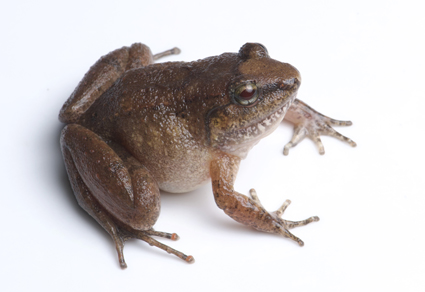
A new species of Limnonectes is described from Namdapha Tiger Reserve, Arunachal Pradesh, northeast India, based on differences in morphological characters and mitochondrial gene 16S rRNA. The genetic divergence of the new species with its congeners of the L. limborgi complex is 2.4–6.8% in the 16S rRNA gene. The new species can be easily differentiated from its congeners by adult snout-vent length range 23.3–35.9 mm, internarial distance greater than inter-upper eyelid width and upper eyelid width, an inverted “V” shaped dermal fold on dorsum, discontinuous dorsolateral folds on dorsum, dark-brown concave line on inter-upper eyelid space. Additionally, the new species exhibits a unique nesting behaviour, constructing mud nest under leaf litter. This study also formally reports L. longchuanensis from India. With the description of this new species and the report of L. longchuanensis, the number of species of the genus currently known from India increases to six.
References
- Ahmed, M.F., Das, A. & Dutta, S.K. (2009) Amphibians and reptiles of Northeast India: A photographic guide. Aaranyak, Guwahati, Assam, 169 pp.
- Benson, D.A., Karsch-Mizrachi, I., Lipman, D.J., Ostell, J. & Wheeler, D.L. (2007) GenBank. Nucleic Acids Research, 35, D21–D25. https://doi.org/10.1093/nar/gkl986
- Boruah, B., Deepak, V., Patel, N.G., Jithin, V., Yomcha, T. & Das, A. (2023) A new species of green tree frog of the genus Gracixalus (Anura: Rhacophoridae) from the evergreen forest of Northeast India. Vertebrate Zoology, 73, 557–574. https://doi.org/10.3897/vz.73.e98444
- Chan, K.O. & Grismer, L.L. (2022) GroupStruct: An R package for allometric size correction. Zootaxa, 5124 (4), 471–482. https://doi.org/10.11646/zootaxa.5124.4.4
- Chen, L., Murphy, R.W., Lathrop, A., Ngo, A., Orlov, N.L., Ho, C.T. & Somorjai, I.L. (2005) Taxonomic chaos in Asian ranid frogs: an initial phylogenetic resolution. The Herpetological Journal, 15 (4), 231–243.
- Decemson, H., Gouda, S., Hmar, G.Z. & Lalremsanga, H.T. (2021) An annotated checklist of amphibians in and around Dampa Tiger Reserve, Mizoram, India. Journal of Threatened Taxa, 13 (3), 17918–17929. https://doi.org/10.11609/jott.6319.13.3.17918-17929
- Deepak, V. & Karanth, P. (2018) Aridification driven diversification of fan-throated lizards from the Indian subcontinent. Molecular Phylogenetics and Evolution, 120, 53–62. https://doi.org/10.1016/j.ympev.2017.11.016
- Dehling, J.M., Neokleous, D.N., Das, I., Grafe, T.U., Min, P.Y. & Hertwig, S.T. (2025) Cryptic radiation within the tadpole-carrying Guardian Frogs from Borneo, Limnonectes palavanensis and L. finchi (Anura: Dicroglossidae), with the description of eight new species. Zootaxa, 5650 (1), 1–80. https://doi.org/10.11646/zootaxa.5650.1.1
- Evans, B.J., Brown, R.M., McGuire, J.A., Supriatna, J., Andayani, N., Diesmos, A., Iskandar, D., Melnick, D.J. & Cannatella, D.C. (2003) Phylogenetics of fanged frogs: testing biogeographical hypotheses at the interface of the Asian and Australian faunal zones. Systematic Biology, 52 (6), 794–819. https://doi.org/10.1080/10635150390251063
- Frost, D.R. (2026) Amphibian Species of the World: an Online Reference. Version 6.2. American Museum of Natural History, New York, New York, Electronic Database. Available from: http://research.amnh.org/herpetology/amphibia/index.html (accessed 8 March 2026)
- Grosjean, S., Ohler, A., Chuaynkern, Y., Cruaud, C. & Hassanin, A. (2015) Improving biodiversity assessment of anuran amphibians using DNA barcoding of tadpoles. Case studies from Southeast Asia. Comptes Rendus. Biologies, 338 (5), 351–361. https://doi.org/10.1016/j.crvi.2015.03.015
- Inger, R.F. & Stuart, B.L. (2010) Systematics of Limnonectes (Taylorana) Dubois. Current Herpetology, 29 (2), 51–68. https://doi.org/10.3105/018.029.0201
- Jiang, J. & Zhou, K. (2001) Evolutionary relationships among Chinese ranid frogs inferred from mitochondrial DNA sequences of 12S rRNA gene. Dong wu xue bao [Acta Zoologica Sinica], 47 (1), 38–44. https://doi.org/10.1142/9789812703576_0001
- Kalyaanamoorthy, S., Minh, B.Q., Wong, T.K., Von Haeseler, A. & Jermiin, L.S. (2017) ModelFinder: fast model selection for accurate phylogenetic estimates. Nature Methods, 14, 587–589. https://doi.org/10.1038/nmeth.4285
- Köhler, J., Jansen, M., Rodríguez, A., Kok, P.J.R., Toledo, L.F., Emmrich, M., Glaw, F., Haddad, C.F.B., Rödel, M.O. & Vences, M. (2017) The use of bioacoustics in anuran taxonomy: Theory, terminology, methods and recommendations for best practice. Zootaxa, 4251 (1), 1–124. https://doi.org/10.11646/zootaxa.4251.1.1
- Köhler, G., Zwitzers, B., Than, N.L., Gupta, D.K., Janke, A., Pauls, S.U. & Thammachoti, P. (2021) Bioacoustics reveal hidden diversity in frogs: Two new species of the genus Limnonectes from Myanmar (Amphibia, Anura, Dicroglossidae). Diversity, 13 (9), 399. https://doi.org/10.3390/d13090399
- Kumar, S., Stecher, G. & Tamura, K. (2016) MEGA7: molecular evolutionary genetics analysisversion 7.0 for bigger datasets. Molecular Biology and Evolution, 33, 1870–1874. https://doi.org/10.1093/molbev/msw054
- Lambertz, M., Hartmann, T., Walsh, S., Geissler, P. & McLeod, D.S. (2014) Anatomy, histology, and systematic implications of the head ornamentation in the males of four species of Limnonectes (Anura: Dicroglossidae). Zoological Journal of the Linnean Society, 172 (1), 117–132. https://doi.org/10.1111/zoj.12171
- Lanfear, R., Calcott, B., Ho, S.Y. & Guindon, S. (2012) PartitionFinder: combined selection of partitioning schemes and substitution models for phylogenetic analyses. Molecular Biology and Evolution, 29, 1695–1701. https://doi.org/10.1093/molbev/mss020
- Lyu, Z.T., Huang, L.S., Wang, J., Li, Y.Q., Chen, H.H., Qi, S. & Wang, Y.Y. (2019a) Description of two cryptic species of the Amolops ricketti group (Anura, Ranidae) from southeastern China. ZooKeys, 812, 133–156. https://doi.org/10.3897/zookeys.812.29956
- Mani, M.S. (1974) Biogeography of the Himalaya. In: Mani, M.S. (Ed.), Ecology and Biogeography in India. W. Junk, The Hague, pp. 664–681. https://doi.org/10.1007/978-94-010-2331-3_21
- Mathew, R. & Sen, N. (2010) Pictorial Guide to Amphibians of North East India. Zoological Survey of India, Kolkata, 144 pp.
- Matsui, M., Nishikawa, K. & Eto, K. (2014) A new burrow-utilising fanged frog from Sarawak, East Malaysia (Anura: Dicroglossidae). Raffles Bulletin of Zoology, 62, 679–687.
- Minh, B.Q., Nguyen, M.A.T. & von Haeseler, A. (2013) Ultrafast approximation for phylogenetic bootstrap. Molecular Biology and Evolution, 30, 1188–1195. https://doi.org/10.1093/molbev/mst024
- Mulcahy, D.G., Lee, J.L., Miller, A.H., Chand, M., Thura, M.K. & Zug, G.R. (2018) Filling the BINs of life: report of an amphibian and reptile survey of the Tanintharyi (Tenasserim) Region of Myanmar, with DNA barcode data. ZooKeys, 757, 85–152. https://doi.org/10.3897/zookeys.757.24453
- Nguyen, L.T., Schmidt, H.A., Von Haeseler, A. & Minh, B.Q. (2015) IQ-TREE: a fast and effective stochastic algorithm for estimating maximum-likelihood phylogenies. Molecular Biology and Evolution, 32, 268–274. https://doi.org/10.1093/molbev/msu300
- Ohler, A. & Nicolas, V. (2017) Which frog’s legs do froggies eat? The use of DNA barcoding for identification of deep frozen frog legs (Dicroglossidae, Amphibia) commercialized in France. European Journal of Taxonomy, 271, 1–19. https://doi.org/10.5852/ejt.2017.271
- Ohler, A., Borah, M.M., Das, M.K., Tesia, C. & Bordoloi, S. (2018) A study on amphibian fauna of Arunachal Pradesh (India). Alytes, 36, 276–288.
- Palumbi, S.R., Martin, A., Romano, S., McMillan, W.O., Stice, L. & Grabowski, G. (2002) The Simple Fool’s Guide to PCR. Department of Zoology and Kewalo Marine Laboratory, Hawaii, 45 pp.
- Pawar, S., Koo, M.S., Kelley, C., Ahmed, M.F., Chaudhuri, S. & Sarkar, S. (2007) Conservation assessment and prioritization of areas in Northeast India: Priorities for amphibians and reptiles. Biological Conservation, 136, 346–361. https://doi.org/10.1016/j.biocon.2006.12.012
- Phimmachak, S., Sivongxay, N., Seateun, S., Yodthong, S., Rujirawan, A., Neang, T., Aowphol, A. & Stuart, B.L. (2018) A new Limnonectes (Anura: Dicroglossidae) from southern Laos. Zootaxa, 4375 (3), 325–340. https://doi.org/10.11646/zootaxa.4375.3.2
- Phimmachak, S., Richards, S.J., Sivongxay, N., Saeteun, S., Chuaynkern, Y., Makchai, S., Som, H.E. & Stuart, B.L. (2019) A caruncle-bearing fanged frog (Limnonectes, Dicroglossidae) from Laos and Thailand. Zookeys, 846, 133–155. https://doi.org/10.3897/zookeys.846.33200
- Poyarkov, N.A., Van Nguyen, T., Popov, E.S., Geissler, P., Pawangkhanant, P., Neang, T., Suwannapoom, C. & Orlov, N.L. (2021) Recent progress in taxonomic studies, biogeographic analysis, and revised checklist of amphibians in Indochina. Russian Journal of Herpetology, 28 (3A), 1–110. https://doi.org/10.30906/1026-2296-2021-28-3A-1-110
- R Core Team (2021) R: A language and environment for statistical computing. R Foundation for Statistical Computing, Vienna. Available from: https://www.R-project.org/ (accessed 17 March 2026)
- Rambaut, A., Drummond, A.J., Xie, D., Baele, G. & Suchard, M.A. (2018) Posterior summarization in Bayesian phylogenetics using Tracer 1.7. Systematic Biology, 67, 901–904. https://doi.org/10.1093/sysbio/syy032
- Ripley, S.D. & Beehler, B.M. (1990) Patterns of speciation in Indian birds. Journal of Biogeography, 17, 639–648. https://doi.org/10.2307/2845145
- Sarkar, A.K. & Sanyal, D.P. (1985) On a collection of amphibians from Namdapha National Park, Tirap district, Arunachal Pradesh. Records of the zoological Survey of India, 82, 285–295.
- Sarkar, A.K. & Ray, S. (2006) Amphibia. In: Alfred J.R.B. (Ed.) Fauna of Arunachal Pradesh, State Fauna Series. Vol. 13. Part 1. Zoological Survey of India, Kolkata, pp. 285–316.
- Suwannapoom, C., Yuan, Z.Y., Chen, Z.M., Hou, M., Zhao, H.P., Wang, L., Nguyen, T.S. & Nguyen, T.Q. (2015) Taxonomic revision of the Chinese Limnonectes (Anura, Dicroglossidae) with the description of a new species from China and Myanmar. Zootaxa, 4093 (2), 181–200. https://doi.org/10.11646/zootaxa.4093.2.2
- Thorpe, R.S. (1975) Quantitative handling of characters useful in snake systematics with particular reference to interspecific variation in the Ringed Snake Natrix natrix (L.). Biological Journal of the Linnean Society, 7, 27–43. https://doi.org/10.1111/j.1095-8312.1975.tb00732.x
- Thorpe, R.S. (1983) Phylogenetic analysis of range expansion in the grass snake: reticulate evolution: primary and secondary contact zones. In: Felsenstein, J. (Ed.) Numerical Taxonomy: Proceedings of a NATO Advanced Study Institute. NATO Advanced Study Institute Series G (Ecological Sciences). No. 1. Springer, Berlin, Heidelberg, pp. 464–468. https://doi.org/10.1007/978-3-642-69024-2_47
- Yodthong, S., Rujirawan, A., Stuart, B.L. & Aowphol, A. (2021) A new Limnonectes (Anura: Dicroglossidae) from southern Thailand. Animals, 11 (2), 566. https://doi.org/10.3390/ani11020566
- Zhang, D., Gao, F., Jakovlić, I., Zou, H., Zhang, J., Li, W.X. & Wang, G.T. (2020) PhyloSuite: An integrated and scalable desktop platform for streamlined molecular sequence data management and evolutionary phylogenetics studies. Molecular Ecology Resources, 20, 348–355. https://doi.org/10.1111/1755-0998.13096