

Abstract
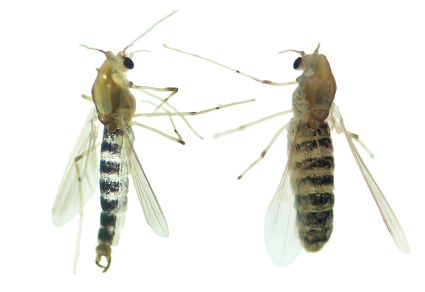
A new species of the genus Xiaomyia Sæther & Wang, 1993 is described and illustrated from West Bengal, India, based on adult males. This represents the first new species of Xiaomyia recorded from India. Diagnostic morphological characters of the adult male, including features of the hypopygium, wing venation, maxillary palps, and antennal ratios, are duly examined and compared with the previously described species. The generic diagnosis is substantially amended to reflect novel morphological characters revealed by the new species, necessitating an update of the criteria used for identification and differentiation within Xiaomyia. The new species X. acuminata sp. nov. differs from the only other member of Xiaomyia primarily by having a long, pointed anal point. Molecular barcoding of the new species is also provided; the species status of Xiaomyia acuminata is strongly supported by an integrative analysis of the molecular data, exhibiting a minimum interspecific Kimura 2-Parameter (K2P) distance of 12.59% from its only nearest congener. Discovery of the new species raises the number of species of this least speciose genus to two worldwide.
References
- Ashe, P. (1983) A catalogue of chironomid genera and subgenera of the world including synonyms (Diptera: Chironomidae). Entomologica Scandinavica Supplement, 17, 1–68.
- Bleidorn, C. & Henze, K. (2021) A new primer pair for barcoding of bees (Hymenoptera: Anthophila) without amplifying the orthologous coxA gene of Wolbachia bacteria. BMC Research Notes, 14, 427. https://doi.org/10.1186/s13104–021–05845–9
- Coffman, W.P., Yurasits, L.A. & de la Rosa, C. (1988) Chironomidae of South India. 1. Generic composition, biogeographical relationships and descriptions of two unusual pupal exuviae (Diptera: Chironomidae). Spixiana Supplement, 14, 155–165.
- Cranston, P.S., Hardy, N.B. & Morse, G.E. (2011) A dated molecular phylogeny for the Chironomidae (Diptera). Systematic Entomology, 37, 172–188. https://doi.org/10.1111/j.1365–3113.2011.00603.x
- Edgar, R.C. (2004) MUSCLE: Multiple sequence alignment with high accuracy and high throughput. Nucleic Acids Research, 32 (5), 1792–1797. https://doi.org/10.1093/nar/gkh340
- Kalyaanamoorthy, S., Minh, B.Q., Wong, T.K.F., von Haeseler, A. & Jermiin, L.S. (2017) ModelFinder: Fast model selection for accurate phylogenetic estimates. Nature Methods, 14, 587–589. https://doi.org/10.1038/nmeth.4285
- Kimura, M. (1980) A simple method for estimating evolutionary rates of base substitutions through comparative studies of nucleotide sequences. Journal of Molecular Evolution, 16 (2), 111–120. https://doi.org/10.1007/BF01731581
- Letunic, I. & Bork, P. (2021) Interactive Tree of Life (iTOL) v5: An online tool for phylogenetic tree display and annotation. Nucleic Acids Research, 49 (W1), W293–W296. https://doi.org/10.1093/nar/gkab301
- Pinho, L.C., Rosa, N.P. & de Campos, L.L.F. (2024) Unveiling the diversity and distribution of non-biting midges (Diptera: Chironomidae) in Brazil through the Taxonomic Catalog of the Brazilian Fauna. Zoologia, (41), e24027. https://doi.org/10.1590/S1984-4689.v41.e24027
- Pramual, P., Simwisat, K. & Martin, J. (2016) Identification and reassessment of the specific status of some tropical freshwater midges (Diptera: Chironomidae) using DNA barcode data. Zootaxa, 4072 (1), 39–60. https://doi.org/10.11646/zootaxa.4072.1.2
- Puillandre, N., Lambert, A., Brouillet, S. & Achaz, G. (2012) ABGD, Automatic Barcode Gap Discovery for primary species delimitation. Molecular Ecology, 21 (8), 1864–1877. https://doi.org/10.1111/j.1365-294X.2011.05239.x
- Puillandre, N., Brouillet, S. & Achaz, G. (2021) ASAP: Assemble species by automatic partitioning. Molecular Ecology Resources, 21, 609–620. https://doi.org/10.1111/1755-0998.13281
- Rambaut, A. (2018) FigTree. Version 1.4.4. Institute of Evolutionary Biology, University of Edinburgh, Edinburgh. Available from: https://github.com/rambaut/figtree/releases (accessed 13 January 2026)
- Ronquist, F., Teslenko, M., Mark, P., Ayres, D.L., Darling, A., Höhna, S., Larget, B., Liu, L., Suchard, M.A. & Huelsenbeck, J.P. (2012) MrBayes 3.2: Efficient Bayesian Phylogenetic Inference and Model Choice Across a Large Model Space. Systematic Biology, 61 (3), 539–542. https://doi.org/10.1093/sysbio/sys029
- Sæther, O.A. & Wang, X. (1993) Xiaomyia, new genus, Shangomyia, new genus and Zhouomyia, new genus, three new and unusual genera of Chironomini from Oriental China (Diptera: Chironomidae). Entomologica Scandinavica, 24, 185–195. https://doi.org/10.1163/187631293X00280
- Sæther, O.A. (1980) Glossary of chironomid morphology terminology (Diptera: Chironomidae). Entomologica Scandinavica Supplement, 14, 1–51.
- Saitou, N. & Nei, M. (1987) The neighbor-joining method: A new method for reconstructing phylogenetic trees. Molecular Biology and Evolution, 4 (4), 406–425.
- Tamura, K., Stecher, G. & Kumar, S. (2021) MEGA 11: Molecular Evolutionary Genetics Analysis Version 11. Molecular Biology and Evolution, 38 (7), 3022–3027. https://doi.org/10.1093/molbev/msab120
- Tang, H. & Cranston, P.S. (2019) A new tribe in the Chironominae (Diptera: Chironomidae) validated by first immature stages of Xiaomyia Sæther & Wang and a phylogenetic review. The Raffles Bulletin of Zoology, 67, 684–693. https://doi.org/10.26107/RBZ-2019-0049
- Wirth, W.W. & Marston, N. (1968) A method for mounting small insect on microscope slides in Canada balsam. Annals of the Entomological Society of America, 61, 783–784. https://doi.org/10.1093/aesa/61.3.783
- Zhang, D., Gao, F., Jakovlić, I., Zou, H., Zhang, J., Li, W.X. & Wang, G.T. (2020) PhyloSuite: An integrated and scalable desktop platform for streamlined molecular sequence data management and evolutionary phylogenetics studies. Molecular Ecology Resources, 20 (1), 348–355. https://doi.org/10.1111/1755-0998.13096