
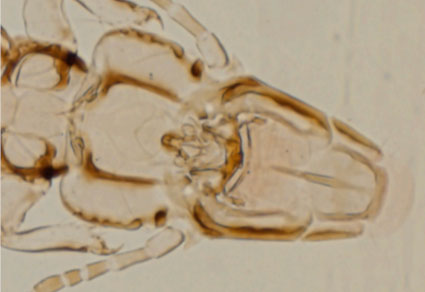

Abstract
The genus Turnicola Clay & Meinertzhagen, 1938a is redescribed and illustrated in detail for the first time, together with specimens here regarded as the type species of this genus, Lipeurus angustissimus Giebel, 1866. As the type series of this species has been lost, we here designate a neotype for L. angustissimus from specimens collected from the type host in Guangdong, China. Specimens from two different host species have the same COI genotype, indicating that Turnicola angustissimus is more widely distributed than previously thought. Differences in the louse prevalences between the two host species suggest that some, yet unknown, ecological factors may impact their louse communities.
References
- Ansari, M.A.R. (1947) Mallophaga (Ischnocera) infesting birds in the Punjab (India). Proceedings of the National Institute of Science, India, 13, 253–303.
- Bedford, G.A.H. (1931) New genera and species of Mallophaga. Report of the Director of Veterinary Services and Animal Industry, Union of South Africa, 17, 283–297.
- Clay, T. (1936) Two new genera of Mallophaga. Proceedings of the Zoological Society of London, 4, 615–618. https://doi.org/10.1111/j.1096-3642.1935.tb01684.x
- Clay, T. (1949) Species of the genus Saemundssonia (Mallophaga) from the Sterninae. American Museum Novitates, 1409, 1–25.
- Clay, T. & Meinertzhagen, R. (1938a) New genera and species of Mallophaga. The Entomologist, 71, 275–279.
- Clay, T. & Meinertzhagen, R. (1938b) Two new genera of Mallophaga. The Entomologist, 81, 73–76.
- Clements, J.F., Rasmussen, P.C., Schulenberg, T.S., Iliff, M.J., Fredericks, T.A., Gerbracht, J.A., Lepage, D., Spencer, A., Billerman, S.M., Sullivan B.L., Smith, M. & Wood, C.L. (2024) The eBird/Clements checklist of Birds of the World. Version 2024. Available from: https://www.birds.cornell.edu/clementschecklist/download/ (accessed 22 September 2025)
- Conci, C. (1941) Nuovi generi di mallofagi (Nota preliminare). Bollettino della Societa Entomologica Italiana, 73, 126–127.
- Dalgleish, R.C. (1967) Two new species of Penenirmus (Mallophaga: Ischnocera) from Asian barbets (Piciformes: Capitonidae). The Canadian Entomologist, 99, 604–606. https://doi.org/10.4093/ent99604-6
- Eichler, W. (1940) Wirtspezifität und stammesgeschichtliche Gleichläufigkeit (Fahrenholzsche Regeln) bei Parasiten im allgemein und bei Mallophagen in besonderen. Zoologischer Anzeiger, 31, 254–262.
- Eichler, W. (1941) Zur Klassifikation der Lausekerfe (Phthiraptera Haeckel: Rhynchophthirina, Mallophaga und Anoplura). Archiv für Naturgeschichte, Neue Folge, 10, 345–398.
- Eichler, W. (1963) Fünfter Band: Arthropoda. III. Abteilung: Insecta. 7. Buch. b) Phthiraptera. 1. Mallophaga. In: Bronns, H.G. (Ed.), Klassen und Ordnungen des Tierreichs. Akademische Verlagsgesellschaft Geest & Portig K.-G., Leipzig, pp. i–vii + 1–291.
- Giebel, C.G. (1866) Die im zoologischen Museum der Universität Halle aufgestellten Epizoen nebst Beobachtungen über dieselben. Mallophaga. Zeitschrift für die Gesammten Naturwissenschaften, Halle, 28, 356–397.
- Giebel, C.G. (1874) Insecta epizoa. Die auf Säugetieren und Vögeln schmarotzenden Insecten nach Chr. L. Nitzsch’s Nachlass bearbeitet. Otto Wigand, Leipzig, xiv + 308 pp., 20 pls. https://doi.org/10.5962/bhl.title.66072
- Grossi, A.A., Lee, M.-B., Tian, C., Zou, F., Choi, C.-Y. & Gustafsson, D.R. (2023) Host migration and size do not influence the prevalence of most chewing lice (Phthiraptera: Amblycera and Ischnocera) on shorebirds (Aves: Charadriiformes) across the world. Diversity, 15 (200), 1–19. https://doi.org/10.3390/d15020200
- Grossi, A.A., Tian, C., Lei, L., Zou, F. & Gustafsson, D.R. (2024) Cospeciation patterns of two groups of chewing lice (Insecta: Ischnocera and Amblycera) infesting Asian songbirds (Aves: Passeriformes). Journal of Parasitology, 110, 649–665. https://doi.org/10.1645/24-87
- Gustafsson, D.R., Lei, L., Luo, K., Chu, X., Zhao, X., Zhang, Q. & Zou, F. (2019) Chewing lice from high-altitude and migrating birds in Yunnan, China, with descriptions of two new species of Guimaraesiella. Medical and Veterinary Entomology 33, 407–419. https://doi.org/10.1111/mve.12378
- Gustafsson, D.R. & Najer, T. (2022) Fahrenholz’s rule is not a valid methodology for determining species limits in chewing lice (Psocodea, Phthiraptera). Bionomina, 29 (1), 1–73. https://doi.org/10.11646/bionomina.29.1.1
- Gustafsson, D.R., Adam, C. & Zou, F. (2022) One new genus and three new species of the Penenirmus-complex (Phthiraptera: Ischnocera) from China, with resurrection of Picophilopterus Ansari, 1947. Zootaxa, 5087 (3), 401–426. https://doi.org/10.11646/zootaxa.5087.3.1
- Gustafsson, D.R., Zou, F., Li, Z. & Sun, X. (2024) Checklist of the Ischnocera (Phthiraptera) of China. EDP Sciences, Les Ulis, 1150 pp.
- Haeckel, E. (1896) Systematische Phylogenie. 2. Theil. Systematische Phylogenie der wirbellosen Thiere (Invertebrata). Verlag von Georg Reimer, Berlin, 720 pp. https://doi.org/10.1515/9783111443935
- Hafner, M.S., Sudman, P.D., Villablanca, F.X., Spradling, T.A., Demastes, J.W. & Nadler, S.A. (1994) Disparate rates of molecular evolution in cospeciating hosts and parasites. Science, 265, 1087–1090. https://doi.org/10.1126/science.8066445
- Harrison, L. (1916) The genera and species of Mallophaga. Parasitology, 9, 1–156. https://doi.org/10.1017/S0031182000005989
- Hermann, J.-F. (1804) Mémoire Aptérologique, publié par Frederic-Louis Hammer. F.G. Levrault, Strasbourg, 144 pp., 9 pls. https://doi.org/10.5962/bhl.title.137910
- Hopkins, G.H.E. & Clay, T. (1952) A check list of the genera & species of Mallophaga. Trustees of the British Museum, London, 362 pp. https://doi.org/10.5962/bhl.title.118844
- Johnson, K.P., Shreve, S.M. & Smith, V.S. (2012) Repeated adaptive divergence of microhabitat specialization in avian feather lice. BMC Biology, 10 (52), 1–11. https://doi.org/10.1186/1741-7007-10-52
- Johnson, K.O., Weckstein, J.D., Virrueta Herrera, S. & Doña, J. (2021) The interplay between host biogeography and phylogeny in structuring diversification of the feather louse genus Penenirmus. Molecular Phylogenetics and Evolution, 164 (107297), 1–12 pp. https://doi.org/10.1016/j.ympev.2021.107297
- Kellogg, V.L. (1896) New Mallophaga, I,— with special reference to a collection made from maritime birds of the Bay of Monterey, California. Proceedings of the California Academy of Sciences, Series 2, 6, 31–168, 14 pls.
- Kettle, P.R. (1981) The phylogenetic relationship within the Galliformes indicated by their lice (Insecta: Phthiraptera). Notornis, 28, 161–167. https://doi.org/10.63172/492674kbchyl
- Kumar, S., Stecher, G. & Tamura, K. (2021) MEGA11: Molecular Evolutionary Genetics Analysis version 11. Molecular Biology and Evolution, 38, 3022–3027. https://doi.org/10.1093/molbev/msab120
- Ledger J.A. (1980) The arthropod parasites of vertebrates in Africa south of the Sahara. Volume IV. Phthiraptera (Insecta). Publications of the South African Institute for Medical Research, 56, 1–327.
- Madge, S. & McGowan, P. (2002) Pheasants, partridges & grouse. Including buttonquail, sandgrouse and allies. Christopher Helm, London, 488 pp.
- Mey, E. (1992) Über einen Grauspecht-Federling aus dem Thüringen Wald und seine systematische Zugehörigkeit. Entomologische Nachrichten und Berichte, 36, 47–53.
- Nitzsch, C.L. (1818) Die Familien und Gattungen der Thierinsekten (insecta epizoica); als Prodromus einer Naturgischechte derselben. Magazin der Entomologie, 3, 261–316.
- Palma, R.L. (1978) Slide-mounting of lice: a detailed description of the Canada Balsam technique. The New Zealand Entomologist, 6, 432–436. https://doi.org/10.1080/00779962.1978.9722313
- Palma, R.L. & Pilgrim, R.L.C. (1984) A revision of the genus Harrisoniella (Mallophaga: Philopteridae). New Zealand Journal of Zoology, 11 (2), 145–166. https://doi.org/10.1080/03014223.1984.10423754
- Piaget, E. (1880) Les Pédiculines. Essai Monographique. E.J. Brill, Leiden, xxxix + 714 pp., 56 pls. https://doi.org/10.1163/9789004588097
- Piaget, E. (1885) Les Pédiculines. Essai Monographique. Supplement. E.J. Brill, Leiden, xvi + 200 pp., 17 pls. https://doi.org/10.1163/9789004584426
- Piaget, E. (1890) Quelques pediculines nouvelles. Tijdschrift voor Entomologie, 33, 223–259.
- Price, R.D., Hellenthal, R.A., Palma, R.L., Johnson, K.P. & Clayton, D.H. (2003) The chewing lice: world checklist and biological overview. Illinois Natural History Survey Special Publication 24. Illinois Natural History Survey, Champaign, Illinois, x + 501 pp.
- Rambaut, A. (2018) FigTree. Version 1.4.4. Institute of Evolutionary Biology, University of Edinburgh, Edinburgh. Available from: https://tree.bio.ed.ac.uk/software/figtree/ (accessed 22 September 2025)
- Suchard, M.A., Lemey, P., Baele, G., Ayres, D.L., Drummond, A.J. & Rambaut, A. (2018) Bayesian phylogenetic and phylodynamic data integration using BEAST 1.10. Virus Evolution, 4, vey016. https://doi.org/10.1093/ve/vey016
- Sychra, O., Literak, I., Podzemny, P., Harmat, P. & Hrabak, R. (2011) Insect ectoparasites on wild birds in the Czech Republic during the pre-breeding period. Parasite, 18, 13–19. https://doi.org/10.1051/parasite/2011181013