

Abstract
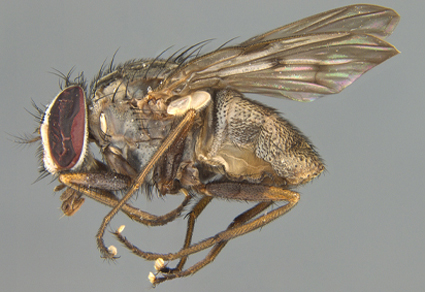
Cariocamyia Snyder, 1951 is a Neotropical genus of Cyrtoneurininae (Diptera: Muscidae) with two known species from Brazil and Colombia. Here, we redescribe both Cariocamyia species, including the first male description of Cariocamyia vibrissata (Stein, 1918), as well as images of the male and female habitus, images of the holotype habitus, and drawings of the male and female terminalia. Additionally, we present an updated distributional map and an identification key, and provide a brief discussion of the morphology of both species.
References
- Albuquerque, D.de O. (1955) Fauna do Distrito Federal. XVII – Descrição do alotipo fêmea de Cariocamyia Snyder, 1951 e notas sôbre o macho (Diptera-Muscidae). Dusenia, 6, 41–46.
- Carbonó-Delahoz, E. & Garcia-Q, H. (2010) La vegetación terrestre en la ensenada de Neguanje, Parque Nacional Natural Tayrona (Magdalena, Colombia). Caldasia, 32, 235–256.
- Costacurta, N.do C., Marinoni, R.C. & de Carvalho, C.J.B. (2003) Fauna de Muscidae (Diptera) em três localidades do Estado do Paraná, Brasil, capturada por armadilha Malaise. Revista Brasileira de Entomologia, 47, 389–397. https://doi.org/10.1590/S0085-56262003000300005
- Couri, M.S. & de Carvalho, C.J.B. (2002) Part II. Apical groups. In: de Carvalho, C.J.B. (Ed.), Muscidae (Diptera) of the Neotropical Region: taxonomy. Editora Universidade Federal do Paraná, Curitiba, pp. 133–262.
- Cumming, J.M. (1992) Lactic acid as an agent for macerating Diptera specimens. Fly Times, 8, 7.
- Cumming, J.M. & Wood, D.M. (2017) 3. Adult morphology and terminology. In: Kirk-Spriggs, A.H. & Sinclair, B.J. (Eds.), Manual of Afrotropical Diptera. Vol. 1. Introductory chapters and keys to Diptera families. South African National Biodiversity Institute, Pretoria, pp. 89–133.
- d’Almeida, J.M. (1994) Ovipositional substrates used by calyptrate Diptera in Tijuca Forest, Rio de Janeiro. Memórias do Instituto Oswaldo Cruz, Rio de Janeiro, 89, 261–264. https://doi.org/10.1590/S0074-02761994000200027
- de Carvalho, C.J.B., Couri, M.S., Pont, A.C., Pamplona, D. & Lopes, S.M. (1993) Part II. Muscidae. In: de Carvalho, C.J.B. (Ed.), A catalogue of the Fanniidae and Muscidae (Diptera) of the Neotropical region. Sociedade Brasileira de Entomologia, São Paulo, 201 pp.
- de Carvalho, C.J.B., Couri, M.S., Pont, A.C., Pamplona, D. & Lopes, S.M. (2005) A catalogue of the Muscidae (Diptera) of the Neotropical Region. Zootaxa, 860 (1), 1–282. https://doi.org/10.11646/zootaxa.860.1.1
- Haseyama, K.L.F. & de Carvalho, C.J.B. (2012) Taxonomy and phylogeny of the Neotropical genus Charadrella Wulp (Diptera, Muscidae). Invertebrate Systematics, 26, 339–416. https://doi.org/10.1071/IS12037
- Haseyama, K.L.F., Wiegmann, B.M., Almeida, E.A.B. & de Carvalho, C.J.B. (2015) Say goodbye to tribes in the new house fly classification: a new molecular phylogenetic analysis and an updated biogeographical narrative for the Muscidae (Diptera). Molecular Phylogenetics and Evolution, 89, 1–12. https://doi.org/10.1016/j.ympev.2015.04.006
- Hennig, W. (1965) Vorarbeiten zu einem phylogenetischen System der Muscidae (Diptera: Cyclorrhapha). Stuttgarter Beiträge zur Naturkunde, 141, 1–100.
- Kutty, S.N., Pont, A.C., Meier, R. & Pape, T. (2014) Complete tribal sampling reveals basal split in Muscidae (Diptera), confirms saprophagy as ancestral feeding mode, and reveals an evolutionary correlation between instar numbers and carnivory. Molecular Phylogenetics and Evolution, 78, 349–364. https://doi.org/10.1016/j.ympev.2014.05.027
- Lopes, S.M. & Couri, M.S. (1989) Key to the identification of Neotropical genera of Cyrtoneurininae (Diptera, Muscidae). Boletim do Museu Nacional, Nova Série, Zoologia, 332, 1–6.
- Löwenberg-Neto, P. & de Carvalho, C.J.B. (2013) Muscidae (Insecta: Diptera) of Latin America and the Caribbean: geographic distribution and check-list by country. Zootaxa, 3650 (1), 1–147. https://doi.org/10.11646/zootaxa.3650.1.1
- Mendes, J. & Linhares, A.X. (1993) Atratividade por iscas, sazonalidade e desenvolvimento ovariano em várias espécies de Muscidae (Diptera). Revista Brasileira de Entomologia, 37, 289–297.
- Monteiro, T.d’A. & Bravo, F.R. (2011) Diptera, Muscidae, Cariocamyia maculosa Snyder: Primeiro registro para o nordeste do Brasil. EntomoBrasilis, 4, 154–156. https://doi.org/10.12741/ebrasilis.v4i3.176
- Pérez, S. & de Carvalho, C.J.B. (2016) Family Muscidae. Zootaxa, 4122 (1), 814–853. https://doi.org/10.11646/zootaxa.4122.1.70
- Pizano, C., Cabrera, M. & García, H. (2014) El bosque seco tropical en Colombia I. Generalidades del bosque seco. In: Pizano, C. & García, H. (Eds.), El bosque seco tropical en Colombia. Instituto de Investigación de Recursos Biológicos Alexander Von Humboldt, Bogotá, pp. 37–46.
- Pont, A.C. (1969) Studies on Australian Muscidae (Diptera). III. A revision of the genera with a facial carina. Australian Journal of Zoology, 17, 919–960. https://doi.org/10.1071/ZO9690919
- Pont, A.C. (1972) Family Muscidae. In: Papavero, N. (Ed.), A Catalogue of the Diptera of the Americas South of the United States. Vol. 97. Museu de Zoologia, Universidade de São Paulo, São Paulo, 111 pp.
- Rodríguez, G.M., Banda-R, K., Reyes, B.S.P. & Estupiñán González, A.C. (2012) Lista comentada de las plantas vasculares de bosques secos prioritarios para la conservación en los departamentos de Atlántico y Bolívar (Caribe colombiano). Biota Colombiana, 13, 7–39.
- Séguy, E. (1937) Diptera Fam. Muscidae. In: Wytsman, P. (Ed.), Genera Insectorum. Desmet-Verteneuil, Brussels, pp. 205–604.
- Shorthouse, D.P. (2010) SimpleMappr, a web-enabled tool to produce publication-quality point maps [online]. Available from: http://www.simplemappr.net (accessed 16 April 2025)
- Snyder, F.M. (1951) New Neotropical Muscidae (Diptera). American Museum Novitates, 1494, 1–11.
- Stein, P. (1918) Zur weiteren Kenntnis aussereuropäischer Anthomyiden. Annales Historico-Naturales Musei Nationalis Hungarici, 16, 147–244.
- Stein, P. (1919) Die Anthomyidengattungen der Welt, analytisch bearbeitet, nebst einem kritisch-systematischen Verzeichnis aller aussereuropäischen Arten. Archiv für Naturgeschichte, 83, 85–178.
- Vockeroth, J.R. (1972) A review of the world genera of Mydaeinae, with a revision of the species of New Guinea and Oceania (Diptera: Muscidae). Pacific Insects Monographs, 29, 1–134.
- Wulp, F.M. van der (1896) Group Anthomyiinae. [Part.] In: Godman, F.D. & Salvin, O. (Eds.), Biologia Centrali-Americana. Zoologia-Insecta-Diptera. Vol. 2. Part 132. Taylor & Francis, London, pp. 321–344.