

Abstract
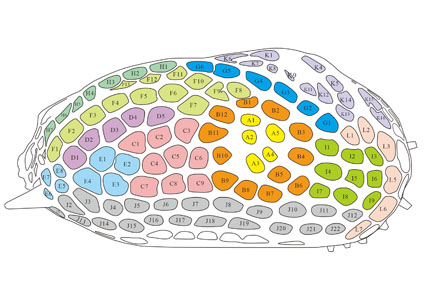
The Bicornucythere bisanensis complex is a species group of trachyleberidid Ostracoda found in shallow-sea sediments along the margin of the East China Sea, which contains three members, namely Bicornucythere bisanensis, B. misumiensis, and Form G. In this study, we analyzed the ontogenetic changes in carapace morphology of B. bisanensis and Form G from the East China Sea and compared them with the specimens of the B. bisanensis complex from the South Yellow Sea, the Leizhou Peninsula, and those in the published literatures, in order to reveal the similarities and differences between the three members. Our results indicate that Form G resembles the young instars of B. bisanensis in carapace size, shape and the fossae arrangement pattern (FAP) on the carapace surface. Our results also show significant differences between Form G and the other two members; B. bisanensis and B. misumiensis share a relatively large carapace size (L=0.66–0.95 mm), a sub-rectangular lateral outline and the same FAP, whilst Form G has a small, sub-triangular carapace (L=0.51–0.66 mm) and a FAP with nine fewer fossae. We concluded that the sub-triangular carapace outline and the peculiar FAP in Form G are species-specific, and we described Form G as a new species, Bicornucythere zhaoi sp. nov.
A few individuals with small, sub-triangular valves and an intermediate type of FAP between B. bisanensis and B. zhaoi sp. nov., which were tentatively named Bicornucythere aff. zhaoi, were discovered from the Pliocene Leizhou Peninsula where it co-occurred with B. bisanensis. Their occurrence may suggest that the latecomer B. zhaoi sp. nov., which does not appear until late Pleistocene, is descended from B. bisanensis by paedomorphosis.
References
- Abe, K. (1983) Population structure of Keijella bisanensis (Okubo) (Ostracoda, Crustacea) - An inquiry into how far the population structure will be preserved in the fossil record. Journal of the Faculty of Science, University of Tokyo, Section II, 20 (5), 443–488.
- Abe, K. (1988) Speciation completed? in Keijella bisanensis species group. In: Hanai, T., Ikeya, N. & Ishizaki, K. (Eds.), Evolutionary Biology of Ostracoda, Its Fundamentals and Applications. Kodansha-Elsevier, Tokyo, pp. 919–925. https://doi.org/10.1016/S0920-5446(08)70229-2
- Abe, K. & Choe, K. (1988) Variation of Pistocythereis and Keijella species in Gamagyang Bay, south coast of Korea. In: Hanai, T., Ikeya, N. & Ishizaki, K. (Eds.), Evolutionary Biology of Ostracoda, Its Fundamentals and Applications. Kodansha-Elsevier, Tokyo, pp. 367–373. https://doi.org/10.1016/S0920-5446(08)70195-X
- Al-Furaih, A.A.F. (1977) Cretaceous and Paleocene species of the ostracod Hornibrookella from Saudi Arabia. Paleontology, 20 (3), 483–502.
- Baird, W. (1850) 2. Description of a new crustacean. Proceedings of the Zoological Society of London, Pt. 18, 102, pl. 1.
- Benson, R.H. (1972) The Bradleya problem, with descriptions of two new psychrospheric ostracode genera, Agrenocythere and Poseidonamicus (Ostracoda: Crustacea). Smithsonian Contributions to Paleobiology, Number 12, 1–138. https://doi.org/10.5479/si.00810266.12.1
- Benson, R.H. (1975) Morphologic stability in Ostracoda. In: Swain, F.M. (Ed.), Biology and Paleobiology of Ostracoda. Bulletins of American Paleontology, 65 (282), pp. 13–46.
- Benson, R.H. (1976) The evolution of the ostracode Costa analyzed by “Theta-Rho Difference”. Abhandlungen und Verhandlungen des Naturwissenschaftichen Vereins in Hamburg, 18/19 (Supplement), 127–139.
- Benson, R.H. (1977) Evolution of Oblitacythereis from Paleocosta (Ostracoda: Trachyleberididae) during the Cenozoic in the Mediterranean and Atlantic. Smithsonian Contributions to Paleobiology, Number 33, 1–47. https://doi.org/10.5479/si.00810266.33.1
- Benson, R.H. (1982) Comparative transformation of shape in a rapidly evolving series of structural morphotypes of the ostracode Bradleya. In: Bate, R.H., Robinson, E. & Sheppard, L.M. (Eds.), Fossil and Recent Ostracoda. Ellis Horwood Ltd., Chichester, pp. 147–164.
- Benson, R.H. (1983) Biomechanical stability and sudden change in the evolution of the deep-sea ostracode Poseidonamicus. Paleobiology, 9 (4), 398–413. https://doi.org/10.1017/S0094837300007867
- Brady, G.S. (1866) On new or imperfectly known species of marine Ostracoda. The Transactions of the Zoological Society of London, 5, 359–393. https://doi.org/10.1111/j.1096-3642.1866.tb00649.x
- Danielopol, D.L., Geige, W., Tӧlderer-Farmer, M., Orellana, C.P. & Terrat, M.-N. (1988) In search of Cypris and Cythere: a report of the evolutionary ecological project on limnic Ostracoda from the Mondsee (Austria). In: Hanai, T., Ikeya, N. & Ishizaki, K. (Eds.), Evolutionary Biology of Ostracoda, Its Fundamentals and Applications. Kodansha-Elsevier, Tokyo, pp. 485–500. https://doi.org/10.1016/S0920-5446(08)70203-6
- Denoël, M. & Joly, P. (2001) Adaptive significance of facultative paedomorphosis in Triturus alpestris (Amphibia, Caudata): resource partitioning in an Alpine lake. Freshwater Biology, 46, 1387–1396. https://doi.org/10.1046/j.1365-2427.2001.00762.x
- Forel, M.-B. (2015) Heterochronic growth of ostracods (Crustacea) from microbial deposits in the aftermath of the end-Permian extinction. Journal of Systematic Palaeontology, 13 (4), 315–349. https://doi.org/10.1080/14772019.2014.902400
- Gou, Y.X., Zheng, S.Y. & Huang, B.R. (1983) Pliocene ostracode fauna of Leizhou Peninsula and northern Hainan Island, Guangdong Province. Palaeontologica Sinica, 162 (B18), 1–134, 23 pls. [in Chinese with English abstract]
- Hanai, T. (1970) Studies on the ostracod Subfamily Schizocytherinae Mandelstam. Journal of Paleontology, 44 (4), 693–729.
- Hanai, T. & Ikeya, N. (1991) Two new genera from the Omma-Manganji ostracode fauna (Plio-Pleistocene) of Japan - with a discussion of theoretical versus purely descriptive ostracode nomenclature. Transactions and Proceedings of the Palaeontological Society of Japan, New Series, 163, 861–878.
- Hong, Y., Yasuhara, M., Iwatani, H., Seto, K., Yokoyama, Y., Yoshioka, K. & Mamo, B. (2017) Freshwater reservoir construction by damming a marine inlet in Hong Kong: Paleoecological evidence of local community change. Marine Micropaleontology, 132, 53–59. https://doi.org/10.1016/j.marmicro.2017.04.003
- Hong, Y., Yasuhara, M., Iwatani, H. & Mamo, B. (2019) Baseline for ostracod-base northwestern Pacific and Indo-Pacific shallow-marine paleoenvironmental reconstructions: ecological modeling of species distributions. Biogeosciences, 16, 585–604. https://doi.org/10.5194/bg-16-585-2019
- Hou, Y., Chen, D., Yang, H., He, J., Zhou, Q. & Tian, M. (1982) Cretaceous-Quaternary Ostracode Fauna from Jiangsu. Geological Publishing House, Beijing, 386 pp. [in Chinese with English summary]
- Huang, B. (1985) Ostracoda from the column sample under surface deposit on the bottom of north Bohai Sea. Journal of Oceanography of Huanghai & Bohai Seas, 3 (4), 42–53. [in Chinese with English abstract]
- Hunt, G. (2007) Morphology, ontogeny, and phylogenetics of the genus Poseidonamicus (Ostracoda: Thaerocytherinae). Journal of Paleontology, 81 (4), 607–631. https://doi.org/10.1666/pleo0022-3360(2007)081[0607:MOAPOT]2.0.CO;2
- Irizuki, T. (1993) Morphology and taxonomy of some Japanese hemicytherin Ostracoda - with particular reference to ontogenetic changes of marginal pores. Transactions and Proceedings of the Palaeontological Society of Japan, New Series, 170, 186–211.
- Irizuki, T. (1994) Quantitative analysis of ontogenetic changes of cell-reflecting sculptures in Ostracoda (Crustacea). Journal of Paleontology, 68, 1067–1073. https://doi.org/10.1017/S0022336000026664
- Irizuki, T. (1996) Ontogenetic change in valve characters in three new species of Baffinicythere (Ostracoda, Crustacea) from northern Japan. Journal of Paleontology, 70 (3), 450–462. https://doi.org/10.1017/S0022336000038385
- Irizuki, T. & Seto, K. (2004) Temporal and spatial variations of paleoenvironments of Paleo-Hamana Bay, central Japan, during the Middle Pleistocene - Analyses of fossil ostracode assemblages, and total organic carbon, total nitrogen and total sulfur content. Journal of the Geological Society of Japan, 110 (5), 309–324. [in Japanese with English abstract] https://doi.org/10.5575/geosoc.110.309
- Irizuki, T., Seto, K. & Nomura, R. (2008) The impact of fish farming and bank construction on Ostracoda in Uranouchi Bay on the Pacific coast of southwest Japan - Faunal changes between 1954 and 2002/2005. Paleontological Research, 12 (3), 283–302. https://doi.org/10.2517/1342-8144-12.3.283
- Irizuki, T., Gotomyo, A., Kawano, S., Yoshioka, K. & Nomura, R. (2009a) Relationships between Recent ostracode assemblage and environmental factors in the northern part of Harima-nada Bay off Aioi City, Hyogo Prefecture, Southwest Japan. Geoscience Reports of Shimane University, 28, 1–9. [in Japanese with English abstract]
- Irizuki, T., Taru, H., Taguchi, K. & Matsushima, Y. (2009b) Paleobiogeographical implications of inner bay Ostracoda during the late Pleistocene Shimosueyoshi transgression, central Japan, with significance of its migration and disappearance in eastern Asia. Palaeogeography, Palaeoclimatology, Palaeoecology, 271, 361–328. https://doi.org/10.1016/j.palaeo.2008.11.002
- Irizuki, T., Ito, H., Yoshioka, K., Kawano, S., Nomura, R., Tanaka, Y. & Sako, M. (2010) Recent ostracode assemblages and the marine environment around Kasado Bay in northeastern Suo-Nada Bay, Yamaguchi Prefecture, Southwest Japan. Geoscience Reports of Shimane University, 29, 11–20. [in Japanese with English abstract]
- Irizuki, T., Takahashi, J., Seto, K., Ishiga, H., Fujihara, Y. & Kawano, S. (2022) Response of bay ostracod assemblages to Late Holocene sea-level, centennial-scale climate, and human-induced factors in northeast Beppu Bay, Japan. Marine Micropaleontology, 174, 102002. https://doi.org/10.1016/j.marmicro.2021.102002
- Ishida, K. & Takayasu, K. (2005) Ostracode assemblages of alluvium sediment cores in the western part of Izumo Plain, Shimane Prefecture. Laguna, 12, 73–79. [in Japanese with English abstract]
- Ishizaki, K. (1971) Ostracodes from Aomori Bay, Aomori Prefecture, Northeast Honshu, Japan. The Science Reports of the Tohoku University, Series 2, Geology, 43 (1), 59–97.
- Ishizaki, K. (1983) Ostracoda from the Pliocene Ananai Formation, Shikoku, Japan—description. Transactions and Proceedings of Palaeontological Society of Japan, New Series, 131, 135–158.
- Ishizaki, K. (1990) Sea level change in mid-Pleistocene time and effects on Japanese ostracode faunas. Bulletin of Marine Science, 47 (1), 213–220.
- Ishizaki, K., Irizuki, T. & Sasaki, O. (1993) Cobb Mountain spike of the Kuroshio Current detected by Ostracoda in the lower Omma Formation (Early Pleistocene), Kanazawa City, central Japan: analysis of depositional environments. In: McKenzie, K.G. & Jones, P.J. (Eds.), Ostracoda in the Earth and Life Sciences - Proceedings of the 11th International Symposium on Ostracoda. A.A. Balkema, Rotterdam, pp. 315–334.
- Kamiya, T. (1992) Heterochronic dimorphism of Loxoconcha uranouchiensis (Ostracoda) and its implication for speciation. Paleobiology, 18 (2), 221–236. https://doi.org/10.1017/S0094837300013981
- Kawano, S., Tsujimoto, A., Ugai, H., Irizuki, T. & Nomura, R. (2011) Paleoenvironment and microfossil assemblages in the Pleistocene Ogushi Formation, Kumamoto Prefecture, Southwest Japan. Journal of Fossil Research, 44 (1), 1–10. [in Japanese with English abstract]
- Kawano, S., Irizuki, T. & Nomura, R. (2013) Temporal changes of recent ostracode assemblages and bay environment with relation to the opening and extension of the Manzeki-seto Strait in the Tsushima Island, southwest Japan. Earth Science [Chikyu Kagaku], 67, 89–99. [in Japanese with English abstract]
- Liebau, A. (1969) Homologisierende Korrelationen von Trachyleberididen-Oramenten (Ostracoda, Cytheracea). Neues Jahrbuch für Geologie und Paläontologie, 7, 390–402. [in German with English summary]
- Liebau, A. (1971) Homologous Sculpture Patterns in Trachyleberididae and Related Ostracodes. Nolit Publishing House, Belgrade, 93 pp.
- Liebau, A. (1975) The left-right variation of the ostracode ornament. Bulletins of American Paleontology, 65 (282), 77–86.
- Liebau, A. (1977) Carapace ornamentation of the Ostracoda Cytheracea: Principles of evolution and functional significance. In: Loffler, H. & Danielopol, D. (Eds.), Aspects of Ecology and Zoogeography of Recent and Fossil Ostracoda. Dr. W. Junk Publishers, The Hague, pp. 107–120.
- Liebau, A. (1991) Skulptur-Evolution bei Ostrakoden am Beispiel europäischer “Quadracytheren.” Geologie und Paläontologie in Westfalen, 13, 1–395. [in German with English abstract]
- Liu, J., Liu, Q., Zhang, X., Liu, J., Wu, Z., Mei, X., Shi, X. & Zhao, Q. (2016) Magnetostratigraphy of a long Quaternary sediment core in the South Yellow Sea. Quaternary Science Reviews, 144, 1–15. https://doi.org/10.1016/j.quascirev.2016.05.025
- Müller, G.W. (1894) Die Ostracoden des Golfes von Neapel und der angrenzenden Meeres-Abschnitte. Fauna und Flora des Golfes von Neapel und der angrenzenden Meeres-Abschnitte, 21, 1–404.
- Murata, Y. (2002) Recent ostracode assemblages from coastal zones in Liaodong Peninsula, China, with the reclassification of Sinocytheridea. In: Ikeya, N. (Ed.), Paleobiological Study of the Littoral Ostracods from East Asia: Report on the Achievements of Research Project. No. 11691182. Supported by Grant-in-Aid for Scientific Research (B). MEXT Japan. Faculty of Science, Department of Biology and Geosciences, Shizuoka University, Shizuoka, pp. 45–76. [in Japanese with English abstract]
- Nakamura, D. & Tsukagoshi, A. (2022) Morphological types of male copulatory organs of Bicornucythere bisanensis (Ostracoda, Crustacea) and the description of a new Bicornucythere species. Zootaxa, 5134 (4), 569–587. https://doi.org/10.11646/zootaxa.5134.4.5
- Nakao, Y., Nakanishi, T. & Kimura, K. (2008) Ostracode fossil assemblages from the latest Pleistocene-Holocene deposits under the southern part of Nakagawa Lowland. Bulletin of the Institute of Natural Sciences, Department of Humanities and Sciences, Nihon University, 43, 277–286. [in Japanese with English abstract]
- Niiyama, S., Tanaka, G., Komatsu, T., Doan, H.D., Nguyen, H.B., Trinh, H.T. & Nguyen, M.T. (2019) Holocene ostracod assemblages from the Co To Islands, northeastern Vietnam. Journal of Micropalaeontology, 38 (97), 97–111. https://doi.org/10.5194/jm-38-97-2019
- Okada, Y. (1981) Development of cell arrangement in ostracod carapaces. Paleobiology, 7 (2), 276–280. https://doi.org/10.1017/S009483730000405X
- Okada, Y. (1982) Structure and cuticle formation of the reticulated carapace of ostracode Bicornucythere bisanensis. Lethaia, 15, 85–101. https://doi.org/10.1111/j.1502-3931.1982.tb01978.x
- Okubo, I. (1975) Callistocythere pumila Hanai and Leguminocythere bisanensis sp. nov. in the Inland Sea, Japan. Proceedings of the Japanese Society of Systematic Zoology, 11, 23–31.
- Oromi, N., Amat, F., Sanuy, D. & Carranza, S. (2014) Life history trait differences between a lake and a stream-dwelling population of the Pyrenean brook newt (Calotriton asper). Amphibia-Reptilia, 35, 53–62. https://doi.org/10.1163/15685381-00002921
- Ozawa, H. (1996) Ostracode fossils from the late Pliocene to early Pleistocene formation in the Hokuriku district, central Japan. Science Reports of Kanazawa University, 41 (2), 77–115.
- Ozawa, H. (2009) Middle Pleistocene ostracods from the Naganuma Formation, Sagami Group, central Japan: significance of the occurrence for the bay fauna along the Northwest Pacific margin. Paleontological Research, 13 (3), 231–244. https://doi.org/10.2517/1342-8144-13.3.231
- Ozawa, H. & Ishii, T. (2014) Shallow-marine ostracods from the lower Pleistocene Kazusa Group in the Tama Hills, central Japan, with their biogeographical significance in the Northwest Pacific Ocean. Paleontological Research, 18 (4), 189–210. https://doi.org/10.2517/2014PR018
- Ozawa, H. & Tanaka, G. (2019) Paleoenvironmental analysis from fossil ostracod assemblages of the Middle Pleistocene Naganuma Formation in the Sagami Group, central Japan. Bulletin of the Geological Survey of Japan, 70 (1/2), 5–16. https://doi.org/10.9795/bullgsj.70.5
- Ozawa, H., Kaneko, M., Nomura, M., Imahashi, H., Saito, H., Harashima, M., Sato, Y. & Sugawara, H. (2023) Late Pleistocene ostracod and foraminifer fossils with framboidal pyrites from boring cores in the College of Bioresource Sciences, Nihon University, Fujisawa City, Kanagawa Prefecture, central Japan. Bioresource Sciences, 32, 7–23. [in Japanese with English abstract]
- Rosenfeld, A. (1982) Distribution patterns and development of sieve-pores in two Recent ostracode species. Micropaleontology, 28 (4), 372–380. https://doi.org/10.2307/1485450
- Sars, G.O. (1866) Oversigt af Norges marine Ostracoder. Det Norske Videnskabs-Akademi Forhandlingar, 1–130.
- Schornikov, E.I. & Shaitarov, S.V. (1979) A new genus of ostracods from Far-eastern seas. Biologija Morija, 2, 41–47. [in Russian with English abstract]
- Schornikov, E.I. & Tsareva, O.A. (2002) Heterochrony in shell sculpture development within the ostracode genus Hemicythere. Russian Journal of Marine Biology, 28, 7–18. https://doi.org/10.1023/A:1014473413114
- Schweitzer, P.N., Kaesler, R.L. & Lohmann, G.P. (1986) Ontogeny and heterochrony in the ostracode Cavellina Coryell from Lower Permian rocks in Kansas. Paleobiology, 12 (3), 290–301. https://doi.org/10.1017/S0094837300013798
- Steineck, P.L. & Yozoo, D. (1988) The Late Eocene–Recent Bradleya johnsoni Benson lineage (Crustacea, Ostracoda) in the Central Equatorial Pacific. Journal of Micropalaeontology, 7 (2), 187–199. https://doi.org/10.1144/jm.7.2.187
- Sylvester-Bradley, P.C. (1948) The ostracode genus Cythereis. Journal of Paleontology, 22 (6), 792–797.
- Tanaka, G., Komatsu, T. & Nguyen, D.P. (2009) Recent ostracod assemblages from the northeastern coast of Vietnam and the biogeographical significance of the euryhaline species. Micropaleontology, 55 (4), 365–382. https://doi.org/10.47894/mpal.55.4.03
- Tanaka, G., Henmi, Y., Masuda, T., Moriwaki, H., Komatsu, T., Zhou, B., Maekawa, T., Niiyama, S., Nguyen, D.P., Hung, D.D. & Ikeya, N. (2019) Recent ostracod distribution in western Kyushu, Japan, related to the migration of Chinese continental faunal elements. Marine Micropaleontology, 146, 1–38. https://doi.org/10.1016/j.marmicro.2018.12.002
- Tangiku, K. (2002a) Recent ostracode assemblages from coastal zones in the Shandong Peninsula, in northeastern China. In: Ikeya, N. (Ed.), Paleobiological Study of the Littoral Ostracods from East Asia: Report on the Achievements of Research Project. No. 11691182. Supported by Grant-in-Aid for Scientific Research (B). MEXT Japan. Faculty of Science, Department of Biology and Geosciences, Shizuoka University, Shizuoka, pp. 77–123. [in Japanese with English abstract]
- Tangiku, K. (2002b) Recent ostracode assemblages from coastal zones in southern China. In: Ikeya, N. (Ed.), Paleobiological Study of the Littoral Ostracods from East Asia: Report on the Achievements of Research Project. No. 11691182. Supported by Grant-in-Aid for Scientific Research (B). MEXT Japan. Faculty of Science, Department of Biology and Geosciences, Shizuoka University, Shizuoka, pp. 125–139. [in Japanese]
- Tsukagoshi, A. (1990) Ontogenetic change of distributional patterns of pore systems in Cythere species and its phylogenetic significance. Lethaia, 23, 225–241. https://doi.org/10.1111/j.1502-3931.1990.tb01450.x
- Tsukagoshi, A. (1994) Natural history of the brackish-water ostracode genus Ishizakiella from East Asia: evidence for heterochrony. Journal of Crustacean Biology, 14, 295–313. [https://www.jstor.org/stable/1548910]
- Tsukagoshi, A. & Ikeya, N. (1987) The ostracod genus Cythere O.F. Müller, 1785 and its species. Transactions and Proceedings of the Palaeontological Society of Japan, New Series, 148, 197–222.
- Tsukagoshi, A. & Ikeya, N. (1991) A redescription of Cythere japonica Hanai, 1959 (Podocopida: Ostracoda). Zoological Journal of the Linnean Society, 103, 129–143. https://doi.org/10.1111/j.1096-3642.1991.tb00900.x
- Tsukagoshi, A. & Kamiya, T. (1996) Heterochrony of the ostracod hingement and its significance for taxonomy. Biological Journal of the Linnean Society, 57, 343–370. https://doi.org/10.1111/j.1095-8312.1996.tb01855.x
- Valicenti, V.H. (1977) Some Hemicytherinae from the Tertiary of Patagonia (Argentina) and their morphological relationship and stratigraphical distribution. In: Löffler, H. & Danielopol, D. (Eds.), Aspects of Ecology and Zoogeography of Recent and Fossil Ostracoda. Dr. W. Junk b.v. Publishers, The Hague, pp. 93–106.
- Wang, P. & Zhao, Q. (1985) Ostracod distribution in bottom sediments of the East China Sea. In: Wang, P. (Ed.), Marine Micropaleontology of China. China Ocean Press and Springer-Verlag, Beijing, pp. 70–92.
- Wang, P., Zhang, J., Zhao, Q., Min, Q., Bian, Y., Zheng, L., Cheng, X. & Chen, R. (1988) Foraminifera and Ostracoda in Bottom Sediments of the East China Sea. China Ocean Press, Beijing, 438 pp. [in Chinese with English abstract and summaries]
- Wang, Y., Miao, K., Wu, Y., Zhao, Q., Yang, S., Fan, D. & Zhou, B. (2019) Two morphotypes of Bicornucythere bisanensis (Crustacea, Ostracoda) in the East China Sea and their differentiated adaptation to environmental factors. Acta Micropalaeontologica Sinica, 36 (4), 399–411. [in Chinese with English abstract]
- Wang, D., Vannier, J., Yang, X., Sun, J., Sun, Y., Hao, W., Tang, Q., Liu, P. & Han, J. (2020) Cuticular reticulation replicates the pattern of epidermal cells in lowermost Cambrian scalidophoran worms. Proceedings of the Royal Society B, 287, 20200470. https://doi.org/10.1098/rspb.2020.0470
- Wang, H., Xu, H., Zhang, H.C., Cao, M.Z. & Horne, D.J. (2020) Possible predation damage and repair in a Quaternary marine ostracod. Lethaia, 53, 310–315. https://doi.org/10.1111/let.12358
- Wang, H., Xu, H., Aye, K.K.T., Hong, Y., Cao, M. & Yasuhara, M. (2022) Ostracods reveal the palaeoenvironmental changes in Laizhou Bay, Bohai Sea (eastern China) since the Late Pleistocene. Marine Micropaleontology, 175, 102150. https://doi.org/10.1016/j.marmicro.2022.102150
- Wang, Y., Zhou, B., Li, B. & Wang, Y. (2023) Holocene ostracodes in a core from the Dafeng coast, Yancheng City, Jiangsu Province and their paleoenvironmental implications. Acta Micropalaeontologica Sinica, 40 (1), 43–52. [in Chinese with English abstract]
- Whatley, R.C. (1985) Evolution of the ostracods Bradleya and Poseidonamicus in the deep-sea Cainozoic of the south-west Pacific. Special Papers in Palaeontology, 33, 103–116.
- Whatley, R.C., Harlow, C.J., Downing, S.E. & Kesler, K.J. (1983) Observations on the origin, evolution, dispersion and ecology of the genera Poseidonamicus (Benson) and Bradleya (Hornibrook). In: Maddocks, R.F. (Ed.), Applications of Ostracoda. Department of Geosciences, University of Houston, Houston, Texas, pp. 492–509.
- Yamane, K. (1998) Recent ostracode assemblages from Hiuchi-nada Bay, Seto Inland of Japan. Bulletin of Ehime Prefectural Science Museum, 3, 19–59. [in Japanese with English abstract]
- Yasuhara, M. & Irizuki, T. (2001) Recent Ostracoda from the northeastern part of Osaka Bay, southwestern Japan. Journal of Geosciences, Osaka City University, 44 (4), 57–95.
- Yasuhara, M., Irizuki, T., Yoshikawa, S. & Nanayama, F. (2002) Holocene sea-level changes in Osaka Bay, western Japan: ostracode evidence in a drilling core from the southern Osaka Plain. Journal of the Geological Society of Japan, 108 (10), 633–643. https://doi.org/10.5575/geosoc.108.10_633
- Yasuhara, M. & Kumai, H. (2003) Fossil ostracods from the Tako-Shell bed, Shimosa Group and the Someo horizontal hollow tomb floor deposits formed in its outcrop in Somei, Tako-machi, Chiba Prefecture, Japan. Monograph of the Association for the Geological Collaboration, 50, 73–78. [in Japanese with English abstract]
- Yasuhara, M., Yamazaki, H., Irizuki, T. & Yoshikawa, S. (2003) Temporal changes of ostracode assemblages and anthropogenic pollution during the last 100 years, in sediment cores from Hiroshima Bay, Japan. The Holocene, 13 (4), 527–536. https://doi.org/10.1191/0959683603hl643rp
- Yasuhara, M., Yoshikawa, S. & Nanayama, F. (2005) Reconstruction of the Holocene seismic history of a seabed fault using relative sea-level curves reconstructed by ostracode assemblages: Case study on the Median Tectonic Line in Iyo-nada Bay, western Japan. Palaeogeography, Palaeoclimatology, Palaeoecology, 222, 285–312. https://doi.org/10.1016/j.palaeo.2005.03.019
- Yasuhara, M. & Seto, K. (2006) Holocene relative sea-level changes in Hiroshima Bay, Japan: a semi-quantitative reconstruction based on ostracodes. Paleontological Research, 10 (2), 99–116. https://doi.org/10.2517/prpsj.10.99
- Yasuhara, M., Yamazaki, H., Tsujimoto, A. & Hirose, K. (2007) The effect of long-term spatiotemporal variations in urbanization-induced eutrophication on a benthic ecosystem, Osaka Bay, Japan. Limnology and Oceanography, 52 (4), 1633–1644. https://doi.org/10.4319/lo.2007.52.4.1633
- Yasuhara, M., Hunt, G., Okabashi, H. & Brandão, S.N. (2015) Taxonomy of deep-sea trachyleberidid, thaerocytherid, and hemicytherid genera (Ostracoda). Smithsonian Contributions to Paleobiology. No. 96. Smithsonian Institution Scholarly Press, Washington, D.C., 216 pp. https://doi.org/10.5479/si.1943-6688.96
- Zenina, M.A. & Schornikov, E.I. (2008) Ostracod assemblages of the freshened part of Amursky Bay and lower reaches of the Razdolnaya River (Sea of Japan). In: Lutaenko, K.A. & Vaschenko, M.A. (Eds.), Ecological Studies and the State of the Ecosystem of Amursky Bay and the Estuarine Zone of the Razdolnaya River (Sea of Japan). Russian Academy of Sciences Far East Branch, Zhirmunsky Insitute of Marine Biology, Vladivostok Dalnauka, pp. 156–185.
- Zhao, Q., Wang, P. & Zhang, Q. (1985) Ostracoda in bottom sediments of the South China Sea off Guangdong Province, China: their taxonomy and distribution. In: Wang, P. (Ed.), Marine Micropaleontology of China. China Ocean Press, Beijing, pp. 196–217.
- Zhao, Q. & Wang, P. (1988) Distribution of modern Ostracoda in the shelf seas off China. In: Hanai, T., Ikeya, N. & Ishizaki, K. (Eds.), Evolutionary Biology of Ostracoda, Its Fundamentals and Applications. Kodansha-Elsevier, Tokyo, pp. 805–821. https://doi.org/10.1016/S0920-5446(08)70223-1
- Zhao, Q. & Wang, P. (1990) Modern Ostracoda in shelf seas of China: zoogeographical zonation. Oceanologia et Limnologia Sinica, 21 (5), 458–466. [in Chinese with English abstract]
- Zhao, Q., Jian, Z., Zhang, Z., Cheng, X., Wang, K. & Zheng, H. (2009) Holocene benthic Foraminifera and Ostracoda from the shelf mud area of the East China Sea and their paleoenvironmental implications. Acta Micropalaeontologica Sinica, 26 (2), 117–128. [in Chinese with English abstract]