

Abstract
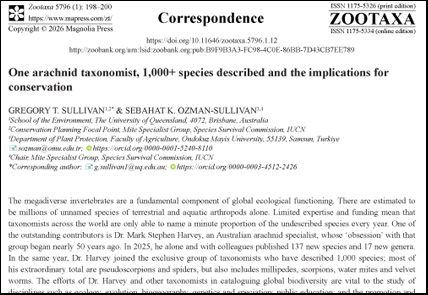
The megadiverse invertebrates are a fundamental component of global ecological functioning. There are estimated to be millions of unnamed species of terrestrial and aquatic arthropods alone. Limited expertise and funding mean that taxonomists across the world are only able to name a minute proportion of the undescribed species every year. One of the outstanding contributors is Dr. Mark Stephen Harvey, an Australian arachnid specialist, whose ‘obsession’ with that group began nearly 50 years ago. In 2025, he alone and with colleagues published 137 new species and 17 new genera. In the same year, Dr. Harvey joined the exclusive group of taxonomists who have described 1,000 species; most of his extraordinary total are pseudoscorpions and spiders, but also includes millipedes, scorpions, water mites and velvet worms. The efforts of Dr. Harvey and other taxonomists in cataloguing global biodiversity are vital to the study of disciplines such as ecology, evolution, biogeography, genetics and speciation; public education; and the promotion and implementation of biodiversity conservation across the planet.
References
- Agnarsson, I. (2023) Grand challenges in research on arachnid diversity, conservation, and biogeography. Frontiers in Arachnid Science, 2, 1101141. [https://www.10.3389/frchs.2023.1101141]
- Anonymous (2025a) Mark Stephen Harvey. ResearchGate. Available from: https://www.researchgate.net/profile/Mark-Harvey-4 (accessed 8 January 2026)
- Anonymous (2025b) Mark S. Harvey. International Commission of Zoological Nomenclature. Available from: https://www.iczn.org/about-the-iczn/commissioners/mark-s-harvey/ (accessed 16 December 2025)
- Giribet, G. & Austin, A. (2025) Special collection: 1000 new species—a lifelong dedication to biodiversity discovery. Invertebrate Systematics. [https://connectsci.au/is/collection/2640/1000-new-species-a-lifelong-dedication-to]
- Harms, D., McRae, J., Curran, M. & Harvey, M.S. (2025) Identifying refugia for invertebrate conservation in biodiversity hotspots: examples from a new genus of dragon pseudoscorpions (Pseudotyrannochthoniidae: Karrichthonius). Invertebrate Systematics, 39 (9), IS25028. https://doi.org/10.1071/IS25028
- Harvey, M.S. (1981) Geogarypus rhantus sp. nov. (Pseudoscorpionida: Garypidae: Geogarypinae); a generic addition to the Australian fauna. Memoirs of the Queensland Museum, 20, 279–283. [https://www.biodiversitylibrary.org/part/154557]
- Harvey, M.S. (1987) New and little-known species of the water mite genera Tartarothyas, Pseudohydryphantes and Cyclohydryphantes from Australia (Chelicerata: Actinedida: Hydryphantidae). Memoirs of Museum Victoria, 48 (2), 107–122. https://doi.org/10.24199/j.mmv.1987.48.24
- Harvey, M.S. (1988) New species of the water mite family Hydryphantidae (Acarina) from the Northern Territory, Australia. The Beagle: Records of the Museums and Art Galleries of the Northern Territory, 5 (1), 17–26. https://doi.org/10.5962/p.260914
- Harvey, M.S. (1998) The Australian water mites. A guide to families and genera. Monographs on invertebrate taxonomy. Vol. 4. CSIRO Publishing, Collingwood, Victoria, 150 pp. https://doi.org/10.1071/9780643105188
- Harvey, M.S. (2025) A new genus of Australian pseudoscorpions (Pseudoscorpiones: Chernetidae: Lamprochernetinae) associated with insectivorous bats (Chiroptera: Vespertilionidae). Australian Journal of Zoology, 73 (6), ZO25027. https://doi.org/10.1071/ZO25027
- Harvey, M.S., Portflitt-Toro, M., Wynne, J.J., Romero-Ortiz, C. & Cotoras, D.D. (2025) Pseudoscorpions from Motu Motiro Hiva, a remote Polynesian island, with the description of a new genus of Chernetidae (Pseudoscorpiones). Diversity, 17, 852. https://doi.org/10.3390/d17120852
- Harvey, M.S., Rix, M.G., Framenau, V.W., Hamilton, Z.R., Johnson, M.S., Teale, R.J., Humphreys, G. & Humphreys, W.F. (2011) Protecting the innocent: studying short-range endemic taxa enhances conservation outcomes. Invertebrate Systematics, 25 (1), 1–10. https://doi.org/10.1071/IS11011
- Readfearn, G. (2025) How many spiders and pseudoscorpions does it take to make one of the world’s greatest taxonomist? The Guardian. Available from: https://www.theguardian.com/science/2025/dec/05/legacy-one-of-worlds-greatest-taxonomists-perth (accessed 5 December 2025)
- Rix, M.G., Huey, J.A., Main, B.Y., Waldock, J.M., Harrison, S.E., Comer, S., Austin, A.D. & Harvey, M.S. (2017) Where have all the spiders gone? Highlighting the decline of a poorly known invertebrate fauna in the agricultural and arid zones of southern Australia. Austral Entomology, 56, 14–22. https://doi.org/10.1111/aen.12258
- Stork, N.E. (2018) How many species of insects and other terrestrial arthropods are there on earth? Annual Review Entomology, 63, 31–45. https://doi.org/10.1146/annurev-ento-020117-043348
- Sullivan, G.T. & Ozman-Sullivan, S.K. (2021) Alarming evidence of widespread mite extinctions in the shadows of plant, insect and vertebrate extinctions. Austral Ecology, 46 (1), 163–176. https://doi.org/10.1111/aec.12932
- Wilson, J.D., Harvey, M.S., Simmons, L.W. & Rix, M.G. (2025a) An integrative systematic revision of the wishbone spiders (Araneae: Anamidae: Aname L. Koch, 1873) of subtropical and tropical eastern Australia, with the description of 55 new species. European Journal of Taxonomy, 985 (1), 1–298. https://doi.org/10.5852/ejt.2025.985.2845
- Wilson, J.D., Rix, M.G., Hillyer, M.J., Huey, J.A., Piccinini, A., Redfern, G.C., Simmons, L.W., Volschenk, E.S. & Harvey, M.S. (2025b) Integrative taxonomy of the hooded wishbone spiders of the Aname mellosa-complex from Western Australia (Araneae: Mygalomorphae: Anamidae). Invertebrate Systematics, 39 (10), IS25012. https://doi.org/10.1071/IS25012
- Winchester, N.N. & Ring, R.A. (1996) Centinelan extinction: extirpation of northern temperate old-growth rainforest arthropod communities. Selbyana, 17 (1), 50–57. [https://journals.flvc.org/selbyana/article/view/120692]
- Woinarski, J.C.Z., Braby, M.F., Gibb, H., Harvey, M.S., Legge, S.M., Marsh, J.R., Moir, M.L., New, T.R., Rix, M.G. & Murphy, B.P. (2024) This is the way the world ends; not with a bang but a whimper: Estimating the number and ongoing rate of extinctions of Australian non-marine invertebrates. Cambridge Prisms: Extinction, 2, e23, 1–11. https://doi.org/10.1017/ext.2024.26