

Abstract
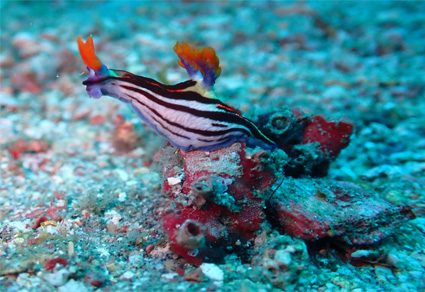
Sea slugs are known as the jewels of the sea, prized by most divers and treasured by underwater photographers. Some species are very rare or difficult to spot, but others are quite common and are often featured in field guides and web pages. However, it is surprising that some of those most common and incredibly beautiful creatures are sometimes undescribed species or, in some cases, misidentified as other species. In this paper, we formally name and describe three of these well-photographed species: Thecacera melkyi sp. nov., Thecacera pikachu sp. nov. and Nembrotha lorosae sp. nov. all belonging to the family Polyceridae Alder and Hancock, 1845, and collected in East Timor. We perform species delimitation analyses and present their phylogenetic scenario based on two mitochondrial (COI, 16S rRNA) and one nuclear marker (H3). We also reveal a new color morphotype of Nembrotha purpureolineata O’Donoghue, 1924 and highlight two possible undescribed species—one Thecacera J. Fleming, 1828 and one Nembrotha Bergh, 1877. It is essential to continue searching for and fully describing new species, especially in less-studied regions, to understand the true biodiversity of our seas.
References
- Akaike, H. (1974) A new look at the statistical model identification. IEEE transactions on automatic control, 19 (6), 716–723. https://doi.org/10.1109/TAC.1974.1100705
- Alfaro, M. E., Zoller, S. & Lutzoni, F. (2003) Bayes or bootstrap? A simulation study comparing the performance of Bayesian Markov chain Monte Carlo sampling and bootstrapping in assessing phylogenetic confidence. Molecular biology and evolution, 20 (2), 255–266. https://doi.org/10.1093/molbev/msg028
- Allan, J.K. (1933) Opisthobranchs from Australia. Records of the Australian Museum, 18 (9), 443–450. https://doi.org/10.3853/j.0067-1975.18.1933.747
- Altschul, S.F., Gertz, E.M., Agarwala, R., Schäffer, A.A. & Yu, Y.K. (2009) PSIBLAST pseudocounts and the minimum description length principle. Nucleic Acids Research, 37, 815–824. https://doi.org/10.1093/nar/gkn981
- Andrimida, A. (2022) New records of nudibranchs and a sacoglossan (Gastropoda: Heterobranchia) from Sempu Strait, Indonesia. Indo Pacific Journal of Ocean Life, 6 (1), 1–9. https://doi.org/10.13057/oceanlife/o060101
- Baba, K. (1972) Thecacera picta spec. nov. from Suruga Bay, Japan. The Veliger, 15 (2), 88–90.
- Behrens, D.W. (2005) Nudibranch behavior with photographers: Constantiine Petrinos & Carine Schrurs. New World Publications, INC., Jacksonville, Florida, 176 pp.
- Bergh, L.S.R. (1877) Malacologische Untersuchungen. In: Semper, C. (Ed.), Reisen im Archipel der Philippinen. Theil 2. Heft 11. Kreidel, Wiesbaden, pp. 429–494, pls. 54–7
- Bergh, L.S.R. (1884) Report on the Nudibranchiata collected by H.M.S Challenger during the years 1873–1876. Report on the Scientific Results of the Voyage of H.M.S. Challenger during the years 1873–76, Zoology, 10 (Part 26), 1–154, pls. 1–14.
- Bergh, L.S.R. (1905) Die Opisthobranchiata der Siboga-expedition. In: Weber M. (Ed.), Uitkomsten op Zoologisch, Botanisch, Oceanographisch en Geologisch Gebied verzameld in Nederlandsch Oost-Indië 1899–1900 aan boord H.M. Siboga onder commando van Luitenant ter zee 1e. kl. G.F. Tydeman. Siboga-Expeditie Monographie, 50 (Livraison 25), 1–248, pls. 1–20. https://doi.org/10.5962/bhl.title.11223
- Britz, R., Hundsdörfer, A. & Fritz, U. (2020) Funding, training, permits—the three big challenges of taxonomy. Megataxa, 1 (1), 49–52. https://doi.org/10.11646/megataxa.1.1.10
- Burn, R. (1967) Notes on an overlooked nudibranch genus, Roboastra Bergh, 1877, and two allied genera (Mollusca:Gastropoda). Australian Zoology, 14, 212–222.
- Camacho-García, Y. & Pola, M. (2011) The Underwater Jewels of Santo. In: The Natural History of Santo. Editorial Publications Scientifiques du Muséum. Patrimoines Naturels. Vol. 70. Muséum National d’Histoire Naturelle, Paris, 572 pp. [ISBN MNHN 978-2-85653-627-8/ISBN IRD 978-2-7099-1708-7]
- Castresana, J. (2000) Selection of conserved blocks from multiple alignments for their use in phylogenetic analysis. Molecular Biology and Evolution, 17, 540–552. https://doi.org/10.1093/oxfordjournals.molbev.a026334
- Coleman, N. (2001) 1001 Nudibranchs. Catalogue of Indo-Pacific Sea Slugs. Neville Coleman’s Underwater Geographic, Pty Ltd, Springwood, Queensland, 144 pp.
- Coleman, N. (2008) Nudibranchs Encyclopedia: Catalogue of Asia/Indo-Pacific Sea Slugs. Neville Coleman’s Underwater Geographic, Pty Ltd, Springwood, Queensland, 416 pp.
- Colgan, D.J., Mclauchlan, A., Wilson, G.D., Livingston, S.P., Edgecombe, G.D., Macaranas, J., Cassis, G. & Gray, M.R. (1998) Molecular phylogenetics of the Arthropoda: relationships based on histone H3 and U2 snRNA DNA sequences. Australian journal of zoology, 46, 419–437. https://doi.org/10.1071/ZO98048
- Debelius, H. (1998) Nudibranchs and Sea Snails: Indo Pacific Field Guide. Ed. M&G Difusion, S.L., Frankfurt, 321pp.
- Debelius, H. & Kuiter, R.H. (2007) Nudibranchs of the world. IKAN, Frankfurt, 360 pp.
- Domínguez, M., Pola, M. & Ramón, M. (2015) A new species of Tambja (Mollusca, Gastropoda, Nudibranchia) from the Mediterranean Sea: description of the first species of the genus from the Balearic Islands and Malta. Helgoland Marine Research, 69, 205–212. https://doi.org/10.1007/s10152-015-0429-4
- Drummond, A.J., Suchard, M.A., Xie, D. & Rambaut, A. (2012) Bayesian phylogenetics with BEAUti and the BEAST 1.8.3. Molecular Phylogenetics and Evolution, 29, 1969–1973. https://doi.org/10.1093/molbev/mss075
- Ebach, M.C., Valdecasas, A.G. & Wheeler, Q.D. (2011) Impediments to taxonomy and users of taxonomy: accessibility and impact evaluation. Cladistics, 27 (5), 550–557. https://doi.org/10.1111/j.1096-0031.2011.00348.x
- Engel, M.S., Ceríaco, L.M.P., Daniel, G.M., Dellapé, P.M., Löbl, I., Marinov, M., Reis, C.A., Young, M.T., Dubois, A., Agarwal, I., Artaev, O.N., Ashrafi, S., Bush, B.C., Castronovo, G.D.P., Enghoff, H., Falniowski, A., Gezelius, L., Jäch, M.A., Kaydan, M.B., Kondreros, V.V., Kundrata, R., Lattig, P., Lorive, G., Macpherson, E., Mezhzherin, S.V., Nikolajev, G.V., Nogueira, A.A., Ohler, A., Páll-Gergely, B., Paramanov, N.M., Pinzari, M., Sánchez-Vialas, A., Spasojavic, T., Storozhenko, S.Y., Takiya, D.M., van Tol, J. & Zacharie, C.K. (2021) The taxonomic impediment: a shortage of taxonomists, not the lack of technical approaches. Zoological Journal of the Linnean Society, 193 (2), 381–387. https://doi.org/10.1093/zoolinnean/zlab072
- Fischer, M.A., Van Der Velde, G. & Roubos, E.W. (2005) Redescription of Thecacera darwini Pruvot-Fol, 1950 (Gastropoda: Opisthobranchia: Nudibranchia) from the Chilean coast. Vita Malacologica, 3, 35–42.
- Fleming, J. (1828) A history of British animals, exhibiting the descriptive characters and systematical arrangement of the genera and species of quadrupeds, birds, reptiles, fishes, Mollusca, and Radiata of the United Kingdom; including the indigenous, extirpated, and extinct kinds, together with periodical and occasional visitants. Bell & Bradfute, Edinburgh and James Duncan, London, xxii + 565 pp., corrigenda. https://doi.org/10.5962/bhl.title.12859
- Folmer, O., Black, M., Hoeh, W., Lutz, R. & Vrijenhoek, R. (1994) Primer del DNA per l’amplificazione della subunità I mitocondriale della citocromo c ossidasi da diversi invertebrati metazoici. Molecular Marine Biology Biotecnologie, 3, 294–299.
- Fujisawa, T. & Barraclough, T.G. (2013) Delimiting species using single-locus data and the generalized mixed yule coalescent approach: a revised method and evaluation on simulated data sets. Systematic Biology, 62, 707–724. https://doi.org/10.1093/sysbio/syt033
- Gosliner, T.M. (1987) Nudibranchs of Southern Africa. A Guide to Opisthobranch Molluscs of Southern Africa. Sea Challengers, Monterey, California, 136 pp. https://doi.org/10.1163/9789004631496
- Gosliner, T.M. & Behrens, D.W. (1997) Description of four new species of phanerobranch dorids (Mollusca: Nudibranchia) from the Indo-Pacific, with a redescription of Gymnodoris aurita (Gould, 1852). Proceedings of the California Academy of Sciences, Series 4, 49 (9), 287–308.
- Gosliner, T.M., Valdés, A. & Behrens, D.W. (2008) Indo-Pacific Nudibranchs and Sea Slug: a field guide to the world’s most diverse fauna. Sea Challengers Natural History Books, Etc., Washington, and California Academy of Sciences, San Francisco, California, 426 pp.
- Gosliner, T.M., Valdés, A. & Behrens, D.W. (2015) Nudibranch and Sea Slug Identification—Indo-Pacific. New Word Publications Inc., Jacksonville, Florida, 408 pp.
- Gosliner, T.M., Valdés, Á. & Behrens, D.W. (2018) Nudibranch & Sea Slug Identification Indo-Pacific. New World Publications, acksonville, Florida, 452 pp.
- Gosliner, T.M., Jones, G., Beasley, L., Claassens, L., Deuss, M., Flora, J., Liltved, W.R., Ogden, C., Pola, M., Sellick, B., Strömvoll, J., Tibiriçá, Y., Toonen, R.J., van der Colff, S., van Zyl, R., & Zsilavecz, G. (2023) Southern African Sea Slugs. Southern Underwater Research Group, Cape Town, 800 pp.
- Hillis, D.M. & Bull, J.J. (1993) An empirical test of bootstrapping as a method for assessing confidence in phylogenetic analysis. Systematic biology, 42 (2), 182–192. https://doi.org/10.1093/sysbio/42.2.182
- Humann, P. & DeLoach, N. (2010) Reef Creature Identification: Tropical Pacific. New World Publications, Jacksonville, Florida, 497 pp.
- Jensen, K.R. (2013) Sea slugs-divers’ favorites, taxonomists’ problems. Aquatic Science & Management, 1 (2), 100–110. https://doi.org/10.35800/jasm.1.2.2013.7271
- Jie, W.B. & Chan, C.Y. (2009) Taiwan Nudibranchs. National Museum of Marine Biology & Aquarium, Pingtung, 309 pp.
- Kaligis, F., Eisenbarth, J.H., Schillo, D., Dialao, J., Schäberle, T.F., Böhringer, N., Bara, R., Reumschüssel, S., König, G.M. & Wägele, H. (2018) Second survey of heterobranch sea slugs (Mollusca, Gastropoda, Heterobranchia) from Bunaken National Park, North Sulawesi, Indonesia-how much do we know after 12 years?. Marine Biodiversity Records, 11 (1), 2. https://doi.org/10.1186/s41200-018-0136-3
- Katoh, K. & Standley, D.M. (2013) MAFFT multiple sequence alignment software version 7: improvements in performance and usability. Molecular Biology and Evolution, 30, 772–780. https://doi.org/10.1093/molbev/mst010
- Kearse, M., Moir, R., Wilson, A., Stones-Havas, S., Cheung, M., Sturrock, S., Buxton, S., Cooper, A., Markowitz, S., Duran, C., Thierer, T., Ashton, B., Meintjes, P. & Drummond, A. (2012) Geneious Basic: an integrated and extendable desktop software platform for the organization and analysis of sequence data. Bioinformatics, 28 (12), 1647–1649. https://doi.org/10.1093/bioinformatics/bts199
- Kristiana, R., Sibero, M.T., Farisa, M.Y., Ayuningrum, D., Dirgantara, D., Hanafi, M., Radjasa, O.K., Sabdono, A. & Trianto, A. (2019) Antibacterial potential of nudibranch-associated bacteria from Saparua and Nusa Laut Islands, Indonesia. Biodiversitas, 20 (7), 1811–1819. https://doi.org/10.13057/biodiv/d200704
- Kozlov, A.M., Darriba, D., Flouri, T., Morel, B. & Stamatakis, A. (2019) RAxML-NG: a fast, scalable and user-friendly tool for maximum likelihood phylogenetic inference. Bioinformatics, 35 (21), 4453–4455. https://doi.org/10.1093/bioinformatics/btz305
- Korshunova, T.A., Driessen, F.M., Picton, B.E. & Martynov, A.V. (2021) The multilevel organismal diversity approach deciphers difficult to distinguish nudibranch species complex. Scientific Reports, 11 (1), 18323. https://doi.org/10.1038/s41598-021-94863-5
- Kumar, S., Stecher, G. & Tamura, K. (2016) MEGA7: molecular evolutionary genetics analysis version 7.0 for bigger datasets. Molecular biology and evolution, 33 (7), 1870–1874. https://doi.org/10.1093/molbev/msw054
- Leach, M. (2017). Nation-building and national identity in Timor-Leste. Routledge, London and New York, 272 pp. https://doi.org/10.4324/9781315311654
- Miller, M.A., Pfeiffer, W. & Schwartz, T. (2010, November) Creating the CIPRES Science Gateway for inference of large phylogenetic trees. In: 2010 gateway computing environments workshop (GCE). IEEE, New Orleans, Louisiana, pp. 1–8. https://doi.org/10.1109/GCE.2010.5676129
- MolluscaBase Eds. (2025a). MolluscaBase. Polyceridae Alder & Hancock, 1845. Accessed through: World Register of Marine Species. Available from: https://www.marinespecies.org/aphia.php?p=taxdetails&id=177 (accessed 6 October 2025)
- MolluscaBase Eds. (2025b) MolluscaBase. Thecacera J. Fleming, 1828. Accessed through: World Register of Marine Species. Available from: https://www.marinespecies.org/aphia.php?p=taxdetails&id=138371 (accessed 28 February 2025)
- Montagu, G. (1813) I. Descriptions of several new or rare Animals, principally marine, discovered on the South Coast of Devonshire. Transactions of the Linnean Society of London, 11 (1), 1–26. https://doi.org/10.1111/j.1096-3642.1813.tb00035.x
- Müller, O.F. (1776) Zoologiae Danicae Prodromus, seu Animalium Daniae et Norvegiae Indigenarum characters, nomina, et synonyma imprimis popularium. [Prodromus of Danish Zoology, or the characters, names, and synonyms of the indigenous animals of Denmark and Norway, especially of the popular ones]. Typis Hallageriis, Havniae, 32 + 282 pp. https://doi.org/10.5962/bhl.title.13268
- Nakano, R. (2004) Opisthobranchs of Japan Islands. Rutles Inc., Tokyo, 304 pp.
- Nakano, R. (2018) Field Guide to Sea Slugs and Nudibranchs of Japan. Bun-ichi Co., Ltd., Tokyo, 544 pp.
- Nylander, J. (2004) MrModeltest. Version 2. Evolutionary Biology Centre, Uppsala University, Uppsala. [software]
- O’Donoghue, C.H. (1924) Report on Opisthobranchiata from the Abrolhos Islands, Western Australia, with description of a new parasitic copepod. Zoological Journal of the Linnean Society, 35 (237), 521–579. https://doi.org/10.1111/j.1096-3642.1924.tb00053.x
- Ompi, M., Lumoindong, F., Undap, N., Papu, A. & Wägele, H. (2019) Monitoring marine heterobranchia in Lembah strait, north Sulawesi (Indonesia), in a changing environment. Aquaculture, Aquarium, Conservation & Legislation, 12 (2), 664–677.
- Palomar, G., Pola, M. & Garcia-Vazquez, E. (2014) First molecular phylogeny of the subfamily Polycerinae (Mollusca, Nudibranchia, Polyceridae). Helgoland Marine Research, 68, 143–153. https://doi.org/10.1007/s10152-013-0374-z
- Palumbi, S.R., Martin, A., Romano, S., Owen Macmillan, W., Stice, L. & Grabowski, G. (1991) The Simple Fool’s Guide to PCR. Department of Zoology, University of Hawaii, Honolulu, Hawaii, 45 pp.
- Pons, J., Barraclough, T.G., Gomez-Zurita, J., et al. (2006) Sequence-based species delimitation for the DNA taxonomy of undescribed insects. Systematic Biology, 55, 595–609. https://doi.org/10.1080/10635150600852011
- Pola, M., Cervera, J.L. & Gosliner, T.M. (2008) Revision of the Indo-Pacific genus Nembrotha (Nudibranchia: Dorididae: Polyceridae), with a description of two new species. Scientia Marina, 72 (1), 145–183. https://doi.org/10.3989/scimar.2008.72n1145
- Pola, M., Tibiriçá, Y. & Cervera, J.L. (2023a) Psychedelics sea slugs: Observations on colour ontogeny in two nudibranch species from the genus Nembrotha (Doridina: Polyceridae). Scientia Marina, 87 (3), e072. https://doi.org/10.3989/scimar.05371.072
- Pola, M., Miguel-González, M. & Paz-Sedano, S. (2023b) New contributions to the subfamily Polycerinae (Nudibranchia, Polyceridae): description of three new species and one new genus. Journal of the Marine Biological Association of the United Kingdom, 103, e76. https://doi.org/10.1017/S0025315423000607
- Pruvot-Fol, A. (1931) Nudibranches australiens figurés par SavilleKent dans son grand ouvrage “The great Australian barrierreef”, et qui ne sont ni décrits ni nimmés. Bulletin du Muséum National d’Histoire Naturelle, Paris, 2éme Serie, 3 (8), 754–755.
- Pruvot-Fol, A. (1950) Le genre Thecacera Fleming, 1828 et une espece nouvelle: Thecacera darwini. Journal de Conchyliologie, 90 (1), 48–52.
- Puillandre, N., Lambert, A., Brouillet, S. & Achaz, G. (2012) ABGD, automatic barcode gap discovery for primary species delimitation. Molecular Ecology, 21, 1864–1877. https://doi.org/10.1111/j.1365-294X.2011.05239.x
- Puillandre, N., Brouillet, S. & Achaz, G. (2021) ASAP: assemble species by automatic partitioning. Molecular Ecology Resources, 21, 609–620. https://doi.org/10.1111/1755-0998.13281
- Quoy, J. R. C.; Gaimard, J. P. (1832–1835) Voyage de la corvette l’Astrolabe: exécuté par ordre du roi, pendant les années 1826–1827–1828–1829, sous le commandement de M. J. Dumont d’Urville. Zoologie. In: Dumont d’Urville, J., 1834 Voyage de Découvertes de l’Astrolabe. 1, 2 (1), 2 (2), 3 (1), 3 (2), 4 and Atlas (Mollusques). J. Tastu, Éditeur-Imprimeur, Paris, pp. i–l + 1–264, pp. 1–321 [1832], pp. 321–686 [1833], pp. 1–366 [1834], pp. 367–954 [1835], [1833] & pls. 1–93 [1833].
- Rambaut, A. (2012) FigTree. Version 1.4.2. University of Edinburgh, Edinburgh. Available from http://tree.bio.ed.ac.uk/software/figtree/ (accessed 21 January 2026)
- Ronquist, F., Teslenko, M., van der Mark, P., Ayres, D.L., Darling, A., H€ohna, S., Larget, B., Liu, L., Suchard, M.A. & Huelsenbeck, J.P. (2012) MRBAYES 3.2: efficient Bayesian phylogenetic inference and model selection across a large model space. Systematic Biology, 61, 539–542. https://doi.org/10.1093/sysbio/sys029
- Ryanskiy, A. & Ivanov, Y. (2022) Nudibranquios del Triángulo de Coral. Samacomic, 192 pp.
- Sørensen, C.G., Rauch, C., Pola, M. & Malaquias, M.A.E. (2020) Integrative taxonomy reveals a cryptic species of the nudibranch genus Polycera (Polyceridae) in European waters. Journal of the Marine Biological Association of the United Kingdom, 100 (5), 733–752. https://doi.org/10.1017/S0025315420000612
- Strömvoll, J. & Jones, G. (2019) A guide to the sea slugs of the Maputaland coast. Castle Graphics North (Pty) Ltd., Hoedspruit, 103 pp.
- Swofford, D.L. (2002) PAUP*. Phylogenetic analysis using parsimony. (*and other methods)¨. Version 4. Sinaeur Associates, Sunderland, Massachussetts. [program]
- Undap, N., Papu, A., Schillo, D., Ijong, F.G., Kaligis, F., Lepar, M., Hertzer, C., Eisenbarth, J.H., Kusen, J.D., & Wägele, H. (2019) First survey of heterobranch sea slugs (Mollusca, Gastropoda) from the island Sangihe, North Sulawesi, Indonesia. Diversity, 11 (9), 170. https://doi.org/10.3390/d11090170
- Uribe, R.A., Sepúlveda, F., Goddard, J.H. & Valdés, Á. (2018) Integrative systematics of the genus Limacia OF Müller, 1781 (Gastropoda, Heterobranchia, Nudibranchia, Polyceridae) in the Eastern Pacific. Marine Biodiversity, 48, 1815–1832. https://doi.org/10.1007/s12526-017-0676-5
- Taylor, J. G. (1999). East Timor: The price of freedom. Zed Books, London and New York, 272 pp.
- Toms, J.A., Pola, M., von der Heyden, S. & Gosliner, T.M. (2021) Disentangling species of the genus Limacia OF Müller, 1781, from southern Africa and Europe using integrative taxonomical methods, with the description of four new species. Marine Biodiversity, 51 (1), 1. https://doi.org/10.1007/s12526-020-01125-0
- Tonozuka, T. (2003) Opisthobranchs of Bali and Indonesia. Hankyu Communications Co., Ltd., Tokyo, 168 pp.
- Veron, J.E.N., Devantier, L.M., Turak, E., Green, A.L., Kininmonth, S., Stafford-Smith, M. & Peterson, N. (2009) Delineating the Coral Triangle. Galaxea, Journal of Coral Reef Studies, 11 (2), 91–100. https://doi.org/10.3755/galaxea.11.91
- Willan, R.C. (1989) Phylogenetic systematics and zoogeography of Australian nudibranchs: 2. Description of a new species of Thecacera with comments on the genus and its contained species. Journal of the Malacological Society of Australia, 10 (1), 1–12. https://doi.org/10.1080/00852988.1989.10674000
- Yonow, N. (1994) Opisthobranchs from the Maldive Islands, including descriptions of seven new species (Mollusca: Gastropoda). Revue Française d’Aquariologie, 20, 4–25.
- Yonow, N. & Jensen, K.R. (2018) Results of the rumphius biohistorical expedition to Ambon (1990). Part 17. The cephalaspidea, anaspidea, pleurobranchida, and sacoglossa (mollusca: Gastropoda: Heterobranchia). Archiv für Molluskenkunde, 147 (1), 1–48. https://doi.org/10.1127/arch.moll/147/001-048
- Zhang, S.Q. & Zhang, S.P. (2023) Description of a new species of Polycera Cuvier, 1816 (Gastropoda: Nudibranchia: Polyceridae) from the East China Sea. The Nautilus, 137 (3–4), 79–90.
- Zhang, J., Kapli, P., Pavlidis, P. & Stamatakis, A. (2013) A general species delimitation method with applications to phylogenetic placements. Bioinformatics, 29, 2869–2876. https://doi.org/10.1093/bioinformatics/btt499