

Abstract
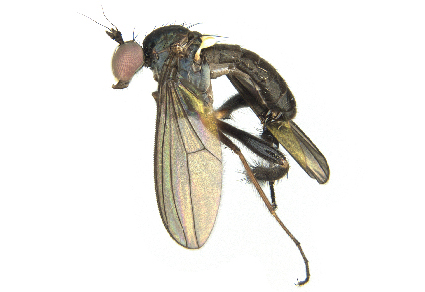
Otorongo Quevedo, Soares & Ramos-Pastrana gen. nov. is erected to accommodate four remarkable newly described species from Colombia and Peru: Otorongo deinonychus sp. nov. (Colombia), O. piscator sp. nov. (Peru), O. runyoni sp. nov. (Colombia) and O. terrificus sp. nov. (Colombia). A cladistic analysis using a morphology-based matrix with 35 characters and 10 terminal taxa, comprising exemplars of most of the Sympycninae genera known from Neotropical fauna was performed to examine the relationships and monophyly of the newly proposed genus. We recovered Otorongo gen. nov. as a monophyletic group, with six autapomorphies mainly associated with male secondary sexual characters: (1) scutellum bearing a fringe of short, hair-like setae, (2) femur III arched, (3) femur III about 2 times wider than femur II, (4) posterodorsal apex of tibia III with a claw-like spur reaching the base of IIIt1, (5) IIIt1 with hook-like anterior bristle, and (6) presence of basal sclerite of sperm pump. The main diagnostic characters are discussed, as well as the relationship between Otorongo gen. nov. and other Sympycninae genera. An illustrated dichotomous key and a distribution map to species are also provided.
References
- Amorim, D.S. (2002) Fundamentos de Sistemática Filogenética. Holos Editora. Ribeirão Preto, 436 pp.
- Barros, L.M., Soares, M.M.M., Freitas-Silva, R.A.P., Sinclair, B.J. & Ale-Rocha, R. (2022) Revision of the New Zealand endemic genus Pseudoscelolabes Collin (Diptera: Hybotidae: Ocydromiinae). Zootaxa, 5150 (4), 516–528. https://doi.org/10.11646/zootaxa.5150.4.3
- Barros, L.M., Soares, M.M.M. & Ale-Rocha, R. (2023) Discovery through iNaturalist: first record of Hoplopeza Bezzi, 1909 (Diptera: Hybotidae) from New Zealand and an updated key to the genera of Ocydromiinae from the Australasian Region. Austral Entomology, 64 (1), e12722. https://doi.org/10.1111/aen.12722
- Bickel, D.J. (1992) The Australian Sympycninae (Diptera: Dolichopodidae): Introduction and description of a new genus, Yumbera. Invertebrate Taxonomy, 6, 1005–1017. https://doi.org/10.1071/IT9921005
- Bickel, D.J. (1999) Australian Sympycninae II: Syntormon Loew and Nothorhaphium, gen. nov., with a treatment of the Western Pacific fauna, and notes on the subfamily Rhaphiinae and Dactylonotus Parent (Diptera: Dolichopodidae). Invertebrate Taxonomy, 13, 179–206. https://doi.org/10.1071/IT97028
- Bickel, D.J. (2009) Dolichopodidae (long-legged flies). In: Brown, B.V., Borkent, A., Cumming, J.M., Wood, D.M., Woodley, N.E. & Zumbado, M.A. (Eds.), Manual of Central American Diptera. Vol. 1. NRC Research Press, Ottawa, pp. 671–694.
- Brooks, S.E. (2005) Systematics and phylogeny of Dolichopodidae (Diptera: Dolichopodidae). Zootaxa, 857 (1), 1–158. https://doi.org/10.11646/zootaxa.857.1.1
- Cumming, J.M. (1992) Lactic acid as an agent for macerating Diptera specimens. Fly Times, 8, 7.
- Drake, C.M. (2021) Comments on the taxonomic status of some British species of Syntormon Loew, 1857 (Diptera, Dolichopodidae). Dipterists Digest, 2, 17–44.
- Farris, J.S. (2008) Parsimony and explanatory power. Cladistics, 24, 1–23. https://doi.org/10.1111/j.1096-0031.2008.00214.x
- Farris, J.S. (1983) The logical basis of phylogenetic analysis. In: Platnick, N.I. & Funk, V.A. (Eds.), Advances in Cladistics 2: Proceedings of the Second Meeting of the Willi Hennig Society. Columbia University Press, Nova Iorque, pp. 7–36.
- Germann, C., Pollet, M., Wimmer, C. & Bernasconi, M.V. (2011) Molecular data shed light on the classification of long-legged flies (Diptera: Dolichopodidae). Invertebrate Systematics, 25, 303–321. https://doi.org/10.1071/IS11029
- Goloboff, P.A. (1993) Estimating character weights during tree search. Cladistics, 9, 83–91. https://doi.org/10.1111/j.1096-0031.1993.tb00209.x
- Goloboff, P.A. (1995) Parsimony and weighting: a reply to Turner and Zandee. Cladistics, 11, 91–104. https://doi.org/10.1111/j.1096-0031.1995.tb00006.x
- Goloboff, P.A., Farris, J.S. & Nixon, K.C. (2008) TNT, a free program for phylogenetic analysis. Cladistics, 24, 774–786. https://doi.org/10.1111/j.1096-0031.2008.00217.x
- Goloboff, P.A. & Morales, M. (2023) TNT version 1.6, with graphical interface for MacOs and Linux, including new routines in parallel. Cladistics, 39, 144–153. https://doi.org/10.1111/cla.12512
- Grichanov, I.Ya. & Brooks, S.E. (2017) Dolichopodidae (long-legged dance flies). In: Kirk-Spriggs, A.H. & Sinclair, B.J. (Eds.), Manual of Afrotropical Diptera. Vol. 2. Nematocerous Diptera and lower Brachycera. Suricata 5. South African National Biodiversity Instiute, Pretoria, pp. 1265–1320.
- Grichanov, I.Ya. (2018) An annotated catalogue of Afrotropical Dolichopodidae (Diptera). Plant Protection News, Supplements, 25, 1–152. https://doi.org/10.14258/abs.v4i2.4120
- Hennig, W. (1966) Phylogenetic Systematics. University of Illinois Press, Urbana and Chicago, 277 pp.
- Holdridge, L.R. (1967) Life Zone Ecology. Tropical Science Center, San José, 206 pp.
- Hurley, R.L. & Runyon, J.B. (2009) A review of Erebomyia (Diptera: Dolichopodidae), with descriptions of three new species. Zootaxa, 2054 (1), 38–48. https://doi.org/10.11646/zootaxa.2054.1.2
- IAVH (2015) Caracterización biofísica, cultural y socioeconómica del complejo de páramos Miraflores - entorno local. Instituto de Investigación de Recursos Biológicos Alexander von Humboldt, Bogotá, D.C., 69 pp.
- Kitching, I.J., Forey, P.L., Humphries, C.J. & Williams, D.M. (1998) Cladistics: The theory and practice of parsimony analysis. 2nd Edition. Oxford University Press, Oxford, 248 pp.
- Land, M.F. (1993a) Chasing and pursuit in the dolichopodid fly Poecilobothrus nobilitatus. Journal of Comparative Physiology A, 173, 605–613. https://doi.org/10.1007/BF00197768
- Land, M.F. (1993b) The visual control of courtship behaviour in the fly Poecilobothrus nobilitatus. Journal of Comparative Physiology A, 173, 595–603. https://doi.org/10.1007/BF00197767
- Leigh, E.G., Jr. (2007) Neutral theory: a historical perspective. Journal of Evolutionary Biology, 20, 2075–2091. https://doi.org/10.1111/j.1420-9101.2007.01410.x
- Lunau, K. (1992) Mating behaviour in the long-legged fly Poecilobothrus nobilitatus L. (Diptera, Dolichopodidae): courtship behaviour, male signalling and mating success. Zoologische Beiträge, 34, 465–479.
- Lunau, K. (1996) Das Balzverhalten von Langbeinfliegen (Diptera, Dolichopodidae). Acta Albertina Ratisbonensia, 50, 49–73.
- Nixon, C.K. & Carpenter, J.M. (1993) On outgroups. Cladistics, 9, 413–426. https://doi.org/10.1111/j.1096-0031.1993.tb00234.x
- Nixon, K.C. (1999–2002) WinClada ver. 1.00.08. Published by the author, Ithaca, New York.
- O’Leary, M.A. & Kaufman, S. (2011) MorphoBank: phylophenomics in the “cloud”. Cladistics, 27 (5), 529–237. https://doi.org/10.1111/j.1096-0031.2011.00355.x
- Quevedo, L., Soares, M.M.M., Gutiérrez-Bustamante, S., Lamas, C.J.E. & Capellari, R.S. (2026) A century later: taxonomic review of the Neotropical genus Hyptiocheta Becker (Diptera: Dolichopodidae) with descriptions of three new Andean species. Austral Entomology. [in press]
- Quevedo, L., Capellari, R.S. & Lamas, C.J.E. (2026) Vicariance drove the speciation in the Pan-American genus Achradocera Becker (Diptera: Dolichopodidae): insights from Geographically Explicit Event Model analysis. Arthropod Systematics and Phylogeny, 84, 15–30. https://doi.org/10.3897/asp.84.e157646
- Ramos-Pastrana, Y., Merchan-Vargas, G.L. & Soares, M.M.M. (2024). First records of the genus Systenus Loew (Diptera: Dolichopodidae) from Colombia, with description of four new species. Zootaxa, 5514 (3), 257–272. https://doi.org/10.11646/zootaxa.5514.3.3
- Runyon, J.B. (2012) The Nearctic species of Telmaturgus (Diptera: Dolichopodidae). The Canadian Entomologist, 144, 337–347. https://doi.org/10.4039/tce.2012.30
- Runyon, J.B. (2024) Revision of the genus Calyxochaetus Bigot (Diptera: Dolichopodidae: Sympycninae). Zootaxa, 5539 (1), 1–74. https://doi.org/10.11646/zootaxa.5539.1.1
- Salvador-Montoya, C.A., Millán, B., Janovec, J.P. & Drechsler-Santos, E.R. (2012) A preliminary checklist of polypores of Peru, with notes on distribution in the Andes-Amazon region and new records for the country. Mycosphere, 3 (3), 282–287. https://doi.org/10.5943/mycosphere/3/3/2
- Schuh, R.T. & Brower, A.V.Z. (2009) Biological systematics: principles and applications. 2nd Edition. Cornell University Press, Ithaca, xiv + 311 pp.
- Sinclair, B.J. & Cumming, J.M. (2006) The morphology, higher-level phylogeny and classification of the Empidoidea (Diptera). Zootaxa, 1180 (1), 1–172. https://doi.org/10.11646/zootaxa.1180.1.1
- Soares, M.M.M. & Capellari, R.S. (2020) Review of the Neotropical genus Pseudosympycnus (Diptera: Dolichopodidae), with description of six new species from Brazil and Peru. Zootaxa, 4881 (2), 231–256. https://doi.org/10.11646/zootaxa.4881.2.2
- Soares, M.M.M., Freitas-Silva, R.A.P. & Ale-Rocha, R. (2021) Review of Brazilian species of Syneches Walker (Diptera, Hybotidae, Hybotinae), with description of ten new species. Zootaxa, 5049 (1), 1–84. https://doi.org/10.11646/zootaxa.5049.1.1
- Soares, M.M.M. & Ale-Rocha, R. (2022) Three new species of Pseudosympycnus (Diptera, Dolichopodidae) from Peru and an updated key to the species. Revista Brasileira de Entomologia, 66 (1), e20220005. https://doi.org/10.1590/1806-9665-RBENT-2022-0005
- Soares, M.M.M., Capellari, R.S. & Ramos-Pastrana, Y. (2023) Rafaelomyia, a remarkable new genus of South American long-legged flies (Diptera, Dolichopodidae). Zootaxa, 5389 (2), 151–172. https://doi.org/10.11646/zootaxa.5389.2.1
- Yang, D., Zhu, Y., Wang, M. & Zhang, L. (2006) World Catalog of Dolichopodidae (Insecta: Diptera). China Agricultural University Press, Beijing, 704 pp.
- Zimmer, M. (2000) Visual communication during courtship in long-legged flies (Diptera: Dolichopodidae). Verhandlungen Westdeutsche Entomologie Gesellschaft, 12, 159–167.
- Zimmer, M. (2003) Courtship in long-legged flies (Diptera: Dolichopodidae): function and evolution of signals. Behavioral Ecology, 14, 526–530. https://doi.org/10.1093/beheco/arg028