

Abstract
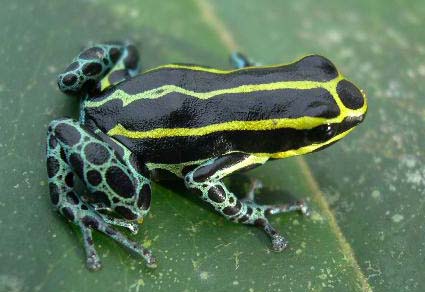
A new species of Ranitomeya from Amazonian lowland forests in western Brazil and southeastern Peru is described and named. This species was formerly considered to be an outlying population of R. uakarii on the southern periphery of its distribution. We analyze new and existing phylogenomic data and infer that the new species is not part of nor closely related to R. uakarii, but is sister to a clade including R. benedicta and a lineage referred to here as R. aff. benedicta. The new species can be distinguished from all other Ranitomeya by its distinctive color pattern, with thin yellow stripes on the dorsum, complete dorsolateral stripes, a complete labial stripe, and a single middorsal stripe that extends from the vent, forks into two stripes anterior to the orbital sockets and merges with dorsolateral stripes, forming a large yellow ring on the top of snout. There are four Ranitomeya species that look similar and co-occur in the general distribution of the new species (R. hwata, R. sirensis, R. variabilis, and R. toraro). The new species can be distinguished from all of them by the combination of a complete middorsal stripe and a round black rostral spot. Given the few and temporally scattered known records, the new species appears to be naturally rare, which raises concern regarding its conservation status.
References
- Albert, J., Carvalho, T.P., Chuctaya, J.A., Petry, P., Reis, R.O., Rengifo, B. & Ortega, H. (2012) Fishes of the Fitzcarrald, Peruvian Amazon. Lulu Press, Raleigh, North Carolina, 251 pp.
- Bolger, A.M., Lohse, M. & Usadel, B. (2014) Trimmomatic: a flexible trimmer for Illumina sequence data. Bioinformatics, 30 (15), 2114–2120. https://doi.org/10.1093/bioinformatics/btu170
- Boulenger, G. (1884) On a collection of frogs from Yurimaguas, Huallaga River, northern Peru. In: Proceedings of the Zoological Society of London. Vol. 1883. London Academic Press, London, pp. 635–638. https://doi.org/10.1111/j.1469-7998.1883.tb06669.x
- Brown, J.L., Schulte, R. & Summers, K. (2006) A new species of Dendrobates (Anura: Dendrobatidae) from the Amazonian lowlands in Peru. Zootaxa, 1152 (1), 45–58. https://doi.org/10.11646/zootaxa.1152.1.2
- Brown, J.L., Twomey, E., Amézquita, A., de Souza, M.B., Caldwell, J.P., Lötters, S., von May, R., Melo-Sampaio, P.R., Mejia-Vargas, D., Perez-Pena, P. & Pepper, M. (2011) A taxonomic revision of the Neotropical poison frog genus Ranitomeya (Amphibia: Dendrobatidae). Zootaxa, 3083 (1), 1–120. https://doi.org/10.11646/zootaxa.3083.1.1
- Brown, J.L., Twomey, E., Pepper, M. & Rodriguez, M.S. (2008) Revision of the Ranitomeya fantastica species complex with description of two new species from Central Peru (Anura: Dendrobatidae). Zootaxa, 1823 (1), 1–24. https://doi.org/10.11646/zootaxa.1823.1.1
- Caldwell, J.P. & de Oliveira, V.R. (1999) Determinants of biparental care in the spotted poison frog, Dendrobates vanzolinii (Anura: Dendrobatidae). Copeia, 1999 (3), 565–575. https://doi.org/10.2307/1447590
- Catenazzi, A., Lehr, E. & von May, R. (2013) The amphibians and reptiles of Manu National Park and its buffer zone, Amazon basin and eastern slopes of the Andes, Peru. Biota Neotropica, 13 (4), 269–283. https://doi.org/10.1590/S1676-06032013000400024
- Crnobrna, B., Santa-Cruz Farfan, R., Gallegos, C., Lopez-Rojas, J., Llanqui, I.B., Panduro Pisco, G. & Arbaiza, A.K. (2023) Herpetological records from the Abujao basin, central Peruvian Amazon. Check List, 19 (4), 433–465. https://doi.org/10.15560/19.4.433
- Espurt, N. (2007) Influence de la subduction d’une ride asismique sur la dynamique de la plaque continentale chevauchante: exemple de la ride de Nazca et du bassin amazonien. PhD Thesis, Université Paul Sabatier—Toulouse III, Toulouse, 328 pp.
- Espurt, N., Baby, P., Brusset, S., Roddaz, M., Hermoza, W. & Barbarand, J. (2010) The Nazca Ridge and uplift of the Fitzcarrald Arch: Implications for regional geology in northern South America. In: Hoorn, C. & Wesselingh, F.P. (Eds.), Amazonia: Landscape and Species Evolution: A Look into the Past. Wiley-Blackwell, Hoboken, New Jersey, pp. 89–100. https://doi.org/10.1002/9781444306408.ch6
- Espurt, N., Baby, P., Brusset, S., Roddaz, M., Hermoza, W., Regard, V., Antoine, P-O. & Salas-Gismondi, R. & Bolaños, R. (2007) How does the Nazca Ridge subduction influence the modern Amazonian foreland basin? Geology, 35 (6), 515–518. https://doi.org/10.1130/G23237A.1
- Espurt, N., Brusset, S., Baby, P., Hermoza, W., Bolaños, R., Uyen, D. & Déramond, J. (2008a) Paleozoic structural controls on shortening transfer in the Subandean foreland thrust system, Ene and southern Ucayali basins, Peru. Tectonics, 27 (3), TC3009. https://doi.org/10.1029/2007TC002238
- Espurt, N., Funiciello, F., Martinod, J., Guillaume, B., Regard, V., Faccenna, C & Brusset, S. (2008b) Flat subduction dynamics and deformation of the South American plate: Insights from analog modeling. Tectonics, 27 (3), TC3011. https://doi.org/10.1029/2007TC002175
- Faircloth, B.C. (2016) PHYLUCE is a software package for the analysis of conserved genomic loci. Bioinformatics, 32 (5), 786–788. https://doi.org/10.1093/bioinformatics/btv646
- Faircloth, B.C., McCormack, J.E., Crawford, N.G., Harvey, M.G., Brumfield, R.T. & Glenn, T.C. (2012) Ultraconserved elements anchor thousands of genetic markers spanning multiple evolutionary timescales. Systematic Biology, 61 (5), 717–726. https://doi.org/10.1093/sysbio/sys004
- Faircloth, B.C., Sorenson, L., Santini, F. & Alfaro, M.E. (2013) A phylogenomic perspective on the radiation of ray-finned fishes based upon targeted sequencing of ultraconserved elements (UCEs). PLoS One, 8 (6), e65923. https://doi.org/10.1371/journal.pone.0065923
- Fonseca, W.L., Silva, J.D., Abegg, A.D., Rosa, C.M. & Bernarde, D.A. (2019) Herpetofauna of Porto Walter and surrounding areas, Southwest Amazonia, Brazil. Herpetology Notes, 12, 91–107.
- Grant, T., Frost, D.R., Caldwell, J.P., Gagliardo, R., Haddad, C.F.B., Kok, P.J.R., Means, D.B., Noonan, B.P., Schargel, W.E. & Wheeler, W.C. (2006) Phylogenetic systematics of dart-poison frogs and their relatives (Amphibia: Athesphatanura: Dendrobatidae). Bulletin of the American Museum of Natural History, 2006 (299), 1–262. https://doi.org/10.1206/0003-0090(2006)299[1:PSODFA]2.0.CO;2
- Grant, T., Rada, M., Anganoy-Criollo, M., Batista, A., Dias, P.H., Jeckel, A.M., Machado, D.J. & Rueda-Almonacid, J.V. (2017) Phylogenetic systematics of dart-poison frogs and their relatives revisited (Anura: Dendrobatoidea). South American Journal of Herpetology, 12 (s1), S1–S90. https://doi.org/10.2994/SAJH-D-17-00017.1
- IUCN (2012) IUCN Red List Categories and Criteria. Version 3.1. 2nd Edition. Available from: https://portals.iucn.org/library/node/10315/ (accessed 5 September 2025)
- Kalyaanamoorthy, S., Minh, B.Q., Wong, T.K., Von Haeseler, A. & Jermiin, L.S. (2017) ModelFinder: fast model selection for accurate phylogenetic estimates. Nature Methods, 14 (6), 587–589. https://doi.org/10.1038/nmeth.4285
- Katoh, K. & Standley, D.M. (2013) MAFFT multiple sequence alignment software version 7: improvements in performance and usability. Molecular Biology and Evolution, 30 (4), 772–780. https://doi.org/10.1093/molbev/mst010
- Koch, E.D., Mônico, A.T., Dayrell, J.S., Ferreira, A.S., Dantas, S.P., Moravec, J. & Lima, A.P. (2025) A remarkable new blue Ranitomeya species (Anura: Dendrobatidae) with copper metallic legs from open forests of Juruá River Basin, Amazonia. PLoS One, 20 (5), e0321748. https://doi.org/10.1371/journal.pone.0321748
- Korneliussen, T.S., Albrechtsen, A. & Nielsen, R. (2014) ANGSD: analysis of next generation sequencing data. BMC Bioinformatics, 15 (1), 356. https://doi.org/10.1186/s12859-014-0356-4
- Li, H. (2013) Aligning sequence reads, clone sequences and assembly contigs with BWA-MEM. arXiv preprint arXiv, 1303.3997. [q-bio.GN] https://doi.org/10.48550/arXiv.1303.3997
- Melin, D.E. (1941) Contributions to the knowledge of the Amphibia of South America. Göteborgs Kungliga Vetenskaps- och Vitterhets-samhälles Handlingar, Serien B, Matematiska och Naturvetenskapliga Skrifter, 1 (4), 1–71.
- Minh, B.Q., Nguyen, M.A.T. & Von Haeseler, A. (2013) Ultrafast approximation for phylogenetic bootstrap. Molecular Biology and Evolution, 30 (5), 1188–1195. https://doi.org/10.1093/molbev/mst024
- Mônico, A.T., Koch, E.D., Dayrell, J.S., Moravec, J. & Lima, A.P. (2025) An Amazonian hidden gem: a new metallic-colored species of Ranitomeya (Anura, Dendrobatidae) from Juruá River basin forests, Amazonas state, Brazil. ZooKeys, 1236, 51. https://doi.org/10.3897/zookeys.1236.146533
- Mora, A., Baby, P., Roddaz, M., Parra, M., Brusset, S., Hermoza, W. & Espurt, N. (2010) Tectonic history of the Andes and sub-Andean zones: implications for the development of the Amazon drainage basin. In: Hoorn, C. & Wesselingh, F.P. (Eds.), Amazonia, Landscape and Species Evolution: A Look into the Past. Wiley-Blackwell, Hoboken, New Jersey, pp. 38–60. https://doi.org/10.1002/9781444306408.ch4
- Muell, M.R., Chávez, G., Prates, I., Guillory, W.X., Kahn, T.R., Twomey, E., Rodrigues, M.T. & Brown, J.L. (2022) Phylogenomic analysis of evolutionary relationships in Ranitomeya poison frogs (Family Dendrobatidae) using ultraconserved elements. Molecular Phylogenetics and Evolution, 168, 107389. https://doi.org/10.1016/j.ympev.2022.107389
- Myers, C.W. (1982) Spotted poison frogs: descriptions of three new Dendrobates from western Amazonia and resurrection of a lost species from "Chiriqui". American Museum Novitates, 2721, 1–23.
- Nguyen, L.-T., Schmidt, H.A., Von Haeseler, A. & Minh, B.Q. (2015) IQ-TREE: a fast and effective stochastic algorithm for estimating maximum-likelihood phylogenies. Molecular Biology and Evolution, 32 (1), 268–274. https://doi.org/10.1093/molbev/msu300
- Prjibelski, A., Antipov, D., Meleshko, D., Lapidus, A. & Korobeynikov, A. (2020) Using SPAdes de novo assembler. Current Protocols in Bioinformatics, 70 (1), e102. https://doi.org/10.1002/cpbi.102
- Raposo do Amaral, F., Neves, L.G., Resende Jr, M.F., Mobili, F., Miyaki, C.Y., Pellegrino, K.C.M. & Biondo, C. (2015) Ultraconserved elements sequencing as a low-cost source of complete mitochondrial genomes and microsatellite markers in non-model amniotes. PLoS One, 10 (9), e0138446. https://doi.org/10.1371/journal.pone.0138446
- Regard, V., Lagnous, R., Espurt, N., Darrozes, J., Baby, P., Roddaz, M., Calderon, Y. & Hermoza, W. (2009) Geomorphic evidence for recent uplift of the Fitzcarrald Arch (Peru): A response to the Nazca Ridge subduction. Geomorphology, 107 (3–4), 107–117. https://doi.org/10.1016/j.geomorph.2008.12.003
- Roberts, J., Brown, J., von May, R., Arizabal, W., Presar, A., Symula, R. & Schulte, R. (2006) Phylogenetic relationships among poison frogs of the genus Dendrobates (Dendrobatidae): A molecular perspective from increased taxon sampling. The Herpetological Journal, 16, 377–385.
- Salas-Gismondi, R., Antoine, P., Baby, P., Brusset, S., Benammi, M., Espurt, N., De Franceschi, D., Pujos, F., Tejada, J. & Urbina, M. (2007) Middle Miocene crocodiles from the Fitzcarrald Arch, Amazonian Peru. Cuadernos del Museo Geominero, 8, 355–360.
- Santos, J.C., Coloma, L.A., Summers, K., Caldwell, J.P., Ree, R. & Cannatella, D.C. (2009) Amazonian amphibian diversity is primarily derived from late Miocene Andean lineages. PLoS Biology, 7 (3), e1000056. https://doi.org/10.1371/journal.pbio.1000056
- Schulte, R. (1999) Pfeilgiftfrösche: Artenteil-Peru. Karl Hauck, Waiblingen, 292 pp.
- Shreve, B. (1935) On a new teiid and Amphibia from Panama, Ecuador, and Paraguay. Occasional Papers of the Boston Society of Natural History, 8 (1935), 209–218.
- de Souza, M.B. (2003) Diversidade de anfíbios nas unidades de conservação ambiental: Reserva Extrativista do Alto Juruá (REAJ) e Parque Nacional da Serra do Divisor (PNSD), Acre–Brasil. PhD Thesis, Universidade Estadual Paulista, Rio Claro, São Paulo, 152 pp.
- de Souza, M.B. (2009) Anfíbios: Reserva Extrativista do Alto Juruá e Parque Nacional da Serra do Divisor, Acre. IFCH, Campinas, 77 pp.
- Tejada-Lara, J.V., Salas-Gismondi, R., Pujos, F., Baby, P., Benammi, M., Brusset, S., Franceschi, D.D.D., Espurt, E., Urbina, M. & Antoine, P.-O. (2015) Life in proto-Amazonia: Middle Miocene mammals from the Fitzcarrald Arch (Peruvian Amazonia). Palaeontology, 58 (2), 341–378. https://doi.org/10.1111/pala.12147
- Twomey, E. & Brown, J.L. (2009) Another new species of Ranitomeya (Anura: Dendrobatidae) from Amazonian Colombia. Zootaxa, 2302 (1), 48–60. https://doi.org/10.11646/zootaxa.2302.1.4
- Twomey, E., Melo-Sampaio, P., Schulte, L.M., Bossuyt, F., Brown, J.L. & Castroviejo-Fisher, S. (2023) Multiple routes to color convergence in a radiation of Neotropical poison frogs. Systematic Biology, 72 (6), 1247–1261. https://doi.org/10.1093/sysbio/syad051
- Twomey, E., Melo-Sampaio, P.R., Brown, J.L., Castroviejo-Fisher, S., Gagliardi-Urrutia, G., Padial, J.M., Gutierrez Poblete, R. & Chaparro, J.C. (2025) A new species of bamboo-dwelling Ranitomeya (Anura: Dendrobatidae) from the Upper Purus River Basin of Brazil and Peru. Zootaxa, 5701 (4), 428–446. https://doi.org/10.11646/zootaxa.5701.4.2
- von May, R., Jacobs, J.M., Jennings, R.D., Catenazzi, A. & Rodríguez, L.O. (2010) Anfibios de Los Amigos, Manu y Tambopata, Perú. Rapid Color Guide 236. The Field Museum, Chicago, Illinois, 12 pp.
- von May, R., Siu-Ting, K., Jacobs, J.M., Medina-Müller, M., Gagliardi, G., Rodriguez, L.O. & Donnelly, M.A. (2009) Species diversity and conservation status of amphibians in Madre de Dios, southern Peru. Herpetological Conservation and Biology, 4 (1), 14–29.