

Abstract
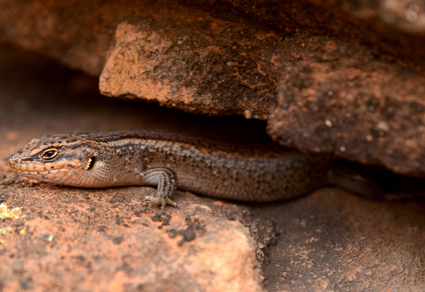
White’s Skinks, Liopholis whitii (Lacépède 1804) are widely distributed throughout rocky habitats of temperate south-eastern Australia, with a highly disjunct population occurring in Mutawintji National Park in arid far western New South Wales. Based on an analysis of genome-wide nuclear single-nucleotide polymorphisms (SNPs) and an assessment of variation in morphology, we provide an appraisal of the group’s evolutionary history and re-evaluate the taxonomic status of candidate lineages. We reveal the presence of three major genetic lineages, including two lineages from temperate south-eastern Australia, and another representing the isolated arid population from Mutawintji National Park. We herein apply the name Liopholis whitii to the temperate “southern” lineage which occurs in South Australia, Victoria and Tasmania; resurrect the name Liopholis compressicauda (Quoy & Gaimard 1824) for the temperate “northern” lineage from southern Queensland, New South Wales, Australian Capital Territory and north-eastern Victoria; and describe the arid lineage from Mutawintji National Park as Liopholis mutawintji sp. nov. Liopholis mutawintji sp. nov. is of particular conservation concern and likely eligible for listing as Critically Endangered under multiple IUCN Red List Criteria.
References
- Ansari, M.H., Cooper, S.J., Schwarz, M.P., Ebrahimi, M., Dolman, G., Reinberger, L., Saint, K.M., Donnellan, S.C., Bull, M.C. & Gardner, M.G. (2019) Plio-Pleistocene diversification and biogeographic barriers in southern Australia reflected in the phylogeography of a widespread and common lizard species. Molecular Phylogenetics and Evolution, 133, 107–119. https://doi.org/10.1016/j.ympev.2018.12.014
- Aplin, K.P., Maryan, B., Armstrong, K.N., Pavey, C.R. & Donnellan, S.C. (2024) Molecular and morphological assessment of the Liopholis inornata (Rosén, 1905) species group (Reptilia: Squamata: Scincidae), with descriptions of two new species from northern Western Australia. Zootaxa, 5551 (2), 299–332. https://doi.org/10.11646/zootaxa.5551.2.4
- Barrows, T.T., Stone, J.O., Fifield, L.K. & Cresswell, R.G. (2001) Late Pleistocene glaciation of the Kosciusko Massif, Snowy Mountains, Australia. Quaternary Research, 55, 179–189. https://doi.org/10.1006/qres.2001.2216
- Boulenger, G.A. (1887) Catalogue of the lizards in the British Museum (Nat. Hist.) III. Lacertidae, Gerrhosauridae, Scincidae, Anelytropsidae, Dibamidae, Chamaeleontidae. British Museum, London, 575 pp.
- Brennan, I.G., Chapple, D.G., Keogh, S.J. & Donnellan, S. (2024) Evolutionary bursts drive morphological novelty in the world’s largest skinks. Current Biology, 34, 1–12.
- https://doi.org/10.1016/j.cub.2024.07.039
- Bryant, L.M. & Krosch, M.N. (2016) Lines in the land: a review of evidence for eastern Australia’s major biogeographical barriers to closed forest taxa. Biological Journal of the Linnean Society, 119, 238–264. https://doi.org/10.1111/bij.12821
- Brygoo, É.-R. (1985) Les types de Scincidés (Reptiles, Sauriens) du Muséum national d’Histoire naturelle. Catalogue critique. Bulletin du Muséum National d’Histoire Naturelle, Series 4, 7, Section A (Zoologie, Biologie et Écologie animales), 3 (Supplement), 1–126. https://doi.org/10.5962/p.287631
- Bureau of Meteorology (2025) Previous droughts: The 2017–2019 drought. Australian Government, Melbourne, Victoria. Available from: http://www.bom.gov.au/climate/drought/knowledge-centre/previous-droughts.shtml (Accessed 1 Apr. 2026)
- Byrne, M. (2008) Evidence for multiple refugia at different time scales during Pleistocene climatic oscillations in southern Australia inferred from phylogeography. Quaternary Science Reviews, 27 (27–28), 2576–2585. https://doi.org/10.1016/j.quascirev.2008.08.032
- Byrne, M., Yeates, D.K., Joseph, L., Kearney, M., Bowler, J., Williams, M.A.J., Cooper, S., Donnellan, S.C., Keogh, J.S., Leys, R. & Melville, J. (2008) Birth of a biome: insights into the assembly and maintenance of the Australian arid zone biota. Molecular Ecology, 17 (20), 4398–4417. https://doi.org/10.1111/j.1365-294x.2008.03899.x
- Cabrelli, A. & Hughes, L. (2015) Assessing the vulnerability of Australian skinks to climate change. Climatic Change, 130, 223–233. https://doi.org/10.1007/s10584-015-1358-6
- Chapple, D.G. (2003) Ecology, life-history, and behaviour in the Australian scincid genus Egernia, with comments on the evolution of complex sociality in lizards. Herpetological Monographs, 17 (1), 145–180. https://doi.org/10.1655/0733-1347(2003)017[0145:elabit]2.0.co;2
- Chapple, D.G. (2005) Life history and reproductive ecology of White’s skink, Egernia whitii. Australian Journal of Zoology, 53, 353–360. https://doi.org/10.1071/zo05030
- Chapple, D.G. & Keogh, S.J. (2004) Parallel adaptive radiations in arid and temperate Australia: molecular phylogeography and systematics of the Egernia whitii (Lacertilia: Scincidae) species group. Biological Journal of the Linnean Society, 83 (2), 157–173.
- https://doi.org/10.1111/j.1095-8312.2004.00378.x
- Chapple, D.G. & Keogh, S.J. (2005) Complex mating system and dispersal patterns in a social skink, Egernia whitii. Molecular Ecology, 14, 1215–1227.
- https://doi.org/10.1111/j.1365-294X.2005.02486.x
- Chapple, D.G. & Keogh, S.J. (2006) Group structure and stability in social aggregations of White’s Skink, Egernia whitii. Ethology, 112, 247–257. https://doi.org/10.1111/j.1439-0310.2006.01153.x
- Chapple, D.G., Chapple, S.N. & Thompson, M.B. (2011) Biogeographic barriers in south‐eastern Australia drive phylogeographic divergence in the garden skink, Lampropholis guichenoti. Journal of Biogeography, 38 (9), 1761–1775. https://doi.org/10.1111/j.1365-2699.2011.02531.x
- Chapple, D.G., Keogh, J.S. & Hutchinson, M.N. (2005) Substantial genetic substructuring in southeastern and alpine Australia revealed by molecular phylogeography of the Egernia whitii (Lacertilia: Scincidae) species group. Molecular Ecology, 14 (5), 1279–1292. https://doi.org/10.1111/j.1365-294x.2005.02463.x
- Chifman, J. & Kubatko, L. (2014) Quartet inference from SNP data under the coalescent model. Bioinformatics, 30 (23), 3317–3324.
- https://doi.org/10.1093/bioinformatics/btu530
- Cogger, H.G. (1975) Reptiles and Amphibians of Australia. A.H. & A.W. Reed, Terrey Hills, 584 pp.
- Cogger, H.G., Cameron, E.E. & Cogger, H.M. (1983) Zoological Catalogue of Australia. 1. Amphibia and Reptilia. Australian Government Publishing Service, Canberra, vi + 313 pp.
- https://doi.org/10.1163/9789004626614_003
- Condon, H.T. (1941) Further records of lizards and frogs from Kangaroo Island. Records of the South Australian Museum, 7, 111–116.
- Cooper, S.J.B., Adams, M. & Labrinidis, A. (2000) Phylogeography of the Australian dunnart Sminthopsis crassicaudata (Marsupialia: Dasyuridae). Australian Journal of Zoology, 48, 461–473. https://doi.org/10.1071/zo00014
- de Freycinet, L. (1839) Voyage Autour du Monde, Entrepris par Ordre du Roi, sous le Ministère et conformément aux instructions de S. Exc. M. le Vicomte du Bouchage, Secrétaire d’état au Département de la Marine, Exécuté sur les corvettes de S. M. l’Uranie et la Physicienne, pendant les années 1817, 1818, 1819 et 1820. Historique. Tome Deuxième. Deuxième Partie. Pillet Aìné, Paris, 400 pp.
- de Queiroz, K. (1998) The general lineage concept of species, species criteria, and the process of speciation: A conceptual unification and terminological recommendations. In: Howard, D.J. & Berlocher, S.H. (Eds.), Endless Forms: Species and Speciation. Oxford University Press, Oxford, pp. 57–75.
- de Queiroz, K. (2007) Species concepts and species delimitation. Systematic Biology, 56 (6), 879–886. https://doi.org/10.1080/10635150701701083
- Department of Climate Change, Energy, the Environment and Water (2024) NARCliM: Far West Climate Change Snapshot. New South Wales Government, Parramatta, New South Wales, 21 pp. [https://www.climatechange.environment.nsw.gov.au/sites/default/files/2024-08/NARCliM2-Snapshot-FarWest.pdf]
- Dissanayake, D.S., Holleley, C.E., Sumner, J., Melville, J. & Georges, A. (2022) Lineage diversity within a widespread endemic Australian skink to better inform conservation in response to regional‐scale disturbance. Ecology and Evolution, 12, e8627. https://doi.org/10.1002/ece3.8627
- Donnellan, S.C., Hutchinson, M.N., Dempsey, P. & Osbourne, W. (2002) Systematics of the Egernia whitii species group (Lacertilia: Scincidae) in southeastern Australia. Australian Journal of Zoology, 50, 439–459. https://doi.org/10.1071/zo01065
- Dubey, S. & Shine, R. (2010) Evolutionary diversification of the lizard genus Bassiana (Scincidae) across southern Australia. PLoS One, 5, e12982. https://doi.org/10.1371/journal.pone.0012982
- Duméril, A.M.C. & Bibron, G. (1839) Erpétologie Générale on Histoire Naturelle Complète des Reptiles. Tome Cinquième, contenant l’histoire de quatre-vingt-trois genres et de deux cent sept espèces des trois dernières familles de l’ordre des sauriens, savoir: les Lacertiens, les Chalcidiens et les Scincoïdens. Roret, Paris: viii + 854 + [1] pp.
- Duyker, E. (2014) Dumont d’Urville. Explorer & Polymath. Otago University Press, Dunedin, 671 pp.
- Evanno, G., Regnaut, S. & Goudet, J. (2005) Detecting the number of clusters of individuals using the software STRUCTURE: a simulation study. Molecular Ecology, 14 (8), 2611–2620. https://doi.org/10.1111/j.1365-294x.2005.02553.x
- Farquhar, J.E., Mulder, J.A., Russell, W., Haines, M.L., Rangers, A. & Chapple, D.G. (2024) A new species of rock skink (Scincidae: Liopholis) from the Central Ranges bioregion of arid Australia. Zootaxa, 5536 (1), 153–177.
- https://doi.org/10.11646/zootaxa.5536.1.6
- Fitzinger, L. (1843) Systema Reptilium. Fasciculus Primus. Amblyglossae. Braumüller et Seidel, Wien, 106 pp.
- https://doi.org/10.5962/bhl.title.4694
- Foster, R. (1993) A significant range extension of Egernia margaretae personata? Herpetofauna, 23 (2), 35–36.
- https://doi.org/10.5962/p.420587
- Gardner, M.G., Hugall, A.F., Donnellan, S.C., Hutchinson, M.N. & Foster, R. (2008) Molecular systematics of social skinks: phylogeny and taxonomy of the Egernia group (Reptilia: Scincidae). Zoological Journal of the Linnean Society, 154 (4), 781–794. https://doi.org/10.1111/j.1096-3642.2008.00422.x
- Georges, A., Gruber, B., Pauly, G.B., White, D., Adams, M., Young, M.J., Kilian, A., Zhang, X., Shaffer, H.B. & Unmack, P.J. (2018) Genomewide SNP markers breathe new life into phylogeography and species delimitation for the problematic short‐necked turtles (Chelidae: Emydura) of eastern Australia. Molecular Ecology, 27 (24), 5195–5213. https://doi.org/10.1111/mec.14925
- Gray, J.E. (1838) Catalogue of the slender-tongued saurians, with descriptions of many new genera and species. Part 1. Annals and Magazine of Natural History, Series 1, 1 (4), 274–283.
- https://doi.org/10.1080/00222933809512291
- Gray, J.E. (1845) Catalogue of the specimens of lizards in the collection of the British Museum. Edward Newman, London, xxviii + 289 pp.
- Gruber, B., Unmack, P.J., Berry, O.F. & Georges, A. (2018) dartr: An r package to facilitate analysis of SNP data generated from reduced representation genome sequencing. Molecular Ecology Resources, 18 (3), 691–699. https://doi.org/10.1111/1755-0998.12745
- Guibé, J. (1954) Catalogue des Types de Lézards du Muséum national d’Histoire naturelle. Colas, Bayeux, 120 pp.
- Halliwell, B., Uller, T., Wapstra, E. & While, G.M. (2016) Resource distribution mediates social and mating behavior in a family living lizard. Behavioral Ecology, 28 (1), 145–153. https://doi.org/10.1093/beheco/arw134
- Hedrick, P.W. (2005) A standardized genetic differentiation measure. Evolution, 59 (8), 1633–1638. https://doi.org/10.1111/j.0014-3820.2005.tb01814.x
- Henzell, R.P. (1972) Adaptation to aridity in lizards of the Egernia whitei species-group. PhD Thesis, University of Adelaide, Adelaide, xi + 208 pp.
- Hewitt, G. (2000) The genetic legacy of the Quaternary ice ages. Nature, 405 (6789), 907–913. https://doi.org/10.1038/35016000
- Hewitt, G.M. (2004) Genetic consequences of climatic oscillations in the Quaternary. Philosophical Transactions of the Royal Society of London. Series B: Biological Sciences, 359 (1442), 183–195.
- https://doi.org/10.1098/rstb.2003.1388
- Hoang, D.T., Vinh, L.S., Flouri, T., Stamatakis, A., Von Haeseler, A. & Minh, B.Q. (2018) MPBoot: fast phylogenetic maximum parsimony tree inference and bootstrap approximation. BMC Evolutionary Biology, 18, 1–11.
- https://doi.org/10.1186/s12862-018-1131-3
- Holdgate, G.R., Wallace, M.W., Sluiter, I.R., Marcuccio, D., Fromhold, T.A. & Wagstaff, B. E. (2014) Was the Oligocene–Miocene a time of fire and rain? Insights from brown coals of the southeastern Australia Gippsland Basin. Palaeogeography, Palaeoclimatology, Palaeoecology, 411, 65–78. https://doi.org/10.1016/j.palaeo.2014.06.004
- IUCN Standards and Petitions Committee (2024) Guidelines for using the IUCN Red List Categories and Criteria. Version 16. Prepared by the Standards and Petitions Committee. IUCN, Gland, 114 pp. Available from: https://www.iucnredlist.org/documents/RedListGuidelines.pdf (accessed 27 January 2026)
- Jacobs, H.J. & Koch, A. (2021) On the discovery and scientific description of the Emerald Tree Monitor, Varanus prasinus (Schlegel, 1839). Bibliotheca Herpetologica, 15 (7), 61–76.
- Jombart, T., Devillard, S. & Balloux, F. (2010) Discriminant analysis of principal components: a new method for the analysis of genetically structured populations. BMC Genetics, 11, 94.
- https://doi.org/10.1186/1471-2156-11-94
- Kalyaanamoorthy, S., Minh, B.Q., Wong, T.K., Von Haeseler, A. & Jermiin, L.S. (2017) ModelFinder: fast model selection for accurate phylogenetic estimates. Nature Methods, 14 (6), 587–589.
- https://doi.org/10.1038/nmeth.4285
- Kawakami, T., Butlin, R.K., Adams, M., Saint, K.M., Paull, D.J. & Cooper, S.J. (2009) Re-examination of a proposed case of stasipatric speciation: phylogeography of the Australian morabine grasshoppers (Vandiemenella viatica species group). Molecular Ecology, 18, 3429–3442. https://doi.org/10.1111/j.1365-294x.2009.04277.x
- Kilian, A., Wenzl, P., Huttner, E., Carling, J., Xia, L., Blois, H., Craig, V., Heller-Uszynska, K., Jaccoud, D., Hopper, C., Ashcenbrenner-Kilian, M., Evers, M., Peng, K., Cayla, C., Hok, P. & Uszynski, G. (2012) Diversity Arrays Technology: a generic genome profiling technology on open platforms. In: Pompanon, F., Bonin, A. (Eds.), Data production and analysis in population genomics. Methods in Molecular Biology. Vol. 888. Humana Press, Totowa, New Jersey, pp. 67–89.
- https://doi.org/10.1007/978-1-61779-870-2_5
- Kopelman, N.M., Mayzel, J., Jakobsson, M., Rosenberg, N.A. & Mayrose, I. (2015) Clumpak: a program for identifying clustering modes and packaging population structure inferences across K. Molecular Ecology Resources, 15, 1179–1191. https://doi.org/10.1111/1755-0998.12387
- Lacépède, [B.G.E.L.] (1804) Mémoire sur plusieurs animaux de la Nouvelle- Hollande dont la description n’a pas encore été publiée. Annales du Muséum National d’Histoire Naturelle, 4, 184–211.
- Lambeck, K. & Chappell, J. (2001) Sea level change through the last glacial cycle. Science, 292 (5517), 679–686. https://doi.org/10.1126/science.1059549
- Leaché, A.D., Banbury, B.L., Felsenstein, J., de Oca, A.N. & Stamatakis A. (2015) Short tree, long tree, right tree, wrong tree: new acquisition bias corrections for inferring SNP phylogenies. Systematic Biology, 64, 1032–1047. https://doi.org/10.1093/sysbio/syv053
- Loveridge, A. (1934) Australian reptiles in the Museum of Comparative Zoölogy, Cambridge, Massachusetts. Bulletin of the Museum of Comparative Zoölogy at Harvard College, 77 (6), 243-383 + pl.
- Martin, H.A. (2006) Cenozoic climatic change and the development of the arid vegetation in Australia. Journal of Arid Environments, 66 (3), 533–563. https://doi.org/10.1016/j.jaridenv.2006.01.009
- Merrem, B. (1820) Versuch eines Systems der Amphibien/Tentamen Systematis Amphibiorum. J.C. Kreiger, Marburg, xv + 191 pp., 1 pl. [duplicating facing pages of German and Latin with identical pagination, up to p. 188]
- https://doi.org/10.5962/bhl.title.5037
- Milton, D.R. (1987) Reproduction of two closely related skinks, Egernia modesta and E. whitii (Lacertilia: Scincidae) in south-east Queensland. Australian Journal of Zoology, 35 (1), 35–41. https://doi.org/10.1071/zo9870035
- Mitchell, F.J. & Behrndt, A.C. (1949) Fauna and flora of the Greenly Islands. Part 1. Introductory narrative and vertebrate fauna. Records of the South Australian Museum, 9, 167–179.
- Moritz, C., Patton, J.L., Schneider, C.J. & Smith, T.B. (2000) Diversification of rainforest faunas: an integrated molecular approach. Annual Review of Ecology and Systematics, 31 (1), 533–563. https://doi.org/10.1146/annurev.ecolsys.31.1.533
- Nguyen, L.T., Schmidt, H.A., Von Haeseler, A. & Minh, B.Q. (2015) IQ-TREE: a fast and effective stochastic algorithm for estimating maximum-likelihood phylogenies. Molecular Biology and Evolution, 32 (1), 268–274. https://doi.org/10.1093/molbev/msu300
- NSW National Parks & Wildlife Service (2000) Centralian Ranges Rock-skink (Egernia margaretae) Recovery Plan. NSW NPWS, Dubbo, New South Wales. Available from: https://nswdpe.intersearch.com.au/nswdpejspui/bitstream/1/12999/1/centralian-ranges-rock-skink-egernia-margaretae-recovery-plan.pdf (accessed 31 March 2025)
- NSW Threatened Species Scientific Committee (2005a) Egernia margaretae–removal from endangered species list. NSW Department of Climate Change, Energy, the Environment and Water. Parramatta, New South Wales. Available from: https://www.environment.nsw.gov.au/topics/animals-and-plants/threatened-species/nsw-threatened-species-scientific-committee/determinations/final-determinations/2004-2007/egernia-margaretae-removal-from-endangered-species-list (accessed 31 March 2025)
- NSW Threatened Species Scientific Committee (2005b) White’s skink (Liopholis whitii) population, Broken Hill Complex Bioregion—endangered population listing. NSW Department of Climate Change, Energy, the Environment and Water, Parramatta, New South Wales. Available from: https://www.environment.nsw.gov.au/topics/animals-and-plants/threatened-species/nsw-threatened-species-scientific-committee/determinations/final-determinations/2004-2007/whites-skink-liopholis-whitii-endangered-population-listing (accessed 31 March 2025)
- Oppel, M. (1811) Die Ordnungen, Familien und Gattungen der Reptilien als Prodrome einer Naturgeschichte derselben. Joseph Lindauer, München, xii + 86 + [1] pp.
- Parkin, T., Rowley, J.J.L., Elliot-Tate, J., Mahony, M.J., Sumner, J., Melville, J. & Donnellan, S.C. (2024) Systematic assessment of the brown tree frog reveals two endemic species in South Australia. Zootaxa, 5406 (1), 1–36. https://doi.org/10.11646/zootaxa.5406.1.1
- Pembleton, L.W., Cogan, N.O. & Forster, J.W. (2013) StAMPP: An R package for calculation of genetic differentiation and structure of mixed‐ploidy level populations. Molecular Ecology Resources, 13 (5), 946–952. https://doi.org/10.1111/1755-0998.12129
- Pepper, M. & Keogh, J.S. (2021) Life in the “dead heart” of Australia: The geohistory of the Australian deserts and its impact on genetic diversity of arid zone lizards. Journal of Biogeography, 48 (4), 716–746. https://doi.org/10.1111/jbi.14063
- Peters, W. (1863) Ein Übersicht de von Hrn. Richard Schomburgk an das zoologische Museum eingesandten Amphibien und Reptilien, aus Buchsfelde bei Adelaide in Südaustralien. Monatsberichte der K. Preussische Akademie der Wissenschafte zu Berlin, 1863, 228–236.
- Pritchard, J.K., Stephens, M. & Donnelly, P. (2000) Inference of population structure using multilocus genotype data. Genetics, 155 (2), 945–959.
- https://doi.org/10.1093/genetics/155.2.945
- Quoy, [J.R.] & Gaimard, [J.P.] (1824a) Description d’une nouvelle espèce de Tortue et de trois espèces nouvelles de Scinques. Bulletin des Sciences Naturelles et de Géologie, 1 (1), 90–91.
- Quoy, [J.R.] & Gaimard, [J.P.] (1824b) Zoologie. In: de Freycinet, L., Voyage Autour du Monde, Entrepris par le ministére et conformément aux instructions de s. exc. M. le Vicomte du Bouchage, Secrétaire d’etat au Départment de la Marine, Exécuté sur les corvettes de S.M. l’Uranie et la Physicienne, pendant les années 1817–1820. Pillet Aìné, Paris, pp. i–iv + 1–712.
- Sadlier, R.A., Frankham, G.J., Beatson, C.A., Eldridge, M.D. & Rowley, J.J. (2019) Genetic evidence in support of the recognition of the Kaputar Rock Skink, one of New South Wales’ most range-restricted vertebrate species. Records of the Australian Museum, 71 (5), 183–197.
- https://doi.org/10.3853/j.2201-4349.71.2019.1716
- Sass, S. & Swan, G. (2010) The herpetofauna of the bimble box-pine woodlands of the Cobar Peneplain Western NSW. Herpetofauna, 40 (1–2), 39–47.
- https://doi.org/10.5962/p.432741
- Schäuble, C.S. & Moritz, C. (2001) Comparative phylogeography of two open forest frogs from eastern Australia. Biological Journal of the Linnean Society, 74 (2), 157–170. https://doi.org/10.1111/j.1095-8312.2001.tb01384.x
- Sherborn, C.D. & Woodward, B.B. (1901) Notes on the dates of publication of the natural history portions of some French voyages.—Part I. ‘Amérique méridionale’; ‘Indes orientales’; ‘Pôle Sud’ (‘Astrolabe’ and ‘Zélée’); ‘La Bonite’; ‘La Coquille’; and ‘L’Uranie et Physicienne.’. Annals and Magazine of Natural History, Series 7, 7 (40), 388–392.
- https://doi.org/10.1080/00222930108678490
- Sniderman, J.M.K., Woodhead, J.D., Hellstrom, J., Jordan, G.J., Drysdale, R.N., Tyler, J.J. & Porch, N. (2016) Pliocene reversal of late Neogene aridification. Proceedings of the National Academy of Sciences, 113 (8), 1999–2004. https://doi.org/10.1073/pnas.1520188113
- Stift, M., Kolář, F. & Meirmans, P.G. (2019) STRUCTURE is more robust than other clustering methods in simulated mixed-ploidy populations. Heredity, 123, 429–441. https://doi.org/10.1038/s41437-019-0247-6
- Storr, G.M. (1968) Revision of the Egernia whitei species-group (Lacertilia: Scincidae). Journal of the Royal Society of Western Australia, 51, 51–62.
- Swan, G. & Foster, R. (2000) Confirmation of occurrence of the skink Egernia margaretae in western New South Wales. Herpetofauna, 30, 48–49.
- https://doi.org/10.5962/p.432519
- Swan, G. & Foster, R. (2005) The reptiles and amphibians of Mutawintji National Park, Western New South Wales. Australian Zoologist, 33 (1), 39–48.
- https://doi.org/10.7882/az.2005.003
- Swan, G., Sadlier, R. & Shea, G. (2022) A Field Guide to Reptiles of New South Wales. 4th Edition. New Holland Publishers, Sydney, 336 pp.
- Swofford, D.L. & Sullivan, J. (2009) Phylogeny inference based on parsimony and other methods using PAUP. In: Lemey, P., Salemi, M. & Vandamme, A.E. (Eds.), The Phylogenetic Handbook: A Practical Approach to Phylogenetic Analysis and Hypothesis Testing. Cambridge: Cambridge University Press, Cambridge, pp. 267–312. https://doi.org/10.1017/cbo9780511819049.010
- Symula, R., Keogh, J.S. & Cannatella, D.C. (2008) Ancient phylogeographic divergence in southeastern Australia among populations of the widespread common froglet, Crinia signifera. Molecular Phylogenetics and Evolution, 47 (2), 569–580. https://doi.org/10.1016/j.ympev.2008.01.011
- Thorpe, R.S. (1976) Biometric analysis of geographic variation and racial affinities. Biological Reviews, 51, 407–452. https://doi.org/10.1111/j.1469-185x.1976.tb01063.x
- Unmack, P.J., Adams, M., Hammer, M.P., Johnson, J.B., Gruber, B., Gilles, A., Young, M. & Georges, A. (2022) Plotting for change: an analytical framework to aid decisions on which lineages are candidate species in phylogenomic species discovery. Biological Journal of the Linnean Society, 135 (1), 117–137. https://doi.org/10.1093/biolinnean/blab095
- Venables, W.N. & Ripley, B.D. (2002) Modern Applied Statistics with S, Fourth edition. Springer, New York, New York, xi + 495 pp.
- https://doi.org/10.1007/978-0-387-21706-2
- Wells, R.W. & Wellington, C.R. (1985) A classification of the Amphibia and Reptilia of Australia. Australian Journal of Herpetology, Supplementary Series No. 1, 1–61.
- Wells, R.W. & Wellington, C.R. (1988) The amphibians and reptiles of the Blue Mountains Region, Sydney Basin, New South Wales Australia. Australian Herpetologist, 504, 1–12.
- Wilson, S. & Swan, G. (2025) A Complete Guide to Reptiles of Australia. 7th Edition. New Holland Publishers, Sydney, 704 pp.
- While, G.M., Uller, T. & Wapstra, E. (2009) Variation in social strategies characterise the social mating system of an Australian lizard, Egernia whitii. Austral Ecology, 34, 938–949. https://doi.org/10.1111/j.1442-9993.2009.02002.x
- Winter, D.J. (2012) MMOD: an R library for the calculation of population differentiation statistics. Molecular Ecology Resources, 12 (6), 1158–1160.
- https://doi.org/10.1111/j.1755-0998.2012.03174.x