

Abstract
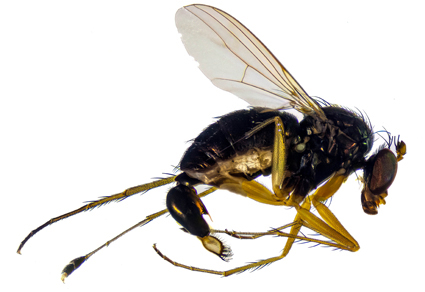
Wing venation provides important characters for systematic and phylogenetic studies of Dolichopodidae and may exhibit sexual dimorphism shaped by underlying biological mechanisms. This study examines sexual dimorphism in wing shape of two Dolichopodinae species, Dolichopus ungulatus and Hercostomus brevicornis, and compares male wing venation with that of closely related species, D. popularis and H. celer. Wing shape was analysed morphometrically using 138 wing images of four species collected in Poland, allowing quantitative assessment of intra- and interspecific variation. The results indicate pronounced sexual dimorphism in both studied species, with partial separation in H. brevicornis, and show significant differentiation in wing venation among related species. These findings highlight the utility of morphometric analysis in detecting subtle morphological differences between sexes and closely related taxa. These morphometric data may provide a useful basis for future studies on wing shape evolution and phylogenetic relationships within Dolichopodinae.
References
- Adams, D.C., Collyer, M., Kaliontzopoulou, A. & Sherratt, E. (2016) Geomorph: Software for geometric morphometric analyses. Comprehensive R Archive Network, Vienna. [software]
- Albert, J. & Rizzo, M. (2024) Multivariate Data. In: R by Example. Use R!. Springer, Cham, pp. 313–345. https://doi.org/10.1007/978-3-031-76074-7_12
- Aldrich, J.M. (1894) Courtship among the flies. The American Naturalist, 28 (325), 35–37. https://doi.org/10.1086/275861
- Bernasconi, M.V., Pollet, M. & Varini-Ooijen, M. & Paul, I.W. (2007) Phylogeny of European Dolichopus and Gymnopternus (Diptera: Dolichopodidae) and the significance of morphological characters inferred from molecular data. European Journal of Entomology, 104 (3), 601–617. https://doi.org/10.14411/eje.2007.075
- Chursina, M.A., Negrobov, O.P. & Selivanova, O.V. (2014) Morphology of Dolichopodidae (Diptera) wings. Amurian Zoological Journal, 6 (1), 51–54. https://doi.org/10.33910/1999-4079-2014-6-1-51-54
- Chursina, M.A., Solodskih, O.Y. & Negrobov, O.P. (2017) Intraspecific variation in wing shape of Dolichopus plumipes (Diptera, Dolichopodidae). Acta entomologica serbica, 22, 91–98.
- Chursina, M.A. (2018) Intraspecific variability of the wing shape of Dolichopus ungulatus Linnaeus, 1758 (Diptera, Dolichopodidae). Bulletin of Tver State University, Series: Biology and Ecology, 3, 21–34. [in Russian] https://doi.org/10.26456/vtbio2
- Chursina, M.A. & Negrobov, O.P. (2018) Phylogenetic Signal in the Wing Shape in the Subfamily Dolichopodinae (Diptera, Dolichopodidae). Entomological Review, 98, 515–527. https://doi.org/10.1134/S0013873818050019
- Chursina, M.A. & Grichanov, I.Ya. (2019) Evolutionary trends in the wing shape of the family Dolichopodidae (Diptera). Caucasian Entomological Bulletin, 15 (1), 215–226. [in Russian] https://doi.org/10.23885/181433262019151-215226
- Chursina, M.A. & Grichanov, I.Ya. (2022) Phylogeny of the genus Dolichopus Latreille, 1796 and testing for phylogenetic signal in morphological characters and morphometric data. bioRxiv. [preprint] https://doi.org/10.1101/2022.02.24.481773
- Chursina, M.A. & Maslova, O.O. (2022) Variation of sexual dimorphism of the wing shape in the family Dolichopodidae (Diptera). Samara Journal of Science, 11 (1), 134–141. https://doi.org/10.55355/snv2022111118
- d'Assis-Fonseca, E.C.M. (1978) Diptera Orthorrhapha Brachycera Dolichopodidae. Handbooks for the Identification of British Insects 9(5). Royal Entomological Society, London, 90 pp.
- Dryden, I.L. & Mardia, K.V. (1998) Statistical shape analysis. Wiley, Chichester, xvii + 347 pp.
- Emlen, D.J. (2001) Costs and the Diversification of Exaggerated Animal Structures. Science, 291, 1534–1536. https://doi.org/10.1126/science.1056607
- Ellington, C.P. (1984) The aerodynamics of hovering insect flight. IV. Aerodynamic mechanisms. Philosophical Transactions of the Royal Society of London, Series B, Biological Sciences, 305 (1122), 79–113. https://doi.org/10.1098/rstb.1984.0052
- Engels, T., Wehmann, H.N. & Lehmann, F.O. (2020) Three-dimensional wing structure attenuates aerodynamic efficiency in flapping fly wings. Journal of the Royal Society Interface, 17 (164), 20190804. https://doi.org/10.1098/rsif.2019.0804
- Dolichopodidae in GBIF Secretariat (2023) GBIF Backbone Taxonomy. Checklist dataset. Available from: https://doi.org/10.15468/39omei (accessed 16 December 2025)
- Gelbič, I. & Olejníček, J. (2011) Ecology of Dolichopodidae (Diptera) in a wetland habitat and their potential role as bioindicators. Central European Journal of Biology, 6, 118–129. https://doi.org/10.2478/s11535-010-0098-x
- Grichanov, I.Ya. (2006) A checklist and keys to North European genera and species of Dolichopodidae (Diptera). All-Russian Institute of Plant Protection RAAS, St. Petersburg, 120 pp.
- Grichanov, I.Ya. & Brooks, S.E. (2017) Dolichopodidae (long-legged flies). In: Kirk-Spriggs, A.H. & Sinclair, B.J. (Eds.), Manual of Afrotropical Diptera. Vol. 2. Nematocerous Diptera and lower Brachycera. Suricata 5. South African National Biodiversity Institute, Pretoria, pp. 1265–1320.
- Klingenberg, C.P., Barluenga, M. & Meyer, A. (2002) Shape analysis of symmetric structures: quantifying variation among individuals and asymmetry. Evolution, 56 (10), 1909–1920. https://doi.org/10.1111/j.0014-3820.2002.tb00117.x
- Klingenberg, C.P. & Monteiro, L.R. (2005) Distances and directions in multidimensional shape spaces: implications for morphometric applications. Systematic Biology, 54 (4), 678–688. https://doi.org/10.1080/10635150590947258
- Land, M.F. (1993a) Chasing and pursuit in the dolichopodids fly Poecilobothrus nobilitatus. Journal of Comparative Physiology A, 173, 605–613. https://doi.org/10.1007/BF00197768
- Land, M.F. (1993b) The visual control of courtship behaviour in the fly Poecilobothrus nobilitatus. Journal of Comparative Physiology A, 173, 605–613. https://doi.org/10.1007/BF00197767
- Lunau, K. (1992) Mating behaviour in the long-legged fly Poecilobothrus nobilitatus L. (Diptera, Dolichopodidae): courtship behaviour, male signalling and mating success. Zoologische Beiträge, 34, 465–479.
- Mardia, K.V., Kent, J.T. & Bibby, J.M. (1979) Multivariate Analysis. Academic Press, London, xv + 521 pp.
- Palaczyk, A. (2022) Digital Catalogue of Biodiversity of Poland — Animalia: Arthropoda: Hexapoda: Insecta: Diptera: Brachycera: Empidoidea. Version 1.3. Polish Biodiversity Information Network, Warsaw. Checklist dataset. Available from: https://doi.org/10.15468/kadehf (accessed 16 December 2025)
- Pollet, M., Meuffels, H. & Grootaert, P. (1992) Geographical distribution and habitat selection of species of Hercostomus subgenus Gymnopternus in the Benelux (Diptera: Dolichopodidae). In: Van Goethem, J.L. & Grootaert, P. (Eds.), Proceedings of the 8th International Colloquium of the European Invertebrate Survey, Brussels, 9–10 September 1991, pp. 101–113.
- Schlager, S. (2017) Morpho and Rvcg – Shape Analysis in R. In: Zheng, G., Li, S. & Szekely, G. (Eds.), Statistical Shape and Deformation Analysis, 217–256. Academic Press, London, pp. 217–256. https://doi.org/10.1016/B978-0-12-810493-4.00011-0
- Smith, K.G. & Empson, D.W. (1955) Note on the courtship and predaceous behaviour of Poecilobothrus nobilitatus L. (Dipt. Dolichopodidae). The British Journal of Animal Behaviour, 3 (1), 32–34.
- Sontigun, N., Sukontason, K.L., Zajac, B.K., Zehner, R., Sukontason, K., Wannasan, A. & Amendt, J. (2017) Wing morphometrics as a tool in species identification of forensically important blow flies of Thailand. Parasites & Vectors, 10, 229. https://doi.org/10.1186/s13071-017-2163-z
- Sontigun, N., Samerjai, C., Sukontason, K., Wannasan, A., Amendt, J., Tomberlin, J.K. & Sukontason, K.L. (2019) Wing morphometric analysis of forensically important flesh flies (Diptera: Sarcophagidae) in Thailand. Acta Tropica, 190, 312–319. https://doi.org/10.1016/j.actatropica.2018.12.011
- Weis-Fogh, T. (1973) Quick estimates of flight fitness in hovering animals, including novel mechanisms for lift production. Journal of Experimental Biology, 59 (1), 169–230. https://doi.org/10.1242/jeb.59.1.169
- Wickham, H. (2016) Getting Started with ggplot2. In: ggplot2. Use R!. Springer, Cham, pp. 11–31. https://doi.org/10.1007/978-3-319-24277-4_2
- Zahavi, A. (1981) Natural selection, sexual selection and the selection of signals. In: Evolution Today: Proceedings of the Second International Congress of Systematic and Evolution Biology. Hunt Institute for Botanical Documentation, Carnegie-Mellon University, Pittsburgh, Pennsylvania, pp. 133–138.
- Zimmer, M., Diestelhorst, O. & Lunau, K. (2003) Courtship in long-legged flies (Diptera: Dolichopodidae): function and evolution of signals. Behavioral Ecology, 14 (4), 526–530. https://doi.org/10.1093/beheco/arg028
- Zimmer, M. (2000) Visual communication during courtship in long-legged flies (Diptera: Dolichopodidae). Verhandlungen der Westdeutschen Entomologen-Gesellschaft, 12, 159–167.