
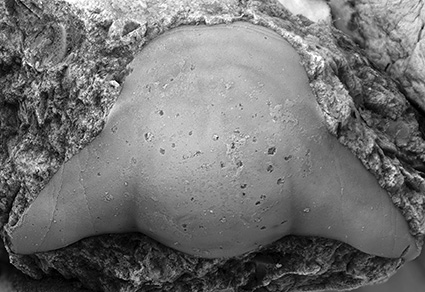

Abstract
Kingstonia Walcott, 1924 is widespread across Laurentian North America in Upper Marjuman (Guzhangian) strata. It is recorded from mixed carbonate-siliciclastic, storm-influenced facies, such as the Nolichucky Formation of Tennessee and the Sullivan Formation of Alberta, as well as shallow subtidal carbonates, including the Du Noir Formation of Wyoming. The genus ranges from the shelf interior in areas such as South Dakota to the Laurentian continental margin in Quebec and Newfoundland. This monograph focuses on the abundant material from shelf margin faunas of the Shallow Bay Formation of western Newfoundland, the Murphy Creek Formation of the Percé area, eastern Quebec, and the Grosses-Roches Formation of the southern shore of the St. Lawrence Estuary, also in Quebec. Kingstonia vagrans Lochman, 1938 occurs in all three formations, and is significant for correlation. We define a new biostratigraphic unit, the K. vagrans Fauna, which can be identified along the Laurentian continental margin in eastern Canada. Kingstonia gaspensis Rasetti, 1946 and K. phalacra sp. nov. are present in the Grosses-Roches Formation, whereas K. inflata is from the Shallow Bay Formation, and also occurs in the Nolichucky Formation of Tennessee. Kingstonia sicaria sp. nov. is from the Du Noir Formation, and a related species from Alberta is placed in open nomenclature. As part of the study, we revise K. apion Walcott, 1924 and Ucebia ara Walcott, 1924, the type species of Kingstonia and Ucebia Walcott, 1924 (considered a junior synonym of Kingstonia), respectively. We also include treatment of the types of K. inflata Resser, 1938, K. walcotti Resser, 1938, and K. rotundata Resser, 1938 from Tennessee, and K. spicata Lochman, 1940 from Missouri.
References
- Aitken, J.D. & Greggs, R.G. (1967) Upper Cambrian formations, southern Rocky Mountains of Alberta, an interim report. Geological Survey of Canada Paper, 66–49, 1–91. https://doi.org/10.4095/100930
- Angelin, N.P. (1854) Palaeontologia Scandinavica. Pars I. Crustacea Formationis Transitionis. Vol. 2. T.O. Weigel, Leipzig, 92 pp.
- Armstrong, M., Westrop, S.R. & Eoff, J.D. (2020) Systematics of a survivor: the Cambrian kingstoniid trilobite Blountia Walcott, 1916 across the Marjuman–Steptoean (Guzhangian–Paibian) extinction interval in Laurentian North America. Zootaxa, 4804 (1), 1–79. https://doi.org/10.11646/zootaxa.4804.1.1
- Bernstein, L., James, N.P. & Lavoie, D. (1992) Cambro-Ordovician stratigraphy in the Québec Reentrant, Grosses-Roches–Les Méchins area, Gaspésie, Québec. Current Research Geological Survey of Canada, 92-1E, 381–392. https://doi.org/10.4095/133593
- Cotton, T.J. (2001) The phylogeny and systematics of blind Cambrian ptychoparioid trilobites. Palaeontology, 44 (1), 167–207. https://doi.org/10.1111/1475-4983.00176
- Deland, C.R. & Shaw, A.B. (1956) Upper Cambrian trilobites from western Wyoming. Journal of Paleontology, 30, 1–28.
- Fortey, R.A. & Hughes, N.C. (1998) Brood pouches in trilobites. Journal of Paleontology, 72 (4), 638–649. https://doi.org/10.1017/S0022336000040361
- Fritz, W.H., Kindle, C.H. & Lespérance, P.J. (1970) Trilobites and stratigraphy of the Middle Cambrian Corner-of-the-Beach Formation, eastern Gaspé Peninsula, Quebec. Geological Survey of Canada Bulletin, 187, 43–58. https://doi.org/10.4095/102331
- Gerhardt, A.M. & Gill, B.C. (2016) Elucidating the relationship between the later Cambrian end-Marjuman extinctions and SPICE Event. Palaeogeography, Palaeoclimatology, Palaeoecology, 461 (C), 362–373. https://doi.org/10.1016/j.palaeo.2016.08.031
- Gregg, J.M., Laudon, P.R., Woody, R.E. & Shelton, K.L. (1993) Porosity evolution of the Cambrian Bonneterre Dolomite, south-eastern Missouri, USA. Sedimentology, 40 (6), 1153–1169. https://doi.org/10.1111/j.1365-3091.1993.tb01385.x
- Hawle, I. & Corda, A.J.C. (1847) Prodrom einer Monographie der böhmische Trilobiten. J.G. Calve’sche Buchhandlung, Prague, 176 pp.
- Henningsmoen, G. (1957) The trilobite family Olenidae : With description of Norwegian material and remarks on the Olenid and Tremadocian Series. Skrifter Utgitt av Det Norske Videnskaps-Akademi i Oslo, 1, 1–303.
- Hu, C.H. (1983) The ontogenic development of two upper Middle Cambrian trilobites from the Bonneterre Dolomite, Missouri (with a discussion on the morphologic varieties of Cedarina vale Lochman). Memoir of the Geological Society of China, 5, 275–280.
- James, N.P. & Stevens, R.K. (1986) Stratigraphy and correlation of the Cambro-Ordovician Cow Head Group, western Newfoundland. Geological Survey of Canada Bulletin, 366, 1–143. https://doi.org/10.4095/125053
- Keefer, W.R. & Lieu, J.A.V. (1966) Paleozoic formations in the Wind River Basin, Wyoming. U.S. Geological Survey Professional Paper, 495-B, 1–60. https://doi.org/10.3133/pp495B
- Kindle, C.H. (1948) Crepicephalid trilobites from Murphy Creek, Quebec, and Cow Head, Newfoundland. American Journal of Science, 246 (7), 441–451. https://doi.org/10.2475/ajs.246.7.441
- Kindle, C.H. (1982) The C.H. Kindle collection: Middle Cambrian to Lower Ordovician trilobites from the Cow Head Group, western Newfoundland. Current Research Geological Survey of Canada, 82-1C, 1–17. https://doi.org/10.4095/124681
- Kindle, C.H. & Whittington, H.B. (1958) Stratigraphy of the Cow Head region, western Newfoundland. Geological Society of America Bulletin, 69 (3), 315–342. https://doi.org/10.1130/0016-7606(1958)69[315:sotchr]2.0.co;2
- Kobayashi, T. (1935) Cambro-Ordovician formations and faunas of South Chosen. Palaeontology. Part Ill. Cambrian faunas of South Chosen with a special study on the Cambrian trilobite genera and families. Journal of the Faculty of Science, Imperial University of Tokyo. Section Geology, Mineralogy, Geography, Seismology, 4 (2), 49–328.
- Kobayashi, T. (1938) Upper Cambrian fossils from British Columbia with a discussion on the isolated occurrence of the so-called “Olenus” beds of Mt. Jubilee. Japanese Journal of Geography and Geology, 15, 149–192.
- Kurtz, V.E., Thacker, J.L., Anderson, K.H. & Gerdemann, P.E. (1975) Traverse in Late Cambrian strata from the St. Francois Mountains, Missouri to Delaware County, Oklahoma. Missouri Department of Natural Resources Report of Investigations, 55, 1–112.
- Lavoie, D. (2001) New insights on the Cambrian carbonate platform, Percé area, Gaspésie, Quebec. Geological Survey of Canada, Current Research, 2001-D16, 1–18. https://doi.org/10.4095/212165
- Lavoie, D., Burden, E. & Lebel, D. (2003) Stratigraphic framework for the Cambrian–Ordovician rift and passive margin successions from southern Quebec to western Newfoundland. Canadian Journal of Earth Sciences, 40 (2), 177–205. https://doi.org/10.1139/e02-078
- Larsen, K.G. (1977) Sedimentology of the Bonneterre Formation, southeast Missouri. Economic Geology, 72 (3), 408–419. https://doi.org/10.2113/gsecongeo.72.3.408
- Lochman, C. (1938) Middle and Upper Cambrian faunas from western Newfoundland. Journal of Paleontology, 12 (5), 461–477.
- Lochman, C. (1940) Fauna of the basal Bonneterre Dolomite (Upper Cambrian) of southeastern Missouri. Journal of Paleontology, 14 (1), 1–53.
- Lochman-Balk, C. (1956). The Cambrian of the Rocky Mountains and southwest deserts of the United States and adjoining Sonora province, Mexico. In: Rogers, J. (Ed.), El Sistema Cámbrico, su paleogeografía y el problema de su base. Parte 2. Australia, América. 20 Congreso Geológico Internacional, México, D.F., México, 20, pp. 529–661.
- Lochman, C. & Duncan, D. (1944) Early Upper Cambrian faunas of central Montana. Geological Society of America Special Papers, 54, 1–172. https://doi.org/10.1130/SPE54-p1
- Lochman, C. & Hu, C.H. (1960) Upper Cambrian faunas from the northwest Wind River Mountains, Wyoming. Part I. Journal of Paleontology, 34 (5), 793–834.
- Lochman, C. & Hu, C.H. (1962) Upper Cambrian faunas from the northwest Wind River Mountains, Wyoming. Part III. Journal of Paleontology, 36 (1), 1–28.
- Markello, J.R. & Read, J.F. (1981) Carbonate ramp-to-deeper shale shelf transitions of an Upper Cambrian intrashelf basin, Nolichucky Formation, southwest Virginia Appalachians. Sedimentology, 28 (4), 573–597. https://doi.org/10.1111/j.1365-3091.1981.tb01702.x
- Matthew, G.F. (1885) Illustrations of the fauna of the St. John Group continued: on the Conocoryphea, with further remarks on Paradoxides. Proceedings and Transactions of the Royal Society of Canada, Series 1, 2, 99–124.
- Miller, B.M. (1936a) Cambrian stratigraphy of northwestern Wyoming. The Journal of Geology, 44 (2, Part 1), 113–144. https://doi.org/10.1086/624413
- Miller, B.M. (1936b) Cambrian trilobites from northwestern Wyoming. Journal of Paleontology, 10 (1), 23–34.
- Palmer, A.R. (1954) The faunas of the Riley Formation in central Texas. Journal of Paleontology, 28 (6), 709–786.
- Palmer, A.R & Peel, J.S. (1981) Dresbachian trilobites and stratigraphy of the Cass Fjord Formation, western North Greenland. Gronlands Geologisk Undersogelse Bulletin, 141, 1–46. https://doi.org/10.34194/bullggu.v141.6683
- Pratt, B.R. (1992) Trilobites of the Marjuman and Steptoean stages (Upper Cambrian), Rabbitkettle Formation, southern Mackenzie Mountains, northwest Canada. Palaeontographica Canadiana, 9, 1–179.
- Raasch, G.O. & Lochman, C. (1943) Revision of three early Upper Cambrian trilobite genera. Journal of Paleontology, 17 (3), 221–235.
- Rasetti, F. (1946) Early Upper Cambrian trilobites from western Gaspé. Journal of Paleontology, 20 (5), 442–446.
- Rasetti, F. (1948a) Lower Cambrian trilobites from the conglomerates of Quebec (exclusive of the Ptychopariidea). Journal of Paleontology, 22 (1), 1–24.
- Rasetti, F. (1948b) Middle Cambrian trilobites from the conglomerates of Quebec (exclusive of the Ptychopariidea). Journal of Paleontology, 22 (3), 315–339.
- Rasetti, F. (1961) Dresbachian and Franconian trilobites of the Conococheague and Frederick limestones of the central Appalachians. Journal of Paleontology, 35 (1), 104–124.
- Rasetti, F. (1955) Lower Cambrian ptychopariid trilobites from the conglomerates of Quebec. Smithsonian Miscellaneous Collections, 128 (7), 1–35.
- Rasetti, F. (1963) Middle Cambrian ptychoparioid trilobites from the conglomerates of Quebec. Journal of Paleontology, 37 (3), 575–594.
- Rasetti, F. (1965) Upper Cambrian trilobite faunas of northeastern Tennessee. Smithsonian Miscellaneous Collections, 148 (3), 1–127.
- Resser, C.E. (1936) Second contribution to nomenclature of Cambrian trilobites. Smithsonian Miscellaneous Collections, 95 (4), 1–33.
- Resser, C.E. (1937) Third contribution to nomenclature of Cambrian trilobites. Smithsonian Miscellaneous Collections, 95 (22), 1–29.
- Resser, C.E. (1938) Cambrian System (restricted) of the Southern Appalachians. Geological Society of America Special Papers, 15, 1–140.
- Resser, C.E. (1942) New Upper Cambrian trilobites. Smithsonian Miscellaneous Collections, 103 (5), 1–164.
- Robison, R.A. (1960) Some Dresbachian and Franconian trilobites of western Utah. Brigham Young University Research Studies Geology Series, 7 (3), 1–51.
- Saltzman, M.R. (1999) Upper Cambrian carbonate platform evolution, Elvinia and Taenicephalus Zones (Pterocephaliid-Ptychaspid biomere boundary), northwestern Wyoming. Journal of Sedimentary Research, 69 (4), 926–938. https://doi.org/10.2110/jsr.69.926
- Shaw, A.B. (1952) Paleontology of northwestern Vermont: II. Fauna of the Upper Cambrian Rockledge Conglomerate near St. Albans. Journal of Paleontology, 26 (3), 458–483.
- Shaw, A.B. & Deland, C.R. (1955) Cambrian of southwestern Wyoming. In: Wyoming Geological Association 10th Annual Field Conference Guidebook. Wyoming Geological Association (WGA), Casper, Wyoming, pp. 38–42.
- Shelton, K.L., Bauer, R.M. & Gregg, J.M. (1992) Fluid-inclusion studies of regionally extensive epigenetic dolomites, Bonneterre Dolomite (Cambrian), southeast Missouri: Evidence of multiple fluids during dolomitization and lead-zinc mineralization. Geological Society of America Bulletin, 104, 675–683. https://doi.org/10.1130/0016-7606(1992)104%3C0675:FISORE%3E2.3.CO;2
- Stitt, J.H. (1998) Trilobites from the Cedarina dakotaensis Zone, lowermost part of the Deadwood Formation (Marjuman Stage, Upper Cambrian), Black Hills, South Dakota. Journal of Paleontology, 72 (6), 1030–1046. https://doi.org/10.1017/S0022336000027384
- Stitt, J.H. & Perfetta, P.J. (2000) Trilobites, biostratigraphy, and lithostratigraphy of the Crepicephalus and Aphelaspis zones, lower Deadwood Formation (Marjuman and Steptoean stages, Upper Cambrian), Black Hills, South Dakota. Journal of Paleontology, 74 (2), 199–223. https://doi.org/10.1666/0022-3360(2000)074%3C0199:TBALOT%3E2.0.CO;2
- Sundberg, F.A., Cothren, H.R. & Dehler, C.M. (2024) Cambrian trilobites from the Nounan Dolomite and lower St. Charles Formation (upper Marjuman to lower Sunwaptan; Miaolingian to Furongian Series), Smithfield Canyon, northern Utah. Journal of Paleontology, 98 (4), 537–566. https://doi.org/10.1017/jpa.2023.48
- Tasch, P. (1951) Fauna and paleoecology of the Upper Cambrian Warrior Formation of Central Pennsylvania. Journal of Paleontology, 25 (3), 275–306.
- Thacker, J.L. & Anderson, K.H. (1977) The geologic setting of the southeast Missouri lead district; regional geologic history, structure and stratigraphy. Economic Geology, 72 (3), 339–348. https://doi.org/10.2113/gsecongeo.72.3.339
- Walcott, C.D. (1884) Palaeontology of the Eureka District. U.S. Geoloical Survey Monograph, 8, 1–298. https://doi.org/10.5962/bhl.title.23478
- Walcott, C.D. (1916a) Cambrian Geology and Paleontology III, no 3.—Cambrian trilobites. Smithsonian Miscellaneous Collections, 64 (3), 1–163.
- Walcott, C.D. (1916b) Cambrian Geology and Paleontology III No 5.—Cambrian trilobites. Smithsonian Miscellaneous Collections, 64 (5), 303–426.
- Walcott, C.D. (1924) Cambrian Geology and Paleontology V. No 2.—Cambrian and Lower Ozarkian trilobites. Smithsonian Miscellaneous Collections, 75 (2), 53–60.
- Walcott, C.D. (1925) Cambrian Geology and Paleontology V. No 3.—Cambrian and Lower Ozarkian trilobites. Smithsonian Miscellaneous Collections, 75 (3), 1–104.
- Westrop, S.R. (1986) Trilobites of the Upper Cambrian Sunwaptan Stage southern Canadian Rocky Mountains, Alberta. Palaeontographica Canadiana, 3, 1–189.
- Westrop, S.R. (1992) Upper Cambrian (Marjuman-Steptoean) trilobites from the Port au Port Group, western Newfoundland. Journal of Paleontology, 66 (2), 228–225. https://doi.org/10.1017/S0022336000033758
- Westrop, S.R. & Dengler, A.A. (2014a) The mid-Cambrian (Series 3, Guzhangian; Marjuman) trilobite Deiracephalus Resser, 1935, from western Newfoundland. Canadian Journal of Earth Sciences, 51 (7), 682–700. https://doi.org/10.1139/cjes-2014-0012
- Westrop, S.R. & Dengler, A.A. (2014b) The mid-Cambrian (Guzhangian; Marjuman) trilobite genus Catillicephala Raymond 1938 (Catillicephalidae) from the Cow Head Group and correlatives in eastern Canada. Memoirs of the Association of Australasian Palaeontologists, 45, 89–116.
- Westrop, S.R. & Dengler, A.A. (2017) The mid-Cambrian (Series 3, Drumian–Guzhangian; Marjuman) trilobite Holmdalia Robison, 1988, in western Newfoundland and its biostratigraphic significance. Canadian Journal of Earth Sciences, 54 (2), 113–128. https://doi.org/10.1139/cjes-2016-0155
- Westrop, S.R. & Landing, E. (2025a) Middle Cambrian (Drumian) trilobites and agnostid arthropods from the Manuels River Formation, Avalonian New Brunswick: bracketing the green–black facies boundary. Canadian Journal of Earth Sciences, 62 (5), 962–1001. https://doi.org/10.1139/cjes-2024-0154
- Westrop, S.R. & Landing, E. (2025b) Revision of Middle Cambrian trilobites and agnostids from Cape Breton Island, Nova Scotia, reveals a Guzhangian faunal interval in the Avalonian cover sequence. Canadian Journal of Earth Sciences, 62 (10), 1480–1497. https://doi/pdf/10.1139/cjes-2025-0020
- Westrop, S.R., Ludvigsen, R. & Kindle, C.H. (1996) Marjuman (Cambrian) agnostoid trilobites of the Cow Head Group, western Newfoundland. Journal of Paleontology, 70 (5), 804–829. https://doi.org/10.1017/S0022336000023854
- Westrop, S.R., Waskiewicz, R.A. & Adrain, J.M. (2007) The Late Cambrian (Steptoean) trilobite genus Bynumina Resser, 1942, in North America. Memoirs of the Association of Australasian Palaeontologists, 34, 357–376.