

Abstract
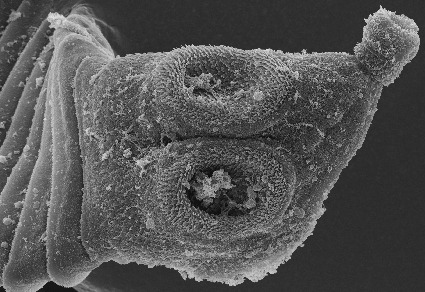
This study describes, on morphological and molecular grounds, Amiculucestus bonasus sp. nov., a parasite of the cownose ray Rhinoptera bonasus from the Western Atlantic. The new species is assigned to Amiculucestus Jensen & Caira, 2022 based on the presence of key diagnostic features such as protandry, presence of an inverted J-shaped cirrus sac, and absence of a seminal receptacle. It can be distinguished from all four other valid species of this genus (i.e., A. calli Jensen & Caira, 2022; A. australiensis Jensen & Caira, 2022; A. herzogae Jensen & Caira, 2022; and A. penghuensis Jensen & Caira, 2022) by the width of the terminal female-mature proglottid, gravid proglottid and ovary, and the combination of other morphometric attributes, such as number of testes, width of the terminal male-mature proglottid and posterior-most immature proglottid, and length of the gravid strobila and ovarian lobe. Phylogenetic analyses of the D1–D3 region of the 28S rDNA gene provide molecular evidence supporting its status as a new species of Amiculucestus. Amiculucestus bonasus sp. nov. is the fifth valid species of this genus and the first identified in the Southwestern Atlantic.
References
- Al Kawari, K.S.R., Saoud, M.F.A. & Wanas, M.Q.A. (1994) Helminth parasites of fishes from the Arabian Gulf 7. On Eniochobothrium qatarense sp. nov. (Cestoda: Lecanicephalidea) and the affinities of Eniochobothrium Shipley and Hornell, 1906, Litobothrium Dailey, 1969 and Renyxa Kurochkin and Slankis, 1973. Japanese Journal of Parasitology, 43, 97–104.
- Caira, J.N., Jensen, K. & Barbeau, E. (2025) Global Cestode Database, World Wide Web electronic publication. Available from: https://www.tapewormdb.uconn.edu/ (accessed 10 January 2025)
- Caira, J.N., Jensen, K., Waeschenbach, A., Olson, P.D. & Littlewood, D.T.J. (2014) Orders out of chaos – molecular phylogenetics reveals the complexity of shark and stingray tapeworm relationships. International Journal for Parasitology, 44, 55–73. https://doi.org/10.1016/j.ijpara.2013.10.004
- Chervy, L. (2009) Unified terminology for cestode microtriches: a proposal from the International Workshops on Cestode Systematics in 2002–2008. Folia Parasitologica, 56, 199–230. https://doi.org/10.14411/fp.2009.025
- Cielocha, J.J., Jensen, K. & Caira, J.N. (2014) Floriparicapitus, a new genus of lecanicephalidean tapeworm (Cestoda) from sawfishes (Pristidae) and guitarfishes (Rhinobatidae) in the Indo-West Pacific. Journal of Parasitology, 100, 485–499. https://doi.org/10.1645/13-468.1
- Clopton, R.E. (2004) Standard nomenclature and metrics of plane shapes for use in gregarine taxonomy. Comparative Parasitology, 71, 130–140. https://doi.org/10.1654/4151
- Dávalos, L.M., Cirranello, A.L., Geisler, J.H. & Simmons, N.B. (2012) Understanding phylogenetic incongruence: lessons from phyllostomid bats. Biological Reviews of the Cambridge Philosophical Society, 87 (4), 991–1024. https://doi.org/10.1111/j.1469-185X.2012.00240.x
- Degnan, J.H. & Rosenberg, N.A. (2009) Gene tree discordance, phylogenetic inference and the multispecies coalescent. Trends in Ecology & Evolution, 24 (6), 332–340. https://doi.org/10.1016/j.tree.2009.01.009
- Ewing, B. & Green, P. (1998) Base-calling of automated sequencer traces using Phred II. Error probabilities. Genome Research, 8, 186–194. https://doi.org/10.1101/gr.8.3.186
- Ewing, B., Hillier, L., Wendl, M.C. & Green, P. (1998) Base-calling of automated sequencer traces using Phred I. Accuracy assessment. Genome Research, 8, 175–185. https://doi.org/10.1101/gr.8.3.175
- Froese, R. & Pauly, D. (2025) FishBase. World Wide Web electronic publication. Available from: https://www.fishbase.org (accessed 26 January 2025)
- García-Varela, M. & Nadler, S.A. (2005) Phylogenetic relationships of Palaeacanthocephala (Acanthocephala) inferred from SSU and LSU rDNA gene sequences. Journal of Parasitology, 91, 1401–1409. https://doi.org/10.1645/GE-523R.1
- Gordon, D., Abajian, C. & Green, P. (1998) Consed: a graphical tool for sequence finishing. Genome Research, 8, 195–202. https://doi.org/10.1101/gr.8.3.195
- Gordon, D., Desmarais, C. & Green, P. (2001) Automated finishing with autofinish. Genome Research, 11, 614–625. https://doi.org/10.1101/gr.171401
- Guyer, R.R. & Jensen, K. (2020) Morphological variation in the hyperapolytic lecanicephalidean species Anteropora japonica (Yamaguti, 1934) (Eucestoda). Folia Parasitologica, 67, 006. https://doi.org/10.14411/fp.2020.006
- Hoang, D.T., Chernomor, A., von Haeseler, A., Minh, B.Q. & Vinh, L.S. (2018) UFBoot2: Improving the ultrafast bootstrap approximation. Molecular Biology and Evolution, 35, 518–522. https://doi.org/10.1093/molbev/msx281
- Jensen, K., Caira, J.N., Cielocha, J.J., Littlewood, D.T.J. & Waeschenbach, A. (2016) When proglottids and scoleces conflict: phylogenetic relationships and a family-level classification of the Lecanicephalidea (Platyhelminthes: Cestoda). International Journal for Parasitology, 46, 291–310. https://doi.org/10.1016/j.ijpara.2016.02.002
- Jensen, K. (2005) A monograph on the Lecanicephalidea (Platyhelminthes, Cestoda). Bulletin of the University of Nebraska State Museum, 18, 1–241.
- Jensen, K. & Bullard, S.A. (2010) Characterization of a diversity of tetraphyllidean and rhinebothriidean cestode larval types, with comments on host associations and life-cycles. International Journal for Parasitology, 40, 889–910. https://doi.org/10.1016/j.ijpara.2009.11.015
- Jensen, K. & Caira, J.N. (2022) Phylogenetic analysis and diversity of peculiar new lecanicephalidean tapeworms (Eniochobothriidae) from cownose rays across the globe. Invertebrate Systematics, 36 (10), 879–909. https://doi.org/10.1071/IS22018
- Jensen, K., Cielocha, J.J., Herzog, K.S. & Caira, J.N. (2017) Lecanicephalidea Hyman, 1951. In: Caira, J.N. & Jensen, K. (Eds.), Planetary Biodiversity Inventory (2008–2017). Tapeworms from Vertebrate Bowels of the Earth. University of Kansas, Lawrence, Kansas, pp. 207–229.
- Katoh, K., & Standley, D.M. (2013) MAFFT multiple sequence alignment software version 7: improvements in performance and usability. Molecular Biology and Evolution, 30 (4), 772–780. https://doi.org/10.1093/molbev/mst010
- Koch, K.R., Jensen, K. & Caira, J.N. (2012) Three new genera and six new species of lecanicephalideans (Cestoda) from eagle rays of the genus Aetomylaeus (Myliobatiformes: Myliobatidae) from northern Australia and Borneo. Journal of Parasitology, 98, 175–198. https://doi.org/10.1645/GE-2798.1
- Larsson, A. (2014) AliView: A fast and lightweight alignment viewer and editor for large datasets. Bioinformatics, 30, 3276–3278. https://doi.org/10.1093/bioinformatics/btu531
- Last, P.R., White, W.T., de Carvalho, M.R., Séret, B., Stehmann, M.F.W. & Naylor, G.J.P. (2016) Rays of the World. CSIRO Publishing, Clayton, Victoria and Comstock Publishing Associates, Ithaca, New York, 790 pp.
- Littlewood, D.T.J., Curini-Galletti, M. & Herniou, E.A. (2000) The interrelationships of Proseriata (Platyhelminthes: Seriata) tested with molecules and morphology. Molecular Phylogenetics and Evolution, 16, 449–466. https://doi.org/10.1006/mpev.2000.0802
- Minh, B.Q., Schmidt, H.A., Chernomor, O., Schrempf, D., Woodhams, M.D., von Haeseler, A. & Lanfear, R. (2020) IQ-TREE 2: new models and efficient methods for phylogenetic inference in the genomic era. Molecular Biology and Evolution, 37 (5), 1530–1534. https://doi.org/10.1093/molbev/msaa015
- Naylor, G.J.P., Caira, J.N., Jensen, K., Rosana, K.A.M., White, W.T. & Last, P.R. (2012) A DNA sequence-based approach to the identification of shark and ray species and its implications for global elasmobranch diversity and parasitology. Bulletin of the American Museum of Natural History, 367, 1–262. https://doi.org/10.1206/754.1
- Oliveira, C.D.L., de Oliveira, C.Y.B., Silva, H.R. & Julio, T.G. (2019) Diversidade de raias marinhas na costa do Brasil e seus estados de ameaça nacional e global. Arquivos de Ciências do Mar, 52 (1), 7–20. https://doi.org/10.32360/acmar.v52i1.33089
- Oosthuizen, G., Naidoo, K., Smit, N.J. & Schaeffner, B.C. (2022) Adding one more to the list: A new species of Eniochobothrium (Cestoda: Lecanicephalidea) from the Oman cownose ray in South Africa. International Journal for Parasitology: Parasites and Wildlife, 19, 138–147. https://doi.org/10.1016/j.ijppaw.2022.08.011
- Olson, P.D., Cribb, T.H., Tkach, V.V., Bray, R.A. & Littlewood, D.T.J. (2003) Phylogeny and classification of the Digenea (Platyhelminthes: Trematoda). International Journal of Parasitology, 33, 733–755. https://doi.org/10.1016/S0020-7519(03)00049-3
- Olson, P.D., Littlewood, D.T.J., Bray, R.A. & Mariaux, J. (2001) Interrelationships and evolution of the tapeworms (Platyhelminthes: Cestoda). Molecular Phylogenetics and Evolution, 19, 443–467. https://doi.org/10.1006/mpev.2001.0930
- Philippe, H., Brinkmann, H., Lavrov, D.V., Littlewood, D.T.J., Manuel, M., Wörheide, G. & Baurain, D. (2011) Resolving Difficult Phylogenetic Questions: Why More Sequences Are Not Enough. PLoS Biology, 9 (3), e1000602. https://doi.org/10.1371/journal.pbio.1000602
- Pleijel, F., Jondelius, U., Norlinder, E., Nygren, A., Oxelman, B., Schander, C., Sundberg, P. & Thollesson, M. (2008) Phylogenies without roots? A plea for the use of vouchers in molecular phylogenetic studies. Molecular Phylogenetics and Evolution, 48, 369–371. https://doi.org/10.1016/j.ympev.2008.03.024
- Kubatko, L.S. & Degnan, J.H. (2007) Inconsistency of phylogenetic estimates from concatenated data under coalescence. Systematic Biology, 56 (1), 17–24. https://doi.org/10.1080/10635150601146041
- Quadros, A.L. (2024) Two new American species of Aberrapex (Eucestoda: Lecanicephalidea: Aberrapecidae) from myliobatid stingrays (Batoidea: Myliobatidae). Zootaxa, 5448 (1), 085–101. https://doi.org/10.11646/zootaxa.5448.1.5
- R Core Team. (2025) R: A language and environment for statistical computing. R Foundation for Statistical Computing, Vienna, Austria. Available from: https://www.R-project.org/ (accessed 28 January 2025)
- Ronquist, F. & Huelsenbeck, J.P. (2003) MrBayes 3: Bayesian phylogenetic inference under mixed models. Bioinformatics, 19 (12), 1572–1574. https://doi.org/10.1093/bioinformatics/btg180
- Schindelin, J., Arganda-Carreras, I., Frise, E., Kaynig, V., Longair, M., Pietzsch, T., Preibisch, S., Rueden, C., Saalfeld, S., Schmid, B., Tinevez, J.Y., White, D.J., Hartenstein, V., Eliceiri, K., Tomancak, P. & Cardona, A. (2012) Fiji: an open-source platform for biological-image analysis. Nature Methods, 9 (7), 676–682. https://doi.org/10.1038/nmeth.2019
- Shipley, A.E. & Hornell, J. (1906) Report on the cestode and nematode parasites from the marine fishes of Ceylon. In: Report to the Government of Ceylon on the Pearl Oyster Fisheries of the Gulf of Manaar (Herdman). Part V. The Royal Society, London, pp. 43–96.
- Schwarz, G. (1978) Estimating the Dimension of a Model. Annals of Statistics, 6, 461–464. https://doi.org/10.1214/aos/1176344136
- Spalding, M.D., Fox, H.E., Allen, G.R., Davidson, N., Ferdaña, Z.A., Finlayson, M., Halpern, B.S., Jorge, M.A., Lombana, A., Lourie, S.A., Martin, K.D., McManus, E., Molnar, J., Recchia, C.A. & Robertson, J. (2007) Marine ecoregions of the world: a bioregionalization of coastal and shelf areas. Bioscience, 57, 573–583. https://doi.org/10.1641/B570707
- Southwell, T. (1911) Description of nine new species of cestode parasites, including two new genera from marine fishes of Ceylon. Ceylon Marine Biological Report, 1, 216–225.
- Vellutini, B.C. & Marques, F.P.L. (2011) WormBox: A Fiji plugin to measure linear distances. Zenodo. https://doi.org/10.5281/zenodo.7339356
- Yamaguti, S. (1934) Studies on the helminth fauna of Japan. Part 4. Cestodes of fishes. Japanese Journal of Parasitology, 6, 1–112.