

Abstract
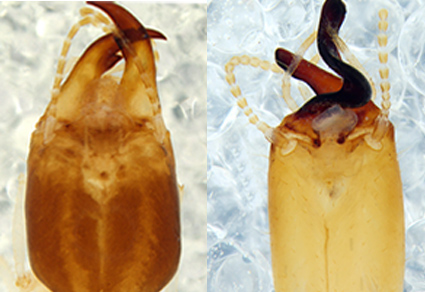
Two new termite species, Speculitermes latalabrum sp. nov. from the subfamily Apicotermitinae Grassé and Noirot, 1955 and Labiocapritermes ghatensis sp. nov. belonging to the subfamily Mirocapritermitinae Kemner, 1934 are described and illustrated here based on the morphological characters of the soldiers and workers. Gut morphology of workers is also described. The genus Speculitermes Wasmann, 1902 is confined to the Oriental region, previously known from Kerala state in India by four species, S. emersoni Bose, 1984, S. sinhalensis Roonwal and Sen-Sarma, 1960, S. chadaensis Chatterjee and Thapa, 1964 and S. dharwarensis Roonwal and Chhotani, 1964. Among the total 12 species from the Oriental region, the soldier caste is hitherto known only for three species, S. dharwarensis, S. sinhalensis and S. macrodentatus Ahmad, 1965. Labiocapritermes Krishna 1968, previously monotypic and endemic to southern India is here expanded with the description of L. ghatensis sp. nov. This paper provides a dichotomous key for Speculitermes and Labiocapritermes of India and species distribution maps.
References
- Aiswarya, P.M., Honey, S. & Sudhikumar, A.V. (2025) Termites (Blattodea: Isoptera) of India: An updated checklist. Acta Zoológica Lilloana, 69 (1), 77–58. https://doi.org/10.30550/j.azl/2013
- Almeida-Azevedo, R., Alves-Oliveira, J., Morais, J.W., Franklin, E. & De Azevedo, R.A. (2023) Step-by-step Dissection Protocol of Apicotermitinae Worker (Blattaria: Isoptera). Sociobiology, 70 (4), e8503. https://doi.org/10.13102/sociobiology.v70i4.8503
- Bignell, D.E. & Eggleton, P. (2000) Termites in ecosystems. In: Abe, T., Bignell, D.E. & Higashi, M. (Eds.), Termites: evolution, sociality, symbioses, ecology. Springer Netherlands, Dordrecht, pp. 363–387. https://doi.org/10.1007/978-94-017-3223-9_17
- Bourguignon, T., Šobotník, J. & Dahlsjö, C.A.L. (2016) The soldierless Apicotermitinae: insights into a poorly known and ecologically dominant tropical taxon. Insectes Sociaux, 63, 39–50. https://doi.org/10.1007/s00040-015-0446-y
- Chhotani, O.B. (1997) The fauna of India and the adjacent countries. Isoptera (Termites): (family Termitidae). Vol. 2. Zoological Survey of India, Calcutta, 800 pp.
- Donovan, S.E., Eggleton, P. & Bignell, D.E. (2001) Gut content analysis and a new feeding group classification of termites. Ecological Entomology, 26 (4), 356–366. https://doi.org/10.1046/j.1365-2311.2001.00342.x
- Eggleton, P. (2000) Global patterns of termite diversity. I. In: Abe, T., Bignell, D.E. & Higashi, M. (Eds.), Termites: evolution, sociality, symbioses, ecology. Springer Netherlands, Dordrecht, pp. 25–51. https://doi.org/10.1007/978-94-017-3223-9_2
- Eggleton, P. (2010) An introduction to termites: biology, taxonomy and functional morphology. In: Bignell, D.E., Roisin, Y. & Lo, N. (Eds.), Biology of termites: a modern synthesis, Springer, Dordrecht, pp. 1–26. https://doi.org/10.1007/978-90-481-3977-4_1
- Hellemans, S., Rocha, M.M., Wang, M., Romero Arias, J., Aanen, D.K., Bagnères, A.G., Buček, A., Carrijo, T.F., Chouvenc, T., Cuezzo, C., Constantini, J.P., Constantino, R., Dedeine, F., Deligne, J., Eggleton, P., Evans, T.A., Hanus, R., Harrison, M.C., Harry, M., Josens, G., Jouault, C., Kalleshwaraswamy, C.M., Kaymak, E., Korb, J., Lee, C.Y., Legendre, F., Li, H.F., Lo, N., Lu, T., Matsuura, K., Maekawa, K., McMahon, D.P., Mizumoto, N., Oliveira, D.E., Poulsen, M., Sillam-Dussès, D., Su, N.Y., Tokuda, G., Vargo, E.L., Ware, J.L., Šobotník, J., Scheffrahn, R.H., Cancello, E., Roisin, Y., Engel, M.S., & Bourguignon, T. (2024) Genomic data provide insights into the classification of extant termites. Nature Communications, 15 (1), 6724. https://doi.org/10.1038/s41467-024-51028-y
- Inward, D.J., Vogler, A.P. & Eggleton, P. (2007) A comprehensive phylogenetic analysis of termites (Isoptera) illuminates key aspects of their evolutionary biology. Molecular phylogenetics and evolution, 44 (3), 953–967. https://doi.org/10.1016/j.ympev.2007.05.014
- Jones, D.T. & Eggleton, P. (2010) Global biogeography of termites: a compilation of sources. In: Bignell, D.E., Roisin, Y. & Lo, N. (Eds.), Biology of termites: a modern synthesis, Springer, Dordrecht, pp. 477–498. https://doi.org/10.1007/978-90-481-3977-4_17
- Jouquet, P., Dauber, J., Lagerlöf, J., Lavelle, P. & Lepage, M. (2006) Soil invertebrates as ecosystem engineers: intended and accidental effects on soil and feedback loops. Applied soil ecology, 32 (2), 153–164. https://doi.org/10.1016/j.apsoil.2005.07.004
- Krishna, K., Grimaldi, D.A., Krishna, V. & Engel, M.S. (2013a) Treatise on the Isoptera of the world. Vol. 1. Bulletin of the American Museum of Natural History, 377 (7), 1–200. [https://digitallibrary.amnh.org/items/f1b1e9eb-f123-4b0c-a3da-82f2cff9235f] https://doi.org/10.1206/377.1
- Krishna, K., Grimaldi, D.A., Krishna, V. & Engel, M.S. (2013b) Treatise on the Isoptera of the world. Vol. 6. Bulletin of the American Museum of Natural History, 377 (7), 1989–2433. https://doi.org/10.1206/377.6
- Lavelle, P., Bignell, D., Lepage, M., Wolters, V., Roger, P., Ineson, P., Heal, O.W. & Dhillion, S. (1997) Soil function in a changing world: the role of invertebrate ecosystem engineers. European Journal of Soil Biology, 33 (4), 159–193.
- Noirot, C. (2001) The gut of termites (Isoptera) comparative anatomy, systematics, phylogeny. II. Higher termites (Termitidae). Annales de la Société Entomologique de France, Nouvelle Série, 37, 431–471.
- Rocha, M.M., Cuezzo, C., Constantini, J.P., Oliveira, D.E., Santos, R.G., Carrijo, T.F. & Cancello, E.M. (2019) Overview of the morphology of neotropical termite workers: history and practice. Sociobiology, 66 (1), 1–32. https://doi.org/10.13102/sociobiology.v66i1.2067
- Roisin, Y., Dejean, A., Corbara, B., Orivel, J., Samaniego, M. & Leponce, M. (2006) Vertical stratification of the termite assemblage in a neotropical rainforest. Oecologia, 149 (2), 301–311. https://doi.org/10.1007/s00442-006-0449-5
- Sands, W.A. (1972) The soldierless termites of Africa (Isoptera: Termitidae). Bulletin of the British Museum (Natural History), Entomology Supplement, 18, 1–244. https://doi.org/10.5962/p.192782
- Santhrupthi, B. & Ranjith, M. (2024) The first description of Speculitermes dharwarensis Roonwal and Chhotani (Blattodea: Termitidae: Apicotermitinae) soldier caste with additional records of distribution. Records of the Zoological Survey of India, 124 (4), 353–359. https://doi.org/10.26515/rzsi/v124/i4/2024/172650