

Abstract
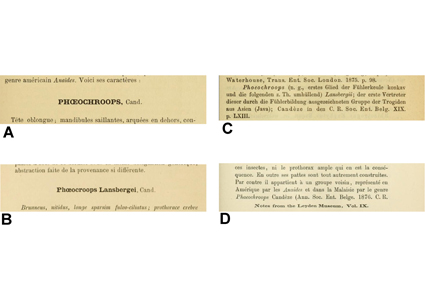
The status of Phoeochroops Candèze, 1876 and of five subsequent spellings is reviewed. Phoeochroops is confirmed as the correct original spelling by an act of the First Reviser, with Phoeocroops considered an incorrect subsequent spelling. Phaechroops, Paechroops and Phaeocroops are incorrect subsequent spellings and are not available names. Phaeochroops, although an incorrect subsequent spelling, is in prevailing usage and could be considered the valid name under Article 33.3.1 of the International Code of Zoological Nomenclature, except that the Code provides no criteria for determining what constitutes prevailing usage of a subsequent spelling, only of names. Modifications to the Code that would clearly define prevailing usage for alternative spellings are suggested.
References
- Allsopp, P.G. (1984) Checklist of the Hybosorinae (Coleoptera: Scarabaeidae). The Coleopterists Bulletin, 38, 105–117.
- Arrow, G.J. (1907) Some new species and genera of lamellicorn Coleoptera from the Indian Empire. Part II. Annals and Magazine of Natural History, Series 7, 19, 416–439. https://doi.org/10.1080/00222930708562664
- Arrow, G.J. (1909) On the characters and relationship of the less-known groups of lamellicorn Coleoptera, with descriptions of new species of Hybosorinae, etc. Transactions of the Entomological Society of London, 4, 479–507. https://doi.org/10.1111/j.1365-2311.1909.tb02183.x
- Arrow, G.J. (1912) Scarabaeidae: Acanthocerinae, Aclopinae, Dynamopinae, Glaphyrinae, Hybosorinae, Idiostominae, Orphninae, Pachypodidae, Troginae. In: Schenkling, S. (Ed.), Coleopterorum Catalogus. Pars 43. Junk, Berlin, pp. 1–66.
- Bacchus, M.E. (1978) A catalogue of the type‑specimens of the Scarabaeinae (Scarabaeidae) and the smaller lamellicorn families (Coleoptera) described by G.J. Arrow. Bulletin of the British Museum (Natural History), Entomology, 37, 97–115.
- Ballerio, A. & Bezděk, A. (2016) Hybosoridae. In: Löbl, I. & Löbl, D. (Eds.), Catalogue of Palaearctic Coleoptera. Revised and updated edition. Vol. 3. Scarabaeoidea – Scirtoidea – Dascilloidea – Buprestoidea – Byrrhoidea. Brill, Leiden, pp. 85–87.
- Basílio, D.S., Cherman, M.A., Vaz‑de‑Mello, F.Z. & Almeida, L.M. (2023) Phylogenetic relationships in Hybosoridae (Coleoptera: Scarabaeoidea). Zoological Journal of the Linnean Society, 198, 1156–1170. https://doi.org/10.1093/zoolinnean/zlac095
- Benderitter, E. (1923) Scarabaeides de la collection Gillet. Annales de la Société Entomologique de Belgique, 63, 5–8.
- Bertkau, P. (1876) Bericht über die wissenschaftlichen Leistungen auf dem Gebiete der Arthropoden während der Jahre 1875 und 1876. Insecta. Coleoptera. Archiv für Naturgeschichte, 42 (2), 351–460.
- Browne, J. & Scholtz, C.H. (1996) The morphology of the hind wing articulation and wing base of the Scarabaeoidea (Coleoptera) with some phylogenetic implications. Bonner zoologische Monographien, 40, 1–200.
- Browne, J. & Scholtz, C.H. (1998) Evolution of the scarab hindwing articulation and wing base: a contribution toward the phylogeny of the Scarabaeidae (Scarabaeoidea: Coleoptera). Systematic Entomology, 23, 307–326. https://doi.org/10.1046/j.1365-3113.1998.00059.x
- Brühl, C. & Krell, F‑T. (2003) Finding a rare resource: Bornean Scarabaeoidea (Coleoptera) attracted by defensive secretions of Diplopoda. The Coleopterists Bulletin, 57, 51–55. https://doi.org/10.1649/0010-065X(2003)057[0051:FARRBS]2.0.CO;2
- Candèze, E. (1876) Note sur un genre nouveau de la tribu des Trogides. Annales de la Société Entomologique de Belgique, Comptes Rendus des Seances, 19, LXII–LXIV.
- Davis, A.J. (1999) Species packing in tropical forests: diel flight activity of rainforest dung‑feeding beetles (Coleoptera: Aphodiidae, Scarabaeidae, Hybosoridae) in Borneo. Raffles Bulletin of Zoology, 47, 473–486.
- Davis, A.J. (2000) Species richness of dung‑feeding beetles (Coleoptera: Aphodiidae, Scarabaeidae, Hybosoridae) in tropical rainforest at Danum Valley, Sabah, Malaysia. The Coleopterists Bulletin, 54, 221–231. https://doi.org/10.1649/0010-065X(2000)054[0221:SRODFB]2.0.CO;2
- Davis, A.J., Huijbregts, H. & Krikken, J. (2000) The role of local and regional processes in shaping dung beetle communities in tropical forest plantations in Borneo. Global Ecology and Biogeography, 9, 281–292. https://doi.org/10.1046/j.1365-2699.2000.00189.x
- Din, A.M.M., Halim, W.M.A, Ahmad, S.Z.S. & Yaakop, S. (2019) Dung beetles (Coleoptera: Scarabaeidae) composition to three different ecosystem functions: a study case in Malaysia. Tropical Life Sciences Research, 30, 69–82. https://doi.org/10.21315/tlsr2019.30.3.5
- Fairmaire, L. (1898) Descriptions de coléoptères d’Asie et de Malaisie. Annales de la Société Entomologique de France, 67, 382–400. https://doi.org/10.3406/bsef.1898.22155
- Holloway, J.D., Kirk‑Spriggs, A.H. & Khen, C.V. (1992) The response of some rain forest insect groups to logging and conversion to plantation. Philosophical Transactions of the Royal Society of London B, 335, 425–436. https://doi.org/10.1098/rstb.1992.0034
- Hrůzová, L., Král, D., Sommer, D. & Šípek, P. (2023) Larval morphology of Phaeochroops rattus (Coleoptera Hybosoridae) and historical overview of known preimaginal stages of the family. Bulletin of Insectology, 76, 283–293.
- ICZN (1999) International Code of Zoological Nomenclature. 4th Edition. The International Trust for Zoological Nomenclature, London, xxix + 306 pp.
- Keith, D. (2000) Un nouveau Phaeochroops Candèze du Myanmar septentrional. Bulletin Mensuel de la Société Linnéenne de Lyon, 69, 51–54. https://doi.org/10.3406/linly.2000.11321
- Keith, D. (2001) Un nouveau Phaeochroops Candèze dʼInde du Nord (Col. Scarabaeoidea Hybosoridae). Bulletin Mensuel de la Société Linnéenne de Lyon, 70, 151–154. https://doi.org/10.3406/linly.2001.11389
- Keith, D. (2022) Le genre Phaeochroops Candèze, 1876 aux Philippines. L’Entomologiste, 78, 159.
- Kolbe, H.J. (1905) Über die Lebensweise und die geographische Verbreitung der coprophagen Lamellicornien. Zoologische Jahrbücher, Supplement, 8, 475–594.
- Krajcik, M. (2012) Checklist of the World Scarabaeoidea. Animma.x Supplement, 5, 1–278.
- Král, D. & Löbl, I. (2006) Hybosoridae. In: Löbl, I. & Smetana, A. (Eds.), Catalogue of Palaearctic Coleoptera. Vol. 3. Scarabaeoidea – Scirtoidea – Dascilloidea – Buprestoidea – Byrrhoidea. Apollo Books, Stenstrup, pp. 96–97.
- Kuijten, P.J. (1978) Revision of the Indo‑Australian species of the genus Phaeochrous Castelnau, 1840 (Coleoptera: Scarabaeidae, Hybosorinae), with notes on the African species. Zoologische Verhandelingen, 165, 1–40.
- Kuijten, P.J. (1981) Revision of the genus Phaeochroops Candèze. Zoologische Verhandelingen, 183, 1–76.
- Kuijten, P.J. (1983) Revision of the genus Hybosorus Macleay (Coleoptera: Scarabaeidae, Hybosorinae). Zoologische Verhandelingen, 203, 1–50.
- Kuijten, P.J. (1985) Revision of some hybosorine genera from the Indo‑Malayan subregion: Microphaeochroops, Microphaeolodes, Mimocoelodes, Pantolasius and Phaeochridius (Coleoptera: Scarabaeidae: Hybosorinae). Zoologische Verhandelingen, 222, 1–39.
- Kuijten, P.J. (1988) Phaeocroides nanus (Arrow), Phaeocroides mapellii Petrovitz and Phaeocroides orientalis (Petrovitz): Notes on generic status synonymy and types; redescriptions (Coleoptera: Hybosoridae). Zoologische Mededelingen, 62, 91–98.
- Lucas, R. (1913) Coleoptera für 1912. Archiv für Naturgeschichte, Abteilung B, 5, 48–408.
- Lucas, R. (1918) Catalogus alphabeticus generum et subgenerum coleopterorum orbis terrarum totius. Archiv für Naturgeschichte, Abteilung A, 84, 1–696.
- Lucas, R. (1920) Catalogus alphabeticus generum et subgenerum coleopterorum orbis terrarum totius (fam., trib., subtr., sect. incl.) Pars 1. Nicolaischen Verlagsbuchhandlung R. Stricker, Berlin, xxxi + 696 pp.
- Neave, S.A. (1940) Nomenclator zoologicus. A list of names of genera and subgenera in zoology from the tenth edition of Linnaeus 1758 to the end of 1935. Vol. III. M–P. Zoological Society of London, London, 1065 pp.
- Nishikawa, M. (1989) The Hybosoridae (Coleoptera, Scarabaeidae) in Sabah, Borneo Island, 1. Kanagawa-Chûhô, 90, 171–176.
- Nishikawa, M. (1996) Hybosorine scarabaeid beetles from northwest Thailand. Elytra, 24, 299–302.
- Nomura, S. (1973) Notes on the coprophagous Lamellicornia from Taiwan. The Entomological Review of Japan, 25, 37–52.
- Ocampo F.C. (2006) Phylogenetic analysis of the scarab family Hybosoridae and monographic revision of the New World subfamily Anaidinae. 3. Phylogenetic analysis of the subfamily Anaidinae. Bulletin of the University of Nebraska State Museum, 19, 13–177.
- Ocampo, F.C. & Ballerio, A. (2006) Phylogenetic analysis of the scarab family Hybosoridae and monographic revision of the New World subfamily Anaidinae. 4. Catalog of the subfamilies Anaidinae, Ceratocanthinae, Hybosorinae, Liparochrinae, and Pachyplectrinae. Bulletin of the University of Nebraska State Museum, 19, 178–209.
- Ocampo, F.C. & Hawks, D.C. (2006) Phylogenetic analysis of the scarab family Hybosoridae and monographic revision of the New World subfamily Anaidinae. 2. Molecular phylogenetics and systematic placement of the family Hybosoridae. Bulletin of the University of Nebraska State Museum, 19, 7–12.
- Paulian, R. (1944) Sur quelques coléoptères corpophages récoltés par le Dr. E. Mjöberg a Bornéo et en Australie. Revue Française d’Entomologie, 10, 64–75.
- Paulian, R. (1945) Coléoptères Scarabéides de l’Indochine. Première Partie. Faune de l’Empire Français III. Librairie Larose, Paris, 227 pp.
- Pic, M. (1928) Notes et descriptions. Mélanges Exotico-Entomologiques, 51, 1–36.
- Preudhomme de Borre, A. (1886) Catalogue des Trogides décrits jusqu’à ce jour, précédé d’un synopsis de leur genres et d’une esquisse de leur distribution géographique. Annales de la Société Entomologique de Belgique, 30, 54–82.
- Ritsema, C. (1888) Lijst der entomologische geschriften van Mr JW van Lansberge, gevolgd door eene opgave der daarin beschreven nieuwe geslachten, ondergeslachten en soorten. Tijdschrift voor Entomologie, 31, 201–234.
- Schmidt, A. (1912a) Neue Scarabaeiden aus den Subfamilien Aphodiinae, Orphninae, und Hybosorinae. Archiv für Naturgeschichte, Abteilung A, 78, 196–202.
- Schmidt, A. (1912b) Coleoptera Lamellicornia fam. Scarabaeidæ subfam. Ægialiinæ, Chironinæ, Dynamopinæ, Hybosorinæ, Idiostominæ, Ochodæinæ, Orphninæ. In: Wytsman, P. (Ed,), Genera Insectorum. Fasicule 150. Verteneuil & Desmet, Bruxelles, pp. 1–87.
- Scholtz, C.H. (1990) Phylogenetic trends in the Scarabaeoidea (Coleoptera). Journal of Natural History, 24, 1027–1066. https://doi.org/10.1080/00222939000770631
- Scudder, S.H. (1882) Nomenclator zoologicus. An alphabetical list of all generic names that have been employed by naturalists for recent and fossil animals from the earliest times to the close of the year 1879. Bulletin of the United States National Museum, 19, 1–309. https://doi.org/10.5479/si.03629236.19.i
- Seidlitz, G. (1898) Bericht über die wissenschaftlichen Leistungen auf dem Gebiete der Entomologie während des Jahre 1898. Coleoptera. Archiv für Naturgeschichte, 65, 101–330.
- Seidlitz, G. (1908) Insecta. Coleoptera für 1909. Archiv für Naturgeschichte, 74 (2), 57–392.
- Seidlitz, G. (1910) Insecta. Allgemeines 1909. Archiv für Naturgeschichte, 76 (3), 1–348.
- Sites, R.W., Lago, P. & Gale, G.A. (2018) Associations of scarab beetles (Insecta: Coleoptera: Scarabaeidae) with dung of four species of mammals in Khao Yai National Park, Thailand. Raffles Bulletin of Zoology, 66, 87–95.
- Taschenberg, O. (1890) Insecta. In: Bibliotheca Zoologica II. Verzeichness der Schriften über Zoologie welche in den periodischen Werken enthalten und vom Jahre 1861-1880 selbständig erschienen sind, mit Einschluss der allgemein-naturgeschichtlichen, periodischen und paleontologischen Schriften. Vol. 3. Engelmann, Leipzig, pp. 1729–2760.
- Ueda, A., Dwibadra, D., Kahono, S., Sugiarto, Ochi, T. & Kon, M. (2022) Atlas of dung beetles collected in the Sungai Wain Protection Forest and its surroundings in the lowlands of Borneo. Bulletin of Forestry and Forest Products Research Institute, Kyushu Research Center, 21, 165–192.
- Ueda, A., Dwibadra, D., Noerdjito, W.A., Sugiarto, Kon, M., Ochi, T., Takagashi, M. & Fukuyama, K. (2017) List of dung beetles (Coleoptera: coprophagous group of Scarabaeoidea) collected in lowland near Balikpapan, East Kalimantan, Indonesia. Bulletin of Forestry and Forest Products Research Institute, Kyushu Research Center, 16, 109–119.
- Van Lansberge, J.W. (1887) Trogides nouveaux. Notes from the Leyden Museum, 9, 199–211.
- Welter‑Schultes, F.W. (2024) International Code of Zoological Nomenclature: Code‑5 progress report. Bulletin of Zoological Nomenclature, 81, 5–10. https://doi.org/10.21805/bzn.v81.a001
- Ziani, S. (2021) Subsequent spelling ritchiei for Mnematium ritchii Macleay, 1821 (Coleoptera: Scarabaeoidea: Scarabaeidae: Scarabaeini) to be maintained for prevailing usage. Insecta Mundi, 856, 1–5.