

Abstract
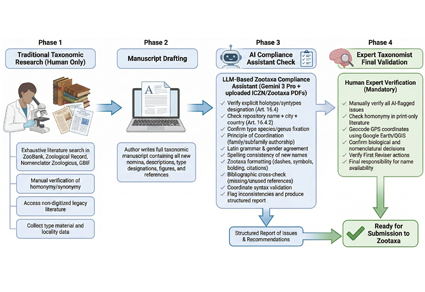
The accelerating crisis of global biodiversity loss demands a commensurate increase in the efficiency, accuracy, and rigor of taxonomic publishing. For over a decade, the recommendations presented by Dubois et al. (2011) have served as an important reference for authors publishing in Zootaxa, establishing a baseline for compliance with the International Code of Zoological Nomenclature (the Code). The recent emergence of Artificial Intelligence (AI), particularly Large Language Models (LLMs), presents a new opportunity to automate the verification of these complex nomenclatural standards. However, the integration of AI into this highly specialized field is fraught with significant risks, ranging from the hallucination of non-existent citations to the inability to parse undigitized historical literature. This paper presents a framework for AI-assisted taxonomic publishing, explicitly bifurcating the technology’s utility into two distinct domains: (1) structural, syntactic, and internal consistency compliance, where AI demonstrates proficiency as a “compliance assistant,” and (2) semantic, historical, and geospatial interpretation, where AI exhibits limitations that require human expertise. These boundaries are delineated, citing recent evidence regarding AI fabrication, geospatial reasoning deficits, and the structural barriers of the “taxonomic impediment”. A “human-supervised hybrid workflow” is proposed that leverages non-AI database queries for comprehensive search tasks while exploiting LLMs for text analysis and formatting. Finally, an engineered prompt designed to function as a robust, pre-submission validation tool is provided, mitigating the risk of introducing unavailable nomina while acknowledging the irreplaceable role of the expert taxonomist.
References
- Alansari, A. & Luqman, H. (2025) Large language models hallucination: a comprehensive survey. arXiv, 2510.06265v2 https://doi.org/10.48550/arXiv.2510.06265
- Alkaissi, H. & McFarlane, S.I. (2023) Artificial hallucinations in ChatGPT: implications in scientific writing. Cureus, 15 (2), e35179 https://doi.org/10.7759/cureus.35179
- Athaluri, S.A., Manthena, S.V., Kesapragada, VSR K.M., Yarlagadda, V., Dave, T. & Duddumpudi, R.T.S. (2023) Exploring the boundaries of reality: investigating the phenomenon of artificial intelligence hallucination in scientific writing through ChatGPT references. Cureus, 15 (4), e37432 https://doi.org/10.7759/cureus.37432
- Dagdelen, J., Dunn, A., Lee, S., Walker, N., Rosen, A.S., Ceder, G., Persson, K.A. & Jain, A. (2024) Structured information extraction from scientific text with large language models. Nature Communications, 15, 1418. https://doi.org/10.1038/s41467-024-45563-x
- Davinack, A.A. (2023) Can ChatGPT be leveraged for taxonomic investigations? Potential and limitations of a new technology. Zootaxa, 5270 (2), 347–350 https://doi.org/10.11646/zootaxa.5270.2.12
- Dubois, A., Minelli, A. & Zhang, Z.-Q. (2011) Recommendations about nomenclature for papers submitted to Zootaxa. Zootaxa, 2943 (1), 58–62 https://doi.org/10.11646/zootaxa.2943.1.3
- Dubois, A. & Nemésio, A. (2007) Does nomenclatural availability of nomina of new species or subspecies require the deposition of vouchers in collections? Zootaxa, 1409 (1), 1–22 https://doi.org/10.11646/zootaxa.1409.1.1
- Elliott, M.J. & Fortes, J.A.B. (2024) Toward reliable biodiversity information extraction from large language models. In: 2024 IEEE 20th International Conference on e-Science (e-Science). IEEE, Osaka, pp. 1–10 https://doi.org/10.1109/e-Science62913.2024.10678666
- Fillies, J., Teich, M., Karam, N., Paschke, A. & Rehbein, M. (2025) Historic to FAIR: leveraging LLMs for historic term identification and standardization. Datenbank-Spektrum, 25 (3), 189–201. https://doi.org/10.1007/s13222-025-00519-3
- Gougherty, A.V. & Clipp, H.L. (2024) Testing the reliability of an AI-based large language model to extract ecological information from the scientific literature. npj Biodiversity, 3, 13. https://doi.org/10.1038/s44185-024-00043-9
- ICZN [International Commission on Zoological Nomenclature] (1999) International Code of Zoological Nomenclature. 4th Edition. International Trust for Zoological Nomenclature, London, xxix + 306 pp. https://doi.org/10.5962/bhl.title.50608
- ICZN (2012) Amendment of Articles 8, 9, 10, 21 and 78 of the International Code of Zoological Nomenclature to expand and refine methods of publication. Zootaxa, 3450 (1), 1–7. https://doi.org/10.11646/zootaxa.3450.1.1
- ICZN (2012) Amendment of Articles 8, 9, 10, 21 and 78 of the International Code of Zoological Nomenclature to expand and refine methods of publication. ZooKeys, 219, 1–10. https://doi.org/10.3897/zookeys.219.3944
- Löbl, I., Klausnitzer, B., Hartmann, M. & Krell, F.-T. (2023) The silent extinction of species and taxonomists—an appeal to science policymakers and legislators. Diversity, 15 (10), 1053. https://doi.org/10.3390/d15101053
- Rathkopf, C. (2025) Hallucination, reliability, and the role of generative AI in science. arXiv, 2504.08526v1 https://doi.org/10.48550/arXiv.2504.08526
- Manvi, R., Khanna, S., Mai, G., Burke, M., Lobell, D. & Ermon, S. (2024) GeoLLM: extracting geospatial knowledge from large language models. arXiv, 2310.06213v2 https://doi.org/10.48550/arXiv.2310.06213
- Santos, C.M.D. & Gois, J.P. (2023) Harnessing the power of AI language models for taxonomy and systematics: a follow-up to “Can ChatGPT be leveraged for taxonomic investigations? Potential and limitations of a new technology” by Davinack (2023). Zootaxa, 5297 (3), 446–450 https://doi.org/10.11646/zootaxa.5297.3.9
- Santos, C.M.D. & Gois, J.P. (2025) Artificial intelligence as catalyst for biodiversity understanding. Communications of the ACM, 68 (3), 27–29 https://doi.org/10.1145/3701570
- Santos, C.M.D., Paulino, L.C., Andrade, M.P., Tognella-Poccia, G. & Gois, J.P. (2025) Reproducibility and scientific interpretation in the age of AI: consilience in biological systematics, ecology, and molecular biology. arXiv, 2507.22942v1 https://doi.org/10.48550/arXiv.2507.22942
- Simpson, G.G. (1940) Types in modern taxonomy. American Journal of Science, 238, 413–431 https://doi.org/10.2475/ajs.238.6.413
- Soares, F.M., Saraiva, A.M., Pires, L.F., Santos, L.O.B. da S., Moreira, D. de A., Corrêa, F.E., Braghetto, K.R., Drucker, D.P. & Delbem, A.C.B. (2025) Exploring a large language model for transforming taxonomic data into OWL: lessons learned and implications for ontology development. arXiv, 2504.18651v1 https://doi.org/10.48550/arXiv.2504.18651
- Valan, M., Makonyi, K., Maki, A., Vondráček, D. & Ronquist, F. (2019) Automated taxonomic identification of insects with expert-level accuracy using effective feature transfer from convolutional networks. Systematic Biology, 68 (6), 876–895 https://doi.org/10.1093/sysbio/syz014