

Abstract
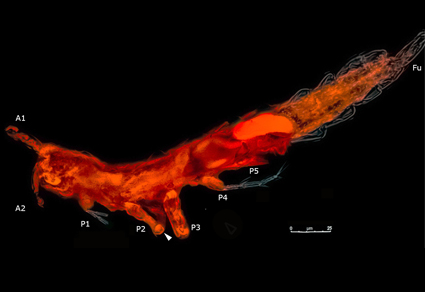
Aggistropodacaris gen. nov., is proposed to accommodate a new species of Fontinalicaridinae found near the National Park of Chapada dos Veadeiros in Goiás, Central Brazil, Tocantins River hydrographic basin. The genus is characterized by a unique morphological adaptation of the males, in which the second pereopod is transformed into a grasping structure. The genus is also characterized by the combination of several characters including 1) a small body size (< 250μm), 2) weak chitinization, 3) lack of integumental windows in the urosome, 4) seven-segmented male antennule, 5) reduced endopod of second pereopod in both male and female, 6) reduced female endopod of third pereopod, 7) elongate endopod of the fourth pereopod reaching midlength of the second exopod in females, and 8) short fifth pereopod in both sexes. Aggistropodacaris gen. nov., is placed within Fontinalicaridinae due to specific apomorphic traits, including the gap between outer setae I-III and dorsal seta VII on the furca, and the bow-like female genital field. Aggistropodacaris gen. nov. shows notable morphological similarities with Siolicaris Jakobi, 1972 and Brasilibathynellocaris Jakobi, 1972, suggesting a close phylogenetic relationship with these genera. The male third pereopod is similar in the new genus and Siolicaris, both with a robust quadratic first exopodite, a short apophysis, and thumb longer than the apophysis with a distal hyaline membrane. The distal hyaline membrane on the male thumb of the third pereopod is also present in Brasilibathynellocaris. Additionally, the fifth pereopod in these three genera is reduced in length, with outer setae located on the distal half. Furthermore, both Aggistropodacaris gen. nov. and Siolicaris exhibit a reduced endopod in the female third pereopod, and the female endopod of the fourth pereopod is longer than the first exopodite, reaching beyond the middle of the second endopodite. This feature is also seen in some species of Brasilibathynellocaris, indicating phylogenetic conservatism across these genera.
References
- Ax, P. (1984) Das phylogenetische System. Gustav Fischer Verlag, Stuttgart, 349 pp.
- Corgosinho, P.H.C., & Martínez Arbizu, P. (2005) Two new interstitial species of Remaneicaris Jakobi from the river Ribeirão do Ouro River, Minas Gerais, Brazil, with a redefinition of the genus. (Copepoda, Harpacticoida, Parastenocarididae). Senckenbergiana biologica, 85, 147–162.
- Corgosinho, P.H.C. (2007a) Sistemática filogenética de Remaneicaris Jakobi (Copepoda, Harpacticoida, Parastenocarididae) da região neotropical. PhD Thesis, Instituto Nacional de Pesquisas da Amazônia (INPA), 140 pages. Available from: https://repositorio.inpa.gov.br/handle/1/11465 (Accessed 24 Sept. 2024).
- Corgosinho, P.H.C., Martínez Arbizu, P. & dos Santos-Silva, E.N. (2007b) Three new species of Remaneicaris Jakobi, 1972 (Copepoda, Harpacticoida, Parastenocarididae) from the Ribeirão do Ouro River, Minas Gerais, Brazil, with some remarks on the ground pattern of the Parastenocarididae. Zootaxa, 1437, 1–28. https://doi.org/10.11646/zootaxa.1437.1.1
- Corgosinho, P.H.C., Martínez Arbizu, P. & Reid, J.W. (2008) Revision of the Genus Murunducaris (Copepoda: Harpacticoida: Parastenocarididae), with Descriptions of Two New Species from South America. Journal of Crustacean Biology, 28, 700–720. https://doi.org/10.1651/07-2907.1
- Corgosinho, P.H.C., Martínez Arbizu, P. & dos Santos-Silva, E.N. (2010a) Revision of Brasilibathynellocaris Jakobi, 1972 (Copepoda: Harpacticoida: Parastenocarididae) with redefinition of the genus. Zoological Journal of the Linnean Society, 159, 527–566. https://doi.org/10.1111/j.1096-3642.2009.00574.x
- Corgosinho, P.H.C., Martínez Arbizu, P. & Santos-Silva, E.N. (2010b) Three new interstitial species of Remaneicaris Jakobi, 1972 (Copepoda: Harpacticoida: Parastenocarididae) from Southern and Southeastern Brazil. Invertebrate Zoology, 7, 1–28. https://doi.org/10.15298/invertzool.07.1.01
- Corgosinho, P.H.C., Reddy, Y.R. & Arbizu, P.M. (2012) Revision of the genus Siolicaris Jakobi, 1972, with redescriptions of S. sioli (Noodt, 1963) and S. jakobi (Noodt, 1963) from South America, and S. sandhya (Ranga Reddy, 2001) comb. nov. from India (Copepoda, Harpacticoida, Parastenocarididae). Zootaxa, 3493, 49–71. https://doi.org/10.11646/zootaxa.3493.1.5
- Corgosinho, P.H.C., Schizas, N.V., Previattelli, D., Rocha, C.E.F. da & dos Santos-Silva, E.N. (2017a) A new genus of Parastenocarididae (Copepoda, Harpacticoida) from the Tocantins River basin (Goiás, Brazil), and a phylogenetic analysis of the Parastenocaridinae. Zoosystematics and Evolution, 93, 167–187. https://doi.org/10.3897/zse.93.11602
- Corgosinho, P.H.C., Mercado-Salas, N.F., Arbizu, P.M., Santos-Silva, E.N. & Kihara, T.C. (2017b) Revision of the Remaneicaris argentina-group (Copepoda, Harpacticoida, Parastenocarididae): supplementary description of species, and description of the first semi-terrestrial Remaneicaris from the tropical forest of Southeast Mexico. Zootaxa, 4238, 499–530. https://doi.org/10.11646/zootaxa.4238.4.2
- Corgosinho, P.H.C., Rocha, C.E.F., Arbizu, P.M. & dos Santos-Silva, E.N. (2021) A new genus of Parastenocarididae Chappuis, 1940 (Copepoda: Harpacticoida) from the Amazonian Region, Brazil, with close affinity to Murunducaris Reid, 1994. Nauplius, 29, 1–26. https://doi.org/10.1590/2358-2936e2021015
- Corgosinho, P.H.C., Rocha, C.E.F.D., Neves, G.P., Calixto, B.R.A., Mendes, M.F.L. & Schizas, N.V. (2024) A new genus and species of Parastenocarididae Chappuis, 1940 (Copepoda, Harpacticoida) from the Espinhaço Mountain Range (Brazil) with an unclear phylogenetic position within the Fontinalicaridinae Schminke, 2010. Zootaxa, 5512, 151–165. https://doi.org/10.11646/zootaxa.5512.2.1
- Cottarelli, V., Bruno, M.C. & Berera, R. (2010) First Record of Parastenocarididae from Thailand and Description of a New Genus (Copepoda: Harpacticoida). Journal of Crustacean Biology, 478–494. https://doi.org/10.1651/09-3201.1
- Ferrari, F.D. & Ivanenko, V.N. (2008) The Identity of Protopodal Segments and the Ramus of Maxilla 2 of Copepods (Copepoda). Crustaceana, 81, 823–835. https://doi.org/10.1163/156854008784771702
- Galassi, D.M.P., Huys, R. & Reid, J.W. (2009) Diversity, ecology and evolution of groundwater copepods. Freshwater Biology, 54, 691–708. https://doi.org/10.1111/j.1365-2427.2009.02185.x
- Gaviria, S., Defaye, D. & Corgosinho, P.H.C. (2017) Two new parastenocaridid genera (Copepoda, Harpacticoida) from South America, including a revision of Noodt’s columbiensis-group and the redescription of Parastenocaris tapajosensis Noodt, 1963. Crustaceana, 90, 535–570. https://doi.org/10.1163/15685403-00003672
- Glatzel, T. & Schminke, H.K. (1996) Mating behavior of the groundwater copepod Parastenocaris phyllura Kiefer, 1938 (Copepoda: Harpacticoida). Contributions to Zoology, 66, 103–108. https://doi.org/10.1163/26660644-06602002
- Huys, R. & Boxshall, G. (1991) Copepod Evolution. The Ray Society, London, 468 p.
- ICZN (1999) International Code of Zoological Nomenclature. 4ª ed. London: International Trust for Zoological Nomenclature. Available in: http://iczn.org.
- Jakobi, H. (1972) Trends (Enp. P₄ ♂) innerhalb der Parastenocarididen (Copepoda Harpacticoidea). Crustaceana, 22, 127–146.
- Menzel, R. (1916) Über das Auftreten der Harpacticidengattungen Epactophanes Mrázek und Parastenocaris Kessler in Surinam. Zoologischer Anzeiger, 47, 145-152, figs. 1-16.
- Noodt, W. (1963) Subterrane Crustaceen der zentralen Neotropis. Zur Frage mariner Relikte im Bereich des Rio Paraguay - Paraná - Amazonas Systems. Zoologischer Anzeiger, 171, 114-147, figs. 1-162.
- Ranga Reddy, Y., Totakura, V.R. & Corgosinho, P.H.C. (2014) Himalayacaris alaknanda n. gen., n. sp. (Copepoda: Harpacticoida: Parastenocarididae) from the Hyporheic Zone of a Himalayan River, Northern India. Journal of Crustacean Biology, 34, 801–819. https://doi.org/10.1163/1937240X-00002281
- Reid, J.W. (1982) Forficatocaris schadeni, a New Copepod (Harpacticoida) from Central Brazil, with Keys to the Species of the Genus. Journal of Crustacean Biology, 2, 578–587. https://doi.org/10.2307/1548098
- Reid, J.W. (1991) The Neotropical Genus Potamocaris Dussart (Copepoda: Harpacticoida: Parastenocarididae), with Descriptions of Two New Species. Journal of Crustacean Biology, 11, 463–472. https://doi.org/10.2307/1548472
- Reid, J.W. (1995) Redescription of Parastenocaris brevipes Kessler and description of a new species of Parastenocaris (Copepoda: Harpacticoida: Parastenocarididae) from the U.S.A. Canadian Journal of Zoology, 73(1), 173-187. https://doi.org/10.1139/z95-020
- Schminke, H.K. (1976) The Ubiquitous Telson and the Deceptive Furca. Crustaceana, 30, 292–300. https://doi.org/10.1163/156854076X00657
- Schminke, H.K. (2010) High-Level Phylogenetic Relationships within Parastenocarididae (Copepoda, Harpacticoida). Crustaceana, 83, 343–367. https://doi.org/10.1163/001121610X12627655658168
- Wells, J.B.J. (1964) Six new species of Parastenocaris (Crustacea, Copepoda) from Southern Rhodesia. Annals and Magazine of Natural History 7: 193–204, figs. 1-65. https://doi.org/10.1080/00222936408651458