
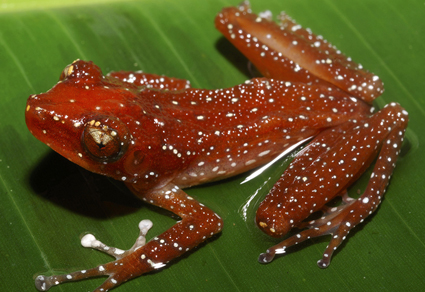

Abstract
The examination of molecular markers confirms hidden diversity and reveals a new species within the Nyctixalus pictus (Peters, 1871) complex. Three genetically distinct clades were recovered: one from the Thai-Malay Peninsula; one from Sumatra, Indonesia; and one from Sarawak, Borneo, East Malaysia. Voucher specimens from each region were compared, and significantly different mean values were found through morphological analyses. The populations also differ significantly in morphospace, as determined by PCA, DAPC, and MFA analyses. The Thai-Malay Peninsula individuals have a distinct, rounded and slightly elongated snout shape compared to the other two clades. Based on these combined data, these three clades are recognized as distinct species. The name N. anodon is reinstated for those from Sumatra, Indonesia. The type locality of Sarawak, East Malaysia for N. pictus restricts the distribution of the species to Borneo. The type specimen of N. pictus was lost (pers. communication, G. Doria), and no lectotype or syntypes were described; thus, a specimen from Sarawak, Borneo, in the collection of the Field Museum of Natural History, Chicago (FMNH), is designated here as the neotype of N. pictus.
References
- Ahl, E. (1931) Amphibia, Anura III, Polypedatidae. Das Tierreich, 55, 1–477.
- Alcala, A.C. & Brown, W.C. (1998) Philippine amphibians: An illustrated field guide. Bookmark Inc., Makati City.
- Anderson, M.J. (2001) A new method for non-parametric multivariate analysis of variance. Austral Ecology, 26 (1), 32–46. https://doi.org/10.1111/j.1442-9993.2001.01070.pp.x
- Badli-Sham, B.H., Syafiq, M.F., Aziz, M.S., Jalil, N.R.M., Awang, M.T., Othman, M.N.A., Aziz, A.A., Dzu, K., Wahab, N.A.A., Jamil, N.L., Ismail, M.A., Azman, W.A.A., Ooi,X.W., Jamaha, N.A.N., Aqmai-Naser, M., Fahmi-Ahmad, M., Shahirah-Ibrahim, N., Rizal, S.A., Belabut, D.M., Onn, C.K., Quah, E.S.H., Grismer, L.L. & Ahmad, A.B. (2023) A decade of amphibian studies (Animalia, Amphibia) at Sekayu lowland forest, Hulu Terengganu, Peninsular Malaysia. ZooKeys, 1157, 43. https://doi.org/10.3897/zookeys.1157.95873
- Barbour, T. (1912) A contribution to the zoogeography of the East Indian Islands. Memoirs of the Museum of Comparative Zoology, 44, 1–203. https://doi.org/10.5962/bhl.title.52042
- Bossuyt, F. & Dubois, A. (2001) A review of the frog genus Philautus Gistel, 1848 (Amphibia, Anura, Ranidae, Rhacophorinae). Zeylanica, 6, 1–112.
- Boulenger, G.A. (1882) Description of a new genus and species of frogs of the family Ranidae. Annals and Magazine of Natural History, 10 (55), 35. https://doi.org/10.1080/00222938209459662
- Chan, K.O., Grismer, L.L. & Brown, R.M. (2018) Comprehensive multi-locus phylogeny of Old World tree frogs (Anura: Rhacophoridae) reveals taxonomic uncertainties and potential cases of over- and underestimation of species diversity. Molecular Phylogenetics and Evolution, 127, 1010–1019. https://doi.org/10.1016/j.ympev.2018.07.005
- Chan, K.O. & Grismer, L.L. (2022) GroupStruct: An R package for allometric size correction. Zootaxa, 5124 (4), 471–482. https://doi.org/10.11646/zootaxa.5124.4.4
- De Alban, J.D.T., Connette, G.M., Oswald, P. & Webb, E.L. (2018) Combined Landsat and L-band SAR data improves land cover classification and change detection in dynamic tropical landscapes. Remote Sensing, 10 (2), 306. https://doi.org/10.3390/rs10020306
- Dever, J.A. (2017) A new cryptic species of the Theloderma asperum complex (Anura: Rhacophoridae) from Myanmar. Journal of Herpetology, 51 (3), 425–436. https://doi.org/10.1670/17-026
- Dring, J.C.M. (1982) Appendix VIII. Frogs recorded within Gunong [sic] Mulu National Park. In: Anderson, J.A.R., Jermy, A.C. & Gathorne-Hardy, G., Earl of Cranbrook (Eds.), Gunung Mulu National Park: A Management and Development Plan. Royal Geographical Society, London, pp. 293.
- Dubois, A. (1981) Liste des genres et sous-genres nominaux de Ranoidea (Amphibiens Anoures) du monde, avec identification de leurs espèces types; consequences nomenclaturales. Monitore Zoologico Italiano, Nuova Serie, Supplemento, 15, 225–284. https://doi.org/10.1080/03749444.1981.10736637
- Ean, T.P., Belabut, D., Onn, C.K. & Ahmad, N. (2022) Amphibian diversity and species composistion in a lowland tropical rainforest of Ulu Gombak, Selangor, Peninsular Malaysia. Malayan Nature Journal, 74 (4), 471–480.
- Grismer, L.L. (2025) Introducing multiple factor analysis (MFA) as a diagnostic taxonomic tool complementing principal component analysis (PCA). Zookeys, 1248, 93–109. https://doi.org/10.3897/zookeys.1248.159516
- Hanifa, B.F., Septiadi, L., Hasyim, M.A., Fathoni, M., Prabasari, K., Erfanada, M.P., Rahmadana, M., Widjanarko, H. & Kurniawan, N. (2023) New data on and the easternmost record of the Javan endemic pearly tree frog, Nyctixalus margaritifer Boulenger, 1882 (Anura, Rhacophoridae). Check List, 19 (6), 971–82. https://doi.org/10.15560/19.6.971
- Hertwig, S.T., Schweizer, M., Das, I. & Haas, A. (2013) Diversification in a biodiversity hotspot – The evolution of Southeast Asian rhacophorid tree frogs on Borneo (Amphibia: Anura: Rhacophoridae). Molecular Phylogenetics and Evolution, 68 (3), 567–581. https://doi.org/10.1016/j.ympev.2013.04.001
- Ibnudarda, R., Kadafi, A.M., Priambodo, B., Farajallah, A., Perwitasari-Farajallah, D. & Hamidy, A. (2025) Genetic and morphometric variation of the genus Nyctixalus in Indonesia based on mtDNA 16S rRNA gene. Journal of Tropical Biodiversity and Biotechnology, 10 (2), jtbb13642. https://doi.org/10.22146/jtbb.13642
- Inger, R.F. (1966) The systematics and zoogeography of the Amphibia of Borneo. Fieldiana: Zoology, 52, 1–402. https://doi.org/10.5962/bhl.title.3147
- IUCN SSC Amphibian Specialist Group. (2018) Nyctixalus margaritifer. The IUCN Red List of Threatened Species, 2018, e.T58804A114112563. Available from: https://doi.org/10.2305/IUCN.UK.2018-2.RLTS.T58804A114112563.en (accessed November 2025)
- IUCN SSC Amphibian Specialist Group. (2020) Nyctixalus spinosus (amended version of 2018 assessment). The IUCN Red List of Threatened Species, 2020, e.T26156A176743176. Available from: https://doi.org/10.2305/IUCN.UK.2020-3.RLTS.T26156A176743176.en (accessed November 2025)
- IUCN (2022) International Union for Conservation of Nature - Red List of Threatened Species. IUCN Red List Unit, Cambridge. Available from: https://www.iucnredlist.org (accessed August 2025)
- Katoh, K., Misawa, K., Kuma, K. & Miyata, T. (2002) MAFFT: a novel method for rapid multiple sequence alignment based on fast Fourier transform. Nucleic Acids Research, 30, 3059–3066. https://doi.org/10.1093/nar/gkf436
- Kumar, S., Stecher, G., Suleski, M., Sanderford, M., Sharma, S. & Tamura, K. (2024) MEGA12: Molecular Evolutionary Genetics Analysis version 12 for adaptive and green computing. Molecular Biology and Evolution, 41, 1–9. https://doi.org/10.1093/molbev/msae263
- Kusuma, A.V. (2023) A study of morphological variation of the spotted tree frog Nyctixalus pictus (Peters, 1871) group in Indonesia. Masters Thesis, Mathematics and Natural Sciences, Palangkaraya University, Palangka Raya, Central Kalimantan, 72 pp.
- Li, J., Jing, C., Murphy, R.W., Zao, H., Zao, E., Rao, D. & Zhang, Y. (2009) New insights to the molecular phylogenetics and generic assessment in the Rhacophoridae (Amphibia: Anura) based on five nuclear and three mitochondrial genes, with comments on the evolution of reproduction. Molecular Phylogenetics and Evolution, 53 (2), 509–522. https://doi.org/10.1016/j.ympev.2009.06.023
- Matsui, M. (1996) Call characteristics and systematic relationships of a Malayan treefrog Nyctixalus pictus (Anura, Rhacophoridae). Herpetological Journal, 6, 62–64.
- Minh, B.Q., Schmidt, H.A., Chernomor, O., Schrempf, D., Woodhams, M.D., von Haeseler, A. & Lanfear, R. (2020) IQ-TREE 2: New Models and Efficient Methods for Phylogenetic Inference in the Genomic Era. Molecular Biology and Evolution, 37 (5), 1530–1534. https://doi.org/10.1093/molbev/msaa015
- Myers, C.W. & Duellman, W.E. (1982) A new species of Hyla from Cerro Colorado, and other tree frog records and geographical notes from western Panama. American Museum Novitates, 2752, 1–25.
- Peters, W.C.H. (1871) Über neue Reptilien aus Ostafrica und Sarawak (Borneo), vorzüglich aus der Sammlung des Hrn. Marquis J. Doria zu Genua. Monatsberichte der Königlichen Preussische Akademie des Wissenschaften zu Berlin, 1871, 566–581.
- Poyarkov, N.A., Jr., Orlov, N.L., Moiseeva, A.V., Pawangkhanant, P., Ruangsuwan, T., Vassilieva, A.B., Galoyan, E.A., Nguyen, T.T. & Gogoleva, S.I. (2015) Sorting out moss frogs: mtDNA data on taxonomic diversity and phylogenetic relationships of the Indochinese species of the genus Theloderma (Anura, Rhacophoridae). Russian Journal of Herpetology, 22, 241–280.
- Pyone, K.H.H., Crego, R.D., Ngwe, S.S., Win, S.D., Connette, K.L., Songer, M. & Connette, G.M. (2024) Understanding the transition of community land use from shifting cultivation to cash cropping in southern Tanintharyi, Myanmar. People and Nature, 6 (3), 1130–1142. https://doi.org/10.1002/pan3.10631
- Ronquist, F.R. & Huelsenbeck, J.P. (2003) MrBayes 3: Bayesian phylogenetic inference under mixed models. Bioinformatics, 19, 1572–1574. https://doi.org/10.1093/bioinformatics/btg180
- Sabaj, M.H. (2025) Codes for natural history collections in ichthyology and herpetology (online supplement). Version 9.7. American Society of Ichthyologists and Herpetologists, Washington, DC. Available from: https://asih.org (accessed 19 August 2025)
- Savage, J.M. & Heyer, W.R. (1997) Digital webbing formulae for Anurans: a refinement. Herpetological Review, 28, 131.
- Sivongxay, N., Davankham, M., Phimmachak, S., Phoumixay, K. & Stuart, B.L. (2016) A new small-sized Theloderma (Anura: Rhacophoridae) from Laos. Zootaxa, 4147 (4), 433–442. https://doi.org/10.11646/zootaxa.4147.4.5
- Stuart, B.L., Inger, R.F. & Voris, H.K. (2006) High levels of cryptic species diversity revealed by sympatric lineages of Southeast Asian forest frogs. Biology Letters, 2 (3), 470–474. https://doi.org/10.1098/rsbl.2006.0505
- Taylor, E.H. (1920) Philippine Amphibia. Philippine Journal of Science, 16, 213–359. https://doi.org/10.5962/bhl.part.4751
- Taylor, E.H. (1962) The amphibian fauna of Thailand. University of Kansas Science Bulletin, 43, 265–599. https://doi.org/10.5962/bhl.part.13347
- Tschudi, J.J. (1838) Classification der Batrachier mit Berücksichtigung der fossilen Thiere dieser Abtheilung der Reptilien. Petitpierre, Neuchâtel, 102 pp. https://doi.org/10.5962/bhl.title.4883
- Van Kampen, P.N. (1907) Amphibien des Indischen Archipels. In: Weber, M. (Ed.), Zoologische Ergebnisse einer Reise in Niederländish Ost-Indien. E.J. Brill, Leiden, pp. 388–416. https://doi.org/10.1163/9789004598300_005
- Zulkefli, N.H. & Zainudin, R. (2022) Ecological guilds of anuran species from different ecosystem types in Malaysia, Borneo (Sarawak). Journal of Sustainability Science and Management, 17 (4), 260–271. https://doi.org/10.46754/jssm.2022.4.019