

Abstract
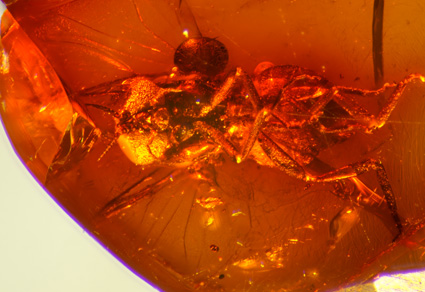
Simulium (Hellichiella) oisense sp. nov., oldest representative of this subgenus, is described from the Lowermost Eocene amber of Oise (Northern France). It shares with this subgenus the pedicel significantly larger than first flagellomere; radius with hair dorsobasally; scutum unpatterned; sensory vesicle typically occupying about one fourth or less of palpomere II; pedisulcus shallow; claws each with basal thumblike; precoxal bridge complete. Compared to the fossil species currently attributed to this subgenus, it is characterized by the presence of 10 antennomeres, palpomere IV shorter than palpomeres II+III, and pedisulcus well distinct. The extant species of this subgenus are Holarctic, living in small sandy streams and under rather cold to cool climates, which does correspond to the paleoenvironment but not the warm paleoclimate of the Oise amber deposit. The subgenus is otherwise known by one species from the Baltic amber and one from the Rovno amber, both Middle Eocene.
References
- Adler, P.H. (2025) World blackflies (Diptera: Simuliidae): a comprehensive revision of the taxonomic and geographical inventory. [Internet document, https://biomia.sites.clemson.edu/pdfs/blackflyinventory.pdf]
- Adler, P.H., Currie, D.C. & Wood, D.M. (2004) The black flies (Simuliidae) of North America. Cornell University Press, Ithaca, New York, London, i–xv + 941 pp.
- Beaucournu-Saguez, F. & Braverman, Y. (1987) Greniera dobyi (Diptera, Simuliidae) espèce nouvelle du Golan (Israël). Annales de Parasitologie Humaine et Comparée, 62 (1), 77–91. https://doi.org/10.1051/parasite/198762177
- Brasero, N., Nel, A. & Michez, D. (2009) Insects from the Early Eocene amber of Oise (France): diversity and palaeontological significance. Denisia, 26, 41–52.
- Craig, D.A., Currie, D.C., Gil-Azevedo, L.H. & Moulton, J.K. (2019) Austrocnephia, new genus, for five species of ‘Paracnephia’ (Diptera: Simuliidae), with a key to Australian black fly genera. Zootaxa, 4627 (1), 1–92. https://doi.org/10.11646/zootaxa.4627.1.1
- Craig, D.A., Currie, D.C & Moulton, J.K. (2018a) Reassignment of Western Australia Paracnephia gladiator Moulton & Adler to a new genus, Bunyipellum (Diptera: Simuliidae). Zootaxa, 4375 (3), 341–357. https://doi.org/10.11646/zootaxa.4375.3.3
- Craig, D.A., Currie, D.C. & Moulton, J.K. (2018b) Nothogreniera new genus, for two species of Australian “Paracnephia” (Diptera: Simuliidae). Zootaxa, 4444 (4), 351–380. https://doi.org/10.11646/zootaxa.4444.4.1
- Craig, D.A., Currie, D.C. & Vernon, P. (2003) Crozetia Davies (Diptera: Simuliidae): redescription of Cr. crozetensis, Cr. seguyi, number of larval instars, phylogenetic relationships and historical biogeography. Zootaxa, 259 (1), 1–39. https://doi.org/10.11646/zootaxa.259.1.1
- Craig, D.A., Moulton, J.K. & Currie, D.C. (2017) Taxonomic revision of Paraustrosimulium Wygodzinsky & Coscarón: reassignment of Austrosimulium colboi and description of P. obcidens n. sp. from Western Australia. Zootaxa, 4337 (4), 451–492. https://doi.org/10.11646/zootaxa.4337.4.1
- Crosskey, R.W. (1969) A re-classification of the Simuliidae (Diptera) of Africa and its islands. Bulletin of the British Museum, (Natural History), Entomology, Supplement, 14, 1–195. https://doi.org/10.5962/p.78201
- Currie, D.C. (1988) Morphology and systematics of primitive Simuliidae (Diptera: Culicomorpha). PhD Thesis, University of Alberta, i–xxi + 331 pp.
- de Franceschi, D. & de Ploëg, G. (2003) Origine de l’ambre des faciès sparnaciens (Eocène inférieur) du Bassin de Paris: le bois de l’arbre producteur. Geodiversitas, 25, 633–647.
- de Moor, F.C. (2017) Simuliidae (blackflies). In: Kirk-Spriggs, A.H. & Sinclair, B.J. (Eds.), Manual of Afrotropical Diptera, Volume 2. Nematocerous Diptera and lower Brachycera. Suricata, 5, 693–728.
- Doby, J.M. & David, F. (1959) Greniera, genre nouveau de Simuliide (Diptères Nématocères) - discussion de la position systématique. Comptes Rendus Hebdomadaires des Séances de l’Académie des Sciences, 249 (5), 763–765.
- Dumbleton, L.J. 1972. Genus Austrosimulium Tonnoir (Diptera Simuliidae) with particular reference to New Zealand fauna. New Zealand Journal of Science, 15 (4), 480–584.
- Gil-Azevedo, L.H. (2010) Review and phylogeny of Lutzsimulium (Diptera: Simuliidae). Zoologia, 27 (5), 761–788. https://doi.org/10.1590/S1984-46702010000500014
- Grenier, P. & Bertrand, H. (1954) Simuliidae (Diptera, Nematocera) d’Espagne. Annales de Parasitologie, 29 (4), 447–459.
- Grenier, P. & Rageau, J. (1960) Simulides (Dipt. Simuliidae) de Tahiti. Remarque sur la classification des Simuliidae. 11 Internationaler Kongreß für Entomologie, Verhandlungen, Wien, 17-25 August 1960, 1, 174–177.
- Moulton, J.K., Currie, D.C. & Craig, D.A. (2018) A new genus, Ectemnoides, for seven species of Australian Gondwanan Simuliidae (Diptera) with description of a novel form of larval attachment. Insect Systematics and Diversity, 2 (4), 1–54. https://doi.org/10.1093/isd/ixy009
- Nel, A. & Brasero, N. (2010) Oise amber. In: Penney, D. (Ed.), Biodiversity of fossils in amber from the major world deposits. Siri Scientific Press, Manchester, pp. 137–148.
- Nel, A., de Ploëg, G., Millet, J., Menier, J.-J. & Waller, A. (2004) The French ambers: a general conspectus and the lowermost Eocene amber deposit of Le Quesnoy in the Paris Basin. Geologica Acta, 2, 3–8. https://doi.org/10.1344/105.000001628
- Nohra, Y. A., Perrichot, V., Jeanneau, L., Le Pollès, L. & Azar, D. (2015) Chemical characterization and botanical origin of French ambers. Journal of Natural Products, 78, 1284–1293. https://doi.org/10.1021/acs.jnatprod.5b00093
- Pepinelli, M., Spironello, M. & Currie, D.C. (2013) Geometric morphometrics as a tool for interpreting evolutionary transitions in the black fly wing (Diptera: Simuliidae). Zoological Journal of the Linnean Society, 169, 377–388. https://doi.org/10.1111/zoj.12065
- Perkovsky, E.E. & Sukhomlin, E.B. (2015) New Late Eocene blackflies (Diptera, Simuliidae) from the Rovno amber (Ukraine). Paleontological Journal, 49 (6), 608–614. https://doi.org/10.1134/S0031030115060106
- Perkovsky, E.E. & Sukhomlin, E.B. (2016) A new species of Hellichiella (Diptera: Simuliidae) with 11-segmented antenna from the Eocene. Israel Journal of Entomology, 46, 79–86.
- Peterson, B.V. (1977) A synopsis of genus Parasimulium Malloch (Diptera-Simuliidae), with descriptions of one new subgenus and two new species. Proceedings of the Entomological Society of Washington, 79 (1), 96–106. [https://biostor.org/reference/73126]
- Rivosecchi, L. & Cardinali, R. (1975) Contributo alla conoscenza dei Simulidi italiani. 23. Nuovi dati tassonomici. Rivista di Parassitologia, 36 (1), 55–78.
- Robin, N., Foldi, I., Godinot, M. & Petit, G. (2016) Scale insect larvae preserved in vertebrate coprolites (Le Quesnoy, France, Lower Eocene): paleoecological insights. The Science of Nature, 103 (85), 1–8. https://doi.org/10.1007/s00114-016-1412-x
- Rubtsov, I.A. (1936) Eine neue Simuliidenart (Simulium oligocenicum sp. n.) aus dem Bernstein. Doklady Akademii nauk SSSR, (N.S.), 2 (11), 8 (84), 353–355.
- Rubtsov, I.A. (1964) Simuliidae (14). In: Lindner, E. (Ed.), Der Fliegen der Palaearktischen Region. E. Schweizerbart’sche Verlagsbuchhandlung, Stuttgart, pp. 1–678.
- Rubtsov, I.A. (1971) Ergebnisse der zoologischen Forschungen von Dr. Z. Kaszab in der Mongolei. Rezultaty zoologicheskikh issledovaniy Dr. Z. Kaszab b Mongolii. 256. Simuliidae III (Diptera). Annales Historico-Naturales Musei Nationalis Hungarici, 63, 261–273.
- Shcherbakov, D.E. (2009) Review of the fossil and extant genera of the cicada family Tettigarctidae (Hemiptera: Cicadoidea). Russian Entomological Journal, 17 (4), 343–348.
- Solé, F., Gheerbrant, E. & Godinot, M. (2013) The ‘miacids’ (Carnivoraformes, Mammalia) from the early Eocene locality of Le Quesnoy (MP7, France); first occurrence of Vassacyon in Europe. Comptes Rendus Palevol, 12 (4), 191-202. https://doi.org/10.1016/j.crpv.2013.05.001
- Vargas, L. & Diaz Najera, A. (1951) Notas sobre sistematica y morfologia de simulidos. Revista de la Sociedad Mexicana de Historia Natural, 12, 123–172.
- Wygodzinsky, P. & Coscarón, S. (1989) Revision of the black fly genus Gigantodax (Diptera: Simuliidae). Bulletin of the American Museum of Natural History, 189, 1–269. [http://hdl.handle.net/2246/935]
- Yankovsky, A.V. (1989) To the systematics of blackflies of the genus Sulcicnephia Rubzov (Diptera Simuliidae). Entomologicheskoe Obozrenie, 68 (1), 180–196.
- Yankovsky, A.V. (2002) Opredelitel’ moshek (Diptera: Simuliidae) Rossii i sopredel’nykh territorii (byvshego SSSR) [A key for the identification of blackflies (Diptera: Simuliidae) of Russia and adjacent regions within the former USSR)]. Opredeliteli po Faune Rossii [Identification Guides to the Fauna of Russia], 170.
- Yankovsky, A.V. (2005) Moshki (Diptera: Simuliidae) rodov Hellichiella Rivosecchi et Cardinali, 1975 i Boreosimulium Rubzov et Yankova, 1982 [Blackflies (Diptera: Simuliidae) of the genera Hellichiella Rivosecchi et Cardinali, 1975 and Boreosimulium Rubzov et Yankovsky, 1982]. Parazitologiia, 39 (6), 508–515.