

Abstract
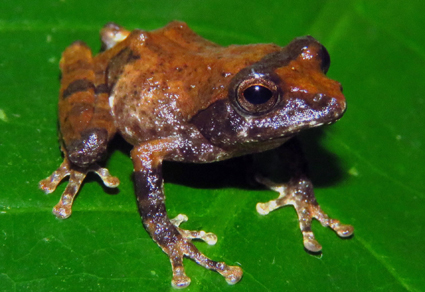
The genus Philautus comprises 52 recognized species, three of which are currently known from Java and are endemic to the island. We conducted extensive fieldwork across Central Java between 2017 and 2025 to reassess the taxonomy of Philautus in this understudied region. We clarified species boundaries and uncovered cryptic diversity within this genus by employing an integrative framework that combined morphological assessments, molecular phylogenetics, and bioacoustic analyses. Our results include a redescription of P. jacobsoni and the formal description of a newly identified montane species, Philautus candrageni sp. nov., from Mount Merapi. We also provide further insights into the taxonomic status of Philautus pallidipes. These findings reveal considerable taxonomic complexity and previously overlooked diversity within Java’s montane amphibian assemblages. They also underscore the importance of sustained integrative research and advocate for targeted conservation efforts for Philautus species across the island.
References
- Alhadi, F., Kaprawi, F., Hamidy, A. & Kirschey, T. (2021) Amfibi Pulau Jawa: Panduan Bergambar dan Identifikasi. Perkumpulan Amfibi Reptil Sumatera, Lampung and NABU, Berlin, 228 pp. [ISBN: 978-3-9822269-9-6]
- American Veterinary Medical Association. (2020) AVMA guidelines for the euthanasia of animals. 2020 Edition. American Veterinary Medical Association, Schaumburg, Illinois, 121 pp.
- Barbour, T. (1908) Some new Amphibia Salientia. Proceedings of the Biological Society of Washington, 21, 189–190.
- Capella-Gutiérrez, S., Silla-Martínez, J.M. & Gabaldón, T. (2009) trimAl: a tool for automated alignment trimming in largescale phylogenetic analyses. Bioinformatics, 25 (15), 1972–1973. https://doi.org/10.1093/bioinformatics/btp348
- Chan, K.O. & Grismer, L.L. (2022) groupStruct: An R package for allometric size correction. Zootaxa, 5124 (4), 471–482. https://doi.org/10.11646/zootaxa.5124.4.4
- Dehling, J.M. & Dehling, D.M. (2013) A new montane species of Philautus (Amphibia: Anura: Rhacophoridae) from western Sarawak, Malaysia, Borneo. Zootaxa, 3686 (2), 277–288. https://doi.org/10.11646/zootaxa.3686.2.8
- Dehling, J.M. (2010) A new bush frog (Anura: Rhacophoridae: Philautus) from Gunung Mulu National Park, East Malaysia (Borneo). Salamandra, 46, 63–72.
- Dehling, J.M., Matsui, M. & Imbun, P.Y. (2016) A new small montane species of Philautus (Amphibia: Anura: Rhacophoridae) from Gunung Kinabalu, Sabah, Malaysia (Borneo). Salamandra, 52 (2), 65–74.
- Dring, J. (1987) Bornean treefrogs of the genus Philautus (Rhacophoridae). Amphibia-Reptilia, 8 (1), 19–47. https://doi.org/10.1163/156853887X00036
- Etter, L., Haas, A., Lee, C.C., Pui, Y.M., Das, I. & Hertwig, S.T. (2021) Out of the trap: A new phytothelm-breeding species of Philautus and an updated phylogeny of Bornean bush frogs (Anura: Rhacophoridae). Journal of Zoological Systematics and Evolutionary Research, 59: 1064–1096 https://doi.org//10.1111/jzs.12465
- Frost, R. (2025) Amphibian Species of the World: an Online Reference. Version 6.2 (Date of access). Electronic Database accessible at https://amphibiansoftheworld.amnh.org/index.php. American Museum of Natural History, New York, USA. https://doi.org/10.5531/db.vz.0001
- Gistel, J. (1848) Naturgeschichte des Thierreichs: für höhere Schulen. Hoffmann’sche Verlagsbuchhandlung, Stuttgart, 375 pp. https://doi.org/10.5962/bhl.title.97235
- Goebel, A.M., Donnelly, J.M. & Atz, M.E. (1999) PCR primers and amplification methods for 12S ribosomal DNA, the control region, cytochrome oxidase I, and cytochrome b in bufonids and other frogs, and an overview of PCR primers which have amplified DNA in amphibians successfully. Molecular Phylogenetics and Evolution, 11 (1), 163–199. https://doi.org/10.1006/mpev.1998.0538
- Grismer, L.L., Aowphol, A., Grismer, J.L., Aksornneam, A., Quah, E.S., Murdoch, M.L., Gregory, J.J., Nguyen, E., Kaatz, A., Bringsøe, H. & Rujirawan, A. (2024) A new species of the Cyrtodactylus chauquangensis group (Squamata: Gekkonidae) from the borderlands of extreme northern Thailand. ZooKeys, 1203, 211–238. https://doi.org/10.3897/zookeys.1203.122758
- Grosjean, S., Delorme, M., Dubois, A. & Ohler, A. (2008) Evolution of reproduction in the Rhacophoridae (Amphibia: Anura). Journal of Zoological Systematics and Evolutionary Research, 46 (2), 169–176. https://doi.org/10.1111/j.1439-0469.2007.00451.x
- Hamidy, A., Munir, M., Mumpuni, M., Rahmania, M. & Kholik, A.A. (2018) Detection of cryptic taxa in the genus Leptophryne (Fitzinger, 1843) (Amphibia: Bufonidae) and the description of a new species from Java, Indonesia. Zootaxa, 4450 (4), 427–444. https://doi.org/10.11646/zootaxa.4450.4.2
- Hedges, S.B. (1994) Molecular evidence for the origin of birds. Proceedings of the National Academy of Sciences, 91 (7), 2621–2624. https://doi.org/10.1073/pnas.91.7.2621
- Hertwig, S.T., Lilje, K.E., Min, P.Y., Haas, A. & Das, I. (2012) Molecular evidence for direct development in the rhacophorid frog, Philautus acutus (Rhacophoridae, Anura) from Borneo. Raffles Bulletin of Zoology, 60 (2), 377–386.
- Hertwig, S.T., Schweizer, M., Das, I. & Haas, A. (2013) Diversification in a biodiversity hotspot—the evolution of Southeast Asian rhacophorid tree frogs on Borneo (Amphibia: Anura: Rhacophoridae). Molecular Phylogenetics and Evolution, 68 (3), 567–581. https://doi.org/10.1016/j.ympev.2013.04.001
- Huelsenbeck, J.P. & Rannala, B. (2004) Frequentist properties of Bayesian posterior probabilities of phylogenetic trees under simple and complex substitution models. Systematic Biology, 53 (6), 904–913. https://doi.org/10.1080/10635150490522629
- Huelsenbeck, J.P. & Ronquist, F. (2001) MrBayes: Bayesian inference of phylogenetic trees. Bioinformatics, 17 (8), 754–755. https://doi.org/10.1093/bioinformatics/17.8.754
- iNaturalist. (n.d.) iNaturalist. Available from: https://www.inaturalist.org (accessed 5 May 2025)
- Inger, R.F. & Stuebing, R.B. (1996) Two new species of frogs from southeastern Sarawak. Raffles Bulletin of Zoology, 44, 543–549.
- Inger, R.F. (1989) Four new species of frogs from Borneo. Malayan Nature Journal, 42, 229–243.
- Iskandar, D.T. (1998) The amphibians of Java and Bali. Research and Development Centre for Biology LIPI, Jakarta, 135 pp.
- IUCN SSC Amphibian Specialist Group. (2018) Philautus jacobsoni. The IUCN Red List of Threatened Species, 2018, e.T58857A114924999. Available from: https://doi.org/10.2305/IUCN.UK.2018-2.RLTS.T58857A114924999.en (accessed 17 July 2025)
- IUCN SSC Amphibian Specialist Group. (2020) Philautus pallidipes (amended version of 2019 assessment). The IUCN Red List of Threatened Species, 2020, e.T58884A176937110. Available from: https://doi.org/10.2305/IUCN.UK.2020-3.RLTS.T58884A176937110.en (accessed 17 July 2025)
- IUCN SSC Amphibian Specialist Group (2023) Philautus aurifasciatus. The IUCN Red List of Threatened Species, 2023, e.T58820A114924718. Available from: https://doi.org/10.2305/IUCN.UK.2023-1.RLTS.T58820A114924718.en (accessed 17 July 2025)
- Köhler, J., Jansen, M., Rodriguez, A., Kok, P.J., Toledo, L.F., Emmrich, M., Glaw, F., Haddad, C.F.B., Rödel, M.O. & Vences, M. (2017) The use of bioacoustics in anuran taxonomy: theory, terminology, methods and recommendations for best practice. Zootaxa, 4251 (1), 1–124. https://doi.org/10.11646/zootaxa.4251.1.1
- Kusrini, M.D. (2013) Panduan bergambar identifikasi amfibi Jawa Barat. Fakultas Kehutanan IPB dan Direktorat Konservasi Keanekaragaman Hayati, Bogor, 74 pp.
- Kusrini, M.D., Fitri, A., Utama, H., Nasir, D.M., Ardiansyah, D., Lestari, V. & Rachmadi, R. (2005) Project 202404: Ecology and Conservation of Frogs of Mount Gede-Pangrango National Park. Institut Pertanian Bogor, Bogor, 65 pp.
- Lanfear, R., Calcott, B., Ho, S.Y. & Guindon, S. (2012) PartitionFinder: combined selection of partitioning schemes and substitution models for phylogenetic analyses. Molecular Biology and Evolution, 29 (6), 1695–1701. https://doi.org/10.1093/molbev/mss020
- Li, J.T., Che, J., Bain, R.H., Zhao, E.M. & Zhang, Y.P. (2008) Molecular phylogeny of Rhacophoridae (Anura): A framework of taxonomic reassignment of species within the genera Aquixalus, Chiromantis, Rhacophorus and Philautus. Molecular Phylogenetics and Evolution, 48 (1), 302–312. https://doi.org/10.1016/j.ympev.2008.03.023
- Li, J.T., Che, J., Murphy, R.W., Zhao, H., Zhao, E.M., Rao, D.Q. & Zhang, Y.P. (2009) New insights to the molecular phylogenetics and generic assessment in the Rhacophoridae (Amphibia: Anura) based on five nuclear and three mitochondrial genes, with comments on the evolution of reproduction. Molecular Phylogenetics and Evolution, 53 (2), 509–522. https://doi.org/10.1016/j.ympev.2009.06.023
- Li, J.T., Li, Y., Klaus, S., Rao, D.Q., Hillis, D.M. & Zhang, Y.P. (2013) Diversification of rhacophorid frogs provides evidence for accelerated faunal exchange between India and Eurasia during the Oligocene. Proceedings of the National Academy of Sciences, 110 (9), 3441–3446. https://doi.org/10.1073/pnas.1300881110
- Liem, D.S. (1971) The frogs and toads of Tjibodas National Park, Mt. Gede, Java, Indonesia. Philippine Journal of Science, 100 (2), 131–161.
- Lleonart, J., Salat, J. & Torres, G.J. (2000) Removing allometric effects of body size in morphological analysis. Journal of Theoretical Biology, 205 (1), 85–93. https://doi.org/10.1006/jtbi.2000.2043
- Malkmus, R. & Riede, K. (1996) Die Baumfrösche der Gattung Philautus vom Mount Kinabalu – Teil I: Überblick und die aurifasciatus-Gruppe mit Beschreibung einer neuen Art (Philautus saueri n. sp.). Sauria, 18 (1), 27–37.
- Matsui, M. (2009) A new species of Philautus (Amphibia: Anura: Rhacophoridae) from the lowland of Sarawak, western Borneo. Zoological Science, 26 (6), 437–442. https://doi.org/10.2108/zsj.26.437
- Matsui, M., Khonsue, W., Panha, S. & Eto, K. (2015) A new tree frog of the genus Gracixalus from Thailand (Amphibia: Rhacophoridae). Zoological Science, 32 (2), 204–210. https://doi.org/10.2108/zs140238
- Matsui, M., Shimada, T. & Sudin, A. (2014) First record of the tree-frog genus Chiromantis from Borneo with the description of a new species (Amphibia: Rhacophoridae). Zoological Science, 31 (1), 45–51. https://doi.org/10.2108/zsj.31.45
- Meegaskumbura, M., Bossuyt, F., Pethiyagoda, R., Manamendra-Arachchi, K., Bahir, M.M., Milinkovitch, M.C. & Schneider, C.J. (2002) Sri Lanka: an amphibian hot spot. Science, 298 (5592), 379. https://doi.org/10.1126/science.298.5592.379
- Meegaskumbura, M., Senevirathne, G., Biju, S.D., Garg, S., Meegaskumbura, S., Pethiyagoda, R., Hanken, J. & Schneider, C.J. (2015) Patterns of reproductive‐mode evolution in Old World tree frogs (Anura: Rhacophoridae). Zoologica Scripta, 44 (5), 509–522. https://doi.org/10.1111/zsc.12121
- Minh, B.Q., Nguyen, M.A.T. & von Haeseler, A. (2013) Ultrafast approximation for phylogenetic bootstrap. Molecular Biology and Evolution, 30 (5), 1188–1195. https://doi.org/10.1093/molbev/mst024
- Mulcahy, D.G., Beckstead, T.H. & Sites Jr, J.W. (2011) Molecular systematics of the Leptodeirini (Colubroidea: Dipsadidae) revisited: species-tree analyses and multilocus data. Copeia, 2011 (3), 407–417. https://doi.org/10.1643/CH-10-058
- Nguyen, L.T., Schmidt, H.A., von Haeseler, A. & Minh, B.Q. (2015) IQ-TREE: a fast and effective stochastic algorithm for estimating maximum-likelihood phylogenies. Molecular Biology and Evolution, 32 (1), 268–274. https://doi.org/10.1093/molbev/msu300
- Nguyen, T.T., Matsui, M. & Duc, H.M. (2014) A new tree frog of the genus Kurixalus (Anura: Rhacophoridae) from Vietnam. Current Herpetology, 33 (2), 101–111. https://doi.org/10.5358/hsj.33.101
- Nguyen, T.T., Matsui, M. & Eto, K. (2015) Mitochondrial phylogeny of an Asian tree frog genus Theloderma (Anura: Rhacophoridae). Molecular Phylogenetics and Evolution, 85, 59–67. https://doi.org/10.1016/j.ympev.2015.02.003
- Ohler, A. & Delorme, M. (2006) Well known does not mean well studied: morphological and molecular support for existence of sibling species in the Java gliding frog Rhacophorus reinwardtii (Amphibia: Anura). Comptes Rendus Biologies, 329 (2), 86–97. https://doi.org/10.1016/j.crvi.2005.11.001
- Oliver, L.A., Prendini, E., Kraus, F. & Raxworthy, C.J. (2015) Systematics and biogeography of the Hylarana frog (Anura: Ranidae) radiation across tropical Australasia, Southeast Asia, and Africa. Molecular Phylogenetics and Evolution, 90, 176–192. https://doi.org/10.1016/j.ympev.2015.05.001
- Pauly, G.B., Hillis, D.M. & Cannatella, D.C. (2004) The history of a Nearctic colonization: molecular phylogenetics and biogeography of the Nearctic toads (Bufo). Evolution, 58 (11), 2517–2535. https://doi.org/10.1111/j.0014-3820.2004.tb00881.x
- Pyron, R.A. & Wiens, J.J. (2011) A large-scale phylogeny of Amphibia including over 2800 species, and a revised classification of extant frogs, salamanders, and caecilians. Molecular Phylogenetics and Evolution, 61 (2), 543–583. https://doi.org/10.1016/j.ympev.2011.06.012
- R Core Team. (2023) R: A language and environment for statistical computing. R Foundation for Statistical Computing, Vienna. [program]
- Rahayuningsih, M., Rahmawati, W. & Hamidy, A. (2021) Analysis of the morphological characteristics of bush frog Philautus spp. Gistel, 1848 (Anura: Rhacophoridae) from Mount Ungaran. Biosaintifika: Journal of Biology & Biology Education, 13 (2), 250–257. https://doi.org/10.15294/biosaintifika.v13i2.31298
- Rambaut, A. (2010) FigTree. Version 1.3.1. Institute of Evolutionary Biology, University of Edinburgh, Edinburgh.
- Rambaut, A., Drummond, A.J., Xie, D., Baele, G. & Suchard, M.A. (2018) Posterior summarization in Bayesian phylogenetics using Tracer 1.7. Systematic Biology, 67 (5), 901–904. https://doi.org/10.1093/sysbio/syy032
- Ripley, B., Venables, B., Bates, D.M., Hornik, K., Gebhardt, A., Firth, D. & Ripley, M.B. (2013) Package ‘MASS’. CRAN, 538 (113–120), 822.
- Ronquist, F. & Huelsenbeck, J.P. (2003) MrBayes 3: Bayesian phylogenetic inference under mixed models. Bioinformatics, 19 (12), 1572–1574. https://doi.org/10.1093/bioinformatics/btg180
- RStudio Team. (2023) RStudio: Integrated Development for R. RStudio, PBC, Boston, Massachusetts. [program]
- Sano, N., Kurabayashi, A., Fujii, T., Yonekawa, H. & Sumida, M. (2005) Complete nucleotide sequence of the mitochondrial genome of Schlegel’s tree frog Rhacophorus schlegelii (family Rhacophoridae): duplicated control regions and gene rearrangements. Genes & Genetic Systems, 80 (3), 213–224. https://doi.org/10.1266/ggs.80.213
- Savage, J.M. & Heyer, W.R. (1997) Digital webbing formulae for anurans: a refinement. Herpetological Review, 28 (3), 131.
- Schlegel, H. (1837) Abbildungen neuer oder unvollständig bekannter Amphibien, nach der Natur oder dem Leben entworfen, herausgegeben und mit einem erläuternden Texte begleitet. Part 1. Arnz & Co., Düsseldorf, 48 pp. https://doi.org/10.5962/bhl.title.95393
- Setiawan, Y. & Yoshino, K. (2020) Spatial modeling on land use change in regional scale of Java Island based on biophysical characteristics. Jurnal Pengelolaan Sumberdaya Alam dan Lingkungan, 10 (3), 511–523. https://doi.org/10.29244/jpsl.10.3.511-523
- Stuart, S.N., Chanson, J.S., Cox, N.A., Young, B.E., Rodrigues, A.S.L., Fischman, D.L. & Waller, R.W. (2008) Threatened Amphibians of the World. Lynx Edicions, IUCN, Conservation International, Barcelona, Gland and Arlington, 758 pp.
- Sueur, J., Aubin, T. & Simonis, C. (2008) Seewave: a free modular tool for sound analysis and synthesis. Bioacoustics, 18 (2), 213–226. https://doi.org/10.1080/09524622.2008.9753600
- Tamura, K., Stecher, G. & Kumar, S. (2021) MEGA11: Molecular evolutionary genetics analysis version 11. Molecular Biology and Evolution, 38 (7), 3022–3027. https://doi.org/10.1093/molbev/msab120
- van Kampen, P.N. (1912) Javanische Amphibien gesammelt vom Edw. Jacobson. Notes from the Leyden Museum, 34, 75–79.
- van Kampen, P.N. (1923) The Amphibia of the Indo-Australian Archipelago. E.J. Brill, Leiden, 304 pp. https://doi.org/10.1163/9789004590182
- Virtriana, R., Deanova, M.A., Safitri, S., Anggraini, T.S., Ihsan, K.T.N., Deliar, A. & Riqqi, A. (2024) Identification of land cover change and spatial distribution based on topographic variations in Java Island. Ecological Frontiers, 44 (1), 129–142. https://doi.org/10.1016/j.chnaes.2023.08.002
- Watters, J.L., Cummings, S.T., Flanagan, R.L. & Siler, C.D. (2016) Review of morphometric measurements used in anuran species descriptions and recommendations for a standardized approach. Zootaxa, 4072 (4), 477–495. https://doi.org/10.11646/zootaxa.4072.4.6
- Wostl, E., Riyanto, A., Hamidy, A., Kurniawan, N., Smith, E.N. & Harvey, M.B. (2017) A taxonomic revision of the Philautus (Anura: Rhacophoridae) of Sumatra with the description of four new species. Herpetological Monographs, 31 (1), 98–141. https://doi.org/10.1655/HERPMONOGRAPHS-D-16-00007
- Yu, G., Rao, D., Zhang, M. & Yang, J. (2009) Re-examination of the phylogeny of Rhacophoridae (Anura) based on mitochondrial and nuclear DNA. Molecular Phylogenetics and Evolution, 50 (3), 571–579. https://doi.org/10.1016/j.ympev.2008.11.023